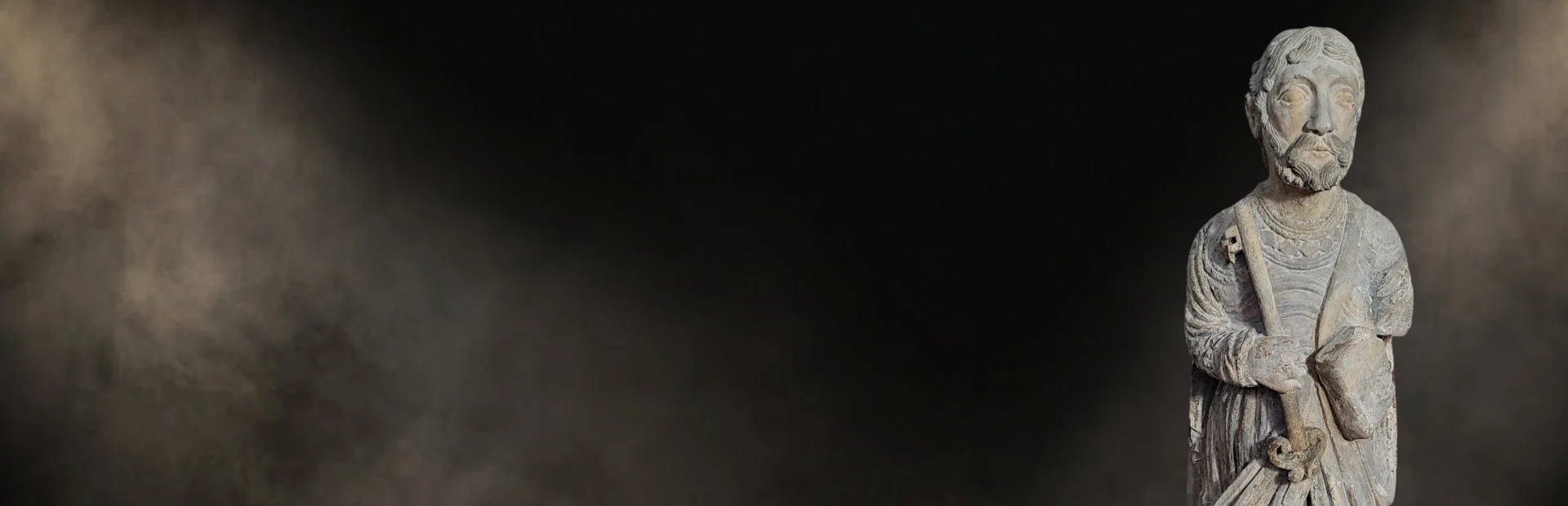
Our selection of Romanesque artworks and medieval sculptures. The collection brings together Enthroned Virgins, figures of Christ and the Apostles, as well as architectural elements emblematic of Romanesque sculpture: historiated capitals, sculpted modillions, reliefs and decorative friezes. Carved in stone, marble or wood, these works reflect the rich iconography, religious symbolism and technical mastery of medieval sculptors.
Collection of Romanesque Art
Our selection of Romanesque artworks and medieval sculptures. The collection brings together Enthroned Virgins, figures of Christ and the Apostles, as well as architectural elements emblematic of Romanesque sculpture: historiated capitals, sculpted modillions, reliefs and decorative friezes. Carved in stone, marble or wood, these works reflect the rich iconography, religious symbolism and technical mastery of medieval sculptors.

Very important engaged capital from the Romanesque period depicting Saint-Thomas and the Christ between two columns. On the side faces, holy women under Romanesque arches. ..

An exceptional plastic in the Cluny tradition. Part probably coming from a portal or arch. Burgundy, first quarter of the 12th century, to compare with the works of the masters of Vezelay and Autun. ..

Exceptional Carolingian marble pluteus element from the San Salvatore abbey in Orvieto, Italy. The frieze shows crosses and a bird in typical 9th century tracery. Pluteus elements of this size are rare for this period and mainly kept in religious buildings or museums...

This rare capital of the first Romanesque art presents an ox mask on one side, a monster mask on the adjacent side and two rosettes on the other sides. The basket is decorated with plant motifs and acanthus leaves...
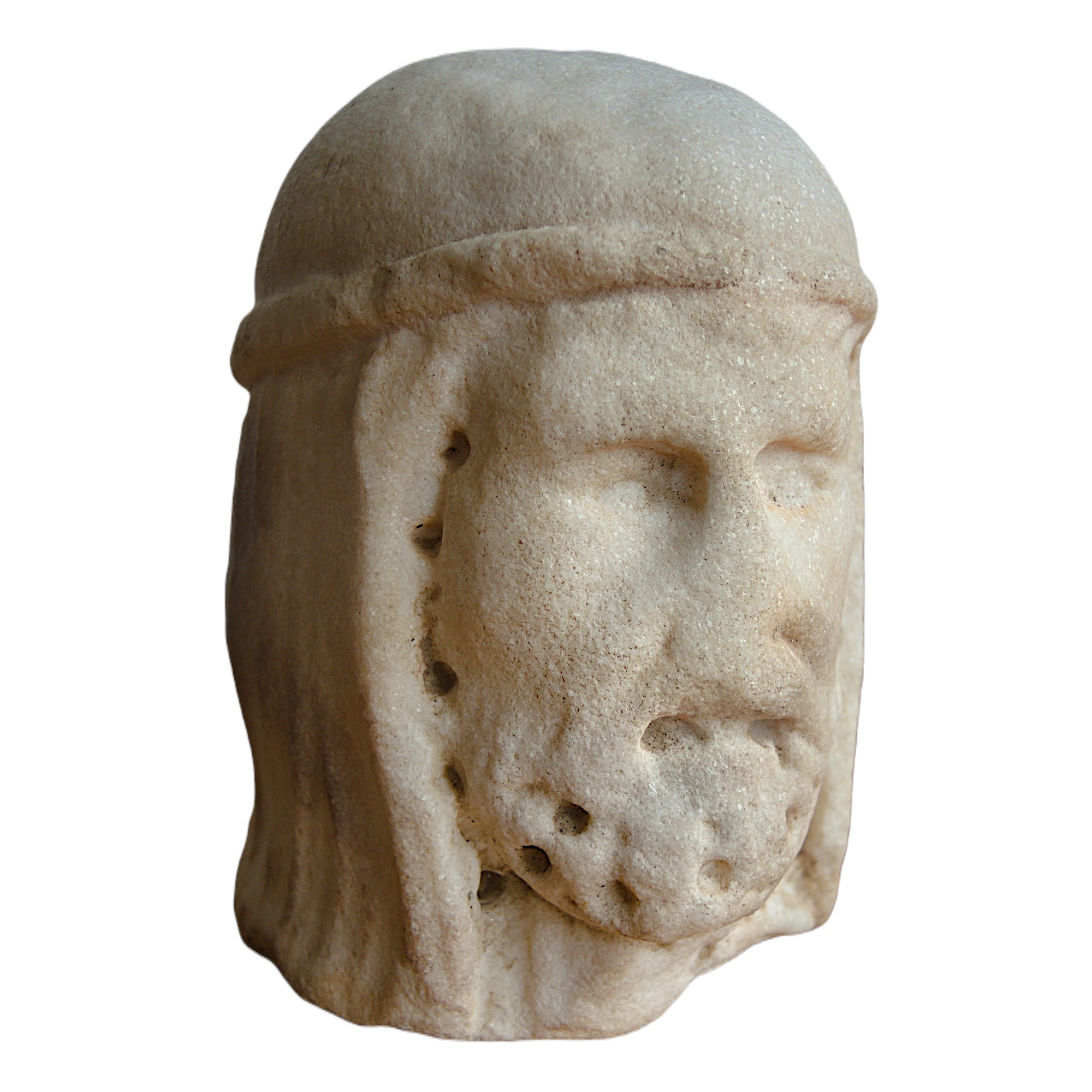
Rare head of a bearded man in marble wearing a hemispherical helmet with a summit button. The helmet has a long neck and nape protector with strips. This type of helmet is known from Byzantine representations of the 9th century (frescoes of the monastery of Saint Lucas in Greece) but the plasticity of the face, its volume and the marked cheekbones rule out a Byzantine origin and place this work in the Carolingian renaissance of the 8th and 9th century. Carolingian figured sculptures are rare and we must look for connections in the psalters of Utrecht and Stuttgart (executed around 820 in the scriptorium of the abbey of Saint-Germain-des-Prés in Paris) as well as with the Carolingian ivories from the same period...
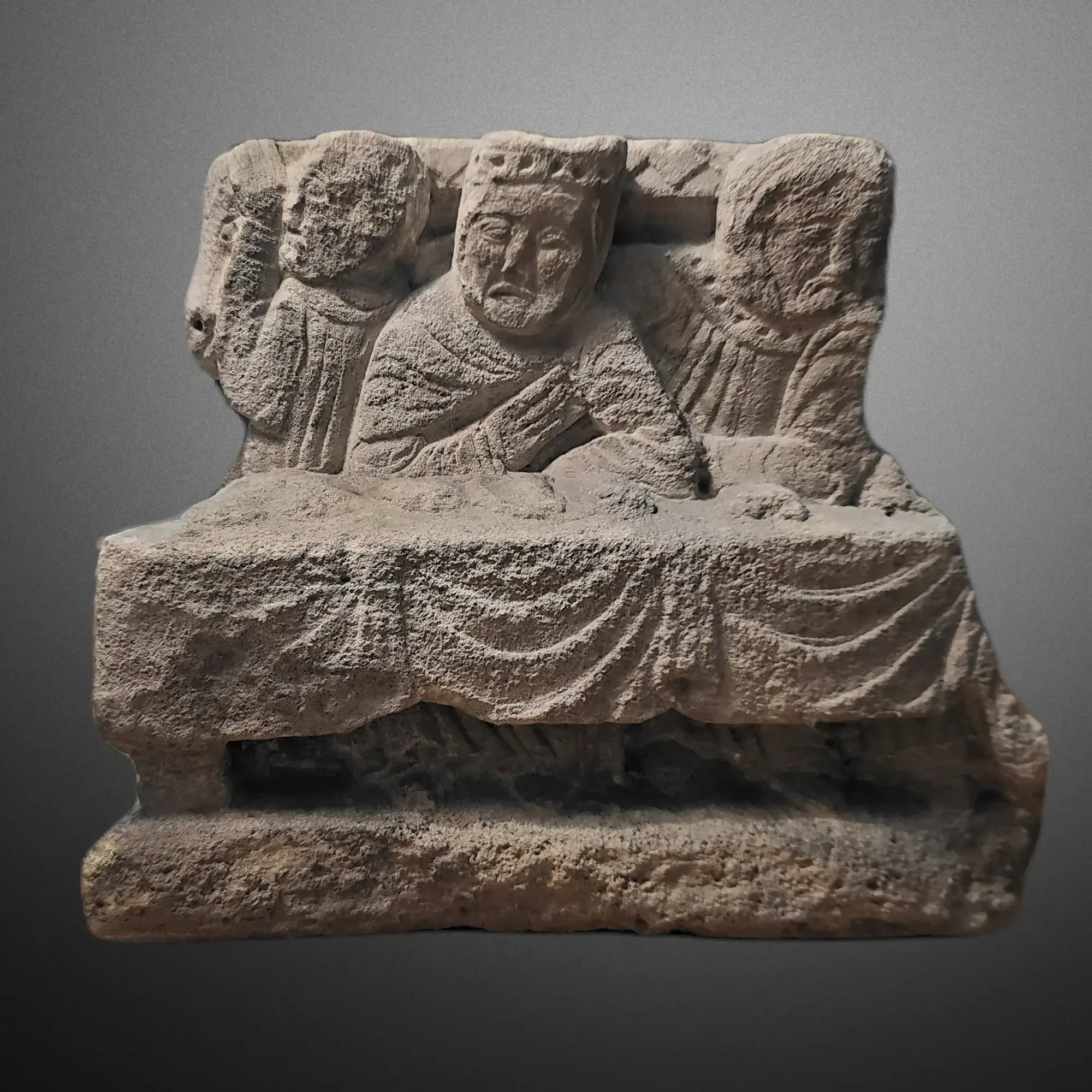
Triangular section corner capital with two sculpted and historiated faces. The first scene shows a horseman joining a banquet scene with a lamenting character in the background. The clothes decorated with curved lines are hemmed with trepan work. The second scene, the banquet, shows a king seated at a table, accompanied by two guests, one of whom seems to welcome the horseman. The table is covered with a pleated cloth and supports a plate in front of the king and some bread. This scene seems to correspond to the biblical episode of Mephibosheth at King David's table. The scene with the rider can therefore be the arrival of Tsiba who will betray Mephibosheth, which can explain the attitude of the second guest who turns away, contrite... ..
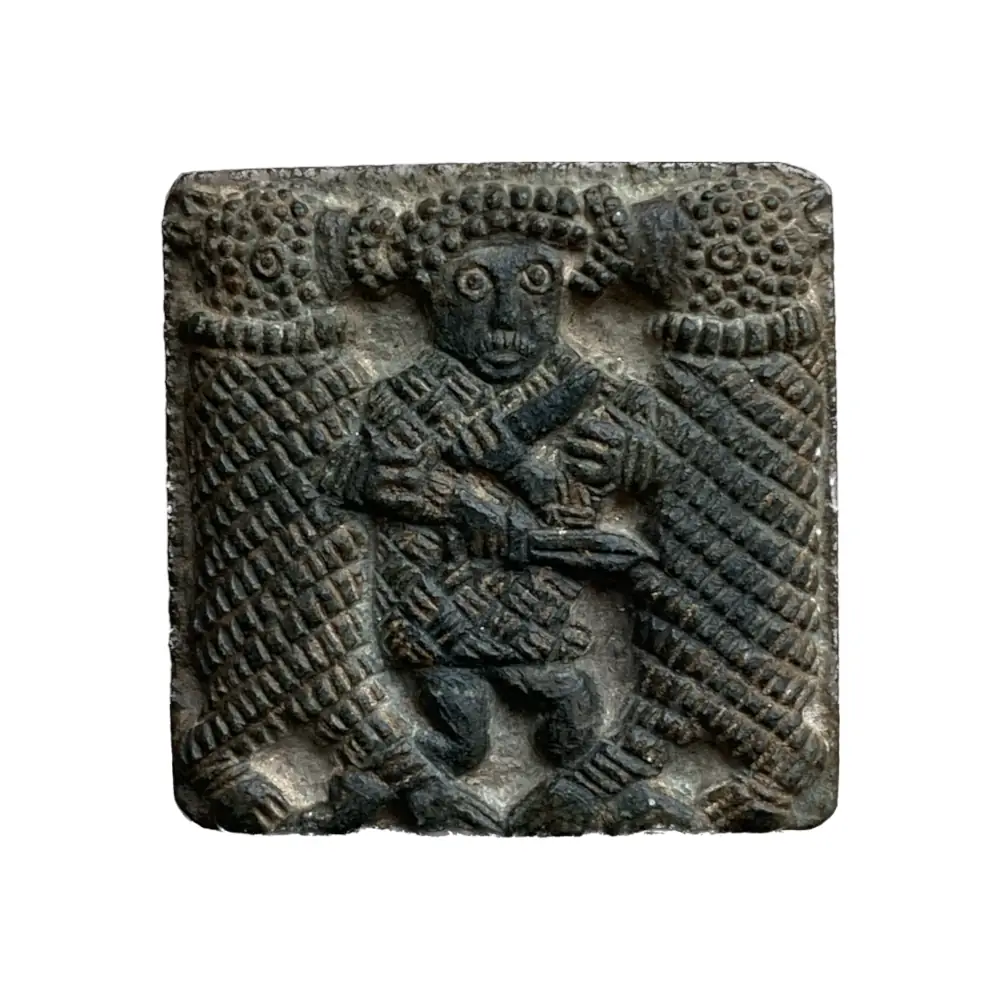
Early medieval. Rare plate representing a man armed with a sword and a knife between two bears. This plate is very close to one of the plates discovered in Torslunda and presenting the same scene. The Torslunda plates discovered in 1870 are bronze matrices intended to produce fine bronze plates intended to adorn helmets from the Vendel period (Vendel, Valsgarde, Sutton Hoo...). Our plate, unlike the Torslunda matrices, is made from a metamorphic stone: we are in the presence of an original model intended to produce molds for bronze matrices. It has also been demonstrated (see bibliography) that these matrices were mass-produced with copies from originals or even helmet plates. A scientific analysis of the stone by the Re.S.Artes laboratory revealed an alteration of the stone corresponding to natural alteration over several centuries...
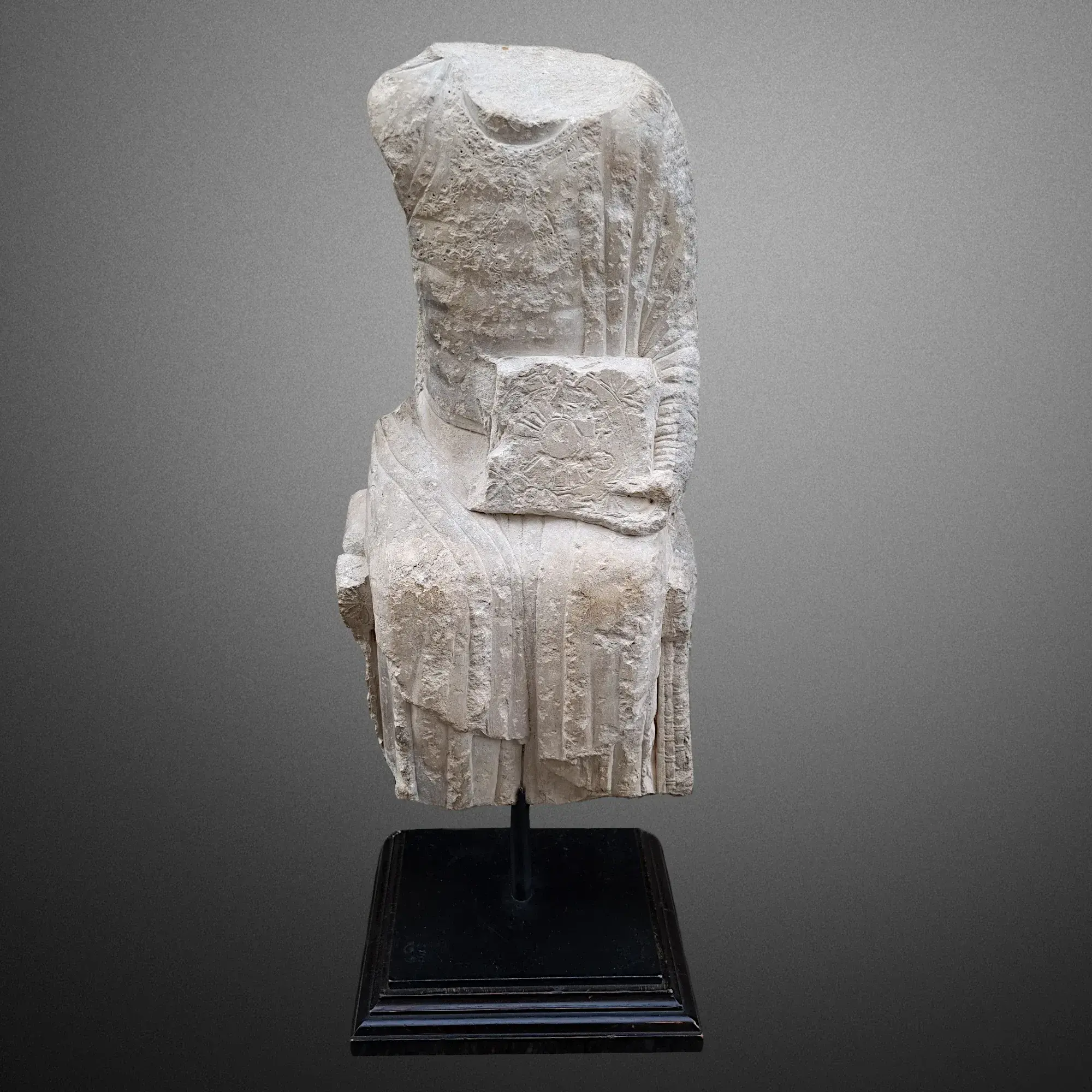
Important and rare Romanesque sculpture in the round depicting Christ. The throne is openwork on the sides and the locks of hair fall down the back. Christ is shown seated on a throne, holding the book in his left hand and raising the now-missing right arm. The lift of the shoulder indicates the original gesture. He wears a cloak with straight, classical folds, richly decorated across the chest. The throne is adorned with rosettes and rows of dots. The Book is also finely carved, with rosettes and figures; it most likely represents the Book of Life, with four engraved episodes relating to the soul being judged. This Christ in Glory belongs to the corpus of Provençal Romanesque sculpture and can be dated to the mid-12th century...
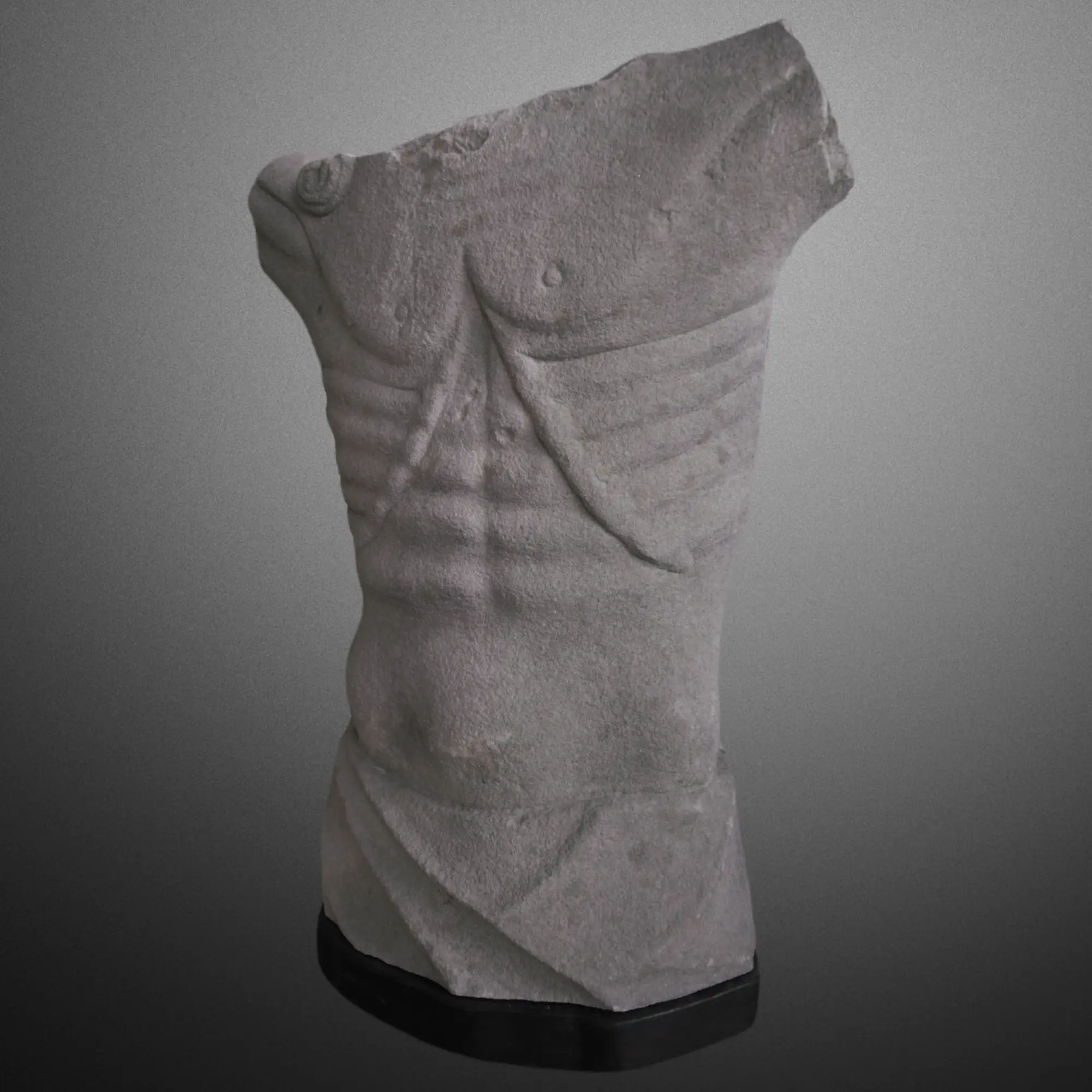
Romanesque sculpture representing a deposition from the cross in stone. The torso of Christ is sculpted in a relatively vigorous manner with the chest and ribs well marked. The perizonium also has pronounced folds. A curl of hair is still visible on the right shoulder. This emotiional Romanesque Christ is sculpted in Alsace sandstone and probably comes from the Strasbourg region. This sculpture has few equivalents in stone, most depositions from the cross being made of wood. Stylistic similarities can be made with the copper or bronze Christs of the second half of the 12th century, but especially with the Christ of the Deposition from the Cross in stone preserved at the Palais des Beaux Arts in Lille dated from the middle of the 12th century...
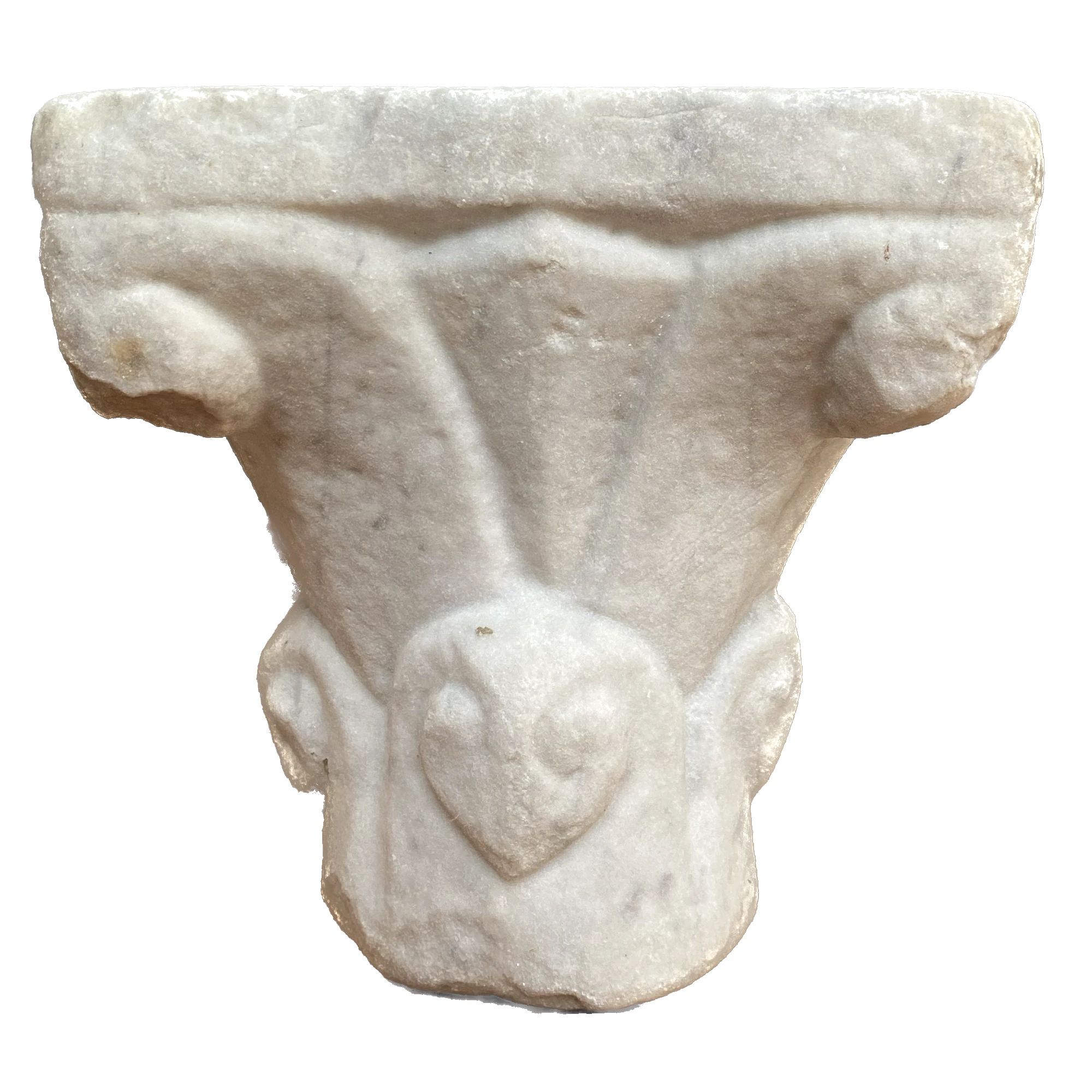
Elegant capital in slightly veined white marble, carved on all sides. Crosses attached to the corners and stylized hooks at the bottom of the basket. The absence of an astragalus caused this sculpture to be classified in the series of small capitals from the early Middle Ages or the end of antiquity. However, the smooth leaf pattern at the top of the basket as well as the style of the hooks place us in the end of the Romanesque period with connections in Occitanie and the South of France...

Rare Visigothic capital in marble from the Pyrenees. This pre-Romanesque capital is carved on all sides and has a very stylized decoration derived from acanthus leaves. The composition of leaves in the center of the sides of the basket evokes an extremely stylized human head. The highly stylized nature of the patterns directs us towards production from the first centuries of the kingdom of Toulouse, before the Visigoth style asserted itself with vigor. Related works: Visigoth capital from the Alcazaba Museum, Almeria, Spain...

Large pre-romanesque capital with two birds facing each other turning away. Interlacing frieze on the basket. ..
The romanesque sculpture is mainly architectural and the works, with some exceptions as the enthroned wooden virgins , mainly come from religious buildings. Romanesque sculpture decorates capitals, corbels, columns and pillars but also porches, tympanums and arches. These often stylized works and fragments have become relatively rare on the market. The Ekinium gallery is passionately looking for these works with such a particular aesthetic.
Browse works of art by period