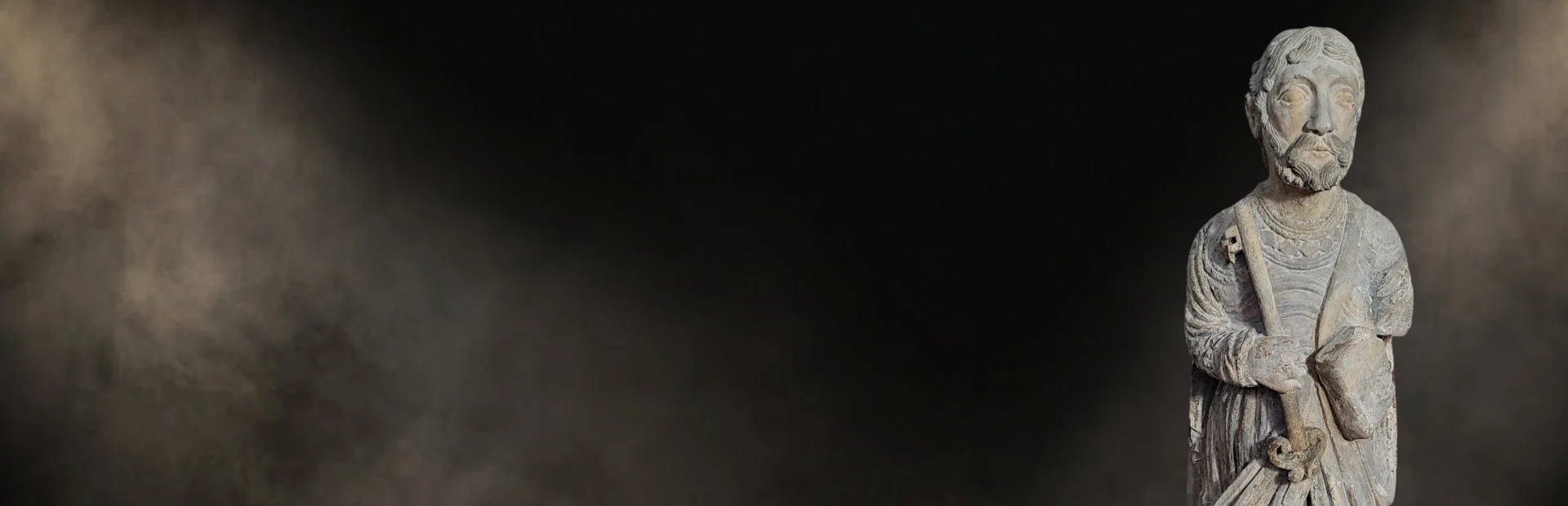
Our selection of Romanesque artworks and medieval sculptures. The collection brings together Enthroned Virgins, figures of Christ and the Apostles, as well as architectural elements emblematic of Romanesque sculpture: historiated capitals, sculpted modillions, reliefs and decorative friezes. Carved in stone, marble or wood, these works reflect the rich iconography, religious symbolism and technical mastery of medieval sculptors.
Collection of Romanesque Art
Our selection of Romanesque artworks and medieval sculptures. The collection brings together Enthroned Virgins, figures of Christ and the Apostles, as well as architectural elements emblematic of Romanesque sculpture: historiated capitals, sculpted modillions, reliefs and decorative friezes. Carved in stone, marble or wood, these works reflect the rich iconography, religious symbolism and technical mastery of medieval sculptors.
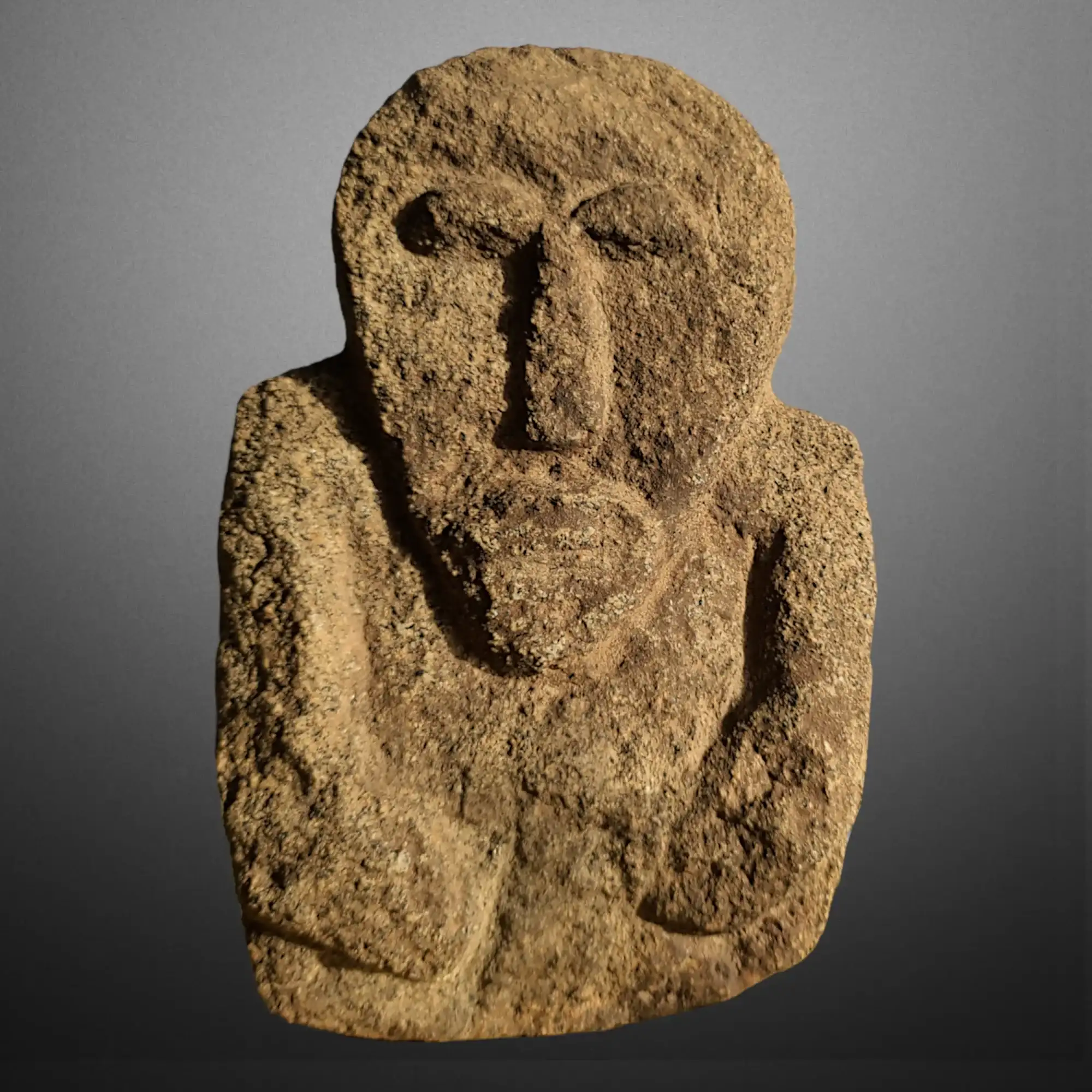
Very rare granite reliefs depicting frontal busts with prominent eyes, a ridged nose, and arms folded/crossed across the chest. The larger figure holds a heavily eroded cross pattée against the chest. These two votive reliefs illustrate the transition from pre-Christian Celtic culture to the earliest Irish Christian imagery, with a persistence of Iron Age stylistic habits. Despite slight differences, both figures share features typical of early Insular art: an oversized head set directly on the shoulders without a distinct neck, and bulging/salient eyes—recurrent markers in the anthropomorphic repertoire of this period...
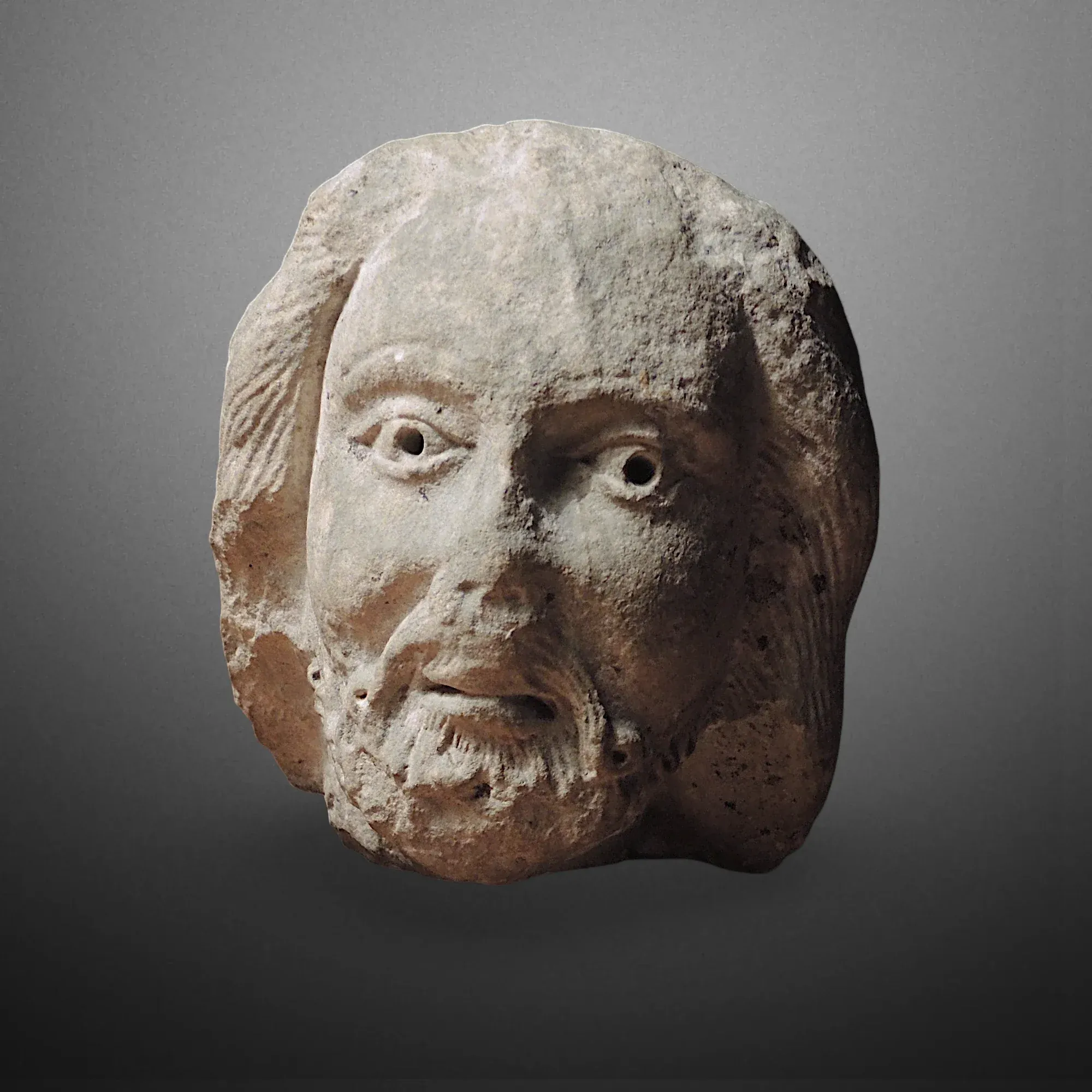
Head sculpted in marble, circa 1150–1170, attributable to a southern Romanesque workshop (Languedoc–Provence). This Romanesque sculpture derives from an appliqué statue of a prophet depicted with a veiled head. The face is stylized, with orbits drilled by trepan for the insertion of stone or lead. The combed hairstyle and stepped beard link it to the works of Saint‑Trophime in Arles and, even more closely, to the sculptures on the south portal of the Saint‑Gilles‑du‑Gard abbey—particularly the archangel statue on that portal. The treatment of the hair, eyes, and facial modelling is strikingly similar...
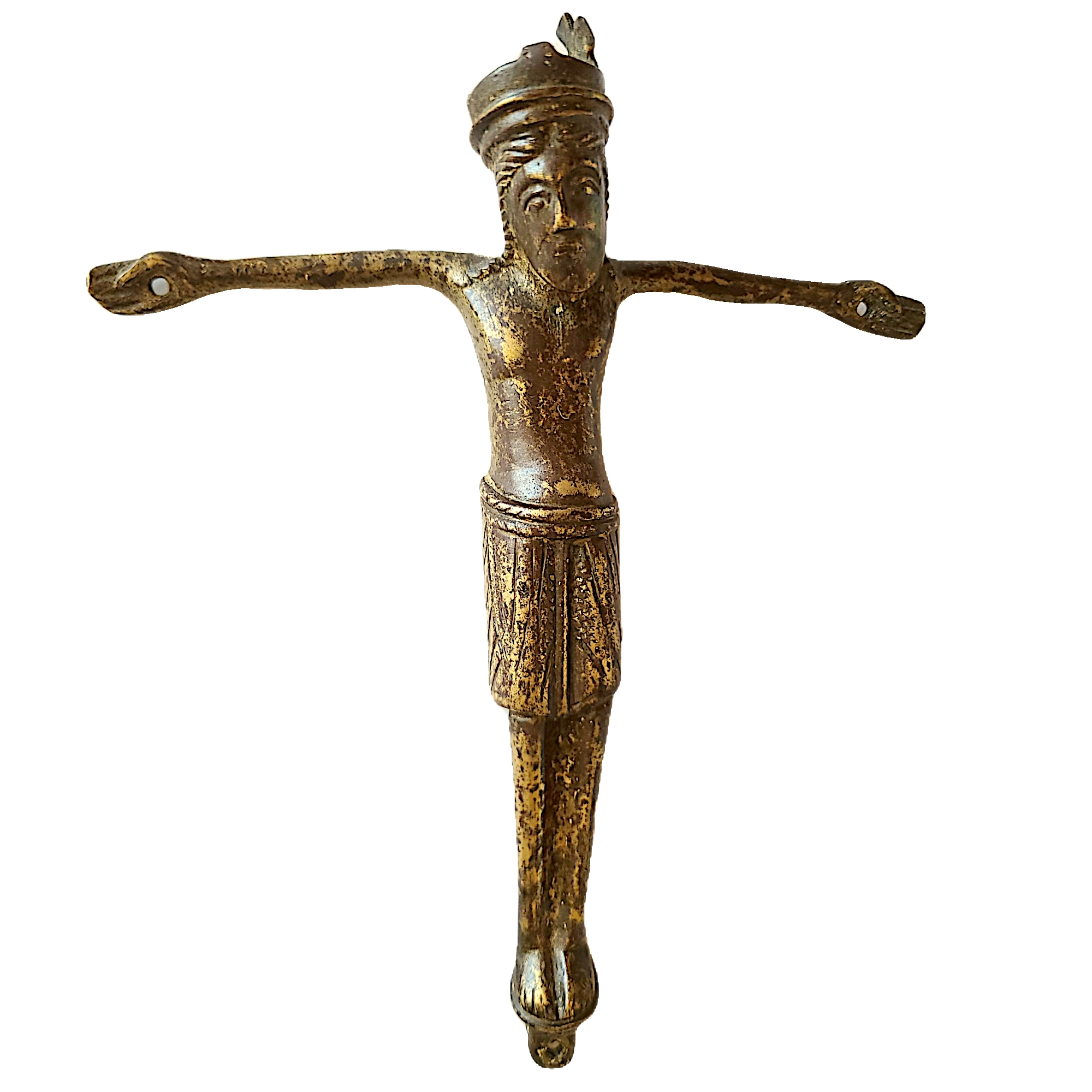
Large Corpus Christi in gilded bronze. Christ is represented crowned, the crown decorated with crosses. It bears a long perizonium with straight and oblique folds, decorated with fine dotted lines on the sides. Long hair with beautiful locks falling over the shoulders. The legs are parallel, the feet resting side by side on the suppedaneum. Beautiful remains of gilding. Of good size and quality of execution, this work is part of the corpus of Rhenish-Mosan Christs from the 12th century, and may have been produced in Cologne. The face of Christ, however, moves away from classical Germanic productions and shows the influences of Mosan art at its peak...

Large capital with water leaf in red Verona marble. This type of capital is typical of 12th century Cistercian abbeys and represents a transition between Romanesque and Gothic art. The sobriety and aesthetics of this capital stand out clearly from the Cluniac and Benedictine sculptures. Our capital is carved on all sides and has a lily on the basket on the 4 sides, the astragal is well marked. The sheets of water, by their rounded extremities, initiate a transition towards the capitals with balls, also well known in Cistercian architecture. This style is very well represented at the Abbey of Sénanque (South of France)...

Head of a bearded man with marked and aged features, probably an old man from the apocalypse. The hair is curly and stylized, bifid beard. Eyelids and cheekbones are well defined. The eyes and ears are worked with a trephine...
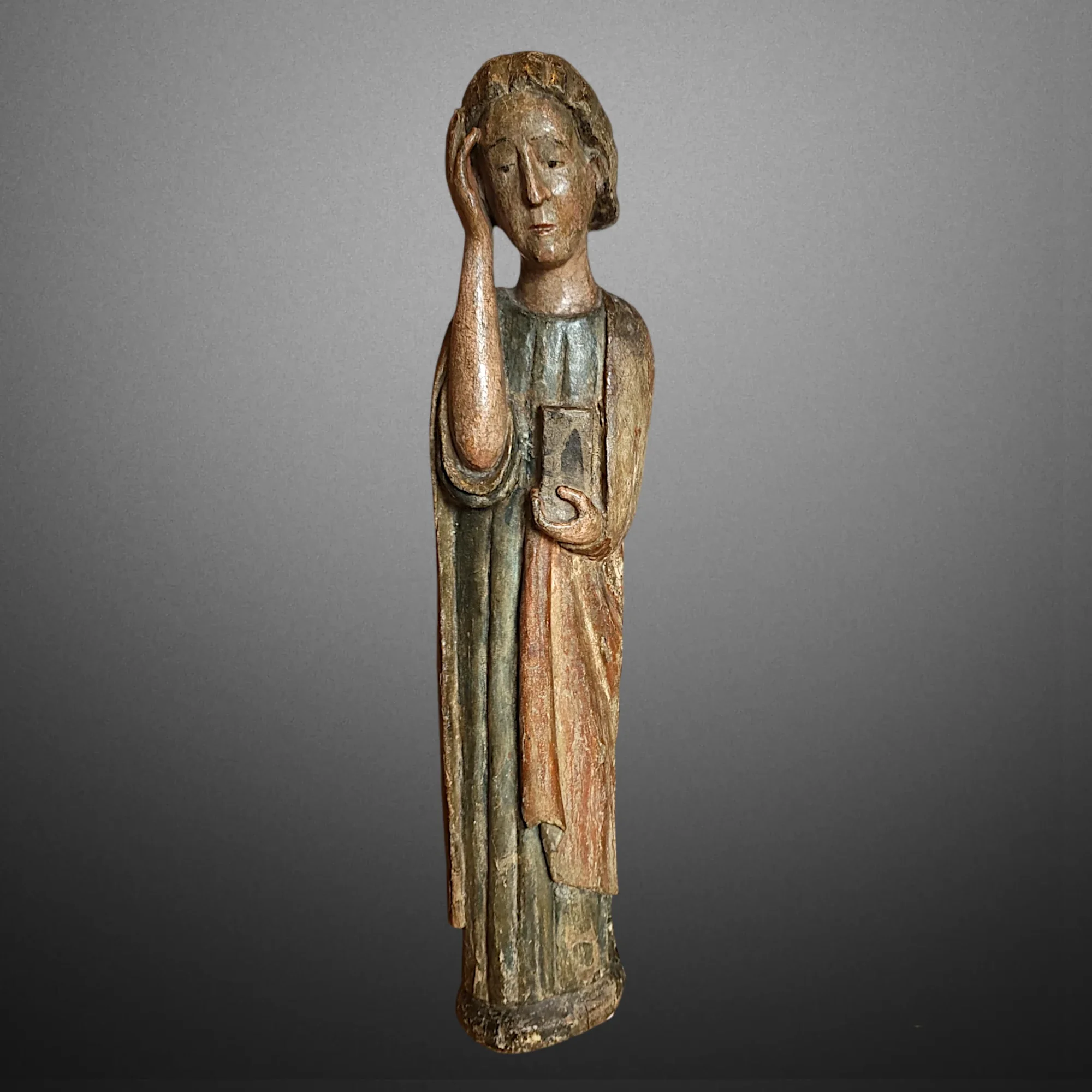
An important and exceptional Saint John at the Calvary. With a slender canon, the saint is dressed in a tunic and a cloak with vertical folds. His face, of great softness, with oval features, slightly drooping eyelids and almond-shaped eyes, expresses deep melancholy. He supports his head with his right hand, while with the other he holds the book of the Gospels. This moving sculpture stands out for its exceptional expressiveness, remarkable execution, and the quality of its original polychromy, admirably preserved. The proportions, stylization of the drapery, and the sober yet precise treatment of the garments place this work at the very end of the 12th century. The elongated style, the treatment of the face, and the verticality of the cloak closely align this sculpture with productions from northern France and, more precisely, the Meuse Valley...

Capital with large smooth stylized and cubic leaves. Abacus with a macaroon and horizontal stripes. Style of the late Merovigian period and early Carolingian period. Comes from a property on the site of the former abbey of Saint-Basle de Verzy (7th century). In 991, Hugues Capet convened the Council of Saint-Basle de Verzy at the abbey of Verzy to judge Arnoul, son of Lothaire. ..

Romanesque capital with hooks in sandstone probably from the abbey of Chaumousey (Vosges). This capital is carved on its 4 sides, with a rosette at the start of the hooks on 3 sides and a cross on the last. Digitations (degenerate acanthus leaves) on the first crown. It does not have an astragal like many 11th century Romanesque capitals. The abbey of Chaumousey was an abbey of the order of Saint-Augustin founded in 1090. The departmental museum of Epinal preserves a capital and various Romanesque and Gothic sculptures coming from this destroyed abbey, and all cut in this same gray sandstone...
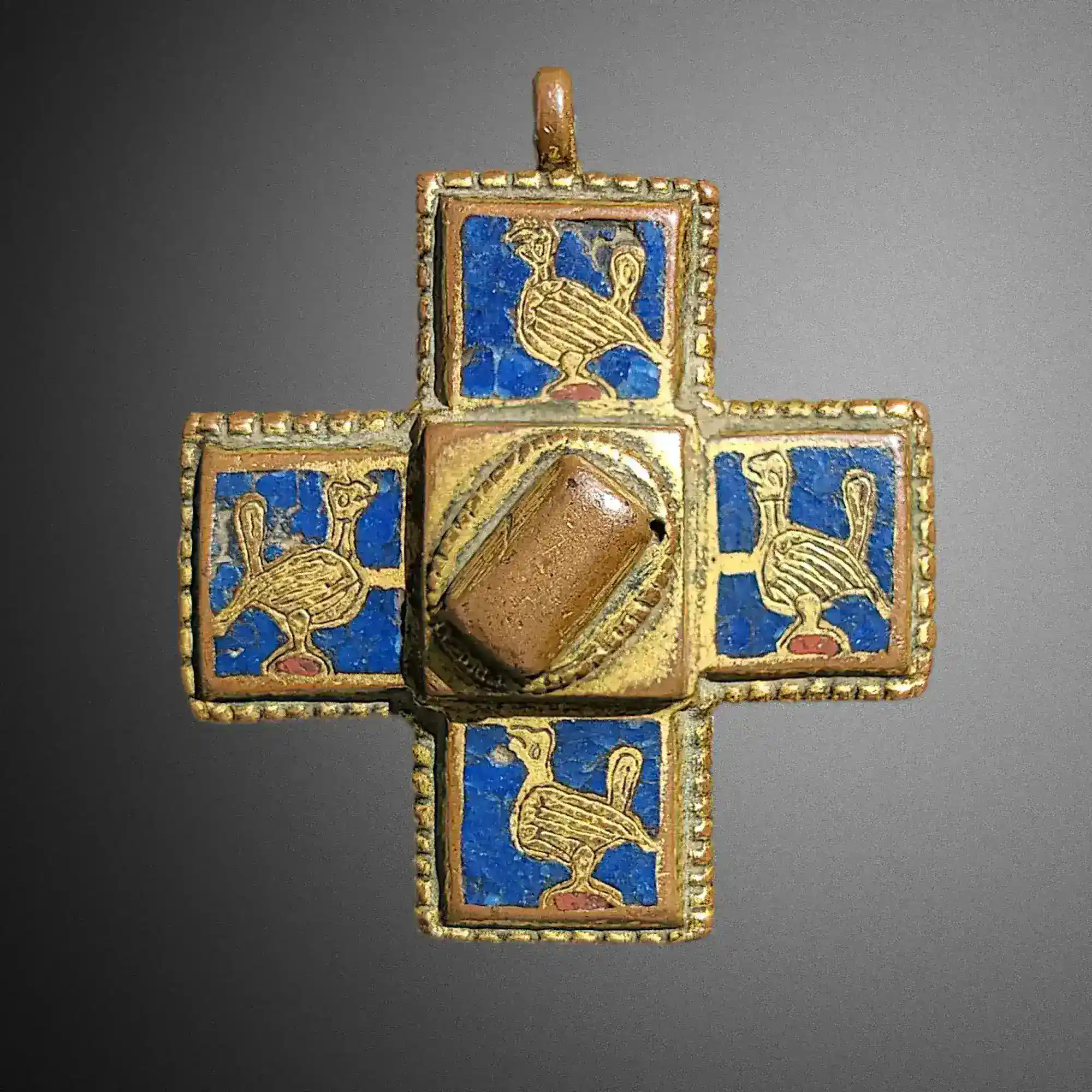
Rare late 11th-century Anglo-Norman pectoral cross in champlevé copper, enameled, and gilded. This large reliquary cross with blue and garnet enamels features a peacock on each arm. The reverse of the cross presents eight eyelets used to secure the reliquary. The overall shape of the object and its design follow Anglo-Saxon or Germanic productions, such as the harness mounting preserved at the Met Museum (51.158) from Trier, dated to the 10th century. However, the iconography of this cross and the champlevé techniques indicate a later production. The depiction of birds, in particular, is very distinctive and evokes insular styles (as seen in the illuminations of the Canterbury manuscripts) but especially the numerous bird representations in the Bayeux Tapestry illustrating the conquest of England by William the Conqueror...
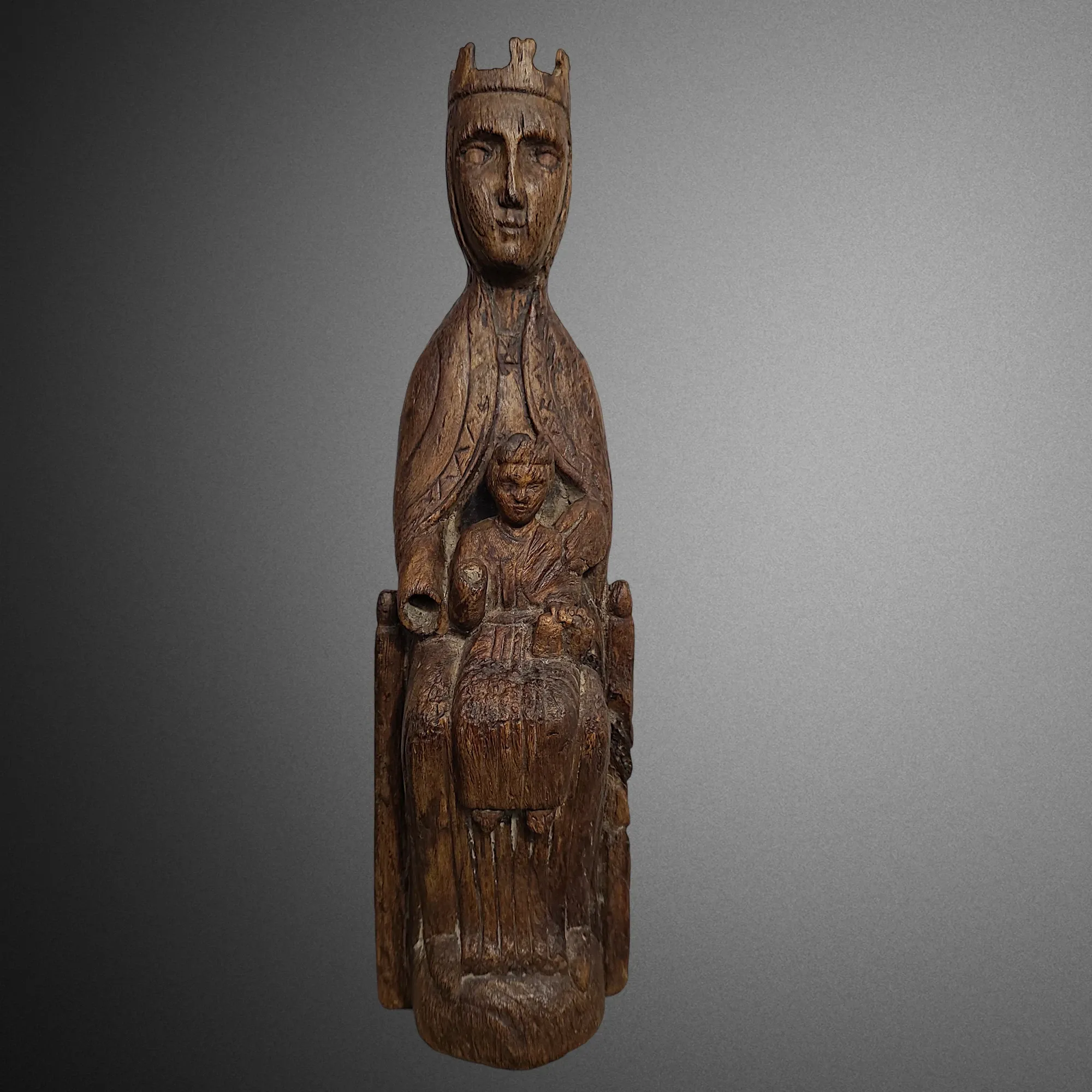
Virgin and Child in Majesty known as Sedes Sapientiae from the Romanesque period. The mother and child are both crowned and present a perfectly frontal position. The Virgin, in a dress with straight pleats, wears a large headdress hemmed in wolf teeth whose sides are joined by a rectangular buckle on the chest. Christ raises his right arm in a sign of blessing and holds the open Book in his left hand. The rectangular throne displays a tall and slender shape typical of Nordic and Germanic productions. The elongated face of the Virgin, the shape of her mouth and the narrow shoulders place this sculpture in the corpus of Germanic Muttergottes of the 12th century with a probable origin around Cologne...
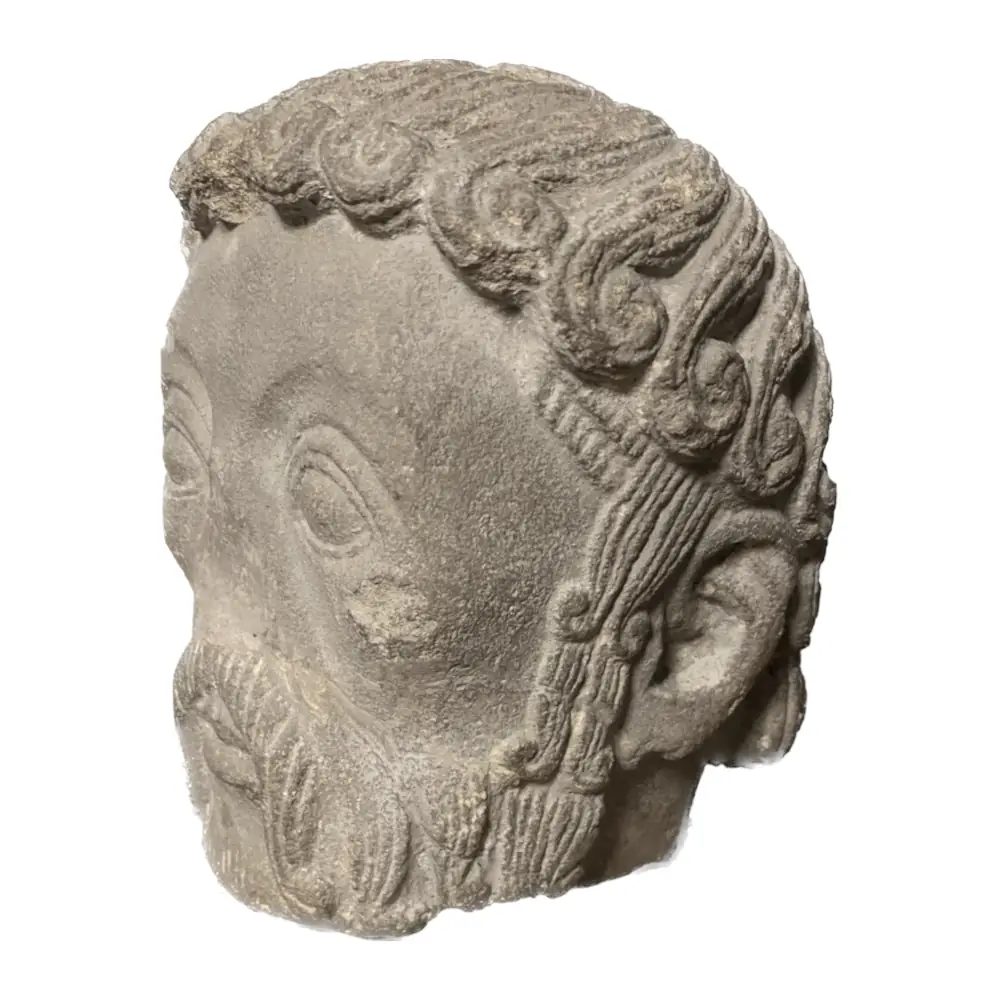
Rare head of a saint or apostle from the beginning of the second Romanesque age. Almond-shaped eyes, with very marked cheekbones, eyelids and eyebrows. Stylized hair and beard with scrolls. The original style of this Romanesque sculpture makes it difficult to locate precisely. However, we can attribute it without too much risk to the Ile de France or Champagne. Origin: Ex Sotheby's, ex Kervorkian collection, ex Robert Kime collection...

Enthroned Virgin in carved walnut, hollow back. Seated on a bench-throne, her bust erect, Mary carries the Child on her left knee in a frontal position; oval face with protruding eyes stretched towards the temples, pointed chin, thin-lipped mouth; head wearing a crown placed on a veil descending to the shoulders; she is dressed in a dress with a simple neckline, belted at the waist, and a coat with open sides. Dressed in a long tunic, the Child, with mid-length hair with curved ends, is also crowned...
The romanesque sculpture is mainly architectural and the works, with some exceptions as the enthroned wooden virgins , mainly come from religious buildings. Romanesque sculpture decorates capitals, corbels, columns and pillars but also porches, tympanums and arches. These often stylized works and fragments have become relatively rare on the market. The Ekinium gallery is passionately looking for these works with such a particular aesthetic.
Browse works of art by period