
Origin : Burgundy, France.
Medium : Polychromed and gilded wood.
Size : Height 76 cm
Period : Last quarter of the 12th century, circa 1175–1200.
Condition : Losses and old woodworm damage.
Price : on demand
REF. 300
Romanesque Enthroned Virgin and Child. Burgundy, late 12th century.
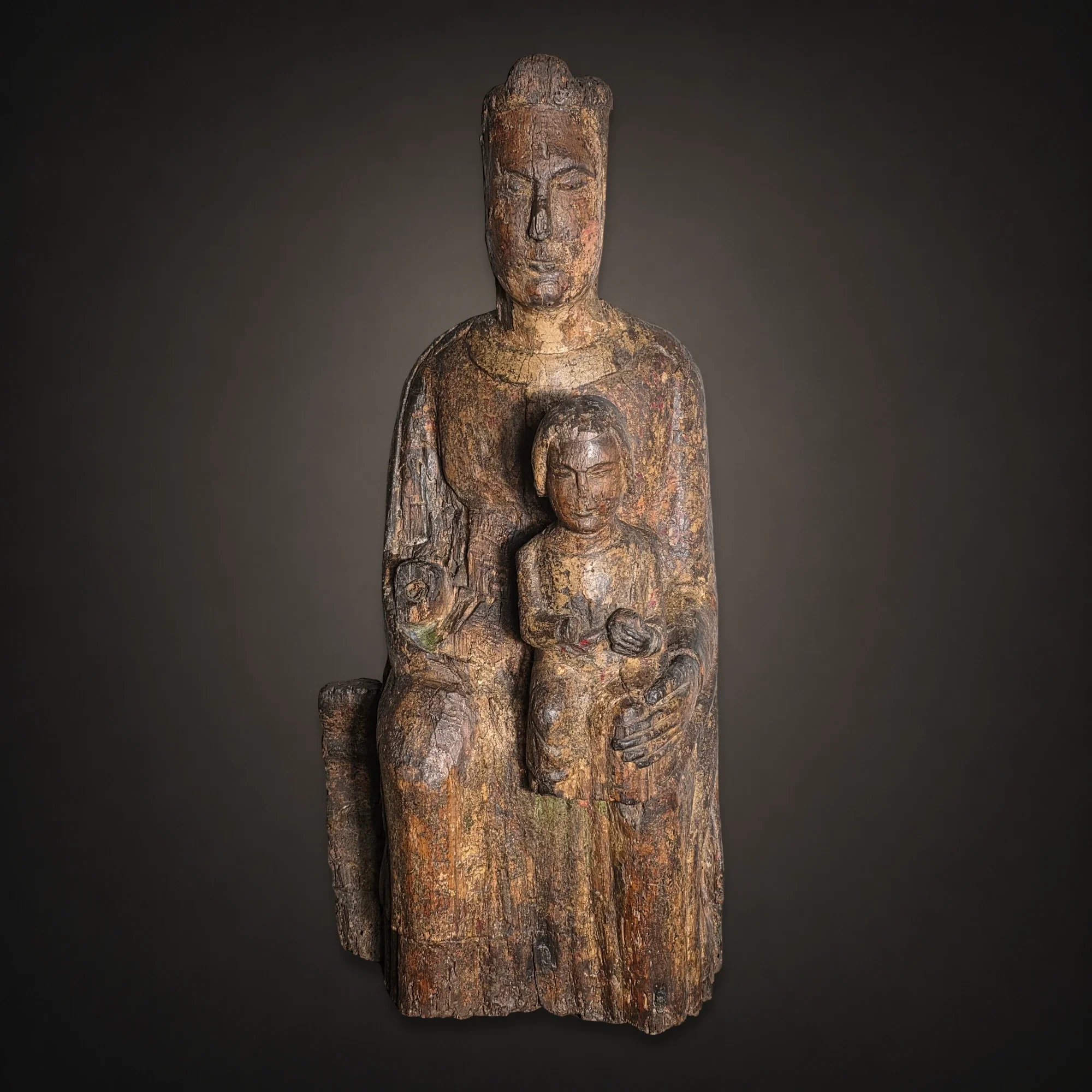
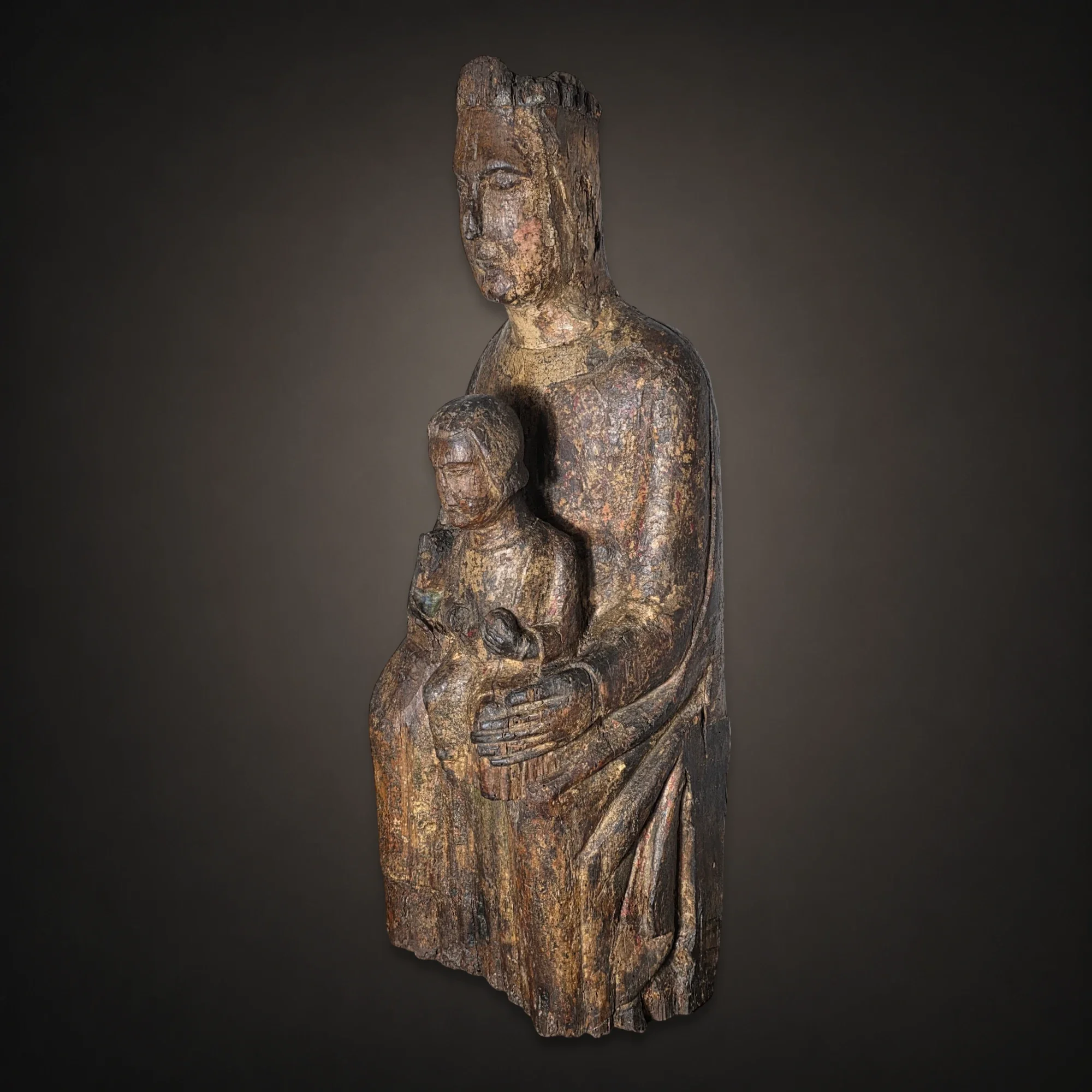
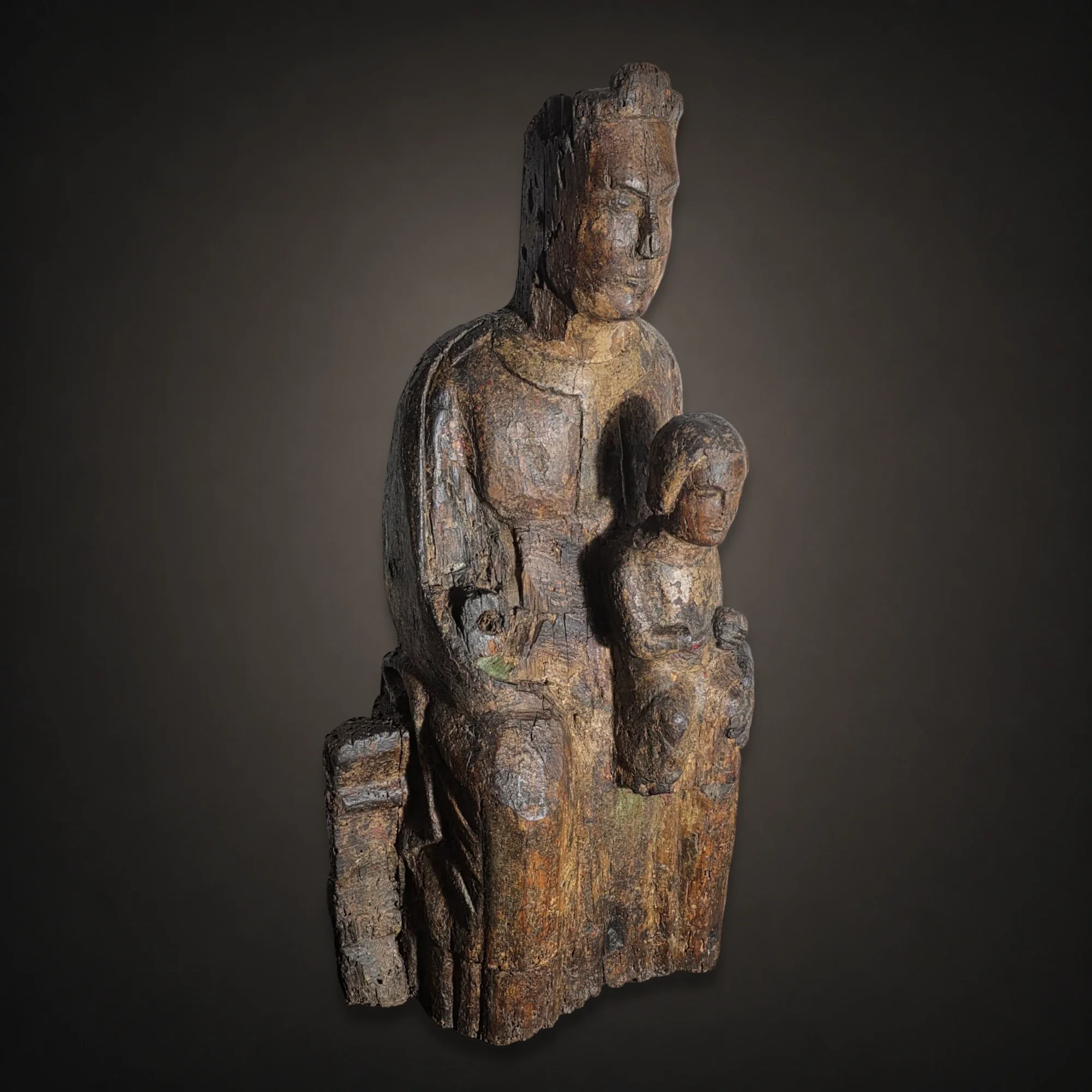
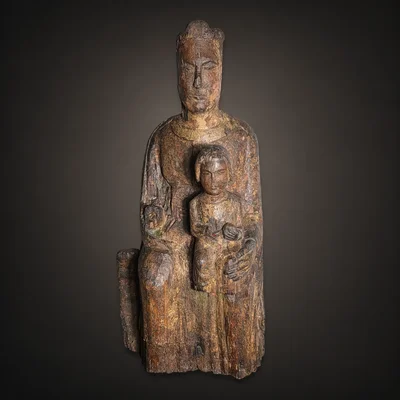
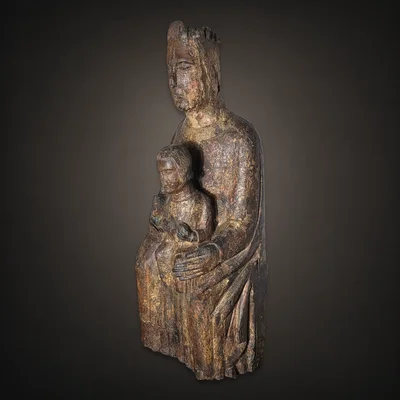
This polychromed and gilded wooden Virgin and Child depicts Mary seated on a throne in a strictly frontal pose. Crowned, the Virgin presents the Christ Child, positioned slightly off-centre on her left knee. Mary’s relatively narrow and elongated head is surmounted by a crown. Her face is characterised by a high forehead, gently arched eyebrows and large almond-shaped eyes framed by thick eyelids. The long, straight nose stands out prominently from the face. The cheeks are only slightly modelled, the mouth is small with tightly closed lips, and the chin is subtly projecting. These features lend the Virgin a markedly hieratic appearance. The Child has a rounded head framed by short hair, almond-shaped eyes, a straight nose and a small mouth. He wears a long tunic with vertical folds and holds an orb in his left hand. His missing right hand was probably raised in a gesture of blessing. Through its frontality, restrained modelling and arrangement of the drapery, this Virgin displays stylistic affinities with several sculptures from Burgundy, suggesting a date in the late 12th century.
During the 12th century, Burgundy was one of the major centres of Romanesque sculpture in France. The influence of religious and artistic centres such as Cluny, Autun and Vézelay encouraged the development of a distinctive sculptural language, reflected not only in monumental sculptural ensembles but also in polychromed wooden statuary. As Nadia Bertoni Cren has demonstrated, this production did not constitute a homogeneous school but encompassed several distinct stylistic traditions.
Our Virgin belongs to the iconographic type of the Sedes Sapientiae, or Throne of Wisdom, in which Mary, seated frontally on a throne, presents the Christ Child as Wisdom Incarnate. Its compact construction, the hieratic treatment of the face and the predominantly linear arrangement of the drapery connect it to the Burgundian Romanesque tradition.
The Virgin of Viévy, preserved in the Musée d’Art sacré in Dijon and dated to the second half of the 12th century by Ilene H. Forsyth (1972), offers a significant comparison. Both sculptures share a frontal and compact composition, a face with strongly defined features, a prominent nose, pronounced eyebrows and a small mouth. The garments, treated with great simplicity, also display broad surfaces almost devoid of folds.
The Virgin of Tamnay, preserved in the Musée archéologique du Nivernais and dated here to the late 12th century, presents a comparable conception of the face. The prominent nose, strongly outlined almond-shaped eyes and clearly defined eyebrows recall our example, despite differences in the treatment of the garments.
Notre-Dame de Bon-Espoir, preserved in the Church of Notre-Dame in Dijon and dated to the second half of the 12th century by Forsyth, displays a comparable stylisation of the face, characterised by its elongated proportions, narrow nose and strongly emphasised eyes.
Particularly close parallels can be found in the Virgin of Nolay, preserved in the Musée des Beaux-Arts in Beaune and dated to the late 12th century. The elongated head, high forehead, straight nose, small mouth and rounded shoulders closely recall our sculpture. In both works, the garments are rendered as broad, relatively unmodulated surfaces, closely integrated with the body.
The Virgin preserved in the Musée des Beaux-Arts in Beaune, related to another example originating from the vicinity of Arnay-le-Duc and dated between the late 12th and early 13th centuries, also provides an important parallel. Both sculptures display a compact construction, a narrow and elongated head, and a face with subtly modelled cheeks. The drapery is organised into broad, smooth surfaces, articulated by linear folds.
Finally, the Virgin of Thoisy-le-Désert, dated to the last quarter of the 12th century, presents a comparable frontal composition, with the Christ Child positioned slightly off-centre. Its softer modelling and more numerous diagonal folds, however, reveal a different approach to sculptural form.
Taken together, these comparisons place our sculpture within the tradition of Burgundian enthroned Virgins of the second half of the 12th century. The most significant parallels are with Viévy, Nolay and the Arnay-le-Duc group, both in the construction of the face and in the overall organisation of the figure and its garments.
The slightly off-centre position of the Child, the articulation of the drapery around the knees and the construction of the face suggest a date in the last quarter of the 12th century, around 1175–1200. The concentration of several stylistic parallels within the territory of present-day Côte-d’Or supports an origin in this part of Burgundy, probably in the Auxois or the Pays d’Arnay.
Provenance: Swiss private collection.
Complete scholarly dossier and study available upon request.
Selected bibliography:
· Ilene H. Forsyth, The Throne of Wisdom: Wood Sculptures of the Madonna in Romanesque France, Princeton, Princeton University Press, 1972.
· Pierre Quarré, La statue de Notre-Dame de Bon-Espoir et son ancienne polychromie, Mémoires de la Commission des Antiquités du département de la Côte-d’Or, vol. XXIII, 1955, pp. 190–197.
· Nadia Bertoni Cren, La sculpture sur bois polychrome des XIe–XIIe siècles en Bourgogne, doctoral dissertation, Université de Bourgogne, 2013.
· Nadia Bertoni Cren, Le cercle d’Autun. Les sources de la statuaire dans la Bourgogne romane, Bulletin du Centre d’études médiévales d’Auxerre, 17.1, 2013.
· Nadia Bertoni Cren, La Majesté de Tamnay, Bulletin de la Société nivernaise des Lettres, Sciences et Arts, vol. 60, 2015, pp. 7–20.
· Nadia Bertoni Cren and Stéphane Cren, La sculpture sur bois romane de Bourgogne. Styles, techniques, restauration, Chenôves, ARC Éditeur, 2020.
In-depth study of the artwork
| Subject: | Virgin in Majesty |
|---|---|
| Material: | polychromed and gilded wood |
| Dimensions: | height 76 cm |
| Origin: | France, Burgundy, probably Côte-d'Or, Auxois or the Arnay region |
| Date: | late 12th century, circa 1175-1200 |
| Provenance: | Swiss private collection |
| Condition: | losses and traces of woodworm activity; remains of original polychromy and gilding |
| Reference: | 300 |
Description
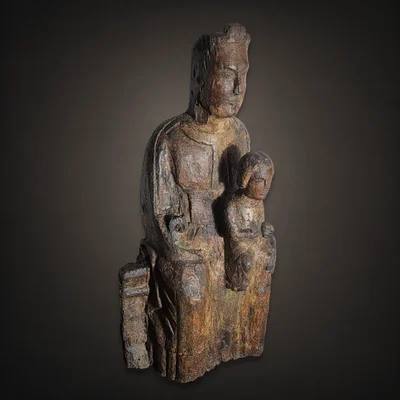
This polychromed and gilded wooden Virgin and Child represents Mary seated on a throne in a strictly frontal attitude. Crowned, the Virgin presents the Child seated frontally and slightly off-centre. He too faces the viewer and is held by his mother, whose elongated fingers rest on his knee. The Virgin's right arm is partially missing.
Mary's head, relatively narrow and elongated, is surmounted by a crown whose upper section is partly damaged. The face has a high forehead, gently arched brows and large almond-shaped eyes with thick eyelids. The long straight nose projects clearly from the face. The cheeks are only lightly modelled, the mouth is small with tightly closed lips, and the chin slightly projecting. The whole gives the Virgin a strongly hieratic presence. A veil, now heavily eroded, frames the face.
The Virgin wears a long dress with a rounded neckline split by an amigaut and a mantle that wraps around the shoulders and falls over the legs. The torso, almost devoid of folds, is treated in broad smooth surfaces. The garment becomes more animated around the knees, where the mantle forms a series of deeply carved oblique folds, particularly visible in profile. In the lower section, the fabrics fall in long vertical folds simply incised into the wood.
The Child is slightly displaced toward the left knee. His round head, framed by short hair, has clearly defined features: almond-shaped eyes, a straight nose and a small mouth. He wears a long tunic with vertical folds. He holds the globe in his left hand. His right hand, now missing, was probably raised in blessing. The two figures remain independent in their attitudes and do not interact through their gaze.
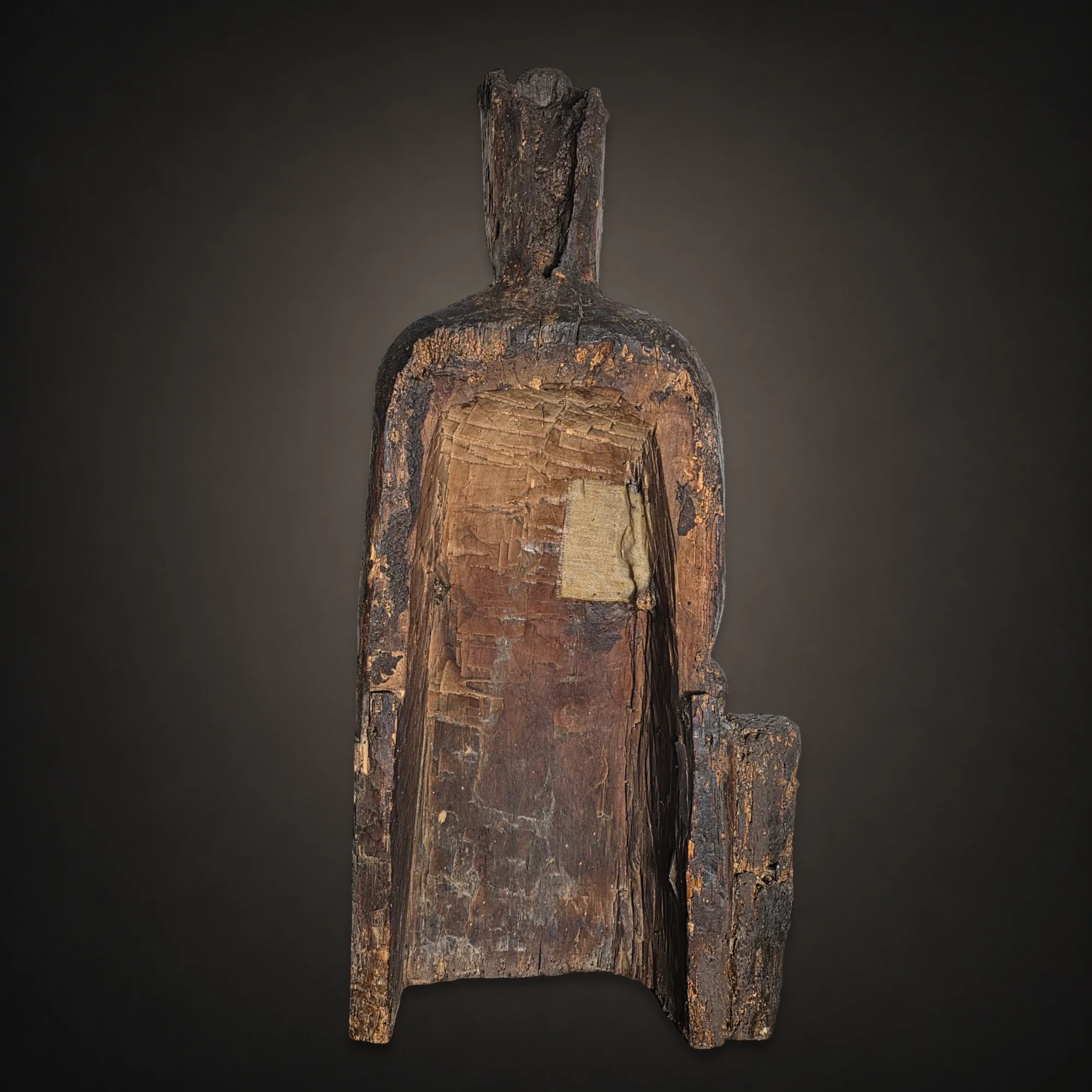
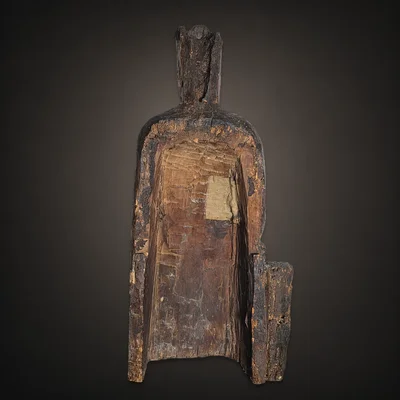
The sculpture is carved from a substantial block of wood, deeply hollowed at the back, where tool marks remain visible. It preserves traces of old gilding and polychromy, notably red, ochre and dark tones.
Despite its alterations, the work retains a monumental presence, enhanced by the frontality of the two figures, the simplicity of the volumes and the hieratic character of the composition.
Condition
The sculpture has losses and traces of old woodworm activity. The Virgin's right arm is incomplete, as is the Child's right arm. Mary's crown is partially damaged. Remains of old polychromy survive on the faces and garments.
The upper part of the Virgin's head was altered at an early date along the sides: the original hairstyle was cut back to allow the attachment of added wooden elements forming a more voluminous headdress. The right upright of the throne, also old, appears to have been added after the sculpture was made, perhaps as early as the 13th century. Finally, the lower part of the statue appears to have been sawn at an early date.
Geographical and stylistic context
In the 12th century, Burgundy was one of the major centres of Romanesque sculpture in France. The influence of the religious establishments of Cluny, Autun and Vézelay fostered the development of a particularly original artistic language, evident in the great programmes of monumental sculpture but also in a smaller body of polychromed wooden sculpture. Long studied less extensively than stone sculpture, these works have been the subject of detailed research that has helped define the different stylistic traditions present in the region.
As Nadia Bertoni Cren has shown, Burgundian wood sculpture does not constitute a perfectly homogeneous school. On the contrary, it reflects several currents developing in parallel, drawing at times on Carolingian and Ottonian traditions and at others on innovations from monumental sculpture.
Virgins in Majesty occupy an important place within this production. Faithful to the iconographic type of the Sedes Sapientiae, they show Mary seated on a throne and presenting the Child frontally to the faithful. The Virgin thus appears as the Throne of Incarnate Wisdom. This conception explains the hieratic character of these sculptures, in which frontality, symmetry and compositional stability take precedence over movement or interaction between the figures.
Within the territory corresponding to present-day Côte-d'Or, several wooden Virgins attest to the persistence of this tradition throughout the 12th century and into the first decades of the following century. The examples from Viévy, Nolay, the Arnay-le-Duc area and Thoisy-le-Désert display, despite differing sensibilities, a certain unity of conception.
The present Virgin belongs to this Burgundian tradition through its particularly compact construction. Mary's figure forms an almost architectural mass, whose verticality is barely interrupted by the Child, slightly offset on her left knee. The throne contributes to this overall organization, while the garment largely conceals the forms of the body.
The treatment of the face is another significant feature. The elongated head, high forehead, straight nose and almond-shaped eyes beneath strongly marked brows emphasize the hieratic character without any search for naturalism. This way of constructing the face through a few strongly asserted lines finds parallels in several Burgundian Romanesque Virgins, especially those recorded in Côte-d'Or.
The treatment of the garments follows a comparable conception. On the torso, the fabrics are reduced to broad, almost smooth surfaces, while the folds of the mantle, incised around the knees, are arranged in oblique lines. This opposition between full volumes and linear drapery is characteristic of sculpture in which line continues to play an essential role in defining form. The treatment of the clothing provides another point of comparison with Burgundian Romanesque sculpture.
Burgundian sculpture of the late 12th century thus retained strongly Romanesque characteristics even as certain workshops began to develop softer modelling and a more natural rendering of fabrics.
Through its frontality, restrained modelling and organization of the drapery, the present Virgin is closely related to this regional tradition. Stylistic comparisons with several works from Côte-d'Or support an origin in this part of Burgundy and a date in the late 12th century.
Comparative corpus and dating
The Virgin and Child studied here finds several points of comparison within the corpus of Virgins in Majesty preserved in Burgundy, and more particularly in Côte-d'Or. The examples from Viévy, Notre-Dame de Bon-Espoir in Dijon, Tamnay, Nolay, the Arnay-le-Duc area and Thoisy-le-Désert reveal different expressions of a sculptural tradition that continued through the second half of the 12th century and into the beginning of the 13th century.
Virgin of Viévy
The Virgin of Viévy, preserved in the Musée d'Art sacré in Dijon and dated by Forsyth (1972) to the second half of the 12th century, offers several strong analogies with the present sculpture. Both works share a highly frontal and compact conception of the figure, as well as a facial treatment characterized by strongly defined features. The long projecting nose, marked brows and small mouth reflect the same search for hieratic representation. The garments at Viévy are treated with great simplicity: the few folds, essentially vertical, emphasize the silhouette without attempting to reproduce the natural movement of fabric. The same sobriety appears in the present Virgin, whose torso is almost devoid of folds.
Virgin of Tamnay
The Virgin of Tamnay, preserved in the Musée archéologique du Nivernais and placed by Bertoni Cren in the first quarter of the 12th century, offers another comparison for the treatment of the face. As in the present example, the features are organized around a powerful nose prolonged by clearly drawn brow ridges. The almond-shaped eyes with strongly emphasized contours and the pronounced chin, however, give Tamnay a more forceful expression. The clothing is also different. The Virgin wears a simple costume, notably characterized by a V-shaped neckline and ornamental details absent from the present sculpture. The affinity therefore lies more in the construction of the face than in the treatment of the garments, which differs appreciably between the two sculptures.
Notre-Dame de Bon-Espoir, Dijon
The Virgin of Notre-Dame de Bon-Espoir, preserved in the church of Notre-Dame in Dijon and dated by Forsyth to the second half of the 12th century, offers a more singular interpretation of the Marian figure. Its elongated face, narrow nose and strongly emphasized eyes belong to a comparable mode of stylization, although the proportions and modelling differ appreciably from the present example.
Virgin of Nolay
The parallels are also close with the Virgin of Nolay, preserved in the Musée des Beaux-Arts in Beaune and dated to the late 12th century. The elongated head, high forehead, straight nose and small mouth directly recall the physiognomy of the present Virgin. The rounded shoulders and torso treated in broad, scarcely animated surfaces further strengthen this relationship. The garment appears closely bound to the body. Unfortunately, the loss of the lower part of the Nolay Virgin prevents a more extensive comparison of the drapery.
Virgin from the Arnay-le-Duc area
The Virgin preserved in the Musée des Beaux-Arts in Beaune, related to an example from the area around Arnay-le-Duc and dated between the late 12th and early 13th centuries, is another particularly interesting parallel. Both sculptures have a compact construction, a relatively narrow and elongated head, and a face dominated by a straight nose and almond-shaped eyes. The lightly modelled cheeks and small mouth heighten the similarity. The draperies nevertheless differ in several respects: on the Beaune example, the mantle falls in long oblique lines from the shoulders, whereas the present Virgin concentrates its most expressive folds around the knees. In both works, however, the garment remains organized by broad smooth surfaces rhythmically articulated by linear folds.
Virgin of Thoisy-le-Désert
Finally, the Virgin of Thoisy-le-Désert, dated to the fourth quarter of the 12th century, offers an interesting comparison for the overall composition and the treatment of the mantle. The Virgin is seated frontally, presenting the Child on her left knee, which she supports with her long hands. The silhouette retains great stability, but the forms are more supple than in the present sculpture. The face, with more delicately modelled features, reveals a search for more natural expression. The mantle also has more numerous oblique folds, whose movements follow the volumes of the body more closely. The present Virgin differs through a more rigid and geometric treatment.
Proposed dating
Taken together, these comparisons place the present sculpture within the tradition of Burgundian Virgins in Majesty of the second half of the 12th century. The hieratic conception of the figure, simplification of the volumes and essentially linear treatment of the drapery attest to the persistence of a strongly Romanesque style.
The most significant comparisons are with the Virgins of Viévy, Nolay and the Arnay-le-Duc area, both in the construction of the face and in the overall organization of figure and garment. The examples from Tamnay and Notre-Dame de Bon-Espoir place these characteristics within a broader regional tradition, while Thoisy-le-Désert illustrates a more supple treatment of forms during the final decades of the 12th century.
The slightly off-centre position of the Child, the articulation of the drapery around the knees and the construction of the face therefore favour a date in the final quarter of the 12th century, circa 1175-1200. The concentration of several stylistic parallels within present-day Côte-d'Or supports an origin in this part of Burgundy.
Bibliographical references
- • FORSYTH, Ilene H., The Throne of Wisdom: Wood Sculptures of the Madonna in Romanesque France, Princeton, Princeton University Press, 1972.
- • QUARRÉ, Pierre, “La statue de Notre-Dame de Bon-Espoir et son ancienne polychromie”, Mémoires de la Commission des Antiquités du département de la Côte-d'Or, vol. XXIII, 1947-1953, published 1955, pp. 190-197.
- • BERTONI CREN, Nadia, La sculpture sur bois polychrome des XIe-XIIe siècles en Bourgogne, doctoral thesis in art history, Université de Bourgogne, Dijon, 2013.
- • BERTONI CREN, Nadia, “Le cercle d'Autun. Les sources de la statuaire dans la Bourgogne romane”, Bulletin du Centre d'études médiévales d'Auxerre (BUCEMA), 17.1, 2013.
- • BERTONI CREN, Nadia, “La Majesté de Tamnay”, Bulletin de la Société nivernaise des Lettres, Sciences et Arts, vol. 60, year 2013, published in Nevers in 2015, pp. 7-20.
- • BERTONI CREN, Nadia and CREN, Stéphane, La sculpture sur bois romane de Bourgogne. Styles, techniques, restauration, Chenôves, ARC Éditeur, 2020.