
Origin : Roussillon, France.
Medium : White Pyrenean marble.
Size : Height 32 cm, diameter 59 cm.
Period : 12th century.
Condition : Erosion and losses
Price : on demand
REF. 293
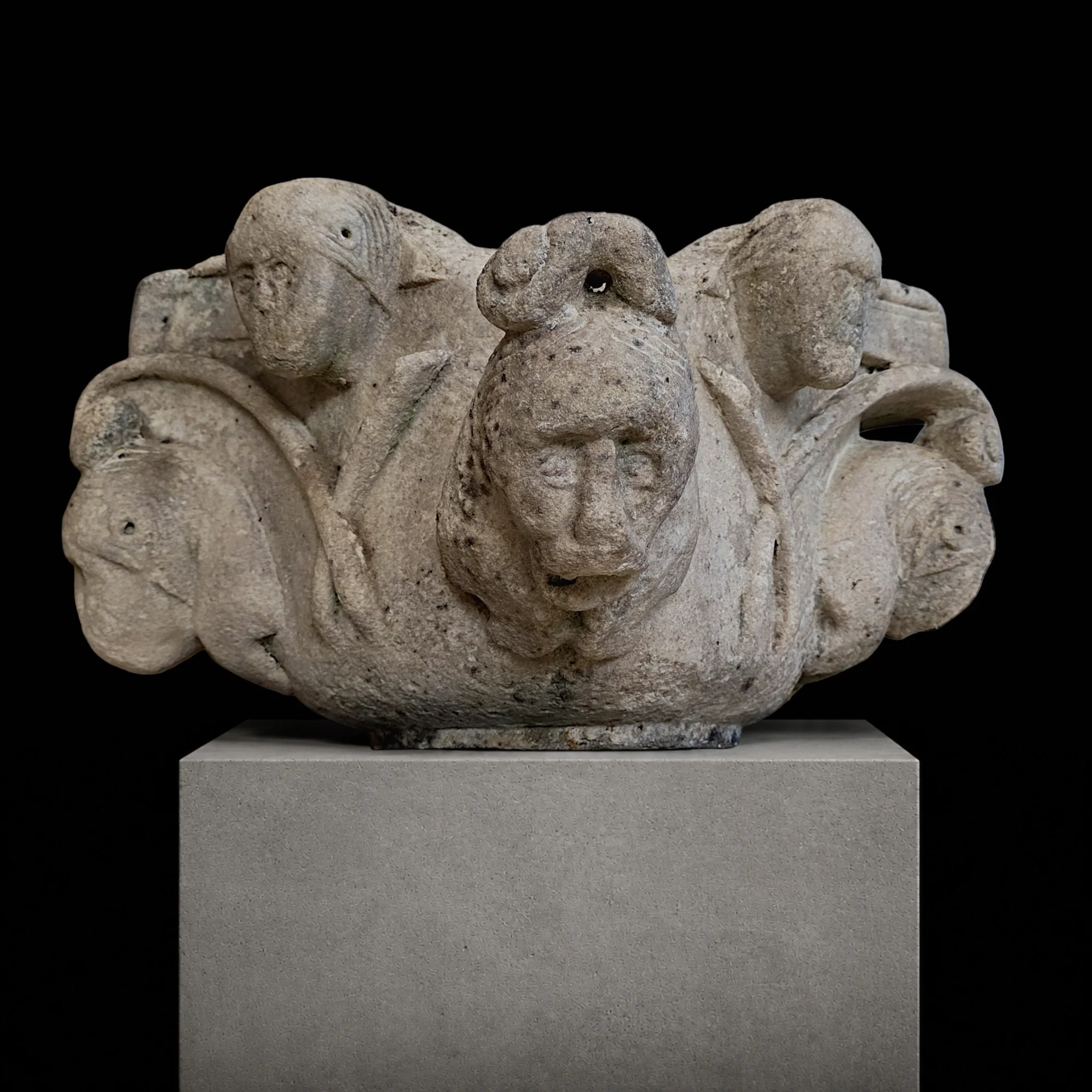
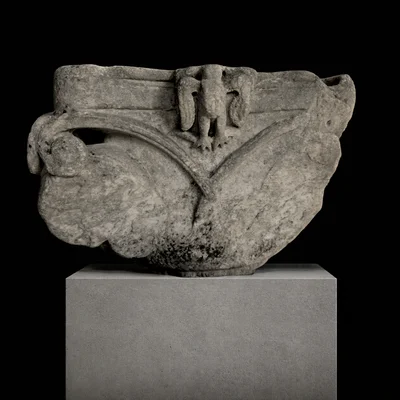
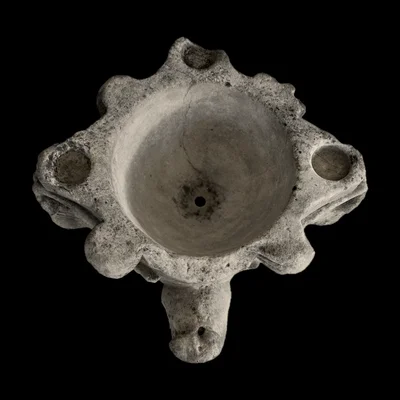
Romanesque baptismal font. Pyrenean marble, Roussillon, circa 1170.
This rare Romanesque baptismal font, carved from white Pyrenean marble probably quarried near Céret, is a remarkable example of late 12th-century liturgical furnishing from Roussillon. Its quatrefoil plan is contained within a broadly quadrangular outer volume, while an astragal moulding defines its circular base and accompanies the outward flare of the walls. The closest comparisons are found among the capitals of the south portal of Notre-Dame de Brouilla, as well as in the cloister of Elne Cathedral and at the Abbey of Saint-Martin-du-Canigou.
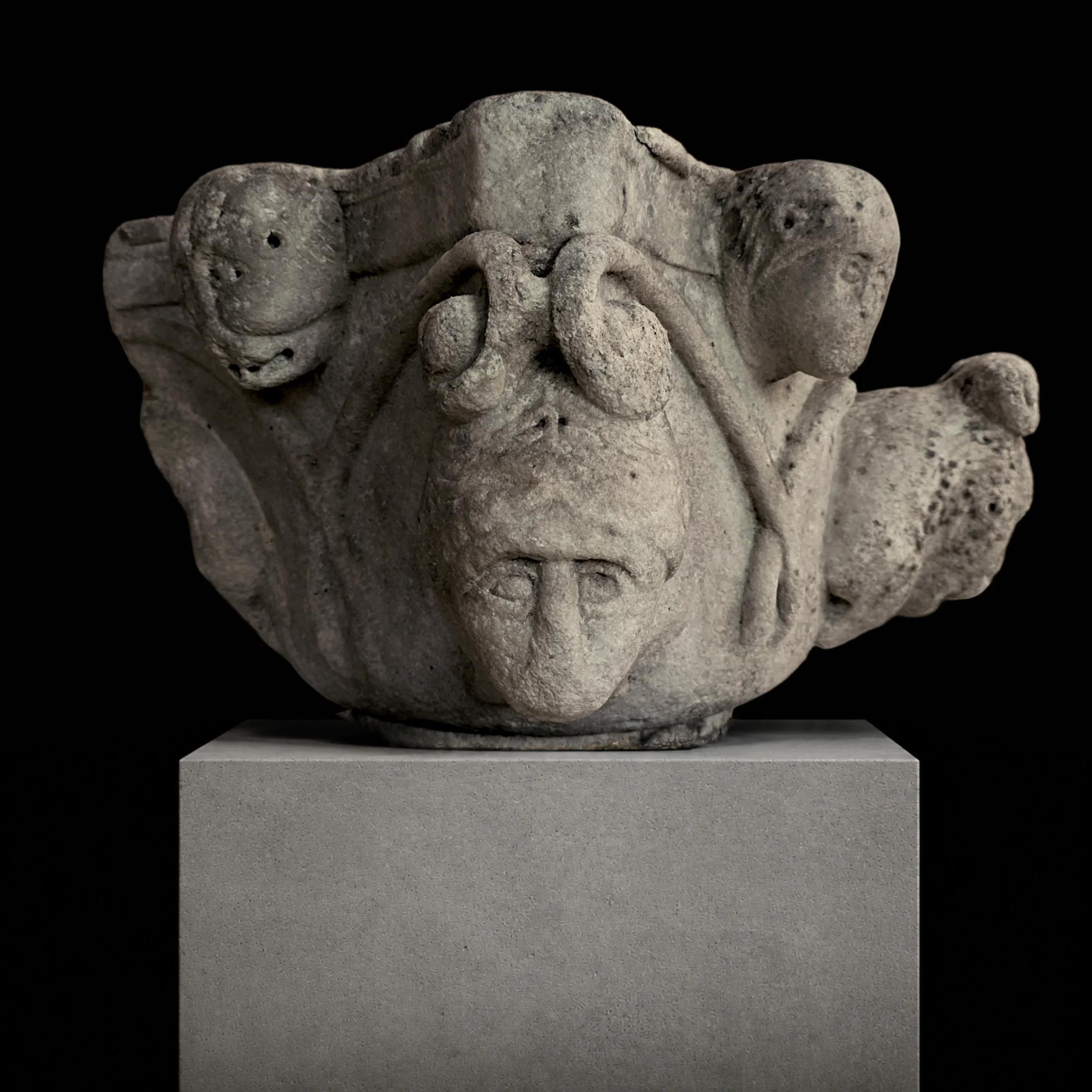
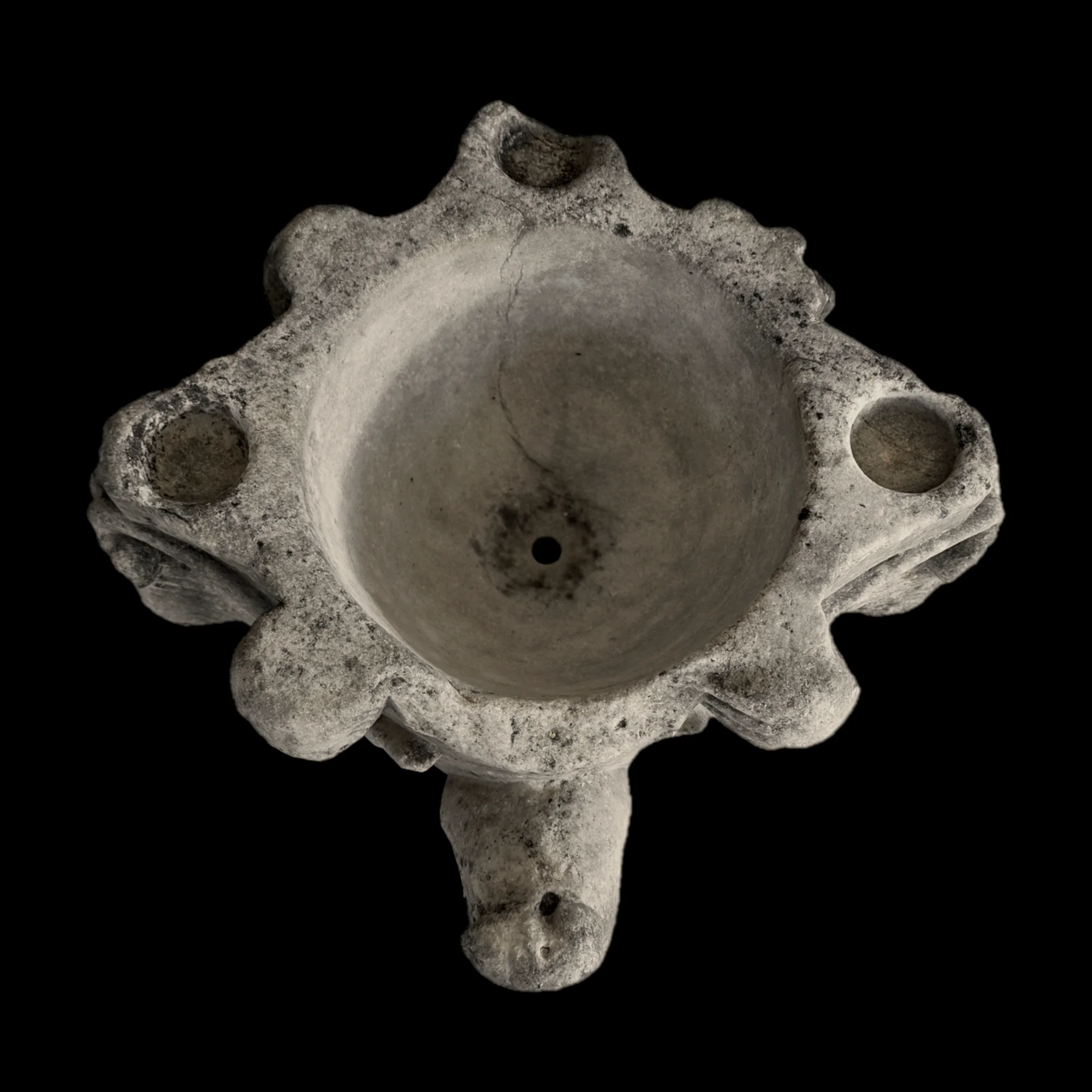
The upper surface is arranged around a large, deeply hollowed hemispherical basin. Four smaller circular cavities, or loculi, were positioned around the central basin; one was lost following an old deliberate break to the rim. Their consistent patina and wear indicate that they formed part of the original design of the font. They may have held ampullae containing the Holy Chrism and the Oil of Catechumens, together with other accessories required for the baptismal liturgy.
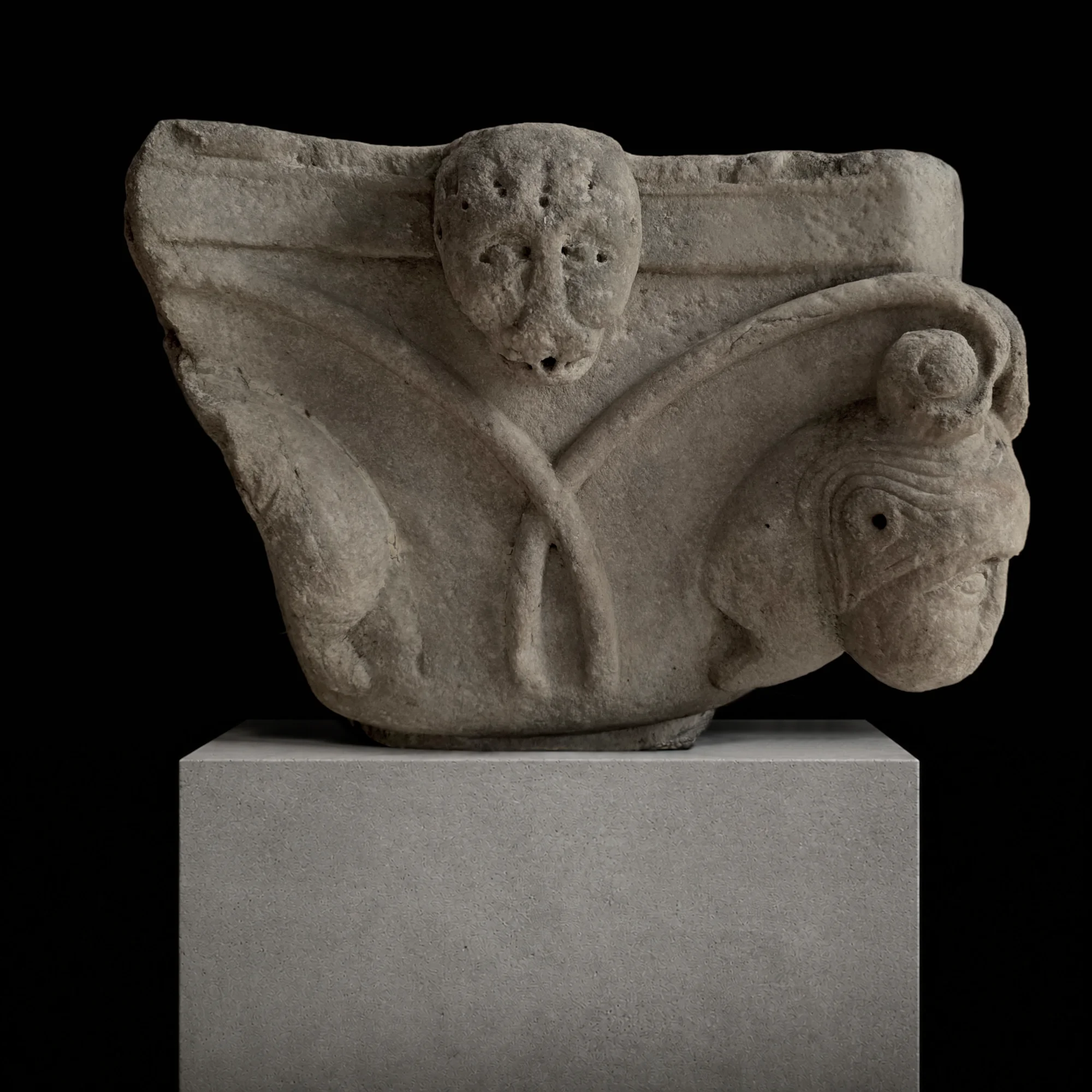
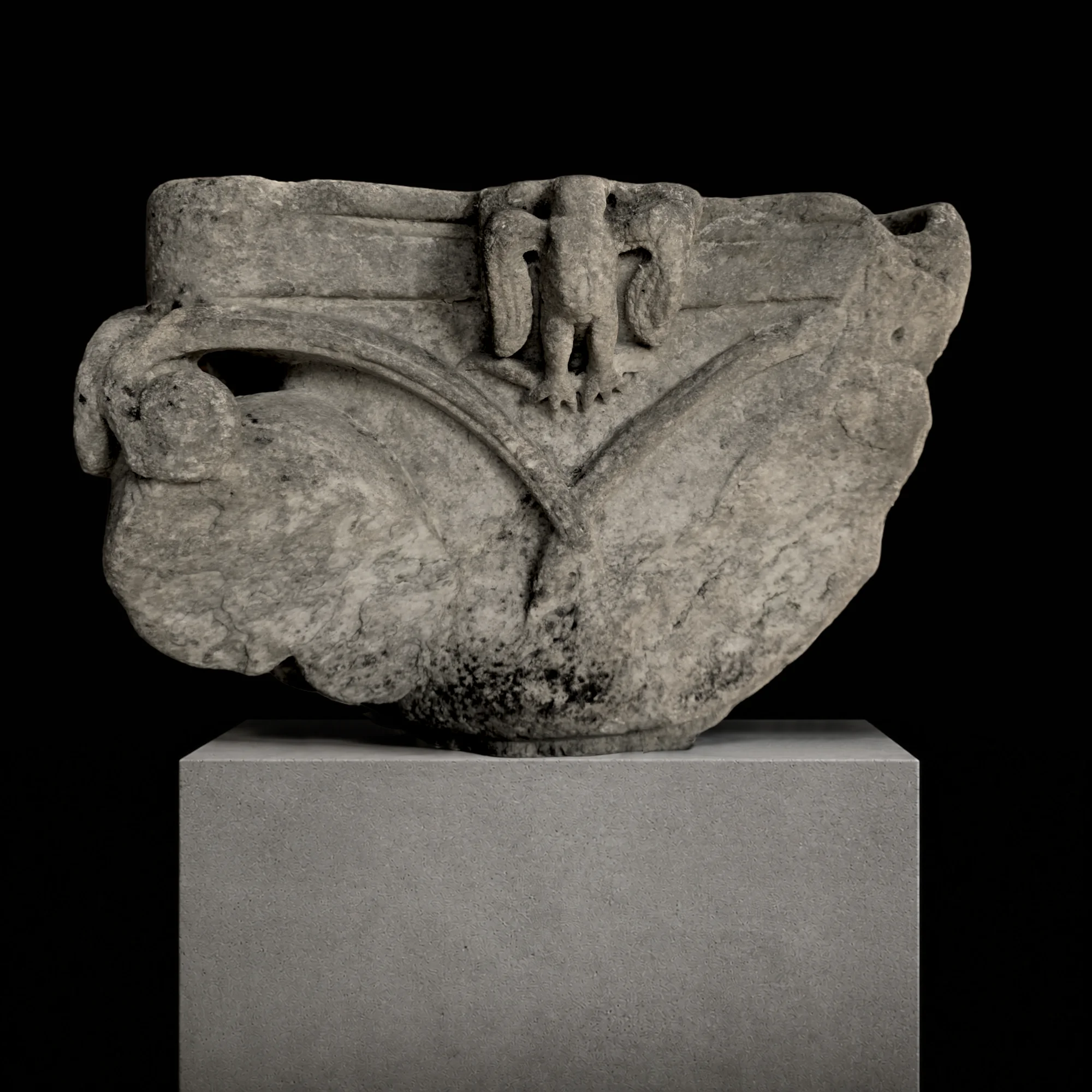
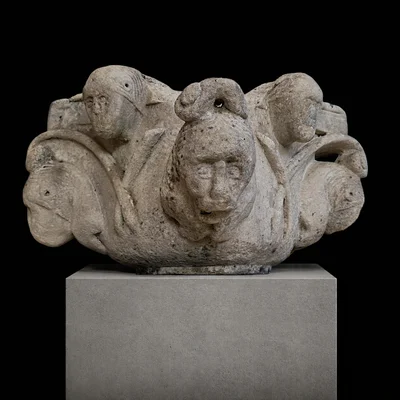
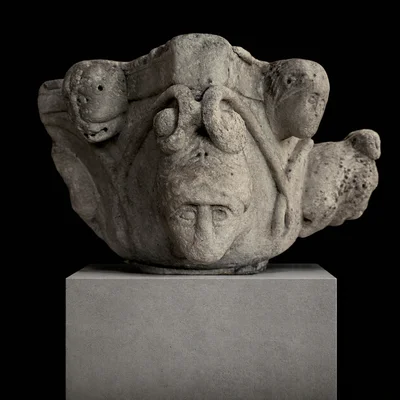
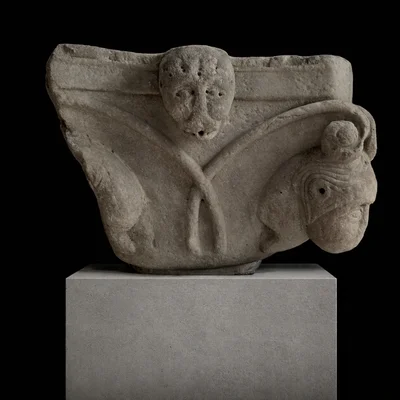
The exterior displays an exceptionally dense iconographic programme combining human masks, a frontal bird of prey with outstretched wings, and fantastic lion-like creatures. The strongly projecting heads are almost carved in the round, while the eyes, nostrils and certain anatomical details are emphasised through the use of the drill. On the principal face, a human bust projecting beyond the plane of the sculpture creates a pronounced sense of frontality. This asymmetry, the radial arrangement of the bestiary around the basin and the structural integration of the loculi make it unlikely that the object is a reused capital: it was conceived from the outset as an independent piece of ecclesiastical furnishing.
Through its material, animal vocabulary and massive treatment of volume, this font belongs fully to the Romanesque sculpture of Roussillon. The convergence of Céret marble, densely packed decoration, figures emerging from the stone and a still fully Romanesque vigour supports an attribution of this medieval sculpture to the workshops of Roussillon, probably between 1170 and 1180.
Full documentation and study available upon request.
References consulted:
· Marcel Durliat, La Sculpture romane en Roussillon, Perpignan, 1948-1954.
· Géraldine Mallet, De l’usage des marbres en Roussillon entre le XIe et le XIVe siècle : la sculpture monumentale, Patrimoines du Sud, no. 4, 2016, pp. 29-51.
· Pierre Ponsich, Le cloître supérieur de Saint-Martin du Canigou. Étude en vue d’une restauration, Études roussillonnaises, vol. XI, 1992.
In-depth study of the artwork
| Subject: | baptismal font |
|---|---|
| Material: | white Pyrenean marble, probably from Céret |
| Dimensions: | height 32cm, width 59cm, depth 57cm |
| Origin: | Occitania, France |
| Dating: | circa 1170 |
| Provenance: | German private collection formed around 1950 |
| Condition: | losses and erosion |
| Reference: | 293 |
Description
This monolithic font, carved in a grayish-white marble of Pyrenean origin, features a quatrefoil plan inscribed within a noticeably quadrangular exterior volume, whose faces and corners are entirely occupied by high-relief figurative decoration. The lower part, of circular section, is emphasized by an astragal ensuring the transition to the flared walls.
The work fits into the typology of anointing and baptismal fonts by affusion from the end of the 12th century. The upper surface is occupied in its center by a vast hemispherical basin, deeply hollowed out and evenly polished. The bottom of this cavity is pierced by an axial drainage hole likely fulfilling the canonical function of a sacrarium. This conduit allowed the consecrated baptismal water, the aqua baptismalis, to flow directly into the earth after the sacrament was performed, thus guaranteeing the non-profanation of the holy matter.
Around the central basin, four smaller circular cavities were carved into the thickness of the marble; one of them has disappeared following an intentional breakage of the rim. Distributed on the periphery of the upper table, these loculi present a size, wear, and patina consistent with those of the sculpted faces, indicating that they belong to the original conception of the work.
They could have served as housings for removable vessels, presumably metal ampullae containing the Holy Chrism (Sanctum Chrisma) and the Oil of Catechumens (Oleum Catechumenorum). The other two cavities could accommodate a reserve of salt necessary for the baptismal rite, as well as a small vessel intended for the ablutions purifying the officiant's fingers, allowing the rite to be performed without defiling the consecrated volume of water in the central font.
The exterior sculpture develops a particularly dense decoration combining human masks, a bird of prey, and fantastic creatures of leonine appearance. The heads stand out powerfully from the mass and, for some, take on the appearance of true elements sculpted in the round.
One face is dominated by a frontal bird of prey with spread wings. Its vertical body descends from the upper border and ends in two paws with widely opened talons. The wings are indicated by deep parallel incisions that highlight the main flight feathers.
The other faces accommodate stylized human masks and fantastic leonine animals placed at the corners. The masks emerge directly in the middle of the abaci. Oval or rounded in shape, they present deliberately schematic features: deeply hollowed eyes, short and wide noses, simply incised mouths. Their direct insertion into the abacus, without a truly developed neck or body, aligns them with the figurative Romanesque capitals of Occitania.
On the main face, however, a bust figure projects much more strongly out of the plane of the sculpture. It constitutes the focal point of the whole and gives the object a distinctly frontal orientation. The exceptional projection of this figure, unparalleled on the other faces, seems to have been designed according to the position of the officiant and the presentation of the font in the liturgical space.
This strong asymmetry distinguishes this font from an ordinary architectural capital. The projection of the bust, the radiating organization of the animals around the central basin, and the integration of the four loculi into the composition indicate that the work was likely conceived from the outset as autonomous liturgical furniture.
The structural integration of the central basin, the drainage conduit, and the peripheral cavities, together with the assertive frontality of the main face, makes the hypothesis of a reused and secondarily hollowed-out architectural capital unlikely. The work appears rather as an original creation situated at the border of architectural sculpture and ecclesiastical furniture, in which the formal vocabulary of the historiated capital is transposed to a font intended for the performance of the baptismal ritual.
Geographic and Stylistic Context
The nature of the material and the iconography of the sculpture direct the study of this font toward Roussillon, a region in which the use of marble in monumental sculpture and liturgical furniture experienced particularly significant development during the 11th and 12th centuries.
The iconography is close to that of the capitals of Saint-Michel-de-Cuxa; however, the marble is noticeably different and not recorded at Cuxa, where the marbles used came primarily from the quarries of Conflent.
The grayish-white marble, punctuated with dark inclusions used for this work, is macroscopically compatible with certain facies of Roussillon marbles, particularly those quarried in the Céret region.
Céret marble was widely distributed in the religious buildings of Roussillon. It was notably employed during the second half of the 12th century for the portals of Monastir-del-Camp, Le Boulou, Brouilla, and Saint-Féliu-d'Amont. Its use is also attested during the various construction campaigns of the cloister of Elne Cathedral. The southern gallery of this cloister, erected between 1170 and 1200, constitutes one of the major ensembles of Romanesque Roussillon sculpture executed in this material.
The connection with the Elne site is based as much on the presumed material as on the organization of the decoration, which at Elne is the heir to the corpus of Cuxa and Serrabone. The Romanesque capitals of the south gallery combine griffins, fantastic animals, plant motifs, and human figures in compositions where the bodies closely follow the shape of the basket. The heads, often highly individualized, detach themselves from the mass under the corners or the volutes of the upper part. The presence of griffins on the paired capitals of the second western bay of this gallery testifies in particular to the importance of the animal and fantastic repertoire in the first Romanesque state of the cloister.
The font employs a comparable syntax. Creatures of leonine appearance occupy the corners and ensure the transition between the different faces, while human masks emerge directly beneath the border. The bodies are subordinated to the overall architecture of the object, whereas the heads are treated as autonomous volumes, sometimes almost in the round. The frontal bird of prey, whose spread wings and open talons structure one of the faces, also belongs to the emblematic repertoire of Catalan Romanesque sculpture.
The treatment of the figures remains, however, more massive and schematic than that of the most accomplished capitals at Elne. The volumes are compact, the anatomies little detailed, and the facial features reduced to a few deep incisions. This plastic vigor could point to a peripheral workshop working in the orbit of the episcopal site rather than a direct intervention by the sculptors of the southern gallery. The proximity to Elne must therefore be understood as a community of material, repertoire, and artistic culture, and not as an assertion of a direct provenance from the cloister.
The corpus of Saint-Martin-du-Canigou offers another significant point of comparison. Six capitals attributed to a campaign around 1170 are carved, for some, in a white marble flecked with gray from a local vein. Their decoration associates large lions placed under the corner volutes and human faces arranged between them. Their iconography and plastic organization have been linked to the workshops of Serrabone, Cuxa, and the lost cloister of Saint-André-de-Sorède.
The font thus belongs to an artistic milieu in which models, sculptors, and materials circulated among Vallespir, the Roussillon plain, and Conflent. The angular animals, the masks placed under the border, the oversized heads, and the strongly projecting volumes constitute a common language across several religious building sites in the region. However, the object does not correspond exactly to any of the preserved ensembles. Its function as furniture, its exceptional scale, and the frontality created by the large projecting bust give it a singular character within this corpus.
The overall shape of the work proceeds directly from the vocabulary of the Romanesque historiated capital: a lower astragal, progressive widening of the walls, figures placed on the abacus, and animals occupying the corners. This architectural language has nevertheless been adapted to an autonomous object. The sculpture is organized around the basin and its loculi, while the bust figure establishes a main face intended to be presented to the officiant or the faithful. The font could thus have been made by a workshop accustomed to carving capitals and portals, but tasked here with designing a monumental piece of liturgical furniture.
Research therefore leads to attributing this rare piece to Roussillon, probably in the orbit of the workshops of Elne or Saint-Martin-du-Canigou, in the last third of the 12th century, using Pyrenean white marble, possibly originating from the Céret quarries.
Comparison Corpus and Dating
The central basin with a drain, the four peripheral loculi, and the figurative decoration organized around a main face compose an original arrangement. The most relevant comparisons must therefore be sought less in the general typology of the object than in the treatment of the marble, the structure of the sculpture, and the figurative repertoire developed by the Roussillon workshops of the second half of the 12th century.
The main corpus of comparison is provided by the Romanesque capitals of the southern gallery of the cloister of Elne Cathedral. This ensemble associates human figures, griffins, birds, quadrupeds, and plant motifs in compositions tightly bound to the structure of the baskets. Animals frequently occupy the corners, while human or monstrous heads emerge under the volutes and the upper border. The paired capitals of the second western bay of the south gallery notably feature griffins arranged symmetrically amidst vegetative scrolls.
The font shares several essential characteristics with this corpus: the development of strongly projecting heads, the reduction of bodies to volumes closely applied against the wall, the presence of leonine creatures at the corners, and the use of long arched forms that replace traditional vegetative volutes. The frontal bird of prey also belongs to the same animal repertoire, even if its isolated and monumental presentation finds no exact equivalent among the preserved capitals of Elne.
One of the most significant comparisons lies in the way the human and animal heads seem to replace the structural elements of the capital. On the font, several faces are directly inserted under the border, without necks or bodily development. The heads of the fantastic animals similarly occupy the corners and determine the transition between the faces. This fusion of decoration and structure constitutes one of the fundamental principles of the Romanesque sculpture of the Elne cloister.
The comparison does not, however, allow the work to be directly attributed to the preserved building site. The scale of the font is significantly larger than that of the capitals of the cloister arcades, and its execution appears more massive. The faces are more summarily modeled, the volumes more compact, and the anatomical transitions less developed. These differences could be explained by the specific nature of the commission: it was not a matter of producing a repeated element within an architectural series, but rather an autonomous piece of liturgical furniture, whose legibility had to be ensured by powerful, strongly projected forms.
The connection with Elne is reinforced by the presumed nature of the material. Studies devoted to Roussillon marbles indicate that Céret marble was used during successive construction campaigns of the cloister. Its presence is attested there from the Romanesque parts up to the Gothic modifications, including in structural and sculpted elements. The grayish-white, cloudy stone punctuated with dark inclusions of the font is macroscopically compatible with certain facies of this marble, although a petrographic attribution cannot be affirmed prior to analysis.
A second comparison group is constituted by the early capitals of the cloister of Saint-Martin-du-Canigou. Six of them are attributed to a campaign situated around 1170. They feature large lions placed beneath the corner volutes, whose imposing maws structure the upper part of the baskets, as well as human faces arranged between the volutes. Some are carved in a white marble flecked with gray coming from a vein identified near the monastery.
These capitals offer particularly interesting points of comparison with the leonine creatures of the font: the same disproportion between the heads and the bodies, the same concentration of volumes in the upper part, the same use of animals to mark the corners. The faces with deeply hollowed eyes and the thick forms of the muzzles also belong to a comparable plastic language. The font differs from them, nevertheless, by the importance of the bust figure, by the presence of the frontal bird of prey, and by a general organization determined by the central basin rather than by the springing of an architecture.
The capitals of Saint-Martin-du-Canigou have themselves been linked to the sculpture of Serrabone, Cuxa, and the lost cloister of Saint-André-de-Sorède. The elements attributed to the latter ensemble are generally placed at the end of the 12th century. This network of comparisons bears witness to the circulation of models and likely sculptors between Conflent, Vallespir, and the Roussillon plain.
The tribune of Serrabone, created around the middle of the 12th century and traditionally linked to the Cuxa workshops, constitutes an important antecedent for the use of the monumental bestiary in the marble sculpture of Roussillon. Its capitals combine lions, eagles, griffins, monsters, and human figures in compositions where the bodies bend to the corners and curves of the baskets. The sculpture there is, however, more sophisticated, the reliefs more deeply disengaged, and the ornamental details more meticulously executed than on the present font. Serrabone must thus be viewed as a major source for the regional vocabulary rather than as an immediate workshop parallel. Its tribune is generally dated to around 1150, close to the consecration of the church in 1151.
The closest capitals adorn the south portal of the church of Notre-Dame de Brouilla. Notably, one finds the same iconographic density, a main face dominated by a large central creature, framed by superimposed human and animal figures, and this peculiarity of heads emerging from the decoration. The capitals of Brouilla are, as the font seems to be, carved in a marble originating from the Céret quarries. The convergence of material, decoration density, use of the drill, organization of the figures, and treatment of the heads thus strengthens the hypothesis of creation in the same artistic milieu.
All these comparisons make it possible to place the font in a relatively coherent stylistic sequence. It appears later than the most accomplished mid-12th-century works represented by Serrabone, but contemporary with or close to the campaigns of Saint-Martin-du-Canigou situated around 1170 and the Romanesque sculpture of the southern gallery of Elne.
The most likely dating is thus in the last third of the 12th century, probably between 1170 and 1180. The homogeneity of the sculpture, the basin, and the loculi, as well as the still fully Romanesque vigor of the bestiary and masks, nevertheless lead us to favor a creation prior to 1200.
Bibliographical References
- • DURLIAT, Marcel, La Sculpture romane en Roussillon, 4 volumes, Perpignan, La Tramontane, 1948-1954.
- • MALLET, Géraldine, “De l'usage des marbres en Roussillon entre le XIe et le XIVe siècle: la sculpture monumentale”, Patrimoines du Sud, no 4, 2016, p. 29-51.
- • BLANC, Philippe, and GÉLY, Jean-Pierre, “L'analyse de la provenance des marbres blancs par cathodoluminescence et son application au marbre de Céret”, in Jacqueline Lorenz and Jean-Claude Miskovsky (eds.), Pierre et Archéologie, Perpignan, Presses universitaires de Perpignan, 2002, p. 81-113.
- • BLANC, Annie, “Les principales carrières de pierre à bâtir du Languedoc et leur utilisation dans les monuments”, in Jacqueline Lorenz and Jean-Claude Miskovsky (eds.), Pierre et Archéologie, Perpignan, Presses universitaires de Perpignan, 2002, p. 45-54.
- • PONSICH, Pierre, “Le cloître supérieur de Saint-Martin du Canigou. Étude en vue d'une restauration”, Études roussillonnaises, vol. XI, 1992.
- • DE VRIENDT, François, “Un intéressant fragment de cuve baptismale romane à Spiennes”, Bulletin de l'Institut royal du Patrimoine artistique, no 38, 2023, p. 8-19.