
Origin : Venice or the Venetian lagoon.
Medium : Limestone.
Size : Diam. 28 cm
Period : Late 12th – early 13th century, c. 1200.
Condition : General surface erosion and minor losses around the edge.
Price : 12 000€
REF. 305
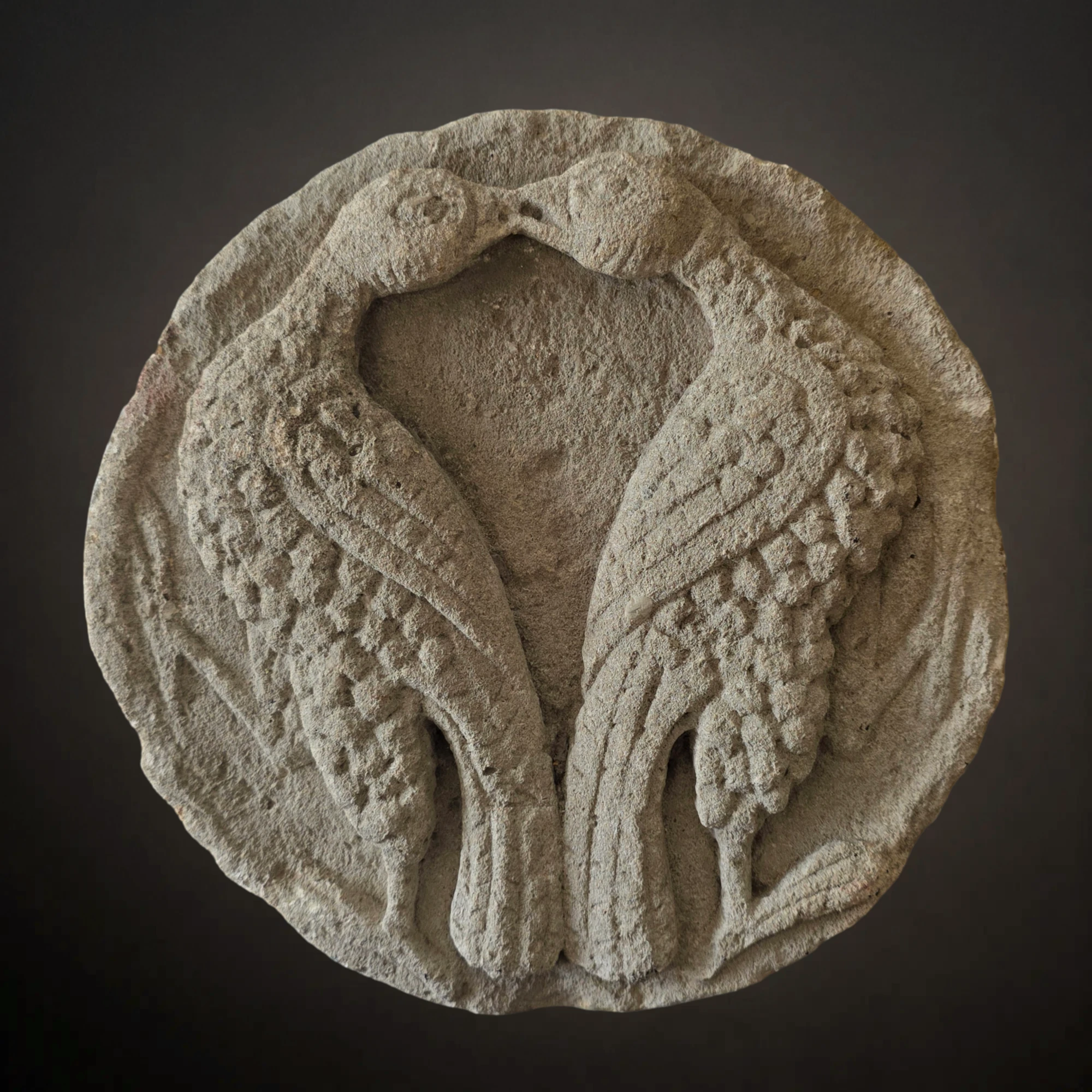
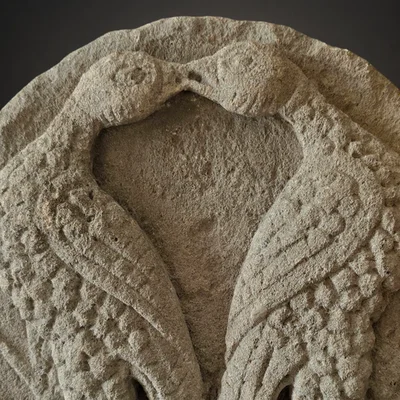
Patera with two addorsed peacocks. Symbol of concord, Venice, late 12th century.
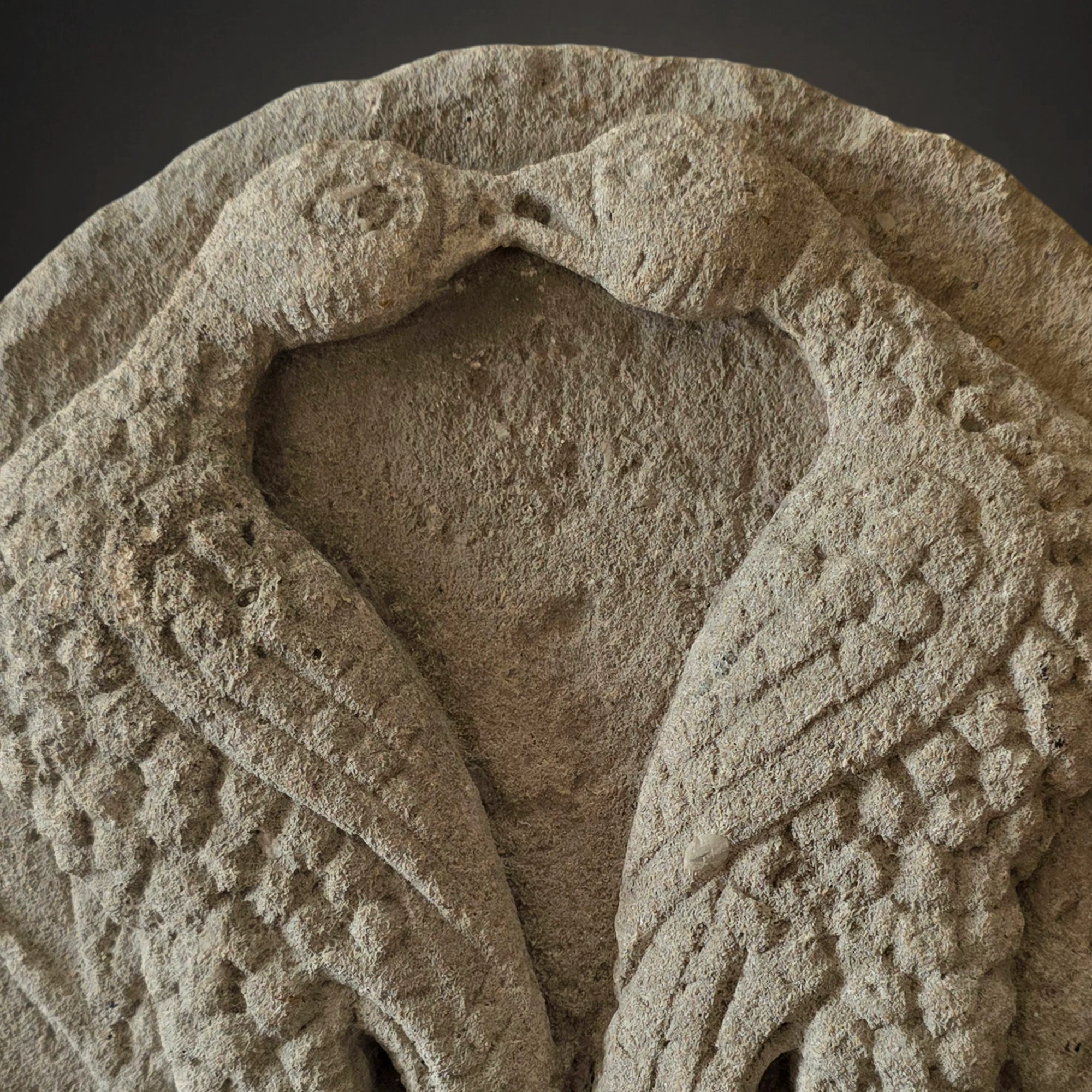
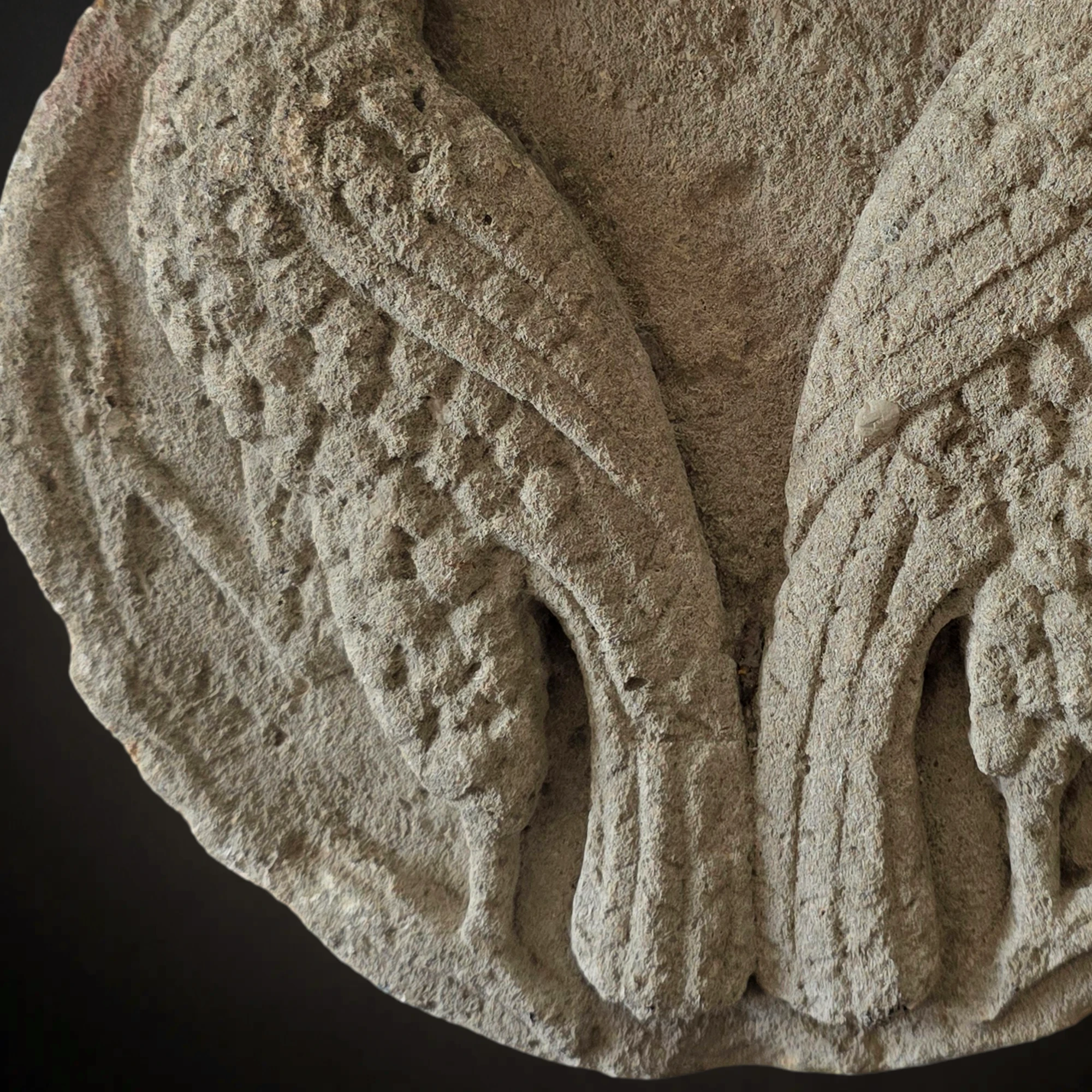
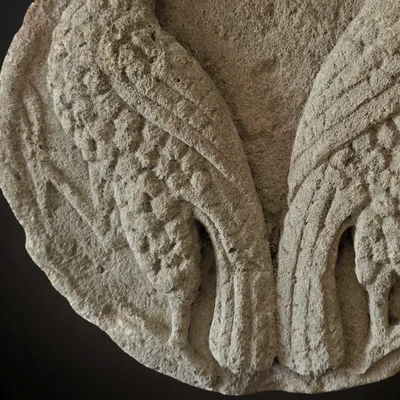
This limestone patera takes the form of a circular disc occupied by two large birds arranged symmetrically, back to back. Their necks rise towards the upper part of the medallion; their heads meet at the top and their beaks touch. The treatment of the plumage in several registers is particularly characteristic. The position of the legs is another remarkable feature. On each bird, one leg provides support while the other is strongly raised and rests against the edge of the patera. The reverse of the sculpture is left rough. The composition, treatment of the plumage and arrangement of the limbs directly relate this work to the corpus of sculpted paterae from Venice and its lagoon dating from the late 12th and early 13th centuries. In the Italian catalogue of cultural heritage, this type of composition, with birds joined at the beak, is interpreted as a symbol of concord, Christian charity, piety and chaste love. In Christian and Byzantine iconography, the peacock is associated with immortality, renewal and the Resurrection. Finally, the paterae placed on Venetian façades collectively fulfilled an apotropaic function, symbolically protecting the dwelling against evil.
Circular paterae are among the characteristic elements of Venetian architectural sculpture from the 11th to the 13th centuries. Mainly incorporated into the façades of secular buildings, they frequently display a zoomorphic repertoire in which animals are arranged symmetrically within the disc.
The closest parallel is a limestone patera preserved at the Museo Provinciale di Torcello, inv. I.G. 1378, attributed to Venetian production of the 12th-13th centuries. It likewise shows two large birds arranged back to back, with upright bodies and a very comparable treatment of the plumage. As on our relief, one leg provides support while the other is strongly raised. The similarity of the material, conception of the relief, plumage and arrangement of the limbs makes it the principal comparandum.
A patera preserved on the façade at Campo San Luca in Venice, dated to the 11th-12th centuries, depicts two addorsed birds whose beaks and wing tips meet. The plumage is likewise organised in several registers, combining repeated small feathers with long longitudinal feathers.
Another patera preserved at Salizada S. Giustina in Castello, dated to the 12th century, shows two birds back to back with joined beaks. The long curved necks, upright bodies and raised position of the limbs provide a further parallel for our sculpture.
Finally, a patera with two confronted peacocks preserved at the Museo Civico Gaggia in Feltre, attributed to the Venetian milieu and precisely dated to 1190-1210, provides an important chronological marker. It confirms the persistence around 1200 of these circular compositions dominated by two large birds with highly structured plumage.
Taken together, these comparisons support an attribution of this patera to Venice or its lagoon, in the late 12th or very early 13th century, around 1200.
Full dossier and study available on request.
References consulted:
· G. Marzemin, Le antiche patere civili di Venezia e i significati simbolici, Venice, 1937.
· Alberto Rizzi, « Appunti per uno studio sulle patere veneziane », Antichità Viva, XIII, no. 6, 1974, pages 32-43.
· Zygmunt Świechowski, Alberto Rizzi and Richard Hamann-Mac Lean, Romanische Reliefs von venezianischen Fassaden. “Patere e formelle”, Wiesbaden, Franz Steiner Verlag, 1982.
· Alberto Rizzi, Scultura esterna a Venezia: corpus delle sculture erratiche all’aperto di Venezia e della sua laguna, Venice, 2014, first edition 1987.
· Éliane Vergnolle, review of Świechowski, Rizzi and Hamann-Mac Lean, Romanische Reliefs von venezianischen Fassaden, Bulletin Monumental, vol. 144, no. 2, 1986, pages 170-171.
· Catalogo Generale dei Beni Culturali, Patera, produzione veneta, 12th-13th centuries, Museo Provinciale di Torcello, inv. I.G. 1378, record CRV-OA_0006411.
· Catalogo Generale dei Beni Culturali, Patera, ambito veneziano, 1190-1210, Museo Civico Gaggia, Feltre, inv. 30, record 0500428684.
In-depth study of the artwork
| Subject: | Patera with two addorsed peacocks. |
|---|---|
| Material: | limestone |
| Dimensions: | diameter 28 cm |
| Origin: | Venice or the Venetian lagoon |
| Date: | late 12th – early 13th century |
| Condition: | general surface erosion and wear to the relief; minor peripheral losses |
| Reference: | 305 |
Description
This patera takes the form of a stone disc occupied by two large birds arranged symmetrically, back to back, their necks rising toward the upper part of the medallion. The heads meet at the top and the beaks touch one another. The two silhouettes thus frame a broad central reserve whose outline is determined by the inner curve of the bodies.
The treatment of the plumage is particularly characteristic. The upper parts of the wings are covered with small overlapping feathers arranged in close rows. Some take the form of scales or small rounded leaves. As the wing descends, these units become larger and more elongated. The primary flight feathers, by contrast, are defined by long lanceolate forms, internally emphasized by parallel longitudinal incisions. This alternation between areas of small, closely set feathers and long, deeply drawn feathers strongly structures the two silhouettes.
Long feathers also descend toward the lower part of the disc. Their almost vertical arrangement and form suggest that the birds are peacocks.
A remarkable feature lies in the position of the legs. On each bird, one leg provides support, while the other is strongly raised and comes to rest against the edge of the patera.
The relief remains relatively shallow. The reverse of the sculpture is left rough. This manner of working the stone and this iconography belong fully to the corpus of medieval Venetian patere.
Condition
The surface shows old and homogeneous erosion affecting chiefly the projecting parts: heads, beaks, the relief of the small feathers and the outer rim. The overall design nevertheless remains perfectly legible, and the deepest incisions of the plumage are still well preserved.
The perimeter shows a few localized losses and irregularities. The reliefs of the two birds display comparable wear, with progressive attenuation of the modelling on the most exposed areas and better preservation in the recesses separating the feathers and limbs.
Geographical and stylistic context
The circular reliefs known in Venice as patere are among the characteristic elements of Venetian architectural sculpture from the 11th to the 13th centuries. The corpus by Świechowski, Rizzi and Hamann-Mac Lean includes numerous examples, the majority originating in Venice and its lagoon. These reliefs were mainly inserted into the façades of civil architecture, between window arches, above portals or within symmetrical compositions combining several sculpted plaques.
The Italian cultural heritage catalogue is particularly explicit regarding Venetian patere representing two back-to-back birds with joined beaks: it describes their encounter as a “mystical kiss” and, drawing on Giuseppe Marzemin, states that the union of the birds was understood as a symbol of concord, Christian charity, piety and chaste love.
Moreover, in Christian and Byzantine iconography, the peacock is associated with immortality, renewal and the Resurrection, notably because of the ancient belief in the incorruptibility of its flesh. The official Italian catalogue expressly adopts this interpretation for Venetian reliefs with peacocks.
Finally, patere placed on Venetian façades collectively fulfilled an apotropaic function, symbolically intended to protect the dwelling from evil.
Official Venetian sources confirm that patere of the 12th and 13th centuries predominantly employ a zoomorphic repertory. Pairs of back-to-back or confronting birds form one of the recurring motifs of this production. The animals may touch beaks, feed from a tree or central source, or simply be integrated into a symmetrical composition filling the entire disc.
This repertory derives from an older tradition nourished in particular by Byzantine models. Eastern textiles, ivories and precious objects offer numerous examples of animals symmetrically arranged on either side of an axis. In Venice, these models were adapted to the constraints of architectural sculpture: the bodies were recomposed according to the frame, the necks close the upper section, while wings, tails and legs fill and articulate the remaining spaces.
The chronology of Venetian patere remains difficult because the same iconographic formulas were used over several generations. Stylistic analysis therefore relies more on the treatment of the relief, the degree to which volumes are released from the background and the organization of motifs than on iconography alone. The published corpus shows a general development from relatively flat reliefs toward progressively fuller volumes in the 12th and 13th centuries, without a clear break between the different phases.
In the present case, the persistence of a relief still strongly attached to the background plane, the predominance of incision in defining the plumage and the position of the legs correspond particularly well to a date around 1200, in Venice or its lagoon.
Comparative corpus and dating
1. Patera with two back-to-back birds — Venetian production, 12th-13th century
Museo Provinciale di Torcello, medieval and modern section, inv. I.G. 1378.
Limestone. Diameter: 40 cm; thickness: 16 cm.
This patera provides the closest comparison with the present work. The official record of the Museo Provinciale di Torcello describes it as a circular disc containing “two birds confronting one another from the back” and attributes it to Venetian production of the 12th-13th centuries on stylistic grounds. Like the present work, it is carved from limestone.
The relationship first concerns the overall conception. In both sculptures, two large birds occupy almost the entire surface of the disc. Their bodies rise vertically, the necks extend toward the top and the small heads converge. A broad reserve remains between the two necks.
The treatment of the plumage is also very close. The wings juxtapose small overlapping feathers with larger elongated ones, while the lower areas are structured by long parallel incisions. In both works, the plumage is less a naturalistic rendering of a bird than an ordered system of repeated forms.
The comparison is particularly convincing in the treatment of the legs. On the Torcello patera, as on the present work, one leg supports the bird while the other is strongly raised. This raised leg occupies a high position within the relief and directly contributes to the organization of the composition.
The combination of comparable material, a similar type of relief, plumage organized according to the same principles and, above all, a similar arrangement of the legs makes Torcello the principal comparandum.
2. Patera with two back-to-back birds — Venice, Campo San Luca, 11th-12th century
Greek marble. Diameter: approximately 25 cm. Świechowski-Rizzi, nos. 105-108, pl. 11.
The patera preserved on the façade at Campo San Luca represents two back-to-back birds whose beaks and wing tips meet. It is dated to the 11th-12th centuries and published in the corpus by Świechowski and Rizzi.
The comparison chiefly concerns the architecture of the composition. In both cases, the birds are organized as two lateral masses responding to one another. The necks rise toward the top of the disc and the joined beaks close the composition. The wings form the principal carved masses, while the area between the two birds remains largely open.
The plumage at Campo San Luca is likewise organized in several registers: small repetitive units on the upper parts of the bodies and large longitudinal feathers in the lower areas. This hierarchy is very clearly repeated in the present work.
Campo San Luca nevertheless has a more tightly closed composition through the meeting of the wings. The present work preserves more space between the bodies and is distinguished by the particularly high position of the raised leg.
This patera therefore provides a major parallel for the scheme of two back-to-back birds with joined beaks and for the overall organization of the feathered surfaces.
3. Patera with two back-to-back birds — Venice, Salizada S. Giustina 2926, Castello, 12th century
Greek marble. Diameter: approximately 25 cm. Świechowski-Rizzi, nos. 137-139, pl. 12.
This patera is dated to the 12th century. It represents two controdorso birds, back to back, with their beaks joined. A 12th-century date was also retained by Toesca and repeated in the modern corpus.
The convergence of the heads at the top, the long curved necks and the strong occupation of the lateral sectors of the disc correspond directly to the construction of the present relief.
The arrangement of the legs also contributes to this vertical organization. As in the present work, one leg of each bird is raised and occupies the space left free beneath the body.
The importance of this comparison lies above all in its 12th-century dating and in the persistence in Venice of the precise type of two back-to-back birds with joined beaks.
4. Patera with confronting peacocks — Venetian milieu, 1190-1210
Museo Civico Gaggia, Feltre, inv. 30.
Marble. Diameter: 31 cm.
This patera represents two confronting peacocks symmetrically occupying the circular field. It offers a relevant parallel with the present work through the highly ordered construction of the two birds and through the importance given to the plumage, which structures the bodies more than it seeks naturalistic representation.
The Italian catalogue record attributes the work to the Venetian milieu and dates it precisely to 1190-1210, emphasizing the existence in Venice and territories under its influence of reliefs employing comparable iconographic solutions. It therefore provides a particularly useful chronological landmark for placing the present patera around 1200, at the transition between the 12th and 13th centuries.
Synthesis of the corpus and proposed dating
The patera in the Museo Provinciale di Torcello is the determining parallel. The use of limestone, the conception of the relief, the vertical organization of the two birds, the very similar arrangement of the plumage and, above all, the distinctive position of the legs establish a particularly close stylistic relationship. The official 12th-13th-century dating of the Torcello example therefore provides the most relevant chronological framework.
Campo San Luca and the patera from Salizada S. Giustina are two antecedents within 12th-century Venetian production. They document the early diffusion of the formula of two back-to-back birds with joined beaks and place the present work within a tradition already well established during the 12th century.
Finally, the Feltre patera, attributed to the Venetian milieu and dated 1190-1210, provides a particularly useful chronological marker around 1200.
The present work naturally stands at the intersection of these different groups. Its relief remains strongly attached to the background, the plumage is predominantly linear and the legs are highly stylized, linking it closely to the Venetian Romanesque tradition, while the fuller development of the bodies and the breadth of the wings anticipate works of the early 13th century.
A date in the late 12th or very early 13th century, around 1200, therefore appears the most coherent.
Its origin can be situated in Venice or its lagoon, within the production of architectural sculpture of which patere are among the most characteristic manifestations.
Bibliographical references
- • MARZEMIN, G., Le antiche patere civili di Venezia e i significati simbolici, Venice, 1937.
- • RIZZI, Alberto, “Appunti per uno studio sulle patere veneziane”, Antichità Viva, XIII, no. 6, 1974, pp. 32-43.
- • ŚWIECHOWSKI, Zygmunt; RIZZI, Alberto; HAMANN-MAC LEAN, Richard, Romanische Reliefs von venezianischen Fassaden. “Patere e formelle”, Wiesbaden, Franz Steiner Verlag, 1982.
- • RIZZI, Alberto, Scultura esterna a Venezia: corpus delle sculture erratiche all’aperto di Venezia e della sua laguna, Venice, 2014, 1st ed. 1987.
- • VERGNOLLE, Éliane, review of Świechowski, Rizzi and Hamann-Mac Lean, Romanische Reliefs von venezianischen Fassaden, Bulletin Monumental, vol. 144, no. 2, 1986, pp. 170-171.
- • Catalogo Generale dei Beni Culturali, Patera, Venetian production, 12th-13th centuries, Museo Provinciale di Torcello, inv. I.G. 1378, record CRV-OA_0006411.
- • Catalogo Generale dei Beni Culturali, Patera, Venetian milieu, 1190-1210, Museo Civico Gaggia, Feltre, inv. 30, record 0500428684.