
Origin : Rhone Provence, probably Arles or the Arles area.
Medium : White marble with slight grey veining, carved in relief.
Size : Diameter 21 cm, thickness 8 cm
Period : Final decade of the 12th century.
Condition : Wear and minor losses. No restoration detected.
Price : 17 000€
REF. 298
Marble Patera, Christ with Cruciform Halo Rhone Provence, probably Arles
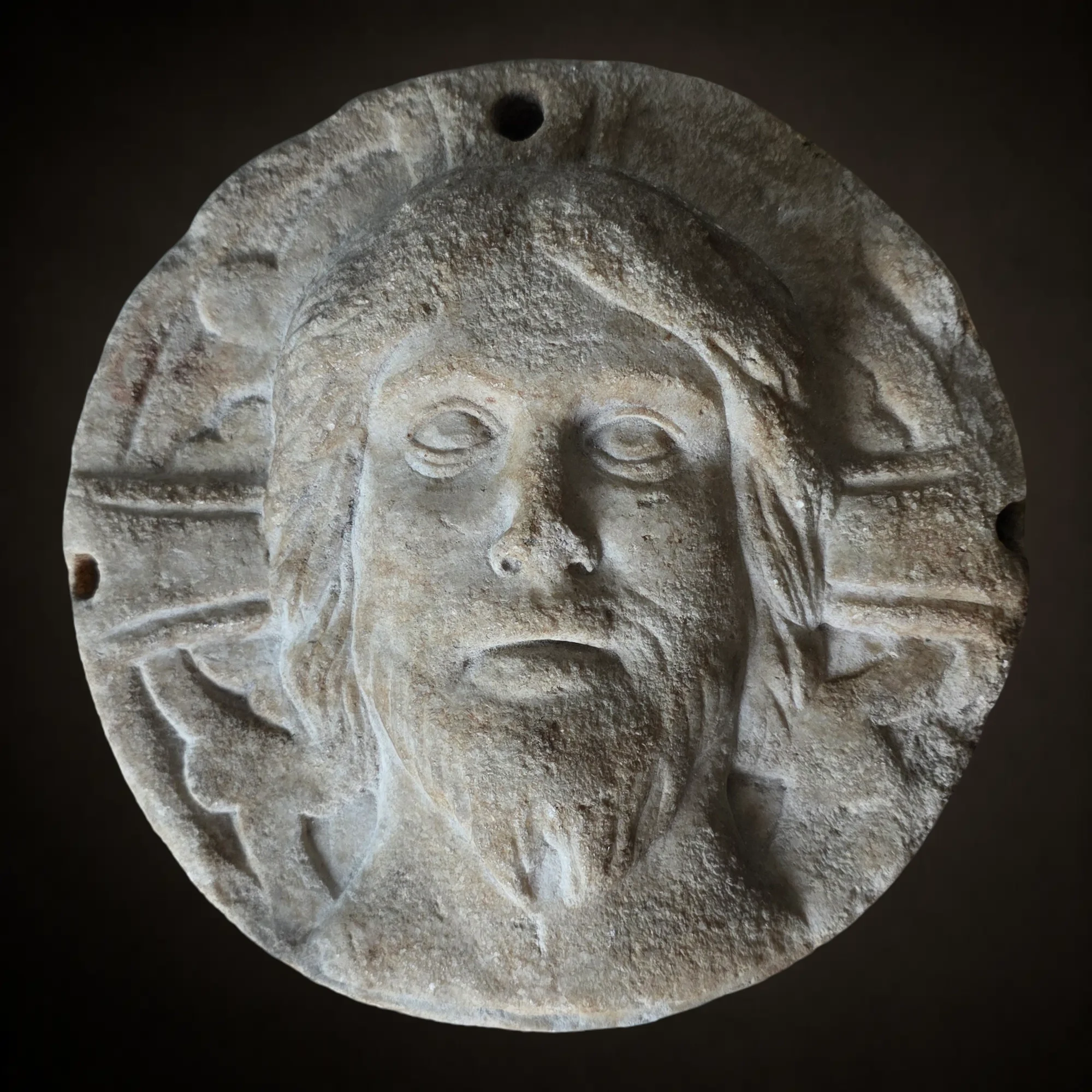
This patera carved from white marble with slight grey veining represents the frontal head of Christ set within a cruciform halo. It belongs to Romanesque sculpture from Rhone Provence and can probably be located in Arles or its immediate surroundings during the final decade of the 12th century. The broad and powerfully constructed face is characterized by full, rounded modelling, ample cheeks and continuous transitions between the different planes. The brow ridges join directly with the root of a long, narrow nose. The large, slightly projecting almond shaped eyes are framed by thick eyelids and emphasized by a double infraorbital fold. The pupils are indicated by discs with a very slightly concave surface. The beard and hair are arranged in broad undulating locks subdivided by fine incisions. The three former fixing points show that the work was conceived as an applied element rather than as a structural architectural component. This patera was probably attached to a chancel or another element of liturgical furnishing.
The closest comparison can be established with the Christ in Majesty on the western portal of Saint Trophime in Arles, generally dated between 1180 and 1190. Both works share the same frontal and compact conception of the head, full cheeks, continuous brow ridges joining the root of a long, narrow nose, and large almond shaped eyes framed by thick eyelids. The most significant correspondence lies in the treatment of the pupils, which are indicated not by deep drilling but by slightly concave discs reserved on the surface of the eyeball. This feature, combined with the double infraorbital fold and a comparable organization of the beard into broad locks subdivided by fine grooves, establishes a particularly close morphological relationship.
The sculptures of the Romanesque galleries of the cloister of Saint Trophime allow this attribution and chronology to be refined. The pillar of Saint Trophime provides a parallel for the full and compact construction of the face and the organization of the hair. The mask on the capital traditionally known as the Tower of Israel also presents a broad physiognomy, rounded cheeks and a strongly structured orbital region. Saint Andrew on the north east pillar constitutes a slightly later chronological marker: the locks become more independent and more clearly individualized, whereas they remain more compact on the patera.
Taken together, these comparisons place the patera in the immediate continuation of the models developed in Arles around the portal of Saint Trophime and support a dating to the final decade of the 12th century.
Provenance: former Princely Collection of the Hohenzollern family in Sigmaringen, Germany.
Complete documentation and study available on request.
Works consulted:
· Andreas Hartmann Virnich, Le portail de Saint Trophime d’Arles. Naissance et renaissance d’un chef d’œuvre roman, Arles, Actes Sud, 1999.
· Andreas Hartmann Virnich, Le rôle des matériaux antiques en réemploi dans la sculpture monumentale antiquisante en Provence romane : l’exemple d’Arles et de Saint Gilles du Gard, Revue archéologique de Narbonnaise, tome 33, 2000, pages 288 à 292.
· Andreas Hartmann Virnich, Du programme décoratif à la mise en œuvre. Les chapiteaux du portail et de la galerie nord du cloître de Saint Trophime d’Arles, Revue d’Auvergne, tome 116, 2002 à 2003, pages 33 à 71.
· Vincent Jacob, Vannina Alessandri, avec la collaboration de Didier Martina Fieschi et Henri Ribot, Arles, cloître Saint Trophime, rapport final d’opération, Service régional de l’archéologie, DRAC Provence Alpes Côte d’Azur, Archeodunum, 2010.
· Jacques Lacoste, La galerie nord du cloître de Saint Trophime d’Arles, Les Cahiers de Saint Michel de Cuxa, numéro 7, 1976, pages 127 à 162.
· Victor Lassalle, L’influence antique dans l’art roman provençal, Paris, 1970.
In-depth study of the artwork
| Subject: | Marble patera representing Christ with a cruciform halo |
|---|---|
| Material: | white marble with slight grey veining |
| Dimensions: | diameter 21 cm; thickness 8 cm |
| Origin: | Rhône Provence, probably Arles or the Arles milieu |
| Date: | last decade of the 12th century |
| Function: | element of monumental liturgical furnishing, probably applied to a chancel screen |
| Provenance: | former princely Hohenzollern collection at Sigmaringen, Germany |
| Reference: | 298 |
Description
This marble patera represents the frontal head of Christ set within a cruciform halo. The broad, powerfully constructed face is characterized by full, rounded modelling. The cheeks are ample, the temples only slightly hollowed, and the transitions between the different planes remain continuous.
The eyebrows describe two regular curves that join directly with the root of the nose. The large almond shaped eyes project slightly and are framed by thick eyelids. Beneath each eyeball appears a clearly constructed double fold. This double fold reinforces the plastic density of the gaze and constitutes an important morphological feature for stylistic comparison and dating.
The pupils are not drilled with a trepan, but indicated by discs whose surfaces are very slightly concave. The long, narrow nose has a straight and continuous ridge. Its tip is damaged. The small horizontal mouth is surmounted by a moustache only slightly detached from the surface of the face.
The beard forms a long triangular mass that strongly extends the oval of the face. Erosion initially gives the impression of summary treatment. The best preserved areas nevertheless reveal a subtler organisation. Large undulating locks structure the whole, each subdivided by finer incisions. The same hierarchy between principal locks and secondary striations appears in the hair.
At the crown of the head, the hair forms a compact mass crossed by fine grooves. On either side of the face it develops into long, supple, sinuous locks. The condition of the surface locally obscures these subdivisions and artificially accentuates the massive character of the hair and beard.
The circular cruciform halo displays three visible arms. The horizontal arms are emphasized by parallel incisions. Along its lower part, the perimeter is accompanied by elements that may be interpreted as palmettes or stylized florets. The cruciform halo identifies the figure as Christ.
Material and technical study
The relief is carved from white marble with slight grey veining. The cream and yellow coloration visible on the front and reverse belongs essentially to the surface. It corresponds to patina, deposits and alteration phenomena rather than to the intrinsic colour of the material.
The reuse of ancient marble remains possible, particularly in the Arles context, although this cannot be established by macroscopic examination alone.
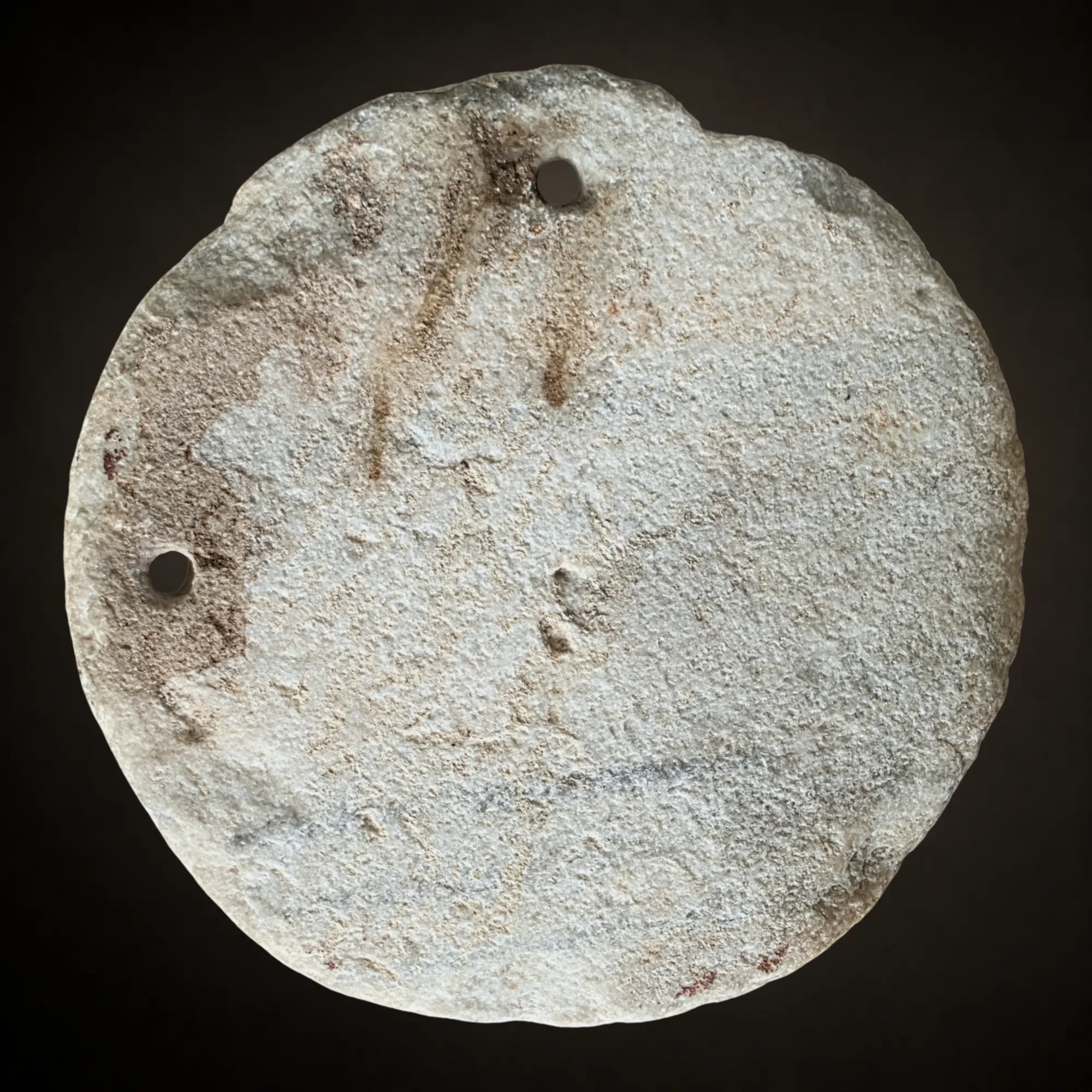
The reverse is almost flat and deliberately rough. The absence of polishing and regularization confirms that it was not intended to remain visible. It has neither the converging shape of a voussoir, nor the joint faces required for the insertion of a keystone, nor a bedding surface corresponding to an element engaged in masonry. The piece therefore cannot be interpreted as a keystone.
Three fixing points are arranged along the upper and lateral axes. The upper perforation is entirely preserved. The two lateral perforations were partially opened toward the edge by breaks. One of the perforations does not pass through the stone. Their regular distribution shows that they belong to a single mounting system and were intended to hold the disc against a vertical support.
Their position on the axes of the halo appears to have been chosen so as to integrate the fixings visually into the composition. The heads of studs or pegs may have blended with the arms of the cross or punctuated them. This arrangement supports the hypothesis of an old system, possibly contemporary with the first installation.
The combination of a flat reverse left rough and three fixing points identifies the object as an applied element. The term patera should be understood here in its ornamental sense, namely a carved disc intended to be fixed to a surface. The absence of any geometry for architectural insertion suggests that its support should be sought primarily among monumental furnishings.
A wall mounted application remains possible. However, the dimensions of the piece, its autonomous character and the organisation of its fixings also suggest that it belonged to monumental liturgical furnishing.
The most coherent hypothesis is that of a patera fixed to a chancel screen or to a liturgical enclosure of comparable function. Placed on the face of a stone panel or a wooden element, the face of Christ would have occupied an axial and immediately legible position. The weight of the piece explains the use of three fixings. These observations favour its identification as an element of monumental liturgical furnishing rather than as a fragment of structural architecture.
Condition
The work shows substantial wear in certain areas. The tip of the nose is damaged. The eyelids, lips and several locks have suffered abrasion. The outer edge preserves more substantial losses around the former lateral fixings.
Erosion has affected the fine secondary incisions of the beard and hair more strongly. The secondary grooves remain clearly visible only in protected areas. This alteration explains why the hair and beard may now appear heavier and more summary than they originally were. Stylistic analysis must therefore rely on the best preserved areas and distinguish the large structural locks from the fine incisions that subdivide them.
No restoration was detected during examination of the work.
Geographical and stylistic context
Romanesque sculpture in Provence developed in a territory profoundly marked by the presence of ancient monuments and materials. In Arles, this relationship with Antiquity was not limited to the reuse of decorative motifs. It is also evident in the conception of bodies and the construction of faces.
The portal and the Romanesque galleries of the cloister of Saint Trophime constitute one of the principal testimonies to this current. Sculptors in Arles favoured full forms, broadly modelled faces, continuous brow arches and hair arranged in regular masses.
These characteristics recur in the patera studied here. The cheeks, forehead, hair and beard form continuous volumes upon which grooves intervene as a finishing device. Large locks organize the masses, after which fine incisions enrich the surface. This conception distinguishes the work from reliefs in which the drawing of hair and beard determines the entire structure of the figure.
The roundness of the face is not, in itself, a geographical criterion. Its association with frontality, the continuity between eyebrows and nose, the thickness of the eyelids, the double infraorbital fold, the projecting eyeball set within a strongly marked almond shape, the flattened disc shaped pupils, the moustache barely detached from the face and the long lateral locks nevertheless corresponds closely to the classicizing language of Provençal Romanesque sculpture, particularly as found in Arles.
The Arles hypothesis is also consistent with the use of marble. Andreas Hartmann Virnich has shown that the major ensembles of Arles and Saint Gilles incorporated ancient materials into their construction. Most monumental sculpture remained executed in the oolitic limestone of the Bois des Lens, but more prestigious materials could be reserved for particular locations or functions.
Arles also offered exceptional access to marbles from ancient monuments. The hypothesis of a reused block is therefore historically plausible, even though it cannot be demonstrated without archaeometric characterization. The material does not allow the patera to be attributed directly to the construction site of Saint Trophime, but it is consistent with an Arles milieu accustomed to selecting and recutting ancient stone.
Saint Gilles must be distinguished on material grounds. Its building campaign belongs primarily to limestone sculpture. It remains essential for understanding the circulation of models and sculptors in the lower Rhône valley, but its corpus does not provide an equally convincing material correspondence. Arles and Saint Gilles participate in the same monumental Provençal culture without their productions being interchangeable.
The relief does not appear to belong to northern French sculpture. It displays neither the elongation of proportions, nor the more nervous organisation of surfaces, nor the naturalistic evolution characteristic of northern Gothic workshops around 1200.
A German origin also appears unconvincing. Its presence in the Sigmaringen collection is not an indication of its place of production. Rhineland and German comparisons frequently show a more graphic conception of eyes and hair, together with a preference for local materials.
Italian production provides numerous examples of circular marble reliefs, notably Venetian patere. These belong, however, to a different decorative tradition, generally more graphic, more ornamental and often marked by Byzantinizing conventions. The full, rounded conception of the face, the continuity of the modelling and the organisation of the hair and beard find more convincing parallels in Rhône Provence than in northern Italy.
Reliefs from Languedoc, notably those of Saint Pons de Thomières, provide a final useful control group. Their more linear articulation of volumes and often more graphic treatment of detail distance them from the patera. Taken together, the observed characteristics therefore point toward Arles or a workshop belonging to its immediate environment.
Comparative corpus and dating
The closest comparison is provided by the Christ in Majesty on the western portal of Saint Trophime. Generally dated between 1180 and 1190, this ensemble is a crucial landmark for Arles Romanesque sculpture at the end of the 12th century.
The Christ of the portal and that of the patera share the same frontal and compact conception of the head. The faces are broad, the cheeks full, and the brow arches join directly with the root of a long, narrow nose. The large almond shaped eyes are defined by thick eyelids. In both works, their lower edge is accompanied by a second parallel line that reinforces the infraorbital region.
The most distinctive correspondence lies in the treatment of the pupils. They are not drilled with a trepan, but indicated by reserved discs on the eyeball, whose surface is very slightly concave. This particular procedure is a more discriminating indicator than the almond shape of the eyes alone. Its association with the double lower fold and the continuity of the brow arches around the nose establishes a close morphological relationship between the two faces.
The beard of the portal Christ provides a further correspondence. It is organized into large structural locks, each subdivided by several fine parallel grooves. The same principle appears in the best preserved areas of the patera. Erosion has erased part of these subdivisions and today gives the masses a heavier appearance than they originally had. In both works, the incisions remain subordinate to the prior construction of broad and continuous volumes.
Differences in scale, material and state of preservation do not permit the conclusion that both works are by the same hand. The portal Christ is distinguished by a more sophisticated execution and higher quality of carving. It also appears slightly earlier than the patera. Nevertheless, the convergence in the treatment of the eyes, eyelids, connection between eyebrows and nose, and organisation of the hair and beard goes beyond simple iconographic resemblance. It considerably strengthens the attribution to the Arles milieu and brings the patera close to the final phase of the portal campaign or to the immediate continuation of its models.
The sculptures of the Romanesque galleries of the Saint Trophime cloister allow this comparison to be placed within a broader chronological sequence. The pillar of Saint Trophime at the north western corner of the north gallery provides a first landmark. The original work is generally dated around 1180. An inscription mentioning the death of Dean Jordan in 1188 is associated with this corner of the cloister. It does not directly date each sculpture, but places the arrangement of the north gallery within a precise chronological context.
The figure on the north western pillar of Saint Trophime and the Christ of the patera share the same frontal and compact conception of the head. The cheeks are full, the brow arches continuous, and the moustache remains closely connected to the beard. The large locks are subdivided by finer grooves that accompany the volumes rather than determine them.
The capital traditionally known as the Tower of Israel in the north gallery provides another point of comparison. The mask at the centre of the composition is characterized by the breadth of the face, the roundness of the cheeks, the strong presence of the nose and the deep setting of the eyes within a powerfully structured orbital region. The comparison primarily concerns the general construction of the physiognomy. The photographs currently assembled do not make it possible to verify with certainty the presence of slightly concave disc shaped pupils or an exactly identical double fold.
Saint Andrew on the north eastern pillar provides a later landmark. Andreas Hartmann Virnich has shown that the block bearing this figure was recut and then inserted into the pillar at a later stage. The sculpture should therefore not necessarily be regarded as contemporary with the first installation of the north gallery ensemble. Its treatment appears to correspond to a late phase of the campaign, close to the transition toward the work on the eastern gallery.
The face of Saint Andrew remains broad and strongly modelled. The construction of the nose and brow arches recalls that of the patera. The most instructive difference concerns the hair and beard. In Saint Andrew, the locks become more autonomous, finer and more clearly separated. On the patera, fine incisions are indeed present but remain subordinate to larger, more compact undulating masses. The patera therefore appears slightly earlier than this sculpture.
Archaeological data support this relative chronology. The excavation report on the cloister places the base and arcade of the north gallery between approximately 1185 and 1200. The burial dated 1188 may be associated with the beginning of the arcade, whose construction would have progressed from east to west using carved elements prepared in advance. The eastern gallery and the dormitory wing belong to a subsequent campaign, dated approximately 1200 to 1220.
The patera therefore appears to belong after the north western pillar of Saint Trophime and in the immediate continuity of the western portal, but before the stage represented by Saint Andrew on the north eastern pillar. The particular treatment of the pupils and hair and beard links it closely to the vocabulary of the portal Christ, while the double infraorbital fold reflects a slightly more advanced development of the modelling.
The Christ carved on a keystone in the lower church of Saint Gilles may be retained as a regional iconographic parallel. It attests to the existence, at the end of the 12th century, of frontal representations of Christ set within a circular frame. It is not, however, a functional parallel for the patera, since its geometry and mode of insertion belong to a vault. The distinction between the two objects confirms that the piece studied here, lacking any voussoir form, belonged to another type of support.
Italian, German and Languedoc comparisons confirm the diffusion of the iconographic type, but do not provide an equally precise correspondence in the construction of the face. The circular form and cruciform halo are therefore insufficient to determine an origin. It is the combination of full, rounded modelling, slightly concave disc shaped pupils, the double infraorbital fold and the hierarchical organisation of the hair and beard that points toward the Arles milieu.
Taken together, these comparisons lead to a dating of the patera in the final decade of the 12th century. This date accounts for its proximity to the final phase of the Saint Trophime portal while placing it slightly before Saint Andrew on the north eastern pillar. It appears more convincing than extending the chronology as far as 1220.
A date well into the 13th century would imply the survival of a strongly archaizing language. This appears less consistent with the sequence currently assembled. The work preserves the frontality, compactness and hierarchical organisation of volumes characteristic of Provençal Romanesque sculpture at the end of the 12th century. The patera may therefore reasonably be placed in the final decade of the 12th century.
Provenance
The patera comes from the former princely Hohenzollern collection at Sigmaringen.
This collection was formed under the impetus of Prince Karl Anton of Hohenzollern. From the 1830s onward, he pursued an active acquisition policy focused on archaeology, antiquities, painting, sculpture and the decorative arts.
In 1846, responsibility for the collections was entrusted to Baron Karl von Mayenfisch, a collector and connoisseur charged with seeking objects of historical, antiquarian or artistic interest. From 1864 onward, curator Friedrich August Lehner worked with him on the systematic inventory of the various holdings and continued to enrich them.
A building intended to house the collections was erected near the castle between 1862 and 1867. The princely museum was inaugurated on 5 October 1867. The diversity and quality of its collections attracted the admiration of visitors. A contemporary account described Karl Anton's gallery as “a true German Musée de Cluny”, a comparison revealing the importance of medieval works within the collection.
Bibliography
- • Hartmann Virnich, Andreas, Le portail de Saint Trophime d’Arles. Naissance et renaissance d’un chef d’œuvre roman, Arles, Actes Sud, 1999.
- • Hartmann Virnich, Andreas, « Le rôle des matériaux antiques en réemploi dans la sculpture monumentale antiquisante en Provence romane : l’exemple d’Arles et de Saint Gilles du Gard », Revue archéologique de Narbonnaise, vol. 33, 2000, pp. 288 to 292.
- • Hartmann Virnich, Andreas, « Du programme décoratif à la mise en œuvre. Les chapiteaux du portail et de la galerie nord du cloître de Saint Trophime d’Arles », Revue d’Auvergne, vol. 116, 2002 to 2003, pp. 33 to 71.
- • Hartmann Virnich, Andreas, « Les galeries romanes du cloître de Saint Trophime d’Arles : études sur un chantier de prestige », in Peter K. Klein, ed., Der mittelalterliche Kreuzgang. Architektur, Funktion und Programm, Regensburg, 2004, pp. 285 to 316.
- • Jacob, Vincent, Alessandri, Vannina, with the collaboration of Didier Martina Fieschi and Henri Ribot, Arles, cloître Saint Trophime, rapport final d’opération, Service régional de l’archéologie, DRAC Provence Alpes Côte d’Azur, Archeodunum, 2010.
- • Lacoste, Jacques, « La galerie nord du cloître de Saint Trophime d’Arles », Les Cahiers de Saint Michel de Cuxa, no. 7, 1976, pp. 127 to 162.
- • Lassalle, Victor, L’influence antique dans l’art roman provençal, Paris, 1970.
- • Rouquette, Jean Maurice, Provence romane, vol. I, La Pierre qui Vire, Éditions Zodiaque, 1974.
- • Stoddard, Whitney S., The Façade of Saint Gilles du Gard. Its Influence on French Sculpture, Middletown, 1973.