
Origin : Normandy, Caen region or Bessin, France.
Medium : Limestone.
Size : Height 33 cm, width 27 cm
Period : Late 11th century.
Condition : Wear and minor losses.
Price : 9 000€
REF. 301
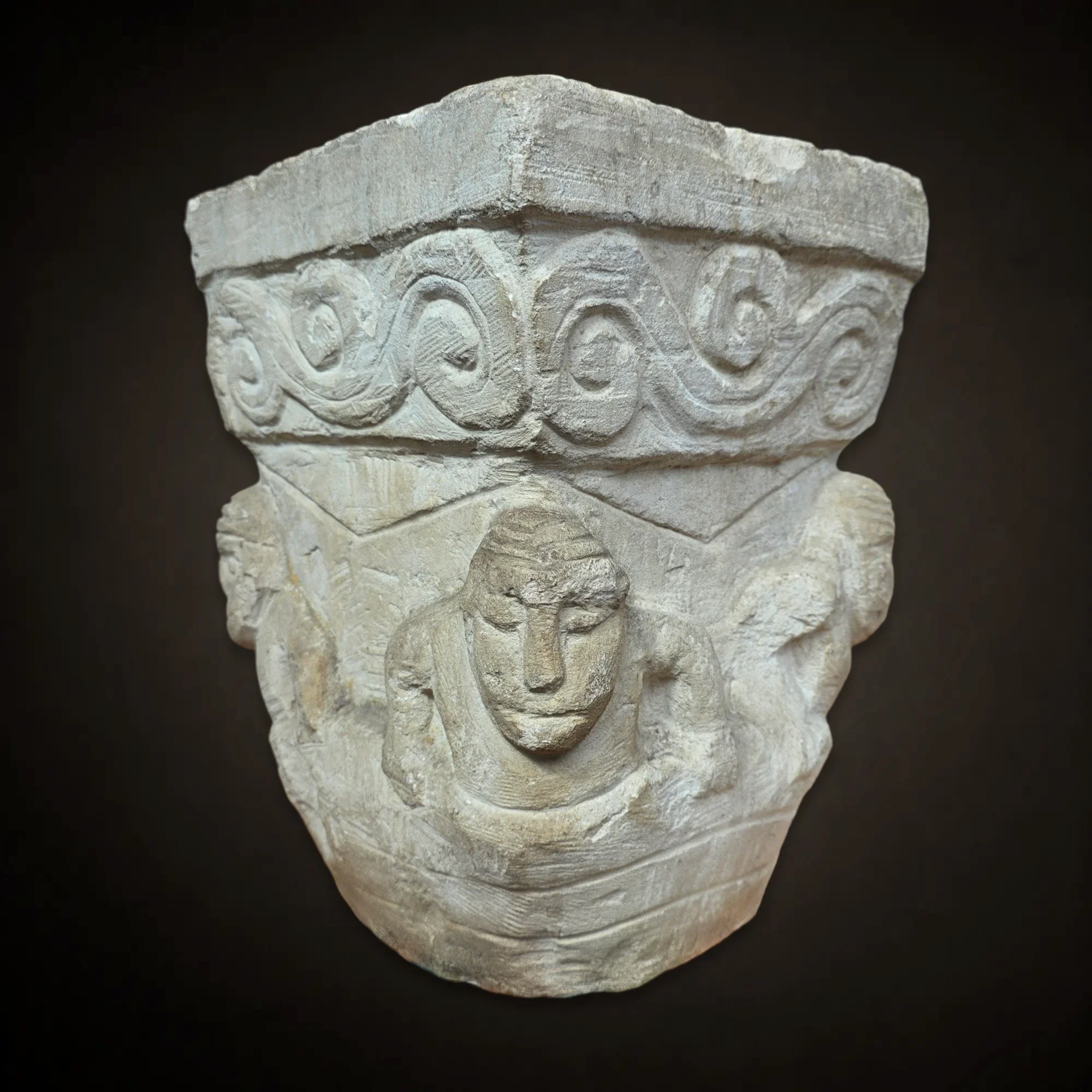
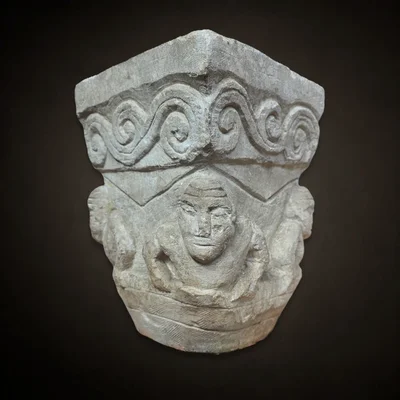
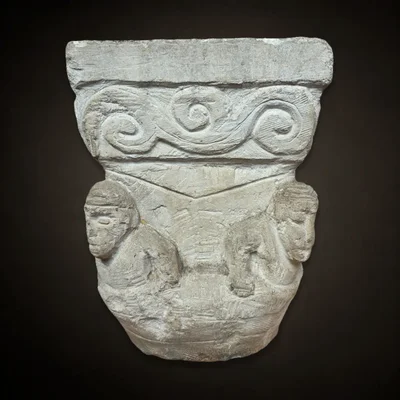
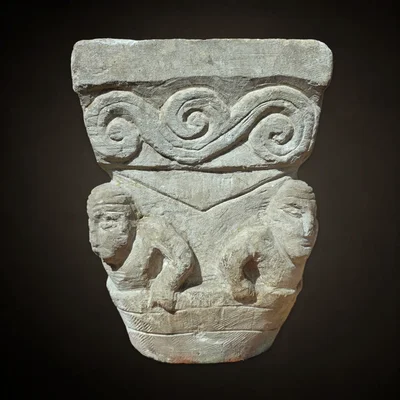
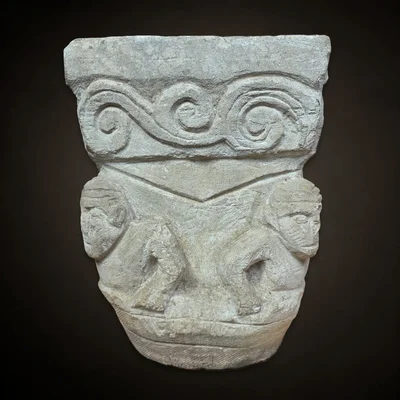
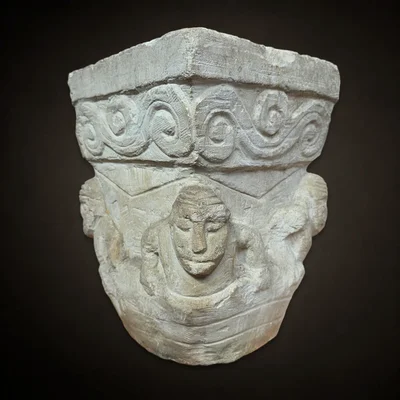
Historiated capital, the Miraculous Draught of Fishes. Normandy, 11th century.
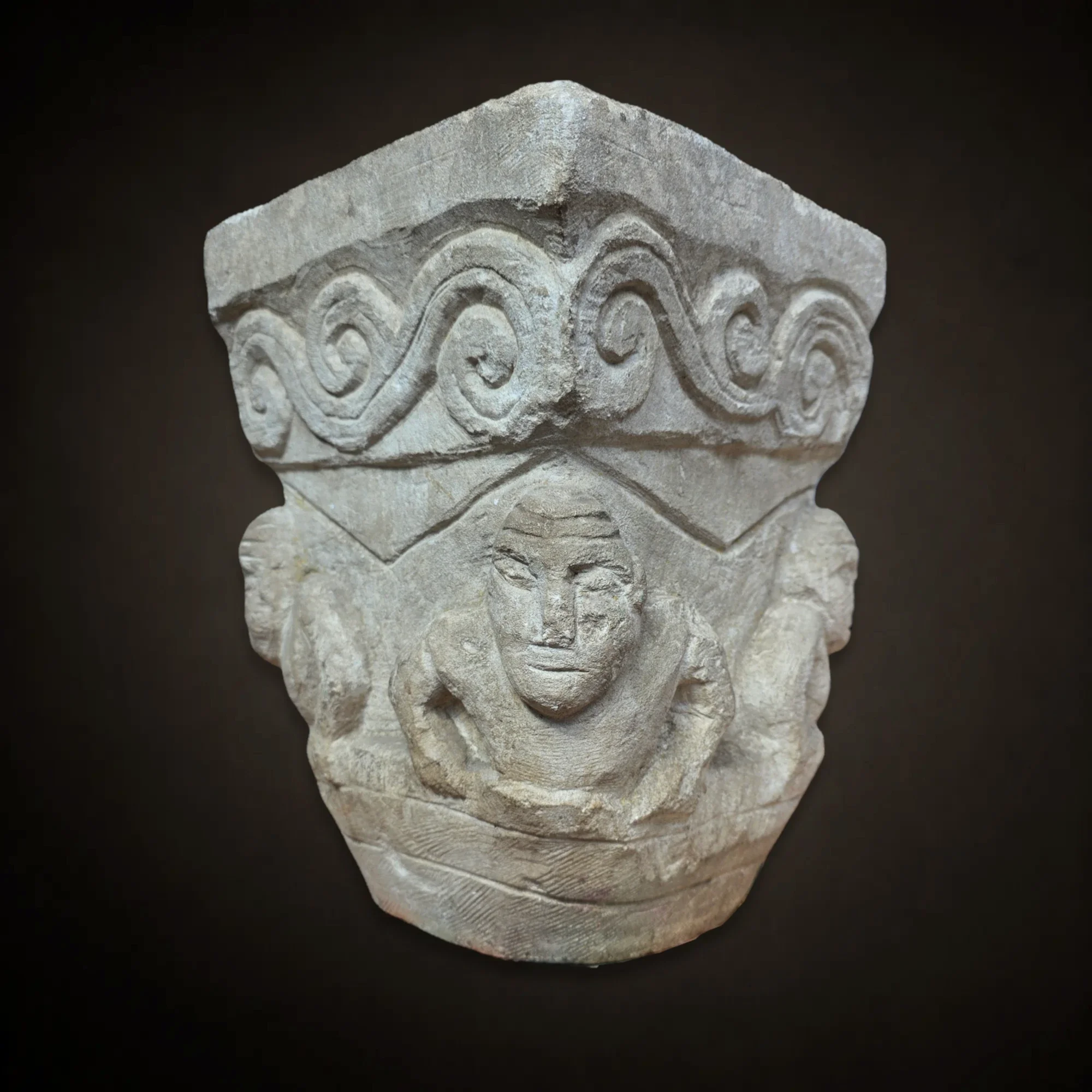
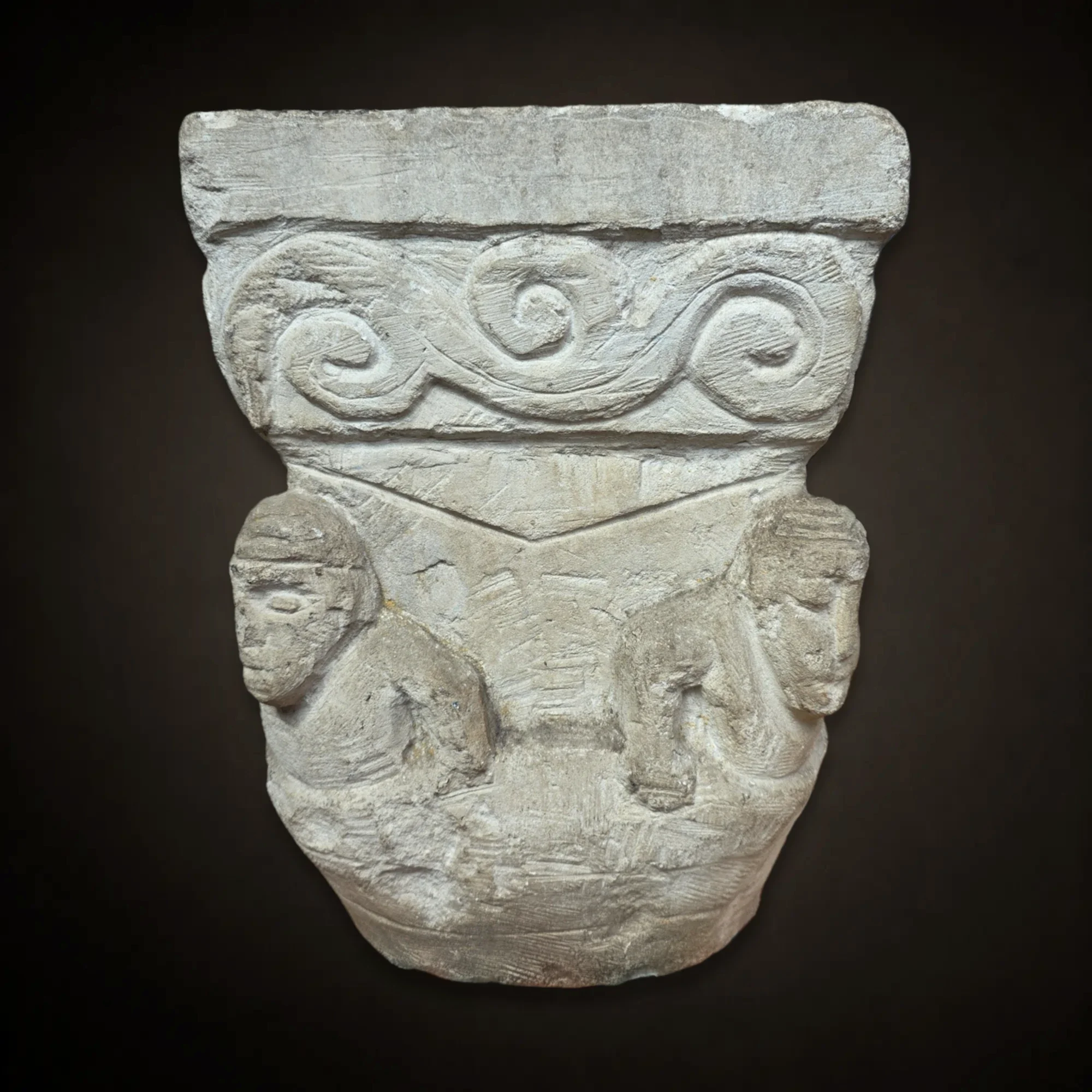
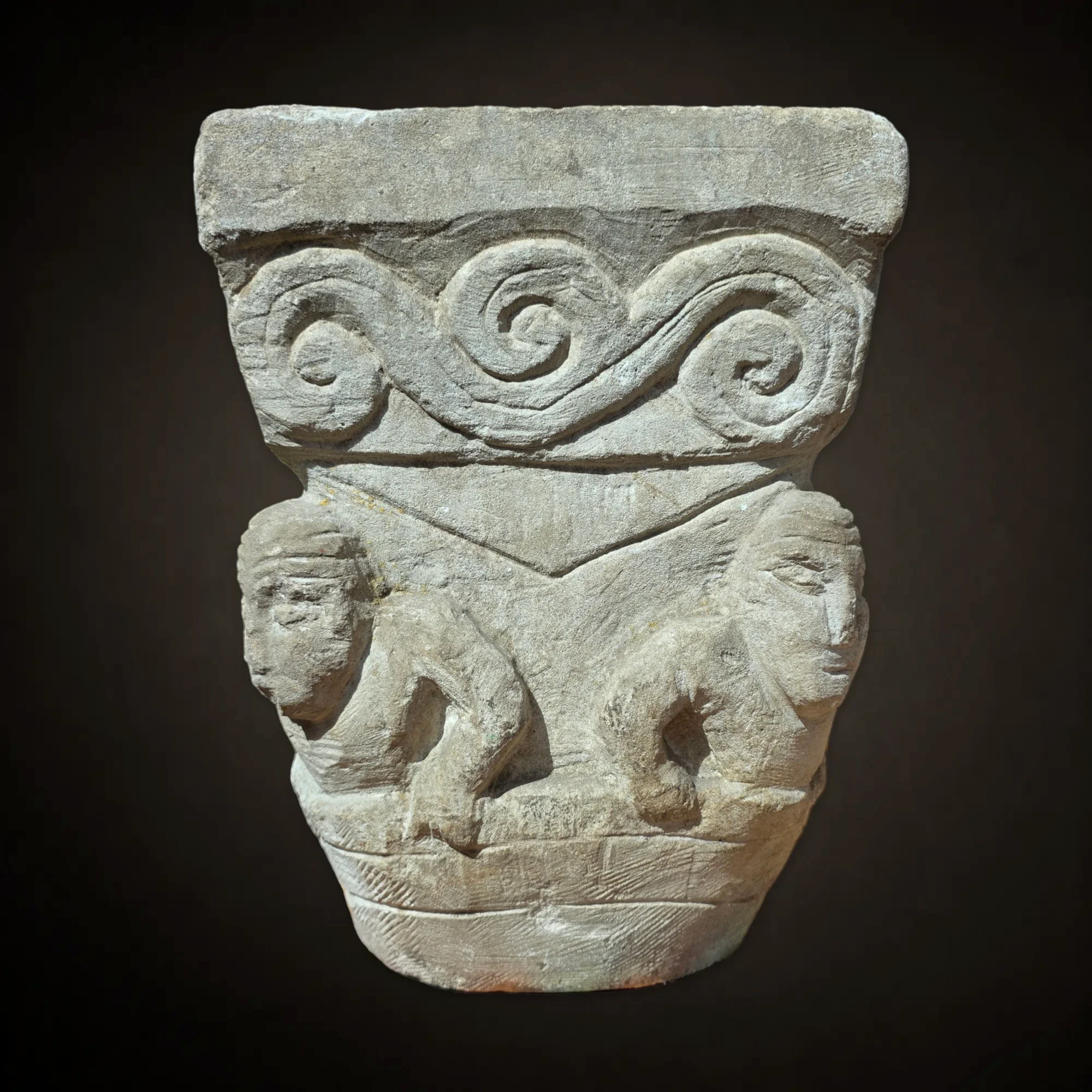
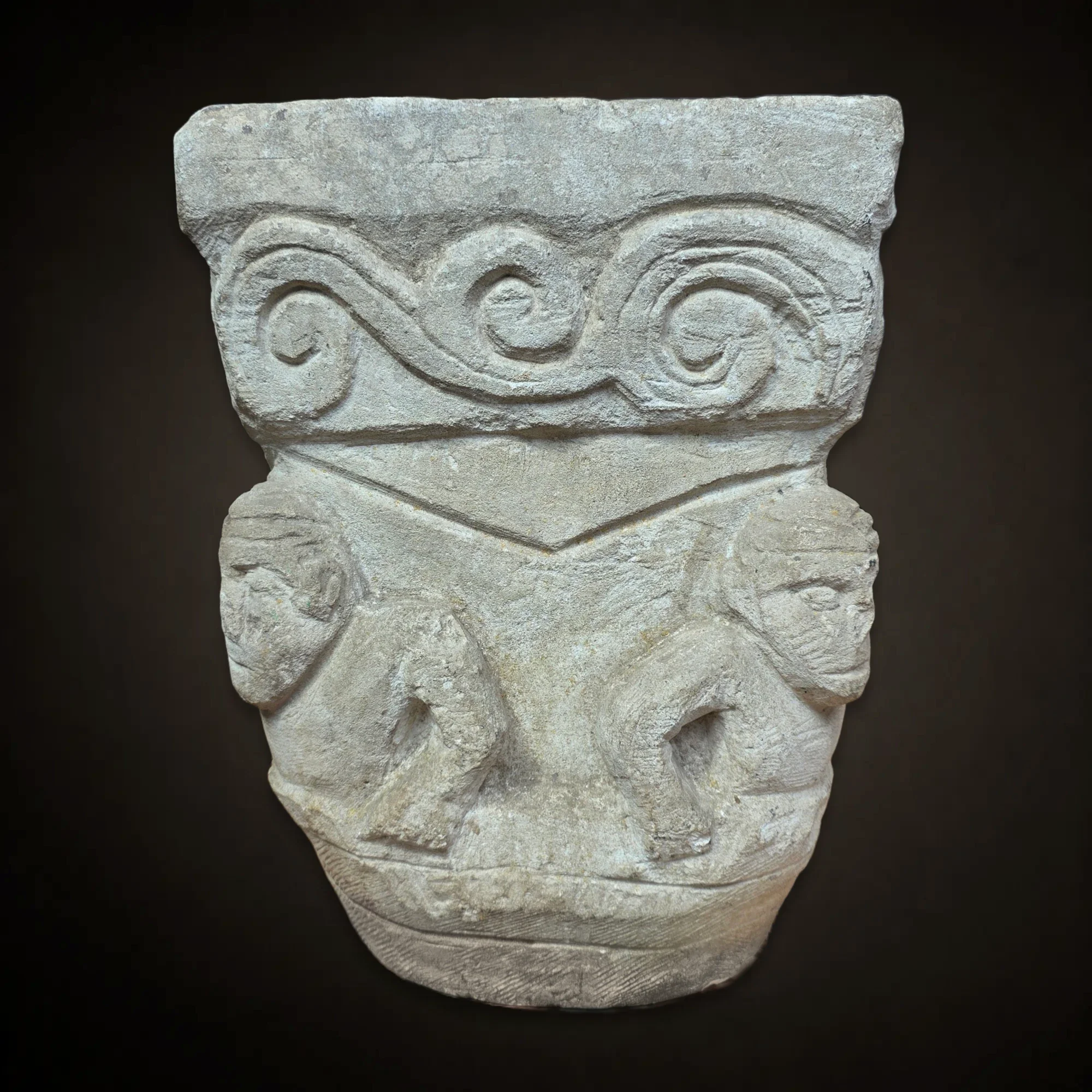
This limestone capital has a basket organised in two registers. A broad frieze of spiralling bands occupies the upper section, while a scene with four figures unfolds below. The four men, bracing themselves, take part in the same action: leaning out over the gunwale of their boat, they appear to be hauling in a net with considerable effort, running around the lower part of the basket. The gunwale of the vessel is clearly marked, with two further lines below that seem to indicate clinker-built construction. This type of construction is also represented in the Bayeux Tapestry. The lower part of the basket is covered with closely spaced hatching, which may represent the mesh of the net. Despite the primitive character of the carving, it therefore seems possible to recognise in this scene a representation of the Gospel account of the Miraculous Draught of Fishes. Two Gospel episodes may serve as references: the fishing on Lake Gennesaret, associated with the calling of the first disciples in the Gospel according to Saint Luke (Luke 5:1-11), and the episode following the Resurrection on the shore of the Sea of Tiberias in the Gospel according to Saint John (John 21:1-14).
The faces are elongated and only lightly modelled. They are structured around a straight, projecting nose of almost rectangular section. The prominent eyes are simply incised beneath a clearly marked brow ridge. A short horizontal line indicates the mouth, while a few parallel grooves define the hair above the forehead. Despite uneven wear, the same scheme is repeated from one figure to another.
The bodies are treated with the same economy of means. The arms describe broad curves and the elbows project away from the torso. The sense of effort is conveyed through the inclination of the shoulders and the amplitude of the gestures rather than through modelling.
This capital belongs to the sculptural tradition of ducal Normandy in the second half of the 11th century, dominated by the major building campaigns at Caen. The abbey church of La Trinité, founded around 1059 by William the Conqueror and Matilda, and Saint-Étienne were its principal centres, alongside Bayeux Cathedral. Sculpture in this context was above all an art of the capital.
The attribution to Normandy is based on the convergence of several characteristics: the geometric construction of the faces, the importance of incision, the treatment of the bodies through broad surfaces, and the association of figurative carving with ribbon ornament.
These features find particularly convincing parallels in the sculpture of the Caen region and the Bessin during the second half of the 11th century. The ensembles at Sainte-Paix and La Trinité in Caen provide significant comparisons. The research of Maylis Baylé has highlighted a local style based on the simplification of forms and the geometric organisation of ornament, which was subsequently to spread throughout the Anglo-Norman world.
The closest parallels for this capital are found in the reliefs from the chapel of Sainte-Paix in Caen (Christ Blessing and Man Striking a Quadruped, Musée de Normandie, 1060s-1080s) and in the figured capital from Saint-Sulpice at Secqueville-en-Bessin (c. 1100).
The corpus can be extended to the historiated capital in the crypt of La Trinité in Caen (after 1090), the sculpted masks at Saint-Jean-d’Abbetot (late 11th century), and the capitals of Graville-Sainte-Honorine (last decade of the 11th century).
Full dossier and study available on request.
References consulted:
· Maylis Baylé, Les chapiteaux de la chapelle Sainte-Paix à Caen, Bulletin monumental, tome 132, no 4, 1974, p. 261-272
· Maylis Baylé, Aspects de la sculpture normande autour de 1100 : à propos de Graville-Sainte-Honorine, Annales de Normandie, 29e année, no 2, 1979, p. 157-178
· Anastasiya Chevalier-Shmauhanets, Entrelacs normands : marqueurs d’un espace sacré dans les églises rurales du diocèse de Rouen (XIe-XIIe siècle), Bulletin du centre d’études médiévales d’Auxerre - BUCEMA, hors-série no 13, 2023
· Musée du Louvre, catalogue entry for the fragment of an abacus decorated with scrollwork from the Abbey of Sainte-Geneviève, inventory RF 488.
In-depth study of the artwork
| Subject: | historiated capital, the Miraculous Draught of Fishes |
|---|---|
| Material: | limestone |
| Dimensions: | height 33 cm; width 27 cm |
| Origin: | Normandy, Caen region or Bessin, France |
| Date: | late 11th century, circa 1080-1090 |
| Provenance: | French private collection |
| Condition: | minor losses and erosion |
| Reference: | 301 |
Description
This limestone capital has a basket organized into two registers. A broad frieze of spiralling bands occupies the upper section, while a scene with four figures unfolds across the lower register.
At its base, the basket, which has no astragal, retains a rounded volume that gradually expands toward the square plane of the abacus. The figures, positioned at the corners, accompany this transition from circle to square. Their heads project beneath the angles of the abacus, while their shoulders and arms extend across the two adjoining faces. Between them, deeply incised chevrons recall the structure of cushion capitals.
The scene reveals itself as one moves around the capital. The four men, braced in effort, participate in the same action: leaning outward over the side of their boat, they appear to be hauling up a net that runs along the bottom of the basket.
The faces are elongated and only lightly modelled. They are organized around a straight, projecting nose of almost rectangular section. The globular eyes are simply incised beneath a clearly marked brow ridge. A short horizontal line indicates the mouth, while a few parallel striations arrange the hair above the forehead. Despite uneven wear, this scheme is repeated from one figure to another.
The bodies are treated with the same economy. The arms describe broad curves and the elbows project away from the torso. The effort is expressed through the inclination of the shoulders and the breadth of the gestures rather than through modelling.
The gunwale of the boat is clearly indicated, with two further lines beneath it that seem to represent clinker-built construction. This type of construction also appears in the Bayeux Tapestry. The lower part of the basket is covered with closely set hatching that may represent the mesh of the net. Despite the summary character of the carving, it therefore seems possible to recognize in this scene a representation of the Gospel account of the Miraculous Draught of Fishes.
Two Gospel episodes may serve as references: the fishing on Lake Gennesaret associated with the calling of the first disciples in the Gospel according to Saint Luke (Luke 5:1-11), and the fishing after the Resurrection on the shore of the Sea of Tiberias in the Gospel according to Saint John (John 21:1-14). In both accounts, an initially unsuccessful catch becomes abundant at Christ's word.
Tool marks remain visible on the abacus, the ribbon frieze, the backgrounds and several parts of the lower register. These dressing marks, present throughout the piece, should be distinguished from the deeper and more closely spaced hatching at the bottom of the basket, which alone appears to have a figurative purpose.
Condition
The capital shows surface wear, bruising and chips affecting mainly the edges and certain projecting parts. The faces are unevenly preserved: several retain a very legible rendering of the eyes, nose and mouth, while others have lost part of their relief. The principal losses are a chip to the abacus and a loss to the arm of one of the figures.
Geographical and stylistic context
This capital belongs to the sculpture of ducal Normandy in the second half of the 11th century, dominated by the great building campaigns of Caen. The Abbaye aux Dames, founded around 1059 by William the Conqueror and Matilda, and Saint-Étienne were its principal centres, alongside Bayeux Cathedral. Sculpture there was above all an art of the capital.
The attribution to Normandy is based on the convergence of several characteristics: the geometric construction of the faces, the importance of incision, the treatment of the bodies as broad surfaces, and the combination of figural decoration with ribbon ornament.
These features find particularly convincing parallels in sculpture from the Caen region and the Bessin during the second half of the 11th century. The ensembles of Sainte-Paix and the Abbaye aux Dames in Caen offer important comparisons. Maylis Baylé's research has identified a local style based on simplified forms and a geometric organization of ornament, which was subsequently to spread throughout the Anglo-Norman world.
This style includes shallow relief and a relatively planar treatment of the bodies.
The upper motif belongs to the repertory of geometrized ribbon scrollwork. Its movement retains something vegetal, but its geometry distances it from any naturalistic description.
The incised chevrons between the figures also connect the piece with Anglo-Norman experiments in the form of the capital. Each face receives a triangular shield-like field, a graphic transposition of the faceted cushion capital. This type is documented in England from the 1080s, in the Chapel of St John in the Tower of London around 1080 and in the crypt at Lastingham before 1088, whereas it only began to spread in Normandy around 1090. Its presence suggests a direct borrowing from the Anglo-Norman milieu. It also accords with the insular affinities that Maylis Baylé, following Louis Grodecki, had already identified in the reliefs of Sainte-Paix.
The localization in the Caen region or the Bessin rests above all on the affinities of the faces with the sculptures of Sainte-Paix and Secqueville-en-Bessin.
Comparative corpus and dating
Caen, Sainte-Paix Chapel: figural reliefs
The reliefs from Sainte-Paix provide the most sensitive comparisons for the treatment of the human figure. The Blessing Christ has an elongated head, a strongly emphasized straight nose and features indicated with very little modelling. The relief of a man striking a quadruped likewise offers a comparable manner of organizing the body and limbs into broad cut-out surfaces.
On the present capital, the faces repeat this articulation between a simple facial volume and a few decisive incisions. The relationship also concerns the arms, whose curvature alone is sufficient to express the action. This places the work within the context of Caen's experiments in figural sculpture during the 11th century.
Secqueville-en-Bessin, Church of Saint-Sulpice: figural capital
The capital at Secqueville is a particularly important point of comparison for the proposed localization. The figure has a narrow face dominated by a long nose, with eyes and a mouth reduced to a simple line, as on the present sculpture. The body, summarily modelled, is closely integrated into the structure of the support.
The comparison concerns this ability to construct human presence with a limited number of means. The fishermen on the present capital possess the same gravity, born of the frontality of the heads and the firmness of the drawing. Baylé places Secqueville among buildings “close to 1100”: this type of elongated face therefore remained current in the Bessin until the turn of the century.
Caen, Abbaye aux Dames: figural capital in the crypt
The figural capital in the crypt of the Abbaye aux Dames offers a parallel for the adaptation of figures to architectural volume. The figures occupy the faces of the basket, their gestures rendered by highly simplified limbs and by recesses that detach their contours.
Differences in proportions and expression indicate different hands. Baylé connects the crypt with a remodelling after 1090. The faces become rounder and more globular, the mouths open, and the figures occupy the spaces left free by retained volutes. On the present capital, the faces remain elongated and the figures occupy the corners: the crypt illustrates a more advanced phase of the same development.
Saint-Jean-d'Abbetot, La Cerlangue: sculpted masks
The masks at Saint-Jean-d'Abbetot extend the comparative corpus farther east. They display a facial construction dominated by the axis of the nose, restrained incised eyes and only slight modulation of the cheeks.
This comparison demonstrates the regional extension of a vocabulary for which the examples from Caen and the Bessin provide the closest correspondences to the present capital. The church belongs to the late 11th century; the broad volutes in its choir, which Baylé compares with those of the crypt of the Abbaye aux Dames, nevertheless belong to a more advanced typology than the frieze studied here.
Graville-Sainte-Honorine: sculpted decoration
Graville provides a comparative framework for the coexistence, around 1100, of figures in low, flattened relief and strongly geometrized ornament. The study of this ensemble must take account of 19th-century restorations; old drawings examined by Maylis Baylé nevertheless make it possible to reconstruct several medieval arrangements.
The interest of the comparison lies in this freedom to associate figural narrative and ornament, as well as in the persistence of highly simplified human forms within sculpture that is nevertheless inventive.
The capitals of the north piers of the nave also set engraved hemispheres within a cubic plane in place of corner volutes. Baylé sees in them “experiments between the usual form of the collared capital and that of cubic blocking-out”; the incised chevrons of the present capital proceed from a comparable graphic transposition. She dates the nave to the final decade of the 11th century, and the capitals of the lost apsidioles, still connected with the workshop of the Abbaye aux Dames, to around 1080-1090.
Saint-Wandrille Abbey, Chapel of Saint-Saturnin: impost
This impost fragment displays interlace formed from flat bands, with volutes close to the frieze in the upper register of the present capital. Dated to the first half of the 11th century, it constitutes a prototype for the frieze.
Attribution and dating
Taken together, these comparisons lead to a Norman origin in the Caen region or the Bessin at the end of the 11th century. The correspondences with Sainte-Paix and Secqueville concern precise aspects of the sculpture: the design of the faces, the shape of the nose, the incised treatment of the eyes and the construction of the limbs. The Abbaye aux Dames in Caen places these characteristics within the development of regional architectural sculpture.
The dating rests on the position of the work between these landmarks. The elongated faces and the still very restrained ribbon frieze connect it with the milieu of Sainte-Paix in the years 1060-1080. By contrast, it does not display the round heads and large flat volutes of the crypt of the Abbaye aux Dames and Saint-Jean-d'Abbetot, which are later than 1090. The cubic shield motif, documented in England around 1080-1088, provides the earliest possible date. A date around 1080-1090 therefore appears the most plausible.
The capital can thus be placed among the surviving examples of Norman figural sculpture from the final decades of the 11th century, within the Anglo-Norman artistic context.
Bibliographical references
- • Maylis Baylé, “Les chapiteaux de la chapelle Sainte-Paix à Caen”, Bulletin monumental, vol. 132, no. 4, 1974, pp. 261-272.
- • Maylis Baylé, “Aspects de la sculpture normande autour de 1100 : à propos de Graville-Sainte-Honorine”, Annales de Normandie, 29th year, no. 2, 1979, pp. 157-178.
- • Anastasiya Chevalier-Shmauhanets, “Entrelacs normands : marqueurs d'un espace sacré dans les églises rurales du diocèse de Rouen (XIe-XIIe siècle) ? État de la question”, Bulletin du centre d'études médiévales d'Auxerre — BUCEMA, special issue no. 13, 2023.
- • Musée du Louvre, catalogue entry for the fragment of an abacus decorated with scrollwork from the Abbey of Sainte-Geneviève, inv. RF 488.
- • Iconographic sources: Gospel according to Saint Luke, 5:1-11; Gospel according to Saint John, 21:1-14.