
Origin : Southern Burgundy France.
Medium : Limestone.
Size : H. 42.5 cm, W. 23.5 cm, D. 8.8 cm
Period : 12th century.
Condition : minor losses
Price : 19 800€
REF. 289
Frieze panel - Romanesque Burgundy. Cluny influences.
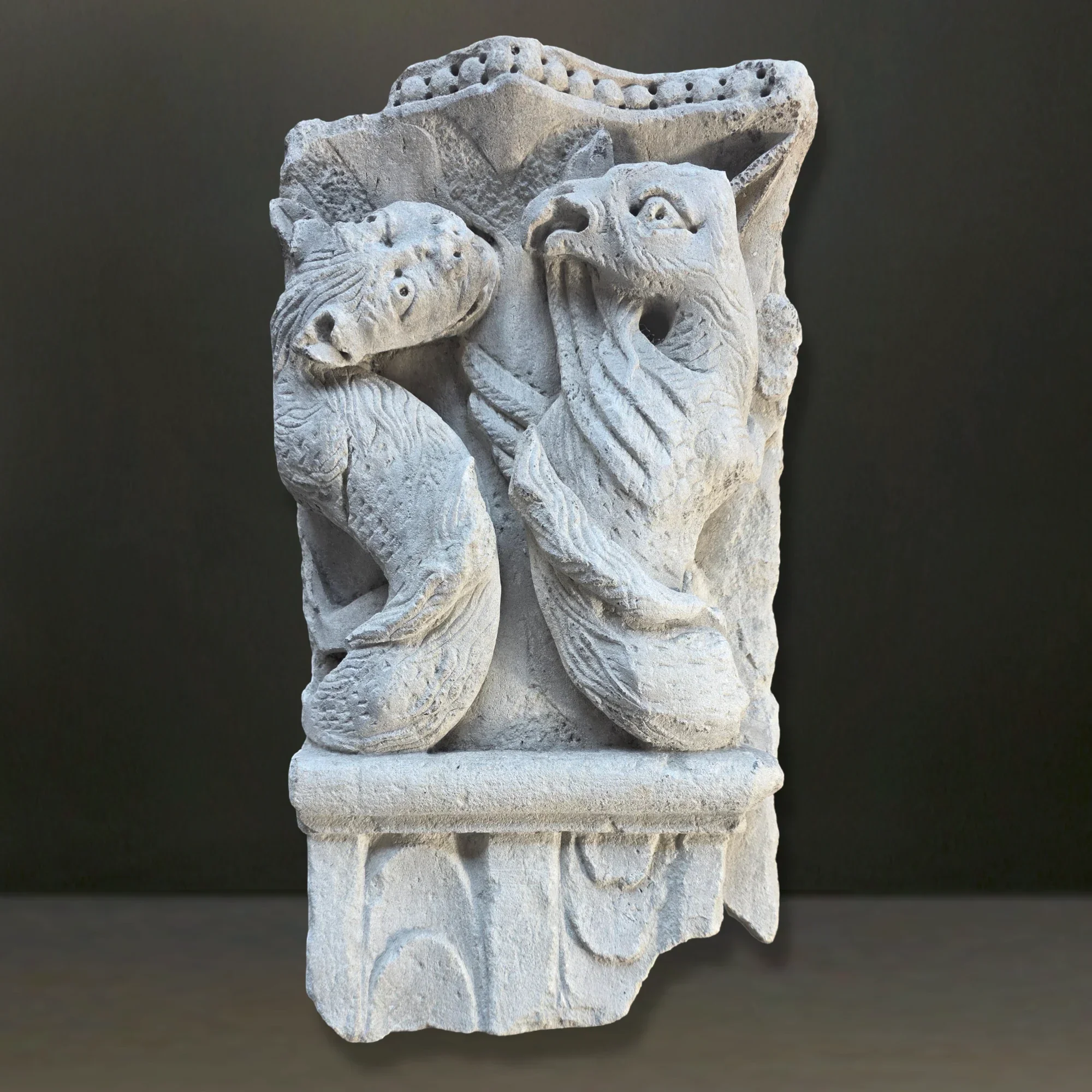
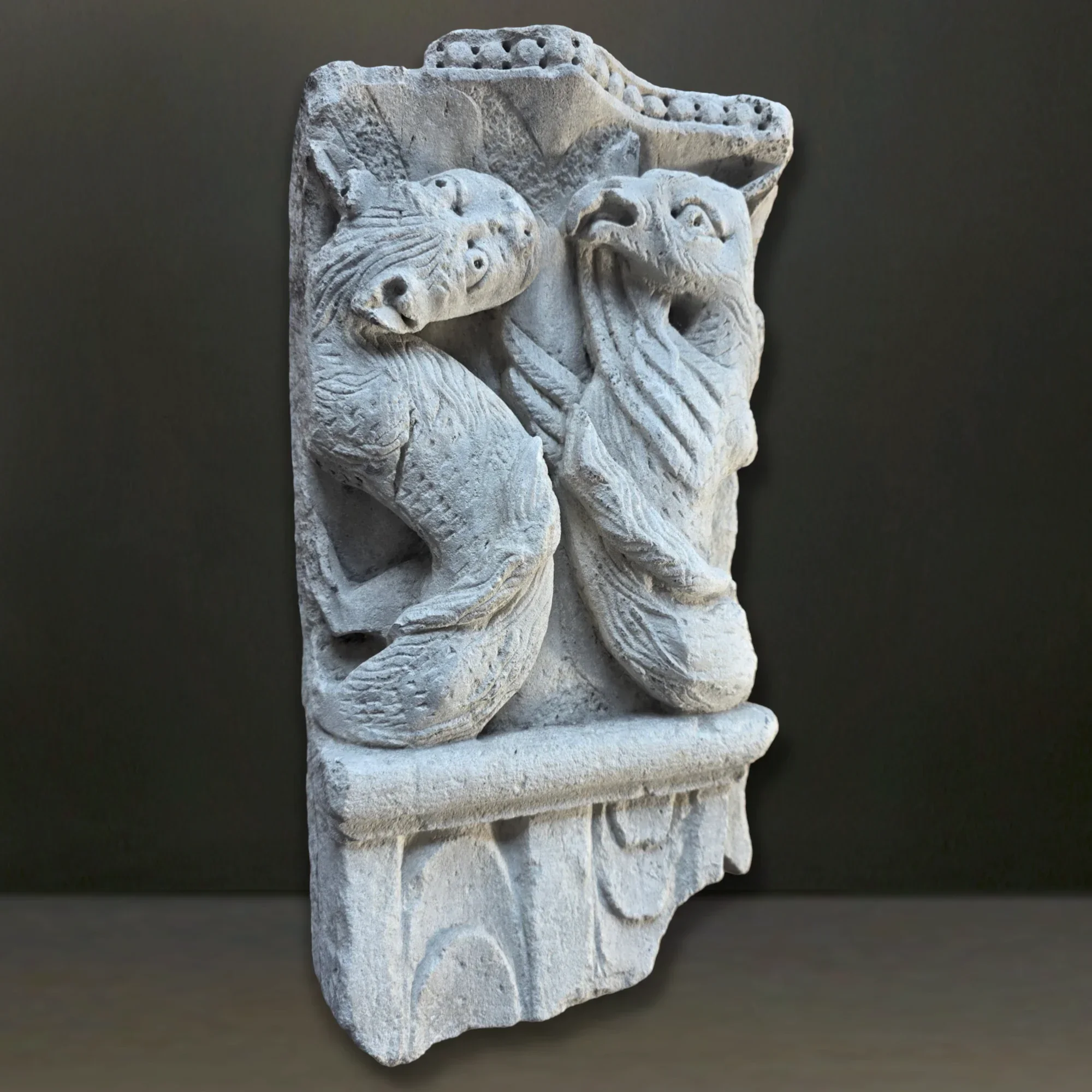
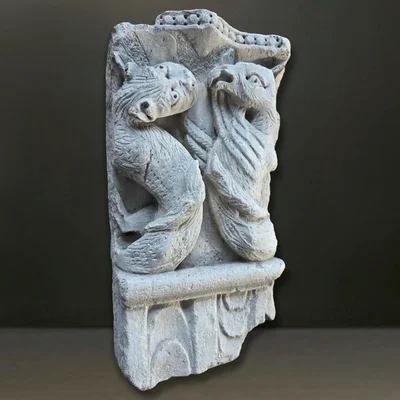
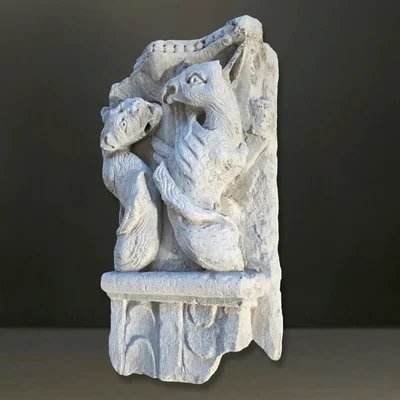
Frieze panel carved in pale limestone, depicting a group of two confronted fantastical animals, identified here as a griffin and an asp, in a composition that may evoke a psychomachy, that is to say a symbolic struggle between Good and Evil. With its dense and vigorous composition, this fantastical bestiary is characteristic of the height of Romanesque art. The upper register is occupied by a group of two confronted fantastical animals, carved in high relief against a hollowed ground: an asp to dexter and a griffin to sinister. The whole strongly suggests an origin in Southern Burgundy, in the second quarter of the 12th century, within the orbit of workshops belonging to the Cluniac circle.
This magnificent relief belongs to the broad tradition of the French Romanesque bestiary, yet its formal language sets it apart from the more narrative southern centers and brings it closer to the Centre-East, and more particularly to Southern Burgundy, more precisely to areas marked by the influence of Cluny.
Several elements support this attribution. The composition is characterized by a tightly structured arrangement of forms, in which the two fantastical creatures occupy almost the entire sculpted field with an evident rhythm. The bodies unfold in supple curves and continuous coils, according to a logic that is less descriptive than rhythmic. These strongly profiled and highly rhythmic silhouettes recur in a group of Romanesque works from Southern Burgundy, where animal decoration is frequently treated as an emblematic, almost heraldic form rather than as a narrative scene.
Among the most convincing comparisons are first the works of Cluny abbey and its sphere of diffusion. For the abbey of Cluny, one may cite the frieze panels of the narthex triforium FA896.29.1-6, as well as certain capitals from the abbey of Mozac, another Cluniac site.
Complete dossier available on request.
Consulted works:
· Contribution à l’histoire de la sculpture des maisons romanes de Cluny, Neil Stratford in Bulletin Monumental, t. 153, n° 3, 1995, p. 221-242.
· Corpus de la sculpture de Cluny. Tome 1. Les parties orientales de la grande église Cluny III, Neil Stratford, Paris, 2011.
· La mythologie revisitée chez les sculpteurs romans en Bourgogne, Neil Stratford, in Comptes rendus des séances de l’Académie des Inscriptions et Belles-Lettres, 147e année, n° 3, 2003, p. 1243-1265.
· La Bourgogne romane, Christian Sapin, Chantal Arnaud et Walter Berry, Dijon, 2006.
· Bourgogne Romane, Raymond Oursel, 1986
In-depth study of the artwork
| Subject: | High relief |
|---|---|
| Material: | limestone |
| Dimensions: | H. 42.5cm, W. 23.5cm, D. 8.8cm |
| Proposed Origin: | Southern Burgundy |
| Dating: | second quarter of the 12th century |
| Provenance: | American private collection; Sotheby's New York sale; private collection. |
| Condition: | small losses, old holes from modern mounting |
| Reference: | 289 |
Description
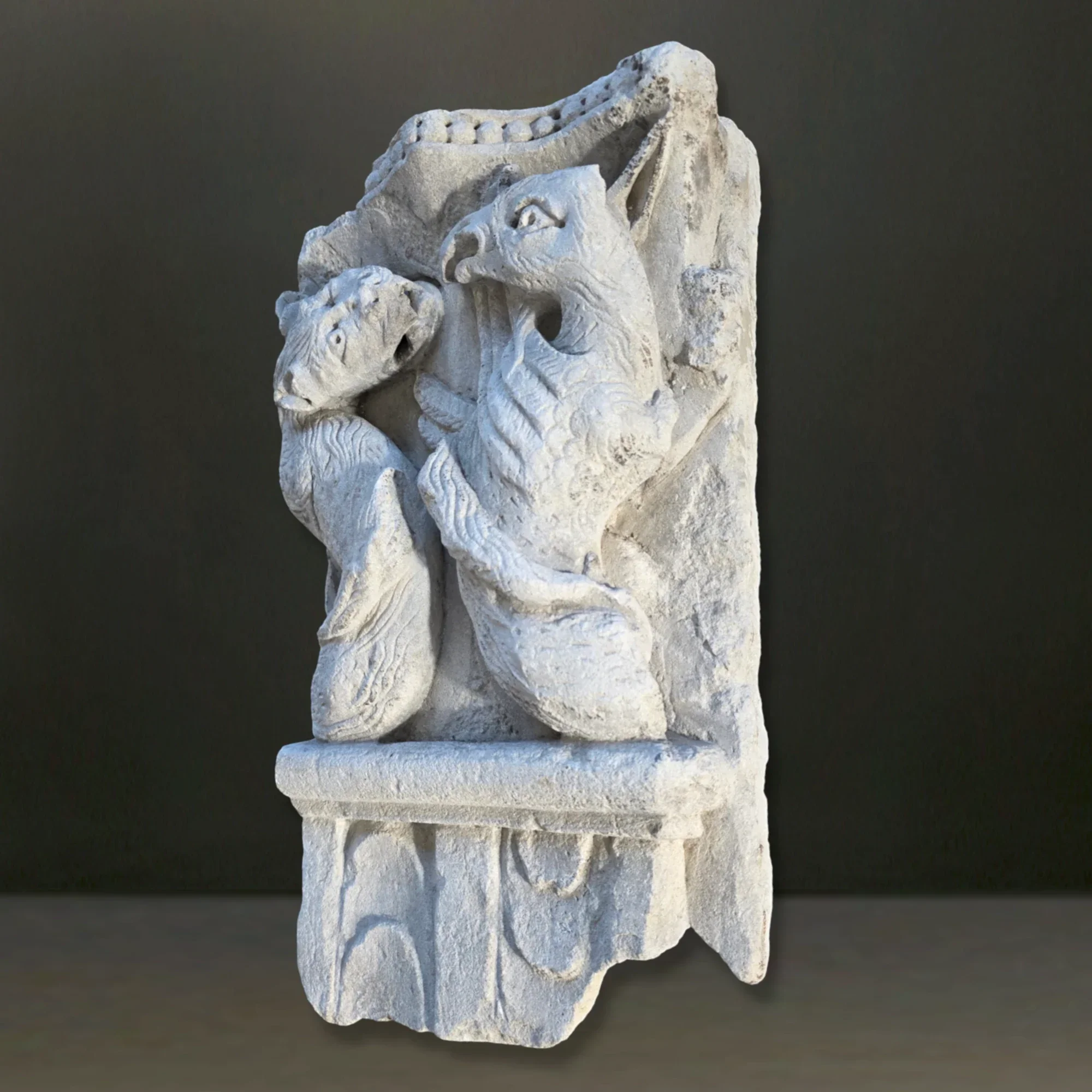
A frieze panel carved in light limestone depicting a group of two confronting fantastic animals, identified here as a griffin and an asp, in a composition that may evoke a psychomachia—a symbolic battle between Good and Evil. With its dense and nervous composition, this fantastic bestiary is characteristic of the apogee of Romanesque art.
The upper register is occupied by a group of two confronting fantastic animals, treated in high relief against a hollowed-out background: an asp on the right (dexter) and a griffin on the left (sinister). The two long and sinuous bodies develop in supple curves and respond to each other on either side of a central axis. They take root in the lower part of the composition, then rise in an upward movement, their heads converging in the upper part.
The griffin features a powerful head with a curved beak, a wide-open maw, and a strongly pronounced round eye drilled with a hand drill. The neck and chest are animated by deep parallel striations, while the curved body shows a treatment mixing stylized plumage and incised locks.
The asp, with a narrower body, inclines its head inward to face the griffin. It has a short snout, marked ears, eyes that are also drilled, and a long coiled body whose surface is rhythmically patterned with incisions evoking fur and scales.
The deeply carved background leaves triangular and curved negative spaces around the bodies, accentuating the projecting effect. In the upper part, behind the heads, appears a radiating or foliated motif, surmounted by the panel's crowning, which is beaded and executed with a drill.
In the lower register, delimited by a horizontal quarter-round carved molding, one can observe geometric motifs or schematic arcades. This register acts as a visual foundation for the fantastic bestiary.
The sides reveal that the relief was conceived as a frieze panel, with its depth concentrated on the heads, chests, and curves of the bodies. The uncarved reverse is entirely flattened with oblique tooling marks, indicating a technical preparation of the back surface. Two small holes correspond to an old modern mounting system for display.
The overall state of preservation is good for this type of architectural piece, with homogeneous general wear and small losses along the edges, yet it retains a beautiful legibility of the main group.
The quality of execution is notable in the graphic treatment of the confronting animals.
Geographic and Stylistic Context
This beautiful relief belongs to the vast current of the French Romanesque bestiary, but its formal language invites us to distance it from the more narrative major southern centers and to bring it closer, more probably, to the Center-East, specifically to southern Burgundy, the Lyonnais, and, more precisely, areas marked by Cluniac influence.
Several elements argue in favor of this. The composition is characterized by a highly structured tightening of forms, where the two fantastic creatures almost entirely occupy the sculpted field with an obvious rhythmic quality. The bodies develop in supple curves and continuous coils, following a logic that is less descriptive than rhythmic. These strongly profiled and rhythmic silhouettes are found in a group of Romanesque productions from southern Burgundy, where animal decoration is frequently treated as an emblematic, almost heraldic form, rather than as a narrative scene.
The treatment of the details supports this attribution. The repeated use of the drill, manes or plumage rendered by long parallel striations, heads accentuated by an almost abstract expression, as well as the deliberate simplification of the anatomy, are part of an ornamental vocabulary characteristic of the Cluniac circle. The piece develops neither the vegetal profusion, the narrative proliferation, nor the linear nervousness characteristic of certain ensembles in Quercy or southern Languedoc; it privileges, on the contrary, a more monumental language centered on the graphic power of the bestiary.
All this leads to proposing, with high probability, an origin in southern Burgundy, within the sphere of the workshops of the Cluniac circle.
Comparison Corpus and Dating
Among the most convincing comparisons are, first of all, the works from Cluny and its sphere of diffusion. Cluniac animal fragments indeed show a common taste for coiled bodies, turned-back heads, powerfully stylized silhouettes, and the construction of the animal as pure sculptural rhythm. Although it is not possible to speak of an identical hand or a direct workshop link, the studied relief shares with this milieu the same sobriety of forms and graphic intensity.
The comparison with the sculptures from the Abbey of Mozac (a Cluniac site) is equally significant. One finds there, in several bestiary capitals, the same use of hollowed-out eyes, parallel striations for manes and wings, as well as a similar tendency to generate the animal's expressiveness through an opposition between the simple volume of the body and the incisive liveliness of the head.
Comparisons with the sculptures of Île Barbe and with the two asps of Sainte-Geneviève preserved in the Louvre are given here to support the dating. They show a bestiary treated not as a decorative anecdote, but as a system of curved, tense, concentrated forms, where the animal figure is organized in spirals, folds, and counter-curves. However, the nervousness and the rendering of the volumes distance us from those productions.
Comparisons with Elne or with Saintes - Saint-Eutrope are useful mainly by contrast. If one finds in those ensembles the recourse to the bestiary and the fantastic animal, their treatment appears to be of a different order. Elne presents a more decorative and disciplined organization of the motif within the medallion, while Saintes develops a more profuse and floral vocabulary, more animated by multiple relationships between figures and decoration. The studied relief is distinguished by a denser, more compact structure, more concentrated on the plastic autonomy of the creatures.
Chronologically, all of these comparisons lead to situating the sculpture in the 12th century, with a stronger probability for the first half or the middle of the century. The style is neither archaic enough to date back to the 11th century, nor supple enough to belong to an advanced phase of the 12th century. The still firm construction of the volumes, the highly stylized character of the bestiary, and the palpable tension of the subject thus invite proposing a dating around 1125-1150.
Bibliographical References
- • Contribution à l'histoire de la sculpture des maisons romanes de Cluny, Neil Stratford in Bulletin Monumental, t. 153, no. 3, 1995, pp. 221-242.
- • Corpus de la sculpture de Cluny. Tome 1. Les parties orientales de la grande église Cluny III, Neil Stratford, Paris, 2011.
- • La mythologie revisitée chez les sculpteurs romans en Bourgogne, Neil Stratford, in Comptes rendus des séances de l'Académie des Inscriptions et Belles-Lettres, 147th year, no. 3, 2003, pp. 1243-1265.
- • Cluny - Onze siècles de rayonnement, CMN, dir. Neil Stratford, Paris 2010.
- • Études sur la sculpture de Cluny, Recueil d'articles, Neil Stratford in Bulletin Monumental, Paris, 1992
- • La Bourgogne romane, Christian Sapin, Chantal Arnaud and Walter Berry, Dijon, 2006.
- • Bourgogne Romane, Raymond Oursel, 1986