
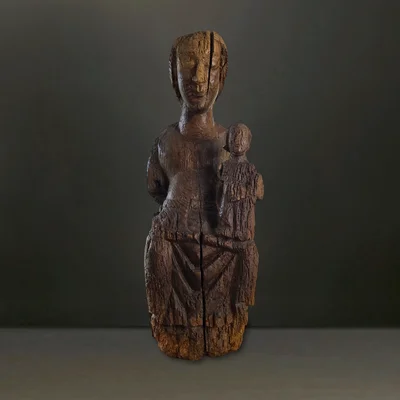
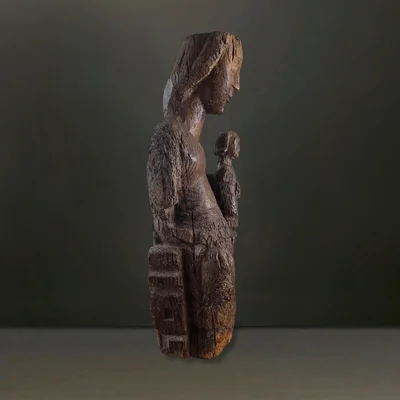
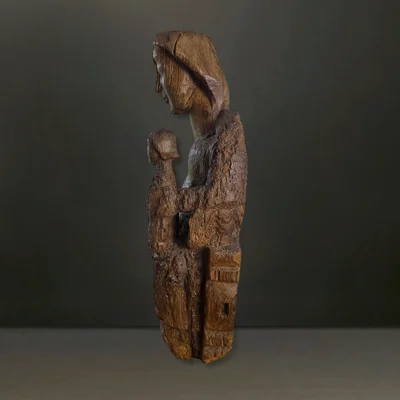
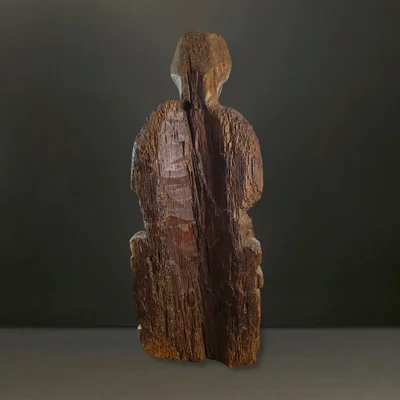
Origin : Pyrenees, France or Spain.
Medium : Pine wood.
Size : H. 71 cm
Period : 13th century.
Condition : Visible losses, cracks, and woodworm damage.
Price : 7 800€
REF. 288
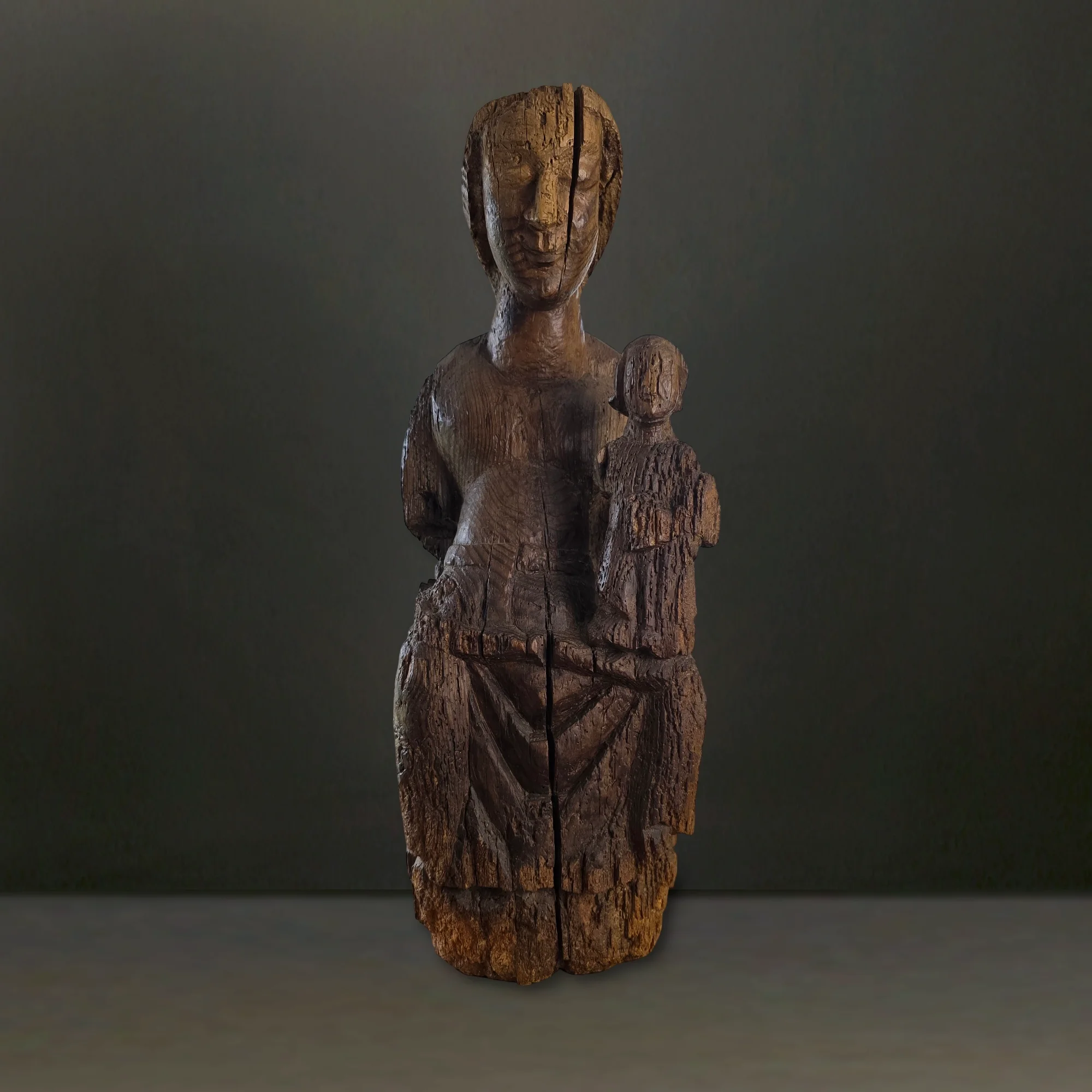
Enthroned Virgin. Pyrenees 13th century.
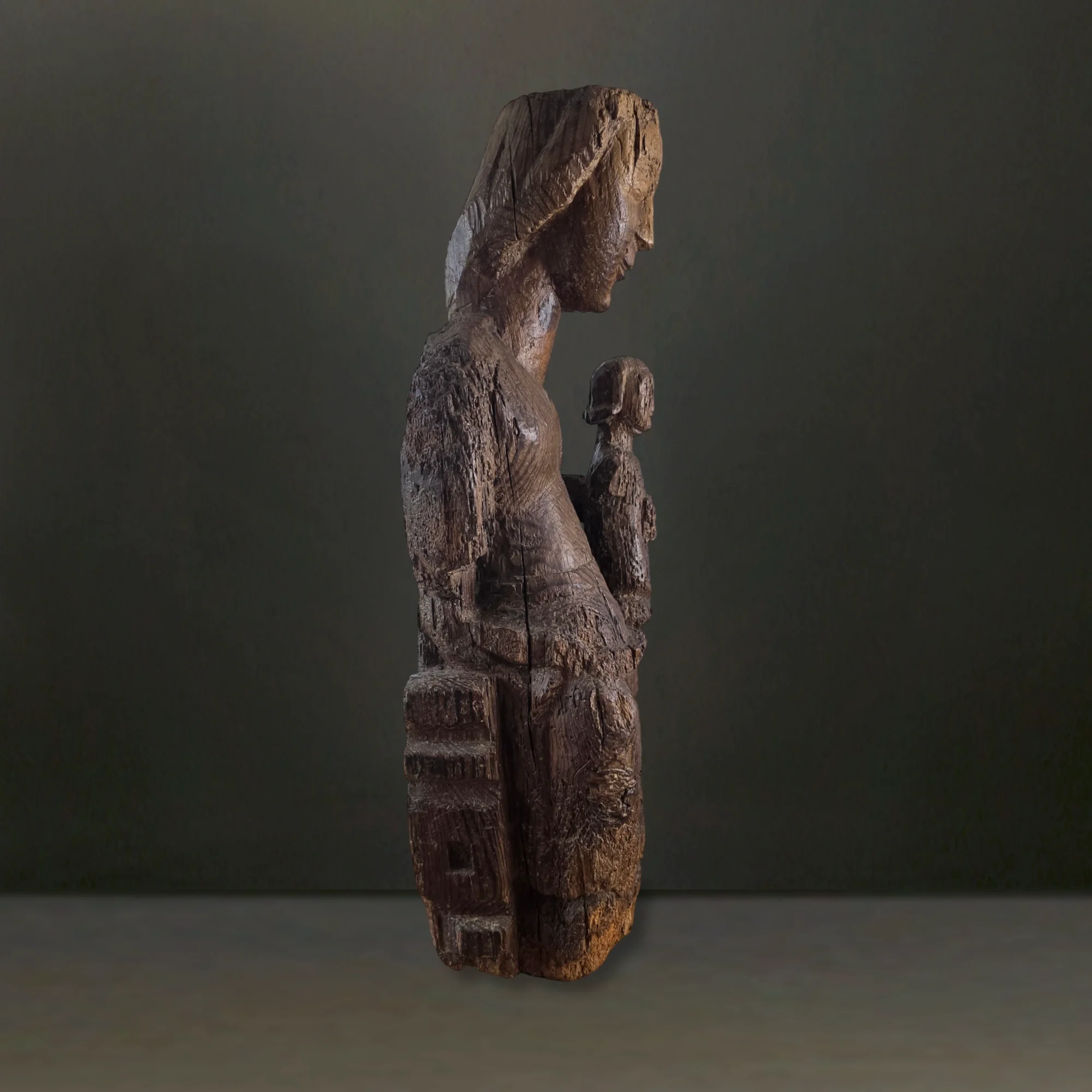
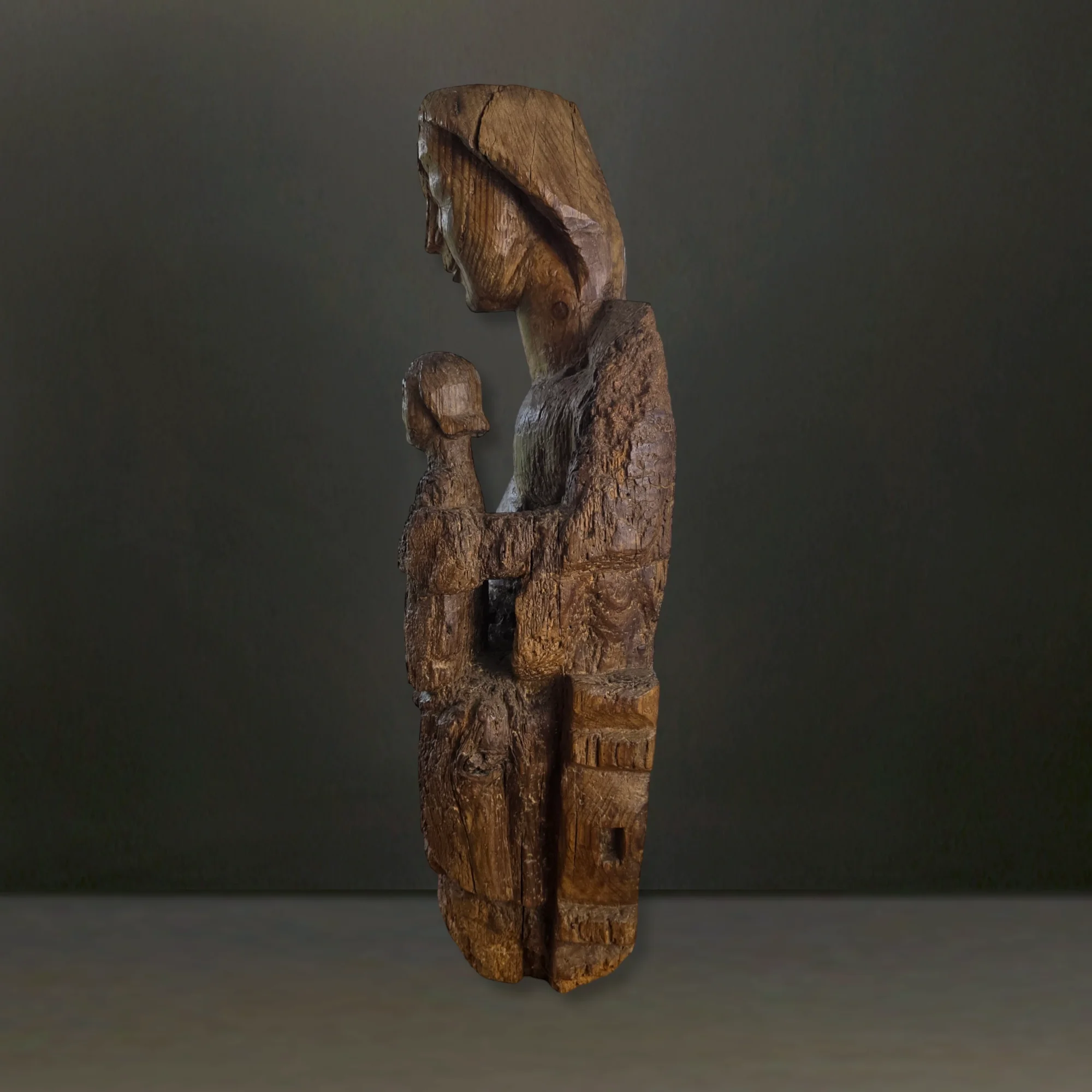
This work belongs to the Romanesque tradition of the Enthroned Virgin (Sedes Sapientiae or Seat of Wisdom), typical of the Pyrenean mountain regions. The Virgin is depicted seated on a bench-throne with molded side posts and presents Christ standing on her left knee. Mary holds a frontal, hieratic pose, characteristic of Romanesque Virgins. This hieraticism is reinforced by the oval shape of the Virgin's face with its slightly prominent almond-shaped eyes. The veiled head was encircled by a crown, now missing. The treatment of the body, however, heralds Gothic influences: the chest and hips are slightly accentuated. The treatment of the drapery is characteristic of the late Romanesque style. Below the Virgin's belt and its pendant, there are "V"-shaped folds followed by simple vertical folds. The treatment of Christ's hair, and his slight forelock (dorelot), allow the creation of the work to be anchored in a phase of stylistic evolution specific to the late Romanesque period, likely in the first half of the 13th century.
By its formal austerity and material, this piece can be compared to the productions of rural Pyrenean workshops. It shares stylistic affinities with the Virgins from the Cerdanya and Conflent areas, where the persistence of Romanesque models was maintained until a late date.
The work can be compared to the Virgin Mare de Déu del Bosc (Espunyola), a piece that is unfortunately lost and dated to the early 13th century.
The success of this iconographic variant (the standing Child) within regional workshops is attested by several major 13th-century works. The Virgin of Alcoletge (Museum of Lleida) as well as the Virgin of Esterri d'Àneu (lost work) perfectly illustrate the enduring nature of this model.
The V-shaped drapery at the bottom of the dress and the position on the bench-throne can be found on the Enthroned Virgin from the Convent of the Mercedarians (Perpignan), also dated to the 13th century.
Complete dossier available upon request.
Consulted works:
· Vierges à l’enfant médiévales de Catalogne, Corpus des Vierges à l’enfant (XIIe-XVe s.) des Pyrénées-Orientales, Subes Marie-Pasquine, Mathon Jean-Bernard, 2013
· Romanes et gothiques : Vierges à l’enfant restaurées des Pyrénées Orientales, JB Mathon 2011.
· Les Vierges en Comminges, inventaire, étude et restauration, Nicole Andrieu, 2013
· Catalunya Romànica, Vigué Jordi, Pladevall Antoni (dir.), Barcelone, Fundació Enciclopèdia Catalana, 1984-1998.
In-depth study of the artwork
| Subject: | seated Virgin and Child |
|---|---|
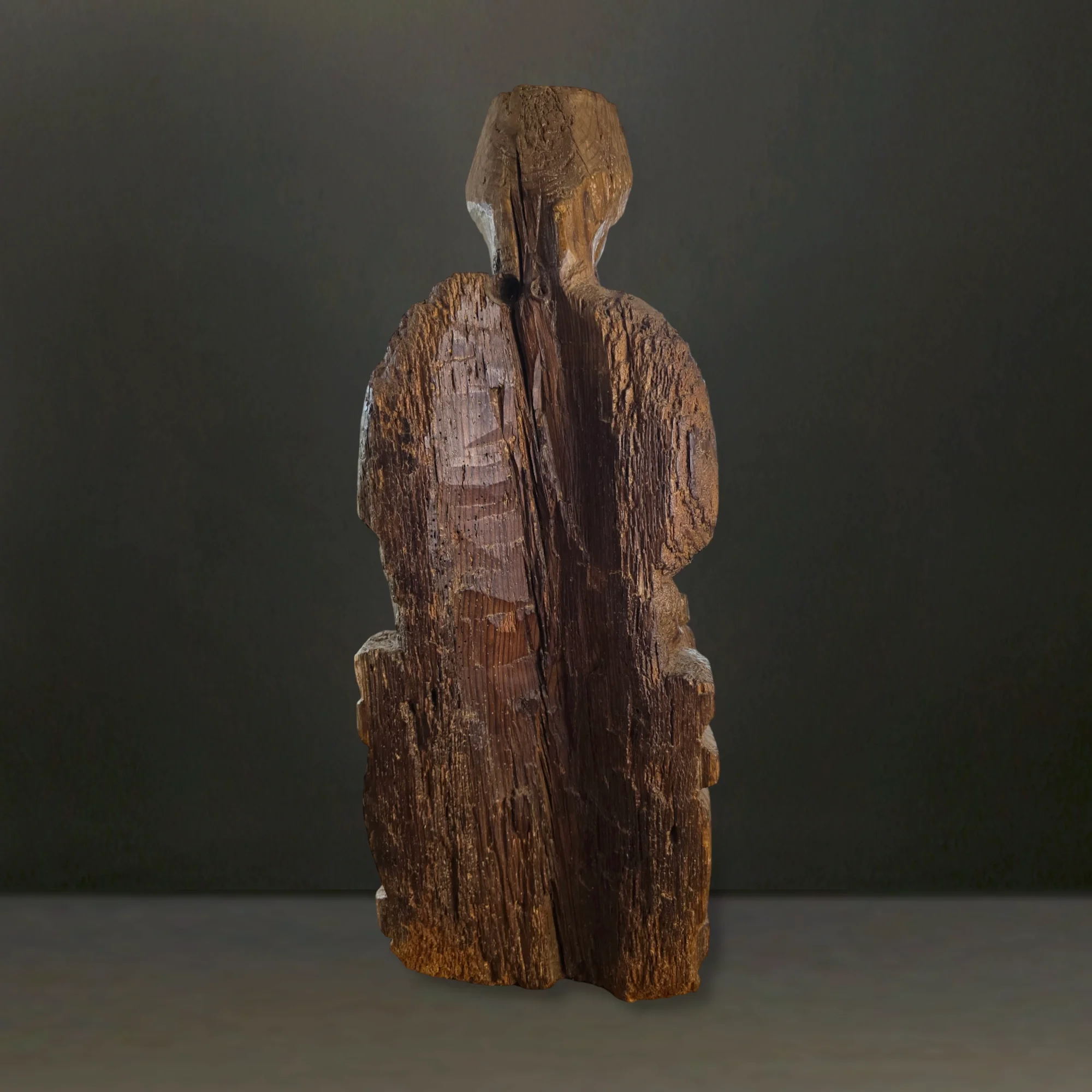
| Material: | pine wood, hollowed back |
| Dimensions: | H. 71.2cm |
| Proposed Origin: | Pyrenees, France or Spain |
| Dating: | 13th century |
| Provenance: | Iberian private collection |
| Condition: | cracks and losses visible on the arms, woodworm damage |
| Reference: | 288 |
Description
This work belongs to the Romanesque tradition of Virgins in Majesty (Sedes Sapientiae or Throne of Wisdom), typical of the Pyrenean mountain areas. The Virgin is depicted seated on a throne-bench with molded side posts and presents Christ standing on her left knee. Mary observes a frontal, hieratic position characteristic of Romanesque virgins. This hieraticism is reinforced by the oval shape of the Virgin's face with its slightly prominent almond-shaped eyes. The veiled head was once encircled by a crown, now missing. The treatment of the body, however, heralds Gothic influences: the chest and hips are slightly defined.
Far from the naturalistic features of childhood, Christ is depicted standing, breaking with the more classic scheme of the seated Child, which accentuates His sovereign dimension. His face, with its assertive proportions, directly echoes Mary's physiognomy, creating visual and spiritual unity between Mother and Son. The left arm, folded against the chest, originally supported the Book of Gospels, while the right hand would have dispensed the blessing.
The treatment of the drapery is characteristic of the late Romanesque style. Below the Virgin's belt and its pendant, one observes "V"-shaped folds followed by simple vertical folds. This geometric and vigorous schematism extends to and finds its resonance in Christ's long tunic, whose vertical and parallel incisions accentuate the rectitude of His posture. The treatment of Christ's hair and His slight curl (dorelot) anchor the creation of the work in a phase of stylistic evolution specific to the late Romanesque, likely in the first half of the 13th century.
Through its formal austerity and material, this piece is akin to the productions of rural Pyrenean workshops. It shares stylistic affinities with the Virgins of the Cerdanya and Conflent regions, where the persistence of Romanesque models was maintained late. Its size of 71 cm makes it a substantial piece, originally intended to reign at the center of an altar or an apsidal niche.
Geographic and Stylistic Context
The high Pyrenean valleys, and more specifically the historical comarcas of Cerdanya and Conflent (current department of Pyrénées-Orientales), constitute one of the richest and most singular centers of Romanesque wood carving in Western Europe. Between the 12th and 13th centuries, this mountainous region, a true crossroads of influences between the Languedoc area and Catalonia (notably the bishoprics of Urgell and Elne, and major abbeys like Saint-Michel de Cuxa or Saint-Martin du Canigou), saw the flourishing of an abundant production of devotional statuary.
Local sculptors favored endemic species from the Pyrenean forests, such as pine, alder, or walnut. The back of the works was almost systematically hollowed out, as in this piece, to facilitate the drying of the heartwood and to limit desiccation cracks.
In the first half of the 13th century, in remote regions like Cerdanya, workshops retained the structural rigor of Romanesque art while progressively integrating new iconographic formulas: a relative softening of features, the introduction of specific morphological details (such as the curl/dorelot), or the dynamization of the Child's posture (shifting from a strict seated position to a standing one).
Comparison Corpus and Dating
The typology of the Child standing on the Virgin's left knee constitutes the fundamental stylistic and chronological marker of this sculpture. Comparing our piece with other Romanesque and pre-Gothic Virgins from the Pyrenean and Catalan sphere allows us to firmly anchor its creation in the first half of the 13th century.
The work can be compared to the Virgin Mare de Déu del Bosc (Espunyola), a piece unfortunately lost and dated to the early 13th century. As on our example, the Virgin there observes a strict Romanesque frontality, while Christ stands on the left knee. This similarity in posture confirms that our sculpture belongs to this same pivotal period of formal innovation.
The success of this iconographic variant (the standing Child) within regional workshops is attested by several major 13th-century works. The Virgin of Alcoletge (Museum of Lleida) and the Virgin of Esterri d'Àneu (lost work) perfectly illustrate the durability of this model. Although their style shows a very slight Gothic softening, one finds the exact off-center and vertical positioning of Christ.
The geographic anchoring of this tradition is verified even in slightly later productions from the local valleys, as seen in the statue of Notre-Dame-de-Serrabone (preserved in the church of Saint-Saturnin in Boule-d'Amont). Dated to the 13th/14th century, it demonstrates how the Conflent workshops assimilated and durably preserved this dynamic of the Child standing on the maternal knees.
The V-shaped folds at the bottom of the dress and the position on the throne-bench are also found on the Virgin in Majesty of the Mercedarian Convent (Perpignan), also dated to the 13th century.
Ultimately, the vigorous archaism of our Virgin's drapery, combined with the innovative posture of the standing Christ, allows us to determine that this work is contemporary or slightly earlier than the aforementioned works, placing it in the first half of the 13th century, at the heart of the Catalan-Pyrenean creative center.
Bibliographical References
- • Vierges à l'enfant médiévales de Catalogne, Corpus des Vierges à l'enfant (XIIe-XVe s.) des Pyrénées-Orientales, Subes Marie-Pasquine, Mathon Jean-Bernard, 2013.
- • Romanes et gothiques: Vierges à l'enfant restaurées des Pyrénées Orientales, JB Mathon, 2011.
- • Les Vierges en Comminges, inventaire, étude et restauration, Nicole Andrieu, 2013.
- • Catalunya Romànica, Vigué Jordi, Pladevall Antoni (dir.), Barcelona, Fundació Enciclopèdia Catalana, 1984-1998.