
Origin : Normandy, France.
Medium : Limestone.
Size : H. 44 × W. 38 × D. 17 cm
Period : First half of the 12th century.
Condition : Visible losses and erosion.
Price : on demand
REF. 303
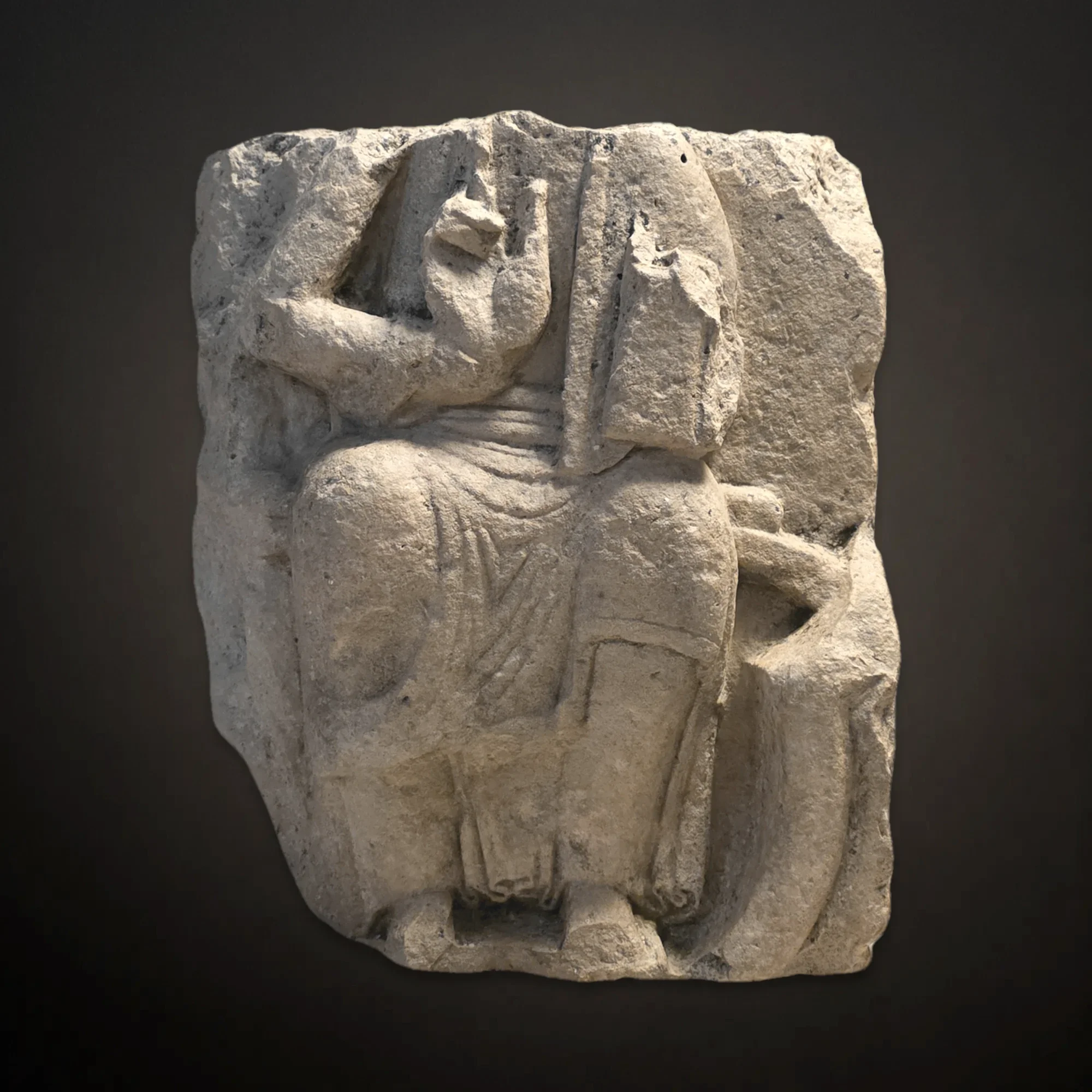
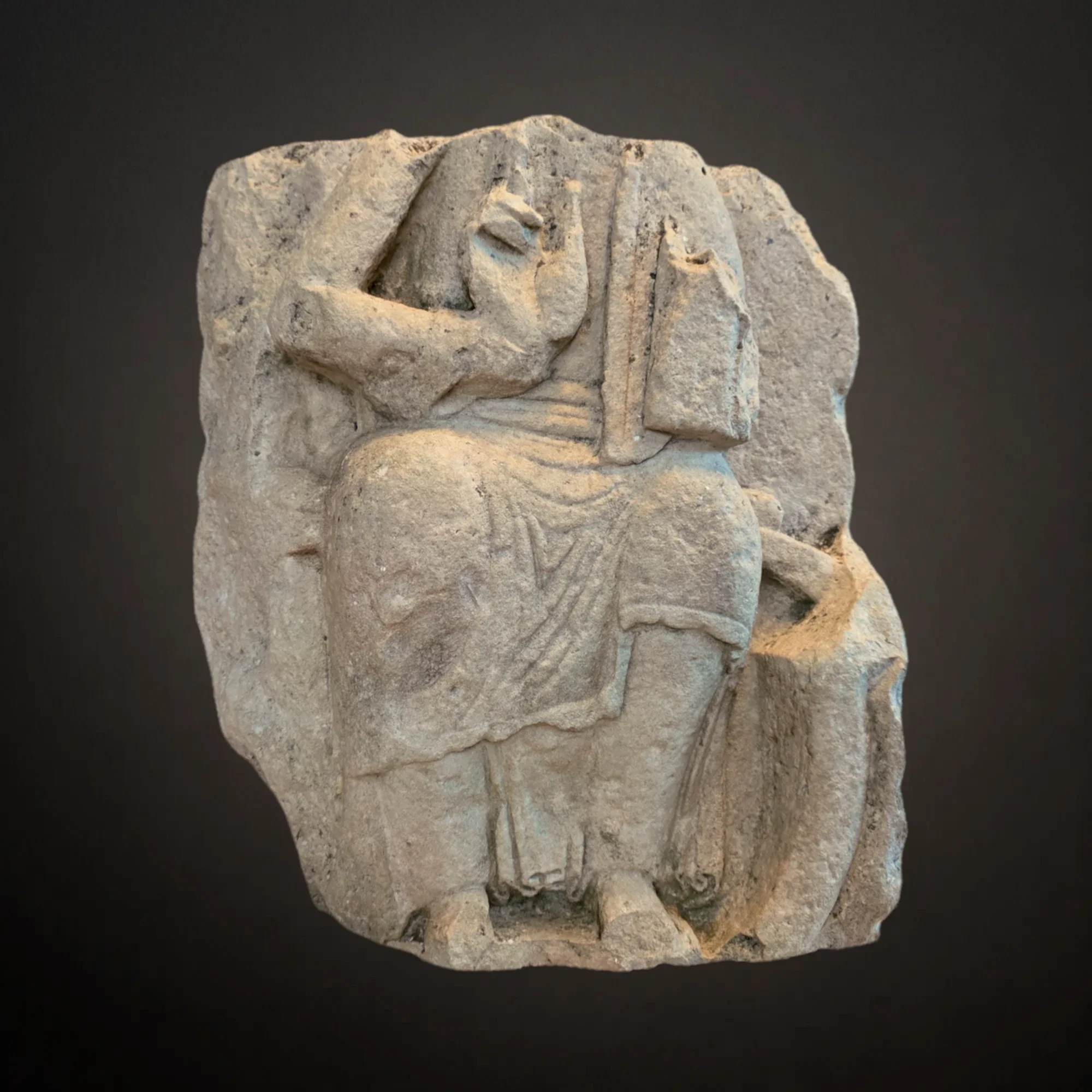
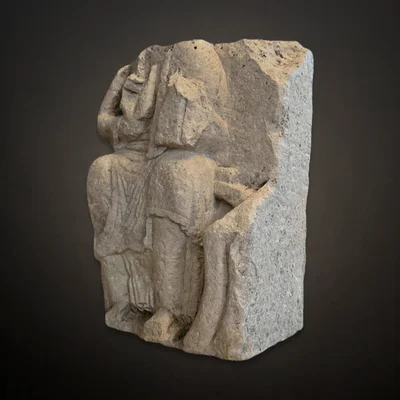
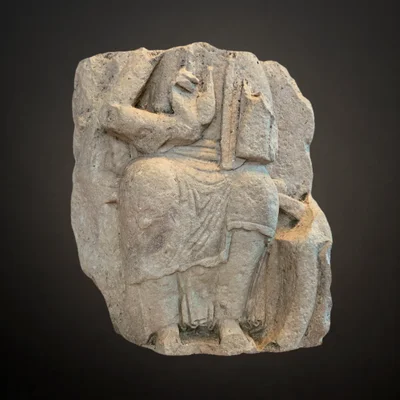
Christ in Majesty, Romanesque sculpture. Normandy, first half of the 12th century.
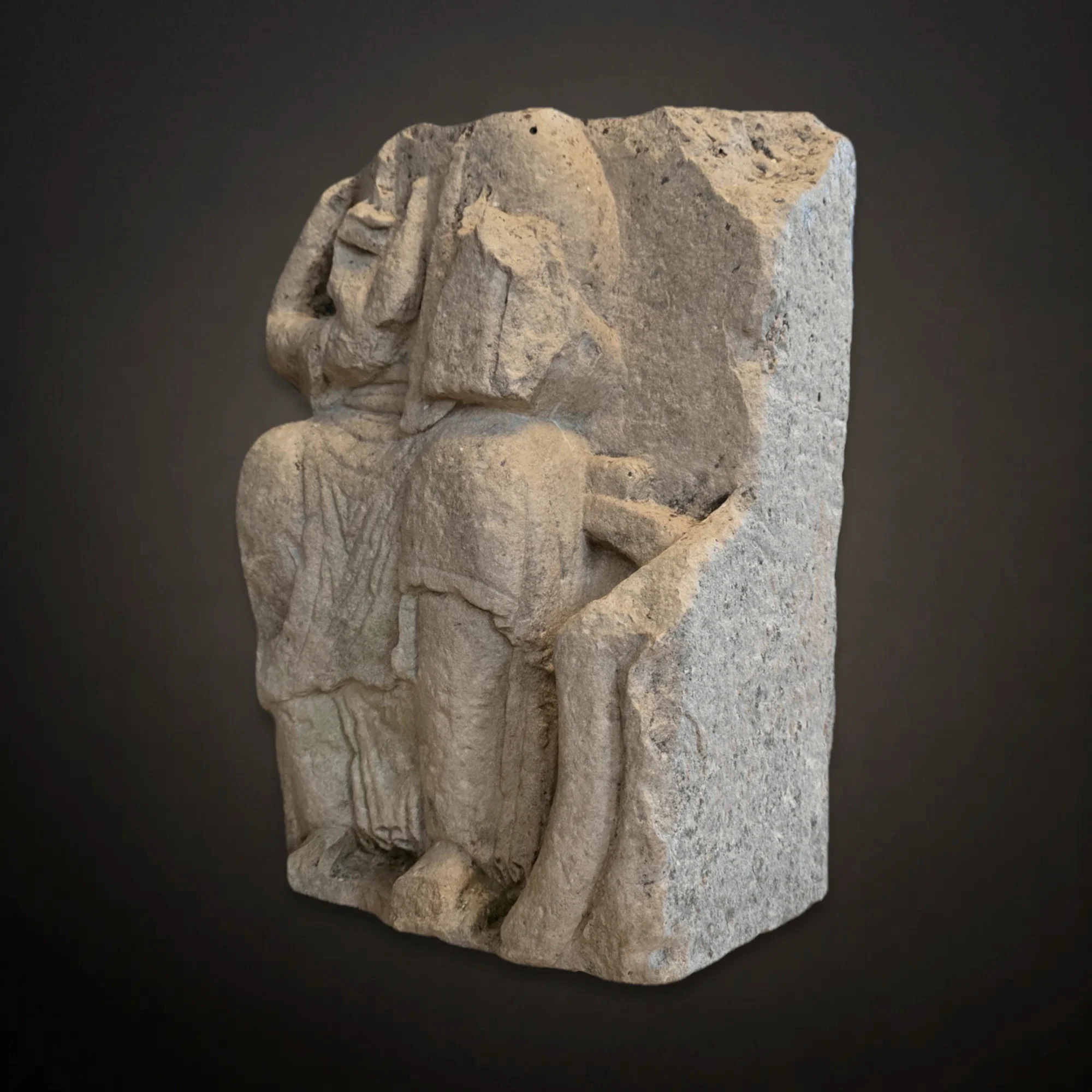
This Romanesque Christ in Majesty is carved in limestone in high relief. Christ is seated frontally on a throne, his right arm raised in blessing and holding the Book in his left hand. The head and part of the torso are missing. He wears a long tunic beneath a mantle. The strongly rounded knees, projecting forward, present broad surfaces almost devoid of folds. Between them, the mantle forms a series of deeply incised diagonal folds radiating from the upper part of the left thigh. Above the knees, shorter folds run horizontally across the garment. Beneath the hemmed edge of the mantle, the tunic displays vertical folds with curled ends. Parts of the curved throne survive on either side of Christ. An arc preserved at the lower left and the beginning of a second curve suggest a double or polylobed mandorla. The sculpture may originally have belonged to a Romanesque portal or a façade niche. The modelling of the knees, the arrangement of the drapery and comparisons with several Norman sculptures suggest a date in the first half of the 12th century.
The Saint-Aubin Bible of Angers, produced in the last quarter of the 11th century (Angers, Municipal Library, MS 4, fol. 208), presents iconography very close to that of our sculpture in the representation of the throne and mandorla.
Romanesque sculpture in Normandy developed during the 11th and 12th centuries alongside the major ecclesiastical building campaigns at Bernay, Jumièges, Caen, Bayeux and Cerisy-la-Forêt. In her study Les origines et les premiers développements de la sculpture romane en Normandie (1992), Maylis Baylé demonstrated the coexistence of several carving traditions, ranging from decoration in low relief to figures with more strongly projecting volumes.
Comparable examples can thus be found in Normandy, particularly in the modelling of the body and the treatment of the drapery.
A capital from the Romanesque cathedral of Bayeux (c. 1060), depicting God in Majesty flanked by two seraphim, provides an early Norman reference. It shows God blessing within a double mandorla. The Christ in Majesty discovered in 2013 in the masonry of the Archbishop’s Palace in Rouen, dated to the 11th–12th centuries, offers a comparison for the strongly projecting knees and the broad, smooth surfaces of our relief.
The church of Notre-Dame-du-Grand-Vivier at Torigni-sur-Vire, where our sculpture was formerly kept on private property, preserves three reused Romanesque reliefs: a victorious horseman, a Virgin and Child, and a Christ in Majesty. The Virgin and Child, also dating from the 12th century, presents rounded knees and folds of drapery comparable to those of our sculpture. Considered alongside the Norman corpus of the late 11th and first half of the 12th century, these features favour a date in the early decades of the 12th century. An origin in Normandy, probably in the western part of the duchy, remains the preferred attribution.
Full dossier and study available upon request.
References consulted:
· Maylis Baylé, Les origines et les premiers développements de la sculpture romane en Normandie, Caen, Art de Basse-Normandie, no. 100 bis, 1992.
· Maylis Baylé, Aspects de la sculpture normande autour de 1100 : à propos de Graville-Sainte-Honorine, Annales de Normandie, 29, 1979, pp. 157–178.
· Maylis Baylé, Chapiteaux provenant de la cathédrale de Bayeux, Bulletin de la Société nationale des Antiquaires de France, 1977 proceedings, published in 1980, pp. 45–50.
· Louis Grodecki, Les débuts de la sculpture romane en Normandie. Bernay, Bulletin monumental, vol. 108, 1950, pp. 7–67.
· Dominique Pitte, Un Christ en majesté découvert à l’archevêché de Rouen, Patrimoine Normand, no. 88, 2014.
· Jean Fournée, À propos d’une sculpture romane de l’église Notre-Dame de Torigni-sur-Vire ayant pour thème le cavalier victorieux, Cahiers Léopold Delisle, 1975, no. 2, pp. 23–35.
· Julien Deshayes, Église Notre-Dame, Orglandes, Pays d’art et d’histoire du Clos du Cotentin, heritage study.
· Marcello Angheben, Le portail royal du Mans et l’évolution de la première sculpture gothique entre les façades de Dijon et de Chartres, Cahiers de civilisation médiévale, vol. 60, 2017, pp. 27–58.
In-depth study of the artwork
| Subject: | Christ in Majesty in high relief |
|---|---|
| Material: | limestone |
| Dimensions: | height 44 cm; width 38 cm; depth 17 cm |
| Origin: | France, Normandy |
| Date: | first half of the 12th century |
| Provenance: | private property in Normandy, Torigni-sur-Vire (Manche) |
| Condition: | losses and erosion |
| Reference: | 303 |
Description
This limestone high-relief fragment represents Christ in Majesty, seated frontally on a throne, his right arm raised in blessing and the Book held in his left hand. Despite the loss of the head and part of the torso, the composition retains a strong presence and remains highly legible, emphasized by the projecting knees and the depth of the relief.
Christ wears a long tunic covered by a mantle whose folds are organized around the legs. The powerfully rounded knees project forward and are treated as broad, relatively smooth surfaces. Between them, the fabric is drawn into a bundle of deeply incised oblique folds radiating from the upper part of the left thigh. Other, shorter and almost horizontal folds cross the garment above the knees. The mantle ends in a hemmed border, beneath which appears the tunic, animated by vertical folds ending in small curls.
The throne remains partly visible on either side of Christ. This type of curved seat has precedents in late 11th-century iconography, notably in the Saint-Aubin Bible from Angers, circa 1075-1100 (Angers, Bibliothèque municipale, ms. 4, fol. 208).
Christ is enclosed within a mandorla, of which one arc survives at lower left. The beginning of a second curve suggests a double mandorla or a polylobed glory, iconographic formulas also attested in the late 11th and early 12th centuries.
The sculpture is now fragmentary. Its upper part was broken and flattened, resulting in the loss of the head and part of the original composition. The top of the block has been reworked with a point, indicating a secondary intervention probably intended to facilitate reuse in masonry. The carved surfaces show old erosion, more pronounced in the upper areas and on the most exposed volumes. The drapery, legs and elements of the throne nevertheless remain remarkably legible.
This high relief may have come from a Romanesque portal, possibly a tympanum. Other original settings are nevertheless possible. At Saint-Sauveur-de-Pierrepont, a Christ in Majesty was preserved in a niche of the former church. At Saint-Benoît-sur-Loire, Dom Jean-Marie Berland proposed identifying a fragment preserving the lower part of a Christ in Majesty as part of a Romanesque altar frontal.
Condition
In addition to the major losses affecting the head, part of the torso and most of the mandorla, there are losses to Christ's fingers and to the Book.
The surface shows old erosion, particularly pronounced on the projecting areas. The top of the block was reworked with a point, probably when the sculpture was reused architecturally.
Geographical and stylistic context
The work belongs within the context of Norman Romanesque sculpture, whose development accompanied the major religious building campaigns undertaken under the dukes of Normandy during the 11th and 12th centuries. The abbeys of Bernay, Jumièges, Caen and Cerisy-la-Forêt bear witness to the activity of regional workshops and the diversity of their sculptural traditions.
In her fundamental study Les origines et les premiers développements de la sculpture romane en Normandie (1992), Maylis Baylé distinguishes two main tendencies: surface sculpture with essentially linear and geometric decoration, often close to manuscript illumination, and sculpture in more pronounced relief, in which the volumes are more fully released. These traditions coexisted during the 11th century and continued, with various developments, into the first decades of the 12th century.
The present Christ combines these two conceptions. The figure is constructed around the strongly projecting knees, whose rounded volumes contrast with the linear drawing of the garments. The deeply incised radiating folds of the mantle organize the fabric into oblique bundles, while the lower tunic retains relatively rigid vertical folds ending in small curls. The sculpture was thus organized in three registers: head, torso and lower body. The now-lost mandorla must have reinforced this arrangement.
Figural sculptures preserved in Norman buildings of the late 11th and early 12th centuries, notably at Caen, Bayeux and in former religious establishments in the Bessin, attest to the persistence of schematic forms and conventions inherited from the sculpture of the previous century.
The first half of the 12th century therefore appears to provide a coherent chronological horizon, although no precise workshop can yet be identified. The projection of the knees, the oblique folds of the mantle and the vertical folds of the tunic favour this period rather than the second half of the century.
Iconographic context: mandorla and throne
The iconography of Christ in Majesty belongs to an ancient tradition deriving notably from Carolingian and Ottonian art. Christ appears as sovereign of the universe, seated on a throne or on an arc symbolizing the heavens, surrounded by a glory manifesting his divine nature.
This glory does not always take the form of an oval mandorla. Medieval representations also use double mandorlas formed by two curves or superimposed circles, as well as polylobed outlines. The distinction between the glory and the seat can sometimes be difficult to establish, since some compositions combine several concentric or intersecting arcs.
The Saint-Aubin Bible from Angers, produced in the last quarter of the 11th century (Angers, Bibliothèque municipale, ms. 4, fol. 208), offers a particularly interesting example of this tradition. Christ in Majesty appears within a composition combining an arched throne and a quadrilobed mandorla.
A second comparison is provided by the celebrated lintel of Saint-Génis-des-Fontaines, dated by its inscription to 1019-1020. Christ appears at the centre of a double mandorla whose inner curve contributes to the representation of his seat. This arrangement is attested in architectural sculpture from the beginning of the 11th century, although the lintel, carved in low relief, differs markedly from the present work.
The Saint-Denis relief from the chapel of Saint-Firmin, described by the Institut national d'histoire de l'art as a seated Christ within a quadrilobed mandorla, likewise illustrates the variety of framing devices used for representations of Christ in Majesty.
On the present sculpture, the remains of an arc at lower left and the beginning of a second curve suggest a double or polylobed mandorla. The throne, of which curved lateral elements survive, is distinct from this framing device. The arrangement is very close to that of the Angers folio.
The antiquity of these formulas does not in itself constitute a dating argument. Their presence nevertheless remains consistent with a work produced in the first half of the 12th century.
The Torigni-sur-Vire context
The provenance of the work from a former private property at Torigni-sur-Vire in the Manche provides an interesting element for its geographical study.
The church of Notre-Dame-du-Grand-Vivier in the same locality preserves several examples of Romanesque sculpture, including three figural reliefs: a victorious horseman, traditionally interpreted as Constantine, a Virgin and Child, and a Christ in Majesty. These works, now preserved in reuse, attest to the existence of Romanesque sculptural decoration in this locality.
The Christ in Majesty at Notre-Dame-du-Grand-Vivier is of particular interest for the present study. Carved in limestone, it likewise shows Christ within a mandorla. It is currently set into the exterior south wall of the nave. The Palissy record of the French Ministry of Culture dates it to the last quarter of the 12th century, later than the date proposed for the present relief.
This comparison should therefore be regarded primarily as iconographic and geographical, not as proof of a common origin or workshop relationship. It nevertheless confirms the presence of this iconography in Romanesque architectural sculpture in the region where the fragment was preserved.
It would nevertheless be premature to connect the fragment with Notre-Dame-du-Grand-Vivier or with any particular building at Torigni-sur-Vire. Its earlier provenance remains unknown, and its preservation in a local property is not sufficient to establish its place of origin.
Taken together, these observations nevertheless support a Norman origin as the preferred hypothesis. The treatment of volumes and drapery, combined with an iconographic formula inherited from earlier traditions, is consistent with a work produced in the first half of the 12th century, probably within the context of workshops active in western Normandy during the first decades of the century.
Comparative corpus and dating
Several representations of Christ in Majesty preserved in Normandy allow comparison of the composition and treatment of the garments. Other ensembles, notably at Chartres and Le Mans, display comparable folds but generally belong to a later period.
Bayeux, capital with God in Majesty
The capital with God in Majesty from the Romanesque cathedral of Bayeux, studied by Maylis Baylé and datable between the 1050s and 1080s, provides one of the earliest landmarks. The blessing figure is enclosed within a double glory and flanked by two seraphim. The garment has closely set folds that continue over the legs. The present Christ differs through much more projecting knees that are almost devoid of folds. The Bayeux capital nevertheless attests to the presence of the double mandorla in Norman sculpture from the second half of the 11th century.
Rouen, Christ in Majesty from the Archbishop's Palace
The Christ in Majesty discovered in 2013 within masonry at the Archbishop's Palace in Rouen provides another reference. Carved in Caen stone and dated to the 11th-12th centuries, it may have come from the former Romanesque cathedral. Its face was mutilated and the figure was probably completed by other blocks. Oblique folds cross broad, sparsely detailed surfaces. The present relief likewise alternates between relatively smooth areas and deeply incised folds, and shares the rounded volume of the knees. The two sculptures nevertheless differ in bodily proportions and the arrangement of the fabrics. Their reuse in later masonry is another point in common.
Saint-Sauveur-de-Pierrepont
In the Manche, the Christ in Majesty at Saint-Sauveur-de-Pierrepont offers a closer comparison for the legs and drapery. The figure is seated within a mandorla, blessing with the right hand and presenting the Book with the left. The knees are rounded, with broad relatively smooth surfaces. The mantle unfolds in oblique folds, less tightly grouped between the legs than on the present sculpture. The dating of the relief remains debated, 12th century or later. It should therefore be retained only as a stylistic comparison and not as a chronological landmark.
Notre-Dame de Savigny
The Christ in Majesty at Notre-Dame de Savigny, also in the Manche, shows Christ enthroned, blessing and holding a long-staffed cross. The garment folds are arranged in parallel curves around the legs. They are more regular and the relief is less projecting than in the present Christ. The sculpture is dated to the 12th century.
Notre-Dame d'Orglandes
The tympanum of Notre-Dame d'Orglandes represents Christ seated within a mandorla, surrounded by the Tetramorph, blessing and holding the Book. Julien Deshayes proposes a date no earlier than the 1150s-1160s. The knees project less than those of the present relief, while the folds of the mantle are distributed over a larger part of the legs. Orglandes chiefly provides an example of this iconography on a Norman Romanesque portal of the second half of the 12th century.
Torigni-sur-Vire, Notre-Dame-du-Grand-Vivier
Two other representations are preserved at Notre-Dame-du-Grand-Vivier in Torigni-sur-Vire: a Christ in Majesty and a Virgin and Child. The former, enclosed within a mandorla, is dated by the Palissy record to the last quarter of the 12th century. Its eroded condition limits examination of the garments. On the Virgin, the rounded knees and certain folds in the lower part of the dress can be compared with the present relief despite the wear of the stone. These two works are particularly relevant because of their location at Torigni-sur-Vire, although no common origin can be established.
Chartres, Royal Portal
Beyond Normandy, the Christ in Majesty on the central tympanum of the Royal Portal at Chartres, circa 1145-1155, wears a mantle arranged in horizontal and oblique folds around the legs. Beneath its lower edge appear the vertical folds of the tunic. The layering of garments is comparable on the present sculpture, but the knees remain more exposed and the folds are more concentrated between the thighs.
Le Mans, south portal of Saint-Julien Cathedral
The south portal of Saint-Julien Cathedral at Le Mans likewise displays draperies whose folds gather into oblique bundles. The comparison concerns chiefly their arrangement and depth. The chronology of the portal, generally placed around the middle of the 12th century, has been debated. As at Chartres, the similarities do not imply a direct influence on the present Christ, which is probably earlier. They nevertheless show that certain features of its drapery also occur in workshops of neighbouring regions.
Proposed dating
The most distinctive feature of the present sculpture remains the treatment of the knees. Broad, rounded and almost devoid of folds, they frame a bundle of oblique incisions descending toward the edge of the mantle. Beneath it, the tunic forms vertical folds ending in small curls. Erosion may have softened some incisions on the most exposed surfaces, but the arrangement of the fabrics remains sufficiently preserved for study.
The Norman corpus places the sculpture in continuity with works of the second half of the 11th century while revealing differences in the projection of the figures and the carving of the drapery. The treatment of the knees and organization of the mantle are compatible with a date in the first decades of the 12th century. Comparisons with Chartres and Le Mans show that certain features of the garments also appear in sculpture from neighbouring regions, generally at a later date.
We therefore retain an attribution to Normandy and a date in the first half of the 12th century, without proposing a specific workshop. The provenance from Torigni-sur-Vire favours western Normandy.
Bibliographical references
- • BAYLÉ, Maylis, Les origines et les premiers développements de la sculpture romane en Normandie, Caen, Art de Basse-Normandie, no. 100 bis, 1992.
- • BAYLÉ, Maylis, “Aspects de la sculpture normande autour de 1100 : à propos de Graville-Sainte-Honorine”, Annales de Normandie, vol. 29, no. 2, 1979, pp. 157-178.
- • BAYLÉ, Maylis, “Chapiteaux provenant de la cathédrale de Bayeux”, Bulletin de la Société nationale des Antiquaires de France, year 1977, published 1980, pp. 45-50.
- • BAYLÉ, Maylis, “Le chapiteau de l'Adoration des Mages à Saint-Paul de Rouen”, Bulletin de la Société nationale des Antiquaires de France, year 1992, published 1994, pp. 108-115.
- • GRODECKI, Louis, “Les débuts de la sculpture romane en Normandie. Bernay”, Bulletin monumental, vol. 108, 1950, pp. 7-67.
- • PITTE, Dominique, “Un Christ en majesté découvert à l'archevêché de Rouen”, Patrimoine Normand, no. 88, January 2014.
- • FOURNÉE, Jean, “À propos d'une sculpture romane de l'église Notre-Dame de Torigni-sur-Vire ayant pour thème le cavalier victorieux”, Cahiers Léopold Delisle, 1975, no. 2, pp. 23-35.
- • BERLAND, Dom Jean-Marie, “Éléments de chancels et des vestiges d'un Christ en majesté découverts à Saint-Benoît-sur-Loire”, Bulletin de la Société nationale des Antiquaires de France, year 1962, published 1964, pp. 116-118.
- • DESHAYES, Julien, Église Notre-Dame, Orglandes, Pays d'art et d'histoire du Clos du Cotentin, heritage study, n.d.
- • KLEIN, Peter, “Les portails de Saint-Génis-des-Fontaines et de Saint-André de Sorède”, Les Cahiers de Saint-Michel de Cuxa, no. 20, 1989, pp. 121-159.
- • ANGHEBEN, Marcello, “Le portail royal du Mans et l'évolution de la première sculpture gothique entre les façades de Dijon et de Chartres”, Cahiers de civilisation médiévale, vol. 60, no. 237, 2017, pp. 27-58.
- • BERNÉ, Damien and PLAGNIEUX, Philippe (eds.), Naissance de la sculpture gothique. Saint-Denis, Paris, Chartres, 1135-1150, Paris, Réunion des musées nationaux-Grand Palais, 2018.