
Origin : Limburg or Upper Guelders.
Medium : Oak wood.
Size : Height 106 cm
Period : circa 1500.
Condition : Losses to the Child’s hands. Right hand of the Virgin restored.
Price : on demand
REF. 294
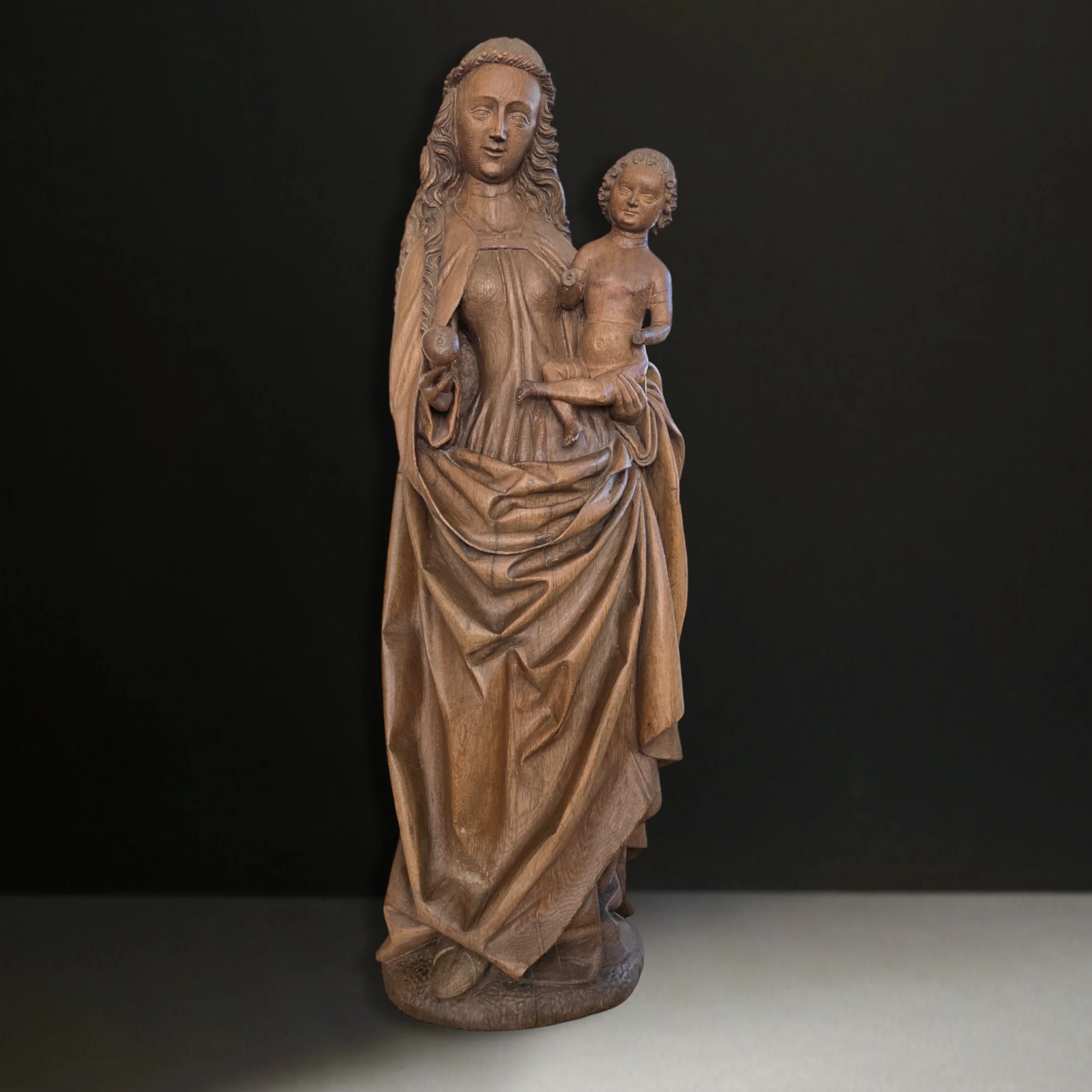
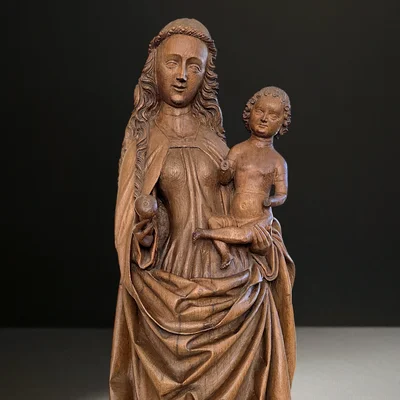
Virgin and Child, Master of Elsloo Group. Limburg or Upper Guelders, circa 1500.
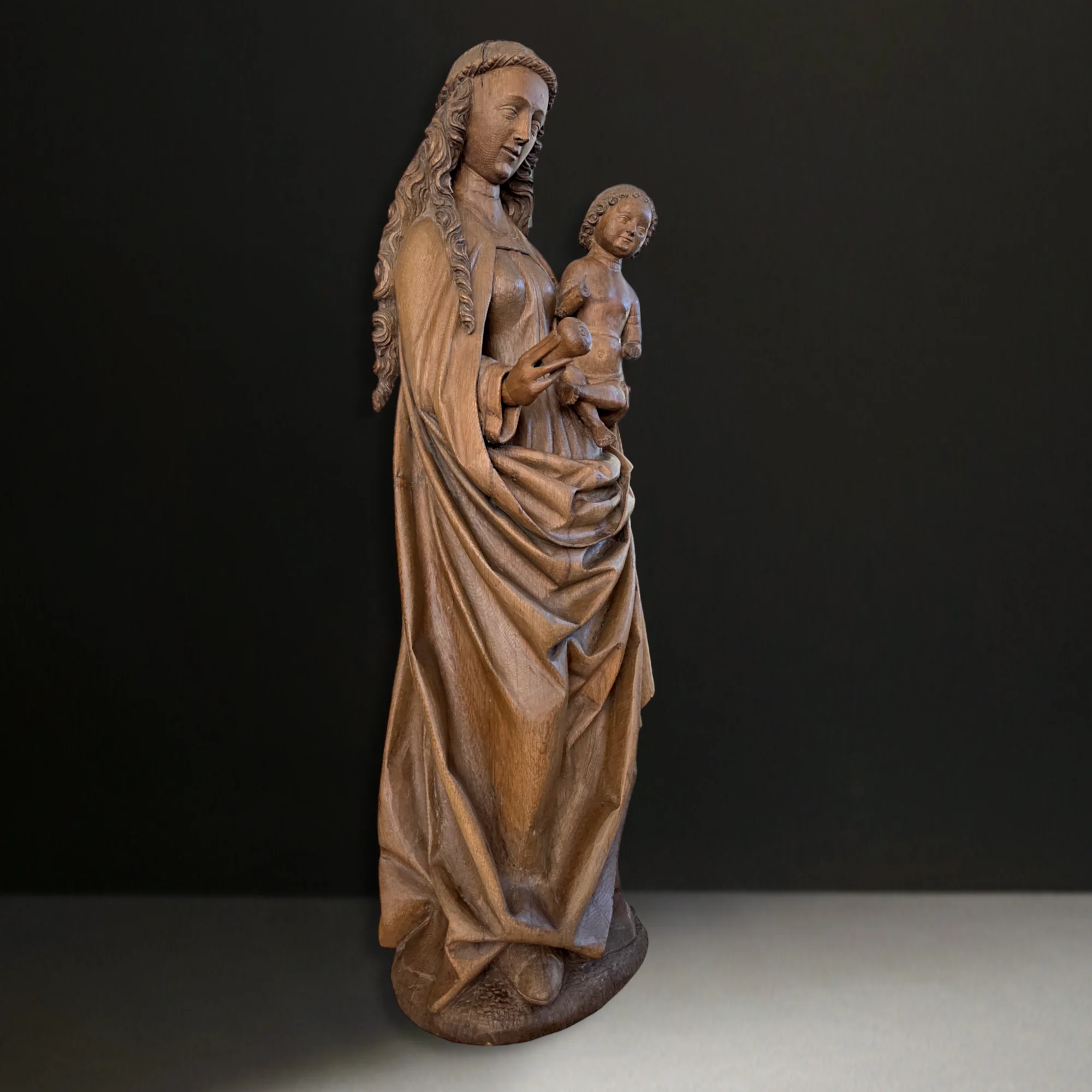
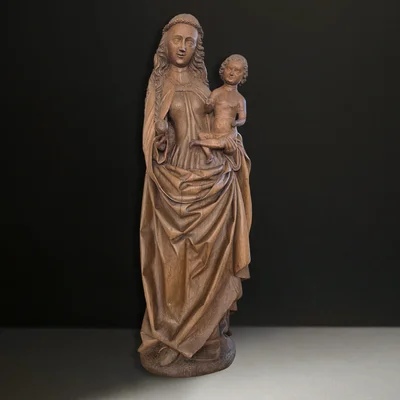
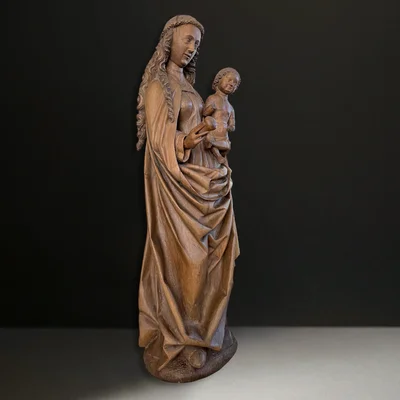
This carved oak Virgin and Child is an important Late Gothic sculpture associated with the Master of Elsloo Group. Measuring 106 cm in height, it originates from Limburg or Upper Guelders, in the former Low Countries, and may be dated to circa 1500. Mary is represented standing, in slight contrapposto, carrying the Child on her left arm. Carved in the round, the figure displays a calm and introspective expression, still recalling the International Gothic style, while the treatment of the body and drapery already announces the fuller forms of the early 16th century. The most significant parallel is the Marianum in the Museum Catharijneconvent in Utrecht, dated circa 1495-1504, together with the Marianums of Venlo and Neer. These comparisons place this Virgin and Child within the Limburg corpus of the Master of Elsloo Group, around 1500, at the transition between the Late Gothic period and the beginning of the 16th century.
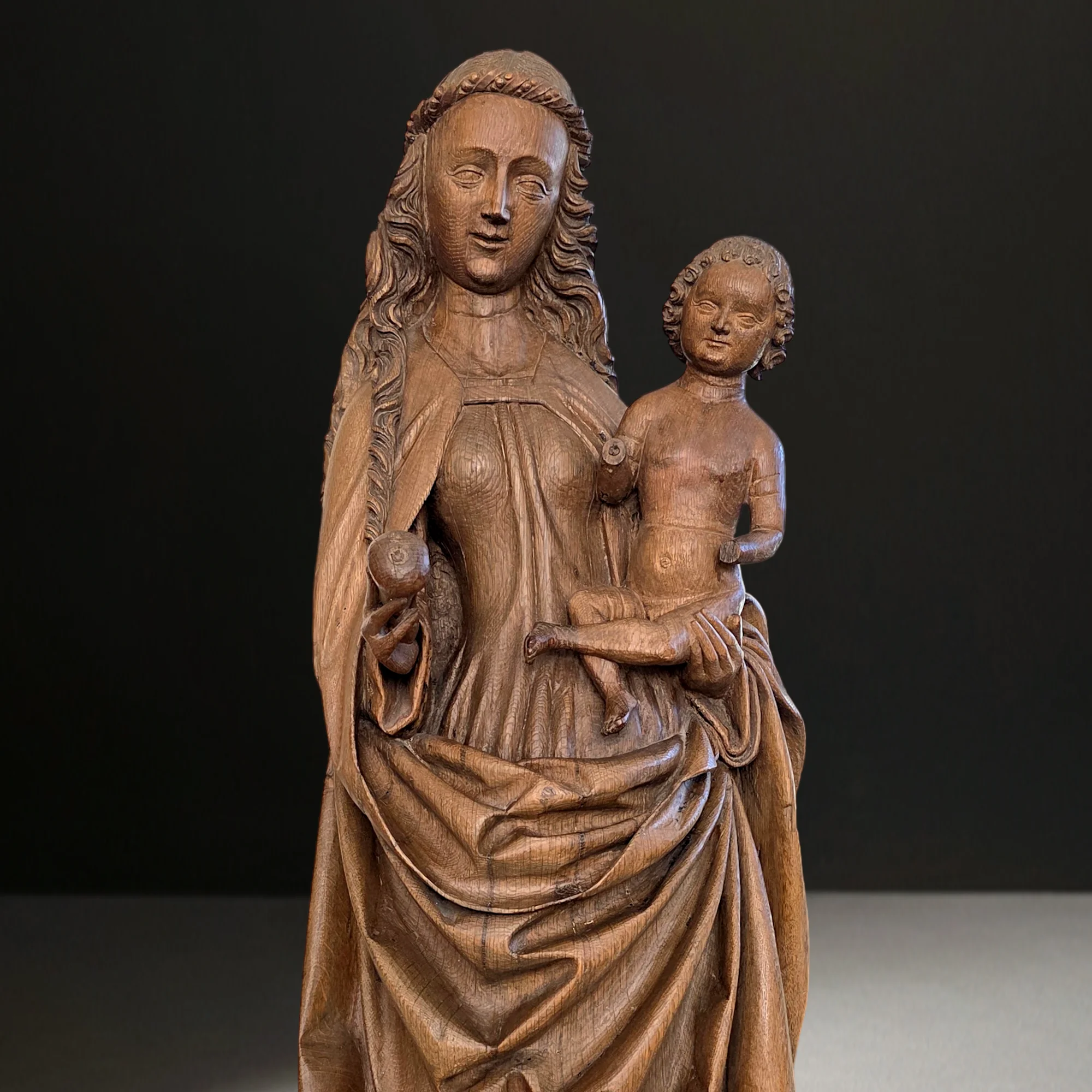
The face of the Virgin, oval and full, is distinguished by a high forehead, heavy eyelids, a straight nose, a small mouth with a discreet smile, and a serene expression. Her long, wavy hair, held by a braided headband, falls on either side of the face.
The mantle, drawn across the front of the body, forms an ample network of oblique, broken and deeply carved folds. This powerful drapery, characteristic of Limburg sculpture around 1500, gives the work a monumental presence while preserving the spiritual balance proper to devotional Virgins.
The Child is one of the most remarkable elements of the work. His nude, short and compact body, cylindrical torso, rounded abdomen, neck marked by horizontal folds, and hair carved in small tight curls strongly connect the sculpture to the earliest creations of the Master of Elsloo Group.
Provenance: former collection of Prof. Dr. Rudolf Schnellbach, director of the Badisches Landesmuseum in Karlsruhe.
Complete dossier and study available upon request.
Works consulted:
· Master of Elsloo. From Lonely Hand to Collection of Masters, Lars Hendrikman, Maastricht, 2019
· A Masterly Hand: Interdisciplinary Research on the Late-Medieval Sculptor(s) Master of Elsloo in an International Perspective: Proceedings of the Conference Held at the Royal Institute for Cultural Heritage in Brussels, Famke Peters (ed.), Brussels 2013
· De Meester van Elsloo. Oppergelders beeldsnijder XVIe eeuw, Hendriks, W. et al., 1974.
In-depth study of the artwork
| Subject: | Virgin and Child, Group of the Master of Elsloo |
|---|---|
| Material: | oak |
| Dimensions: | height 106 cm |
| Origin: | Limburg or Upper Guelders, the Netherlands |
| Date: | c. 1500 |
| Provenance: | Former collection of Prof. Dr. Rudolf Schnellbach, Director of the Badisches Landesmuseum in Karlsruhe |
| Condition: | The Child's hands are missing. The Virgin's right hand has been restored. |
| Reference: | 294 |
Description
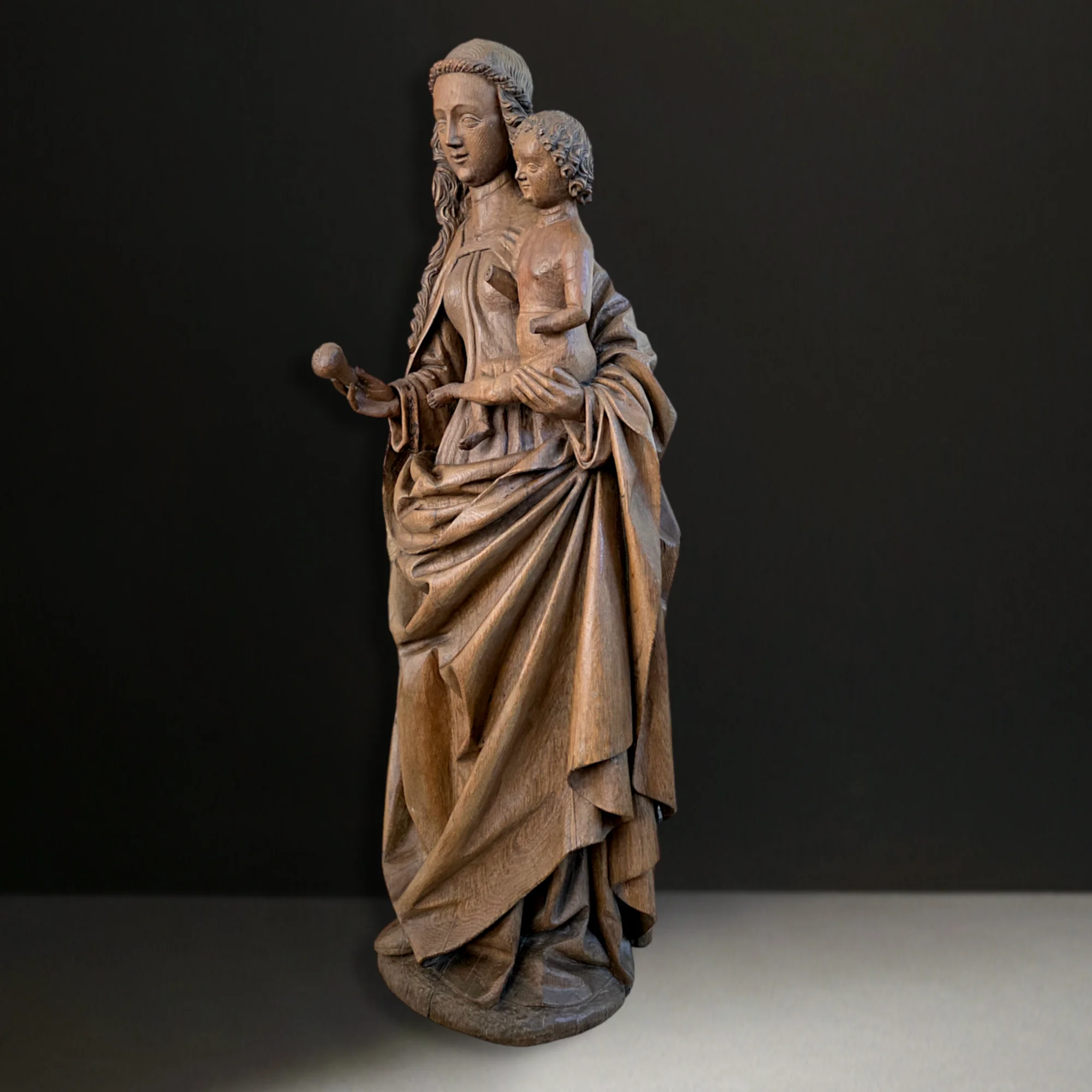
This large oak Virgin and Child depicts Mary standing in a slight contrapposto, holding the Child on her left arm. The figure is carved in the round, yet retains a pronounced frontality typical of Virgins intended to be viewed primarily from the front. The Virgin stands on an integrated oval base, only slightly differentiated from the overall volume.
Mary is shown bareheaded, with long hair falling in wavy locks on either side of her face. A braided band encircles her forehead and partially holds back her hair. Her full, oval face features a high forehead, elongated eyes with heavy lids, a straight nose, a small mouth forming a discreet smile, and a softly rounded chin. The calm, introspective expression still retains something of the International Gothic tradition, while the treatment of the body and drapery already anticipates the fuller forms of the early sixteenth century.
The Virgin wears a dress fitted at the bodice, with a rectangular neckline and vertical folds descending from the chest. The mantle, drawn across the front of the body, forms a broad network of oblique, broken, deeply carved folds. The lower section is particularly structured: a large transverse fold crosses the composition, while the lateral folds unfold in angular cascades. This contrast between the calm of the upper body and the animated mantle gives the work its monumentality.
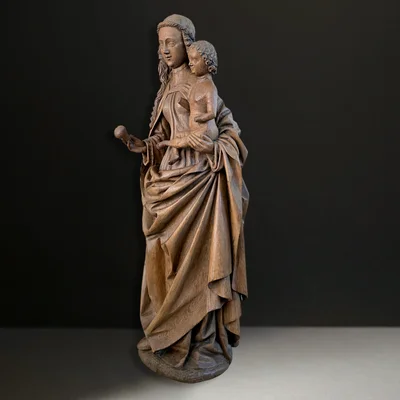
The nude Child sits sideways on Mary's left arm. His short, compact body, with its cylindrical torso and rounded abdomen, is one of the sculpture's most characteristic features. Horizontal folds mark the neck; the head is compact, and the hair is rendered as small, tight, rounded curls. The lively legs are arranged asymmetrically: one rests on the drapery, while the other projects almost horizontally in front of the Virgin's body. This deliberately stylised anatomy, at once archaic and expressive, closely relates the work to the earliest creations of the group of the Master of Elsloo.
The right hand, restored at a later date, shows Mary holding a spherical fruit. The Child probably originally took part in this gestural dialogue with his arms, which are now incomplete.
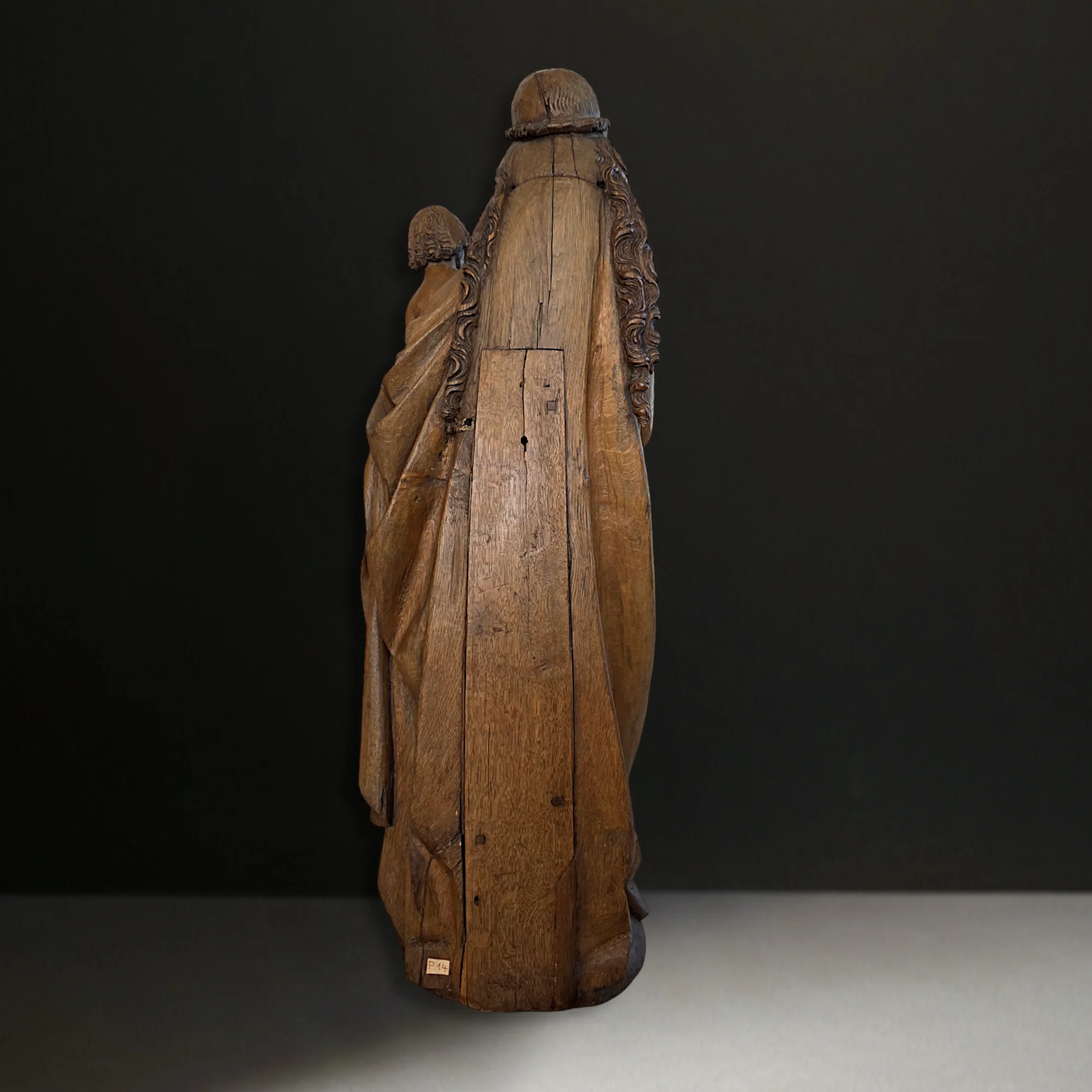
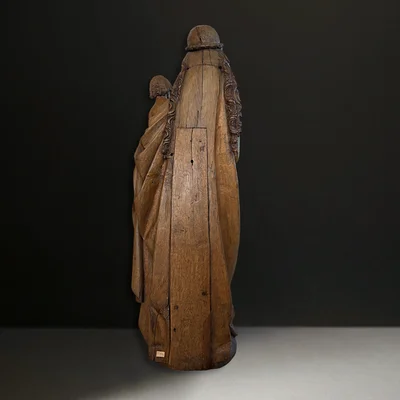
The back reveals a hollowed structure, subsequently closed with oak boards. Hollowing out the trunk was standard practice in the fifteenth and sixteenth centuries to prevent the wood from splitting. The closure of the reverse with an oak board is probably a later alteration intended to make the sculpture freestanding.
Finally, this sculpture from the collection of Prof. Dr. Rudolf Schnellbach bears an old collection label, “P14”.
Geographical and Stylistic Context
This Virgin and Child belongs to the artistic context of Limburg and Upper Guelders, within the contact zone between the Meuse and the Lower Rhine where, at the end of the fifteenth century, the traditions of the Low Countries, the Rhine-Meuse region, and western Germany intersected. This region, which notably includes the artistic centres of Roermond, Maaseik, Venlo, Sittard, and their surroundings, occupies a distinctive place in Late Gothic sculpture. It developed a sculptural language of its own, distinct both from the more urban and narrative workshops of Brabant and from Swabian or Franconian production, which was more often carved in limewood.
The use of oak is an important initial indication of geographical origin. It links the work to the sculptural traditions of the Low Countries and the Lower Rhine, where this material predominated in the production of altarpieces and devotional statues. The fully three-dimensional carving, hollowed back, monumental structure, and now stripped surface are all consistent with workshop practices in this region around 1500. The sculpture thus belongs to an artistic environment in which Late Gothic forms remained vigorous while incorporating a new interest in bodily presence and volume.
Stylistically, the work belongs to the corpus of the Master of Elsloo or, more precisely, in light of recent scholarship (see Lars Hendrikman), to the group of the Master of Elsloo. This conventional designation probably refers not to a single sculptor but to a group of workshops active in Limburg and Upper Guelders around 1500–1530. The group is characterised by a highly recognisable female type: an oval face, high forehead, long lowered eyelids, straight nose, small composed mouth, and a gentle, slightly introspective expression. The abundant hair falls in deeply carved, wavy locks on either side of the face. These characteristics are clearly present in this Virgin, particularly in the braided headband, the long lateral locks, and Mary's serene physiognomy.
The drapery also forms part of this vocabulary. The dress, relatively restrained around the bodice, is animated by closely spaced vertical folds, while the mantle develops into broad oblique and broken sections. The folds create powerful diagonals, V-shaped returns, and deep lateral cascades. This contrast between the verticality of the figure and the agitation of the mantle is characteristic of Late Gothic sculpture from Limburg, where the movement of the fabric creates a decorative dynamism without disrupting the frontality of the devotional image.
The most revealing feature, however, remains the treatment of the Child. His nude, short, compact body, with a cylindrical torso, rounded abdomen, neck marked by horizontal folds, and compact head covered with small rounded curls, belongs fully to the vocabulary of the early Elsloo group. This deliberately stylised anatomy, still archaic in its proportions yet highly animated in attitude, finds a particularly convincing parallel in the Marianum in the Museum Catharijneconvent, Utrecht, dated 1495–1504 and associated with the Master of Elsloo. As in that example, the Child is not treated as a classical or idealised figure, but as a dense, mobile, almost tangible body whose expressive presence plays an essential role in the composition.
This close relationship with the Utrecht Marianum suggests placing the sculpture in a relatively early phase of the corpus, around 1500 rather than among the group's later developments. The still compact vigour of the Child, the noble simplicity of the Virgin's face, and the clear structure of the drapery all point to a work close to the earliest formulations of the Elsloo idiom, before it spread into more fluid and repetitive variants.
The sculpture thus differs from contemporary Franconian or Swabian works, which are often more nervous in their treatment of faces and more graphic in the angular breaks of the drapery. It also differs from Brabantine Virgins, which are generally more theatrical and more closely connected with the aesthetics of export altarpieces. Here the monumentality remains calm, almost meditative, while the detail of the Child and the richness of the folds introduce a strong sculptural individuality.
Through its material, structure, facial type, wavy hair, drapery arranged in broad oblique folds, and above all the highly characteristic body of the Child, this Virgin and Child should therefore be placed within the Limburg and Upper Guelders milieu of the group of the Master of Elsloo, at the turn of the fifteenth and sixteenth centuries. It bears witness to a transitional moment in which the spiritual force of the Late Gothic tradition remained fully present while sculpture acquired a more direct and tangible bodily presence.
Comparative Corpus and Dating
The attribution of this Virgin and Child to the group of the Master of Elsloo rests on a particularly coherent body of comparisons. Rather than being related to a single isolated model, the work should be placed within a Limburg and Upper Guelders corpus in which several common formulas recur around 1500: a female type with an oval, introspective face; abundant hair arranged in long wavy locks; broad, broken drapery; and, above all, a highly distinctive treatment of the Child, whose nude body is short, compact, and animated.
The first group of comparisons concerns the Child in particular. In the present sculpture, he sits on the Virgin's left arm, with a nude torso and asymmetrically arranged legs, one of which projects almost horizontally in front of Mary's body. His anatomy is highly characteristic: a cylindrical torso, rounded abdomen, short neck marked by horizontal folds, compact head, and hair formed by small rounded curls. This type, archaic in proportion yet very lively in attitude, is one of the most recognisable features of the earliest works associated with the Elsloo group.
The most significant parallel is the Marianum in the Museum Catharijneconvent, Utrecht, ABM bh606, dated c. 1495–1504 and associated with the Master of Elsloo. Conceived as a double-sided Marianum, the work shows on one side a Virgin carrying the nude Child almost in profile as he grasps a bunch of grapes held by Mary. Despite differences in function and composition, the comparison with our sculpture is especially close in the morphology of the Child: the same short, dense body, projecting belly, ringed neck, compact head, and tightly curled hair. This parallel is all the more important because it belongs to the early phase of the corpus, around 1500.
A second comparison can be made with the Groot Marianum in Venlo. Here again, the Child has a compact nude body, a relatively large head, rounded curls, and a lively attitude directed towards the Virgin. This work confirms that this type of Child is not an isolated peculiarity but an established formula within Marian sculpture in Limburg and Upper Guelders. It helps place our sculpture within this precise regional corpus, in which the same anatomical and expressive solutions recur in monumental devotional works.
The Marianum in St Martin's Church in Neer completes this first group. Although later in its development, it nevertheless preserves the same principle: a nude Child, compact body, curled hair, and a direct gestural relationship with the Virgin. This third parallel demonstrates the persistence of this formula within the tradition stemming from the Elsloo group. It allows our sculpture to be understood as belonging to an early phase of this visual language, before the type became more widely disseminated and reworked in later variants.
A second group of comparisons concerns the type of the Virgin herself. Mary's figure is distinguished by an oval face, high forehead, long lowered eyelids, straight nose, small composed mouth, and softly rounded chin. Her expression is restrained, almost meditative. This physiognomy finds close parallels in several female figures associated with the Elsloo group.
The Marianum of Thorn offers a particularly convincing comparison for the overall silhouette and Marian type. It likewise features a Virgin with an elongated, serene face and lowered eyes, framed by abundant hair descending in wavy locks. The same balance appears between the serenity of the upper body and the animation of the drapery.
The Virgin of Sint-Truiden provides another important parallel for the structure of the face and the treatment of the hair. The long, deeply carved locks, full cheeks, elongated eyelids, and small mouth belong to the same vocabulary. As in our sculpture, the face is animated not by dramatic expression but by an abstract, introspective gentleness.
Finally, the Saint Catherine of Alexandria attributed to the Master of Elsloo demonstrates that this female canon was not limited to Virgins and Child. It displays the same oval face, lowered gaze, fine mouth, open forehead, and orderly hair. This comparison is valuable because it confirms the existence of a female type specific to the group and reused for several female saints.
The arrangement of the folds in the Virgin's mantle fully belongs to the vocabulary of the group of the Master of Elsloo. The dress retains a relatively calm structure around the bodice, while the mantle, drawn across the front of the figure, develops into oblique, broken, and deeply carved folds.
This treatment finds close parallels in the Utrecht Marianum, the Groot Marianum in Venlo, and the Marianum in Neer, where Mary's mantle likewise forms broad diagonal sections with angular returns and V-shaped folds. In these works, the drapery is not merely descriptive: it constructs the volume of the figure and gives the Virgin a monumental presence while preserving a degree of frontality.
The comparison is also evident in the Marianum of Thorn and the Virgin of Sint-Truiden. The same alternation appears between vertical tubular folds, deep lateral falls, and more sharply broken folds in the lower part of the mantle. The Saint Catherine attributed to the Master of Elsloo confirms that this manner of treating clothing belongs more broadly to the group's female repertoire: the folds are broad, rhythmic, strongly articulated, yet never wholly disordered.
In our sculpture, the drapery retains a compact and structured force. It appears earlier than some of the more decorative variants in the corpus. This vigour, combined with the archaic character of the Child, supports an early dating around 1500–1510, in an early phase of the Limburg idiom associated with the Elsloo group.
The convergence of these groups of comparisons is decisive. The Child directly relates our sculpture to the Marianums of Utrecht, Venlo, and Neer, while the Virgin finds her closest parallels among the female figures of Thorn, Sint-Truiden, and the Saint Catherine associated with the Elsloo group. The work therefore does not depend on a single isolated detail, but on a coherent set of stylistic features shared across the Limburg corpus.
The work should be dated to an early phase of the group. The comparison with the Utrecht Marianum, dated c. 1495–1504, is particularly important. The still compact and almost archaic character of the Child, the restraint of Mary's face, and the clear structure of the drapery all support an early date around 1500–1510. Later works by the group often develop softer, more repetitive, or more decorative formulas, whereas our sculpture retains a primitive vigour and a strong sculptural individuality.
By virtue of its material, oak, its facial type, the highly characteristic morphology of the Child, and its close links with several Marianums from the Maasland, this Virgin and Child can therefore be placed within the corpus of the group of the Master of Elsloo, in Limburg or Upper Guelders, around 1500.
Bibliographical References
- • Master of Elsloo. From Lonely Hand to Collection of Masters, Lars Hendrikman, Maastricht, 2019
- • A Masterly Hand: Interdisciplinary Research on the Late-Medieval Sculptor(s) Master of Elsloo in an International Perspective: Proceedings of the Conference Held at the Royal Institute for Cultural Heritage in Brussels, A. Truyen and Famke Peters (eds.), Brussels, 2013
- • De Meester van Elsloo. Oppergelders beeldsnijder XVIe eeuw, Hendriks, W. et al., 1974.
- • Een onbekend beeldsnijder der 16e eeuw: de "Meester van Elsloo", Timmers, Oud-Holland. Journal for Art of the Low Countries 57, 1940.
- • Virtuoos gesneden - De Meester van Elsloo & Jan van Steffeswert, Famke Peters, 2025.