
Origin : Southern Germany, Southern Swabia.
Medium : Polychromed and gilded limewood.
Size : Height 110 cm
Period : circa 1470-1480.
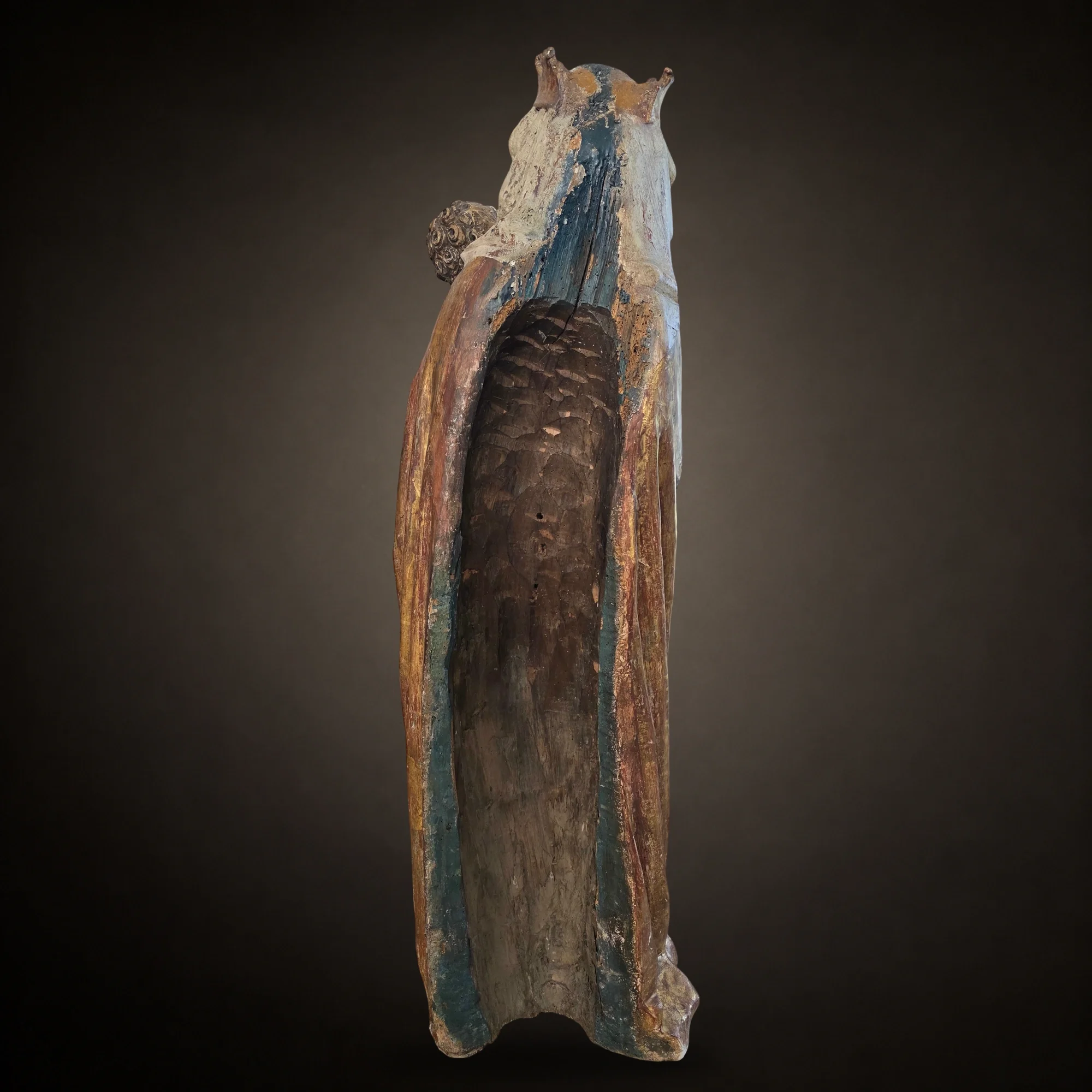
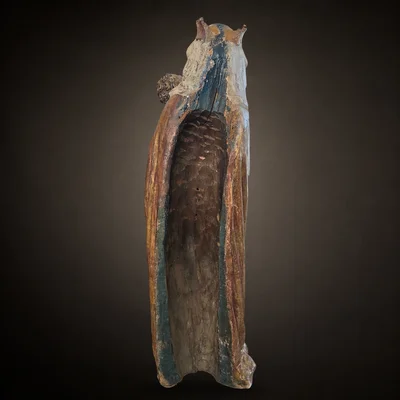
Condition : Hollowed reverse. Early polychromy with restorations.
Price : on demand
REF. 295
Virgin and Child – Southern Germany Circle or workshop of Hans Rueland
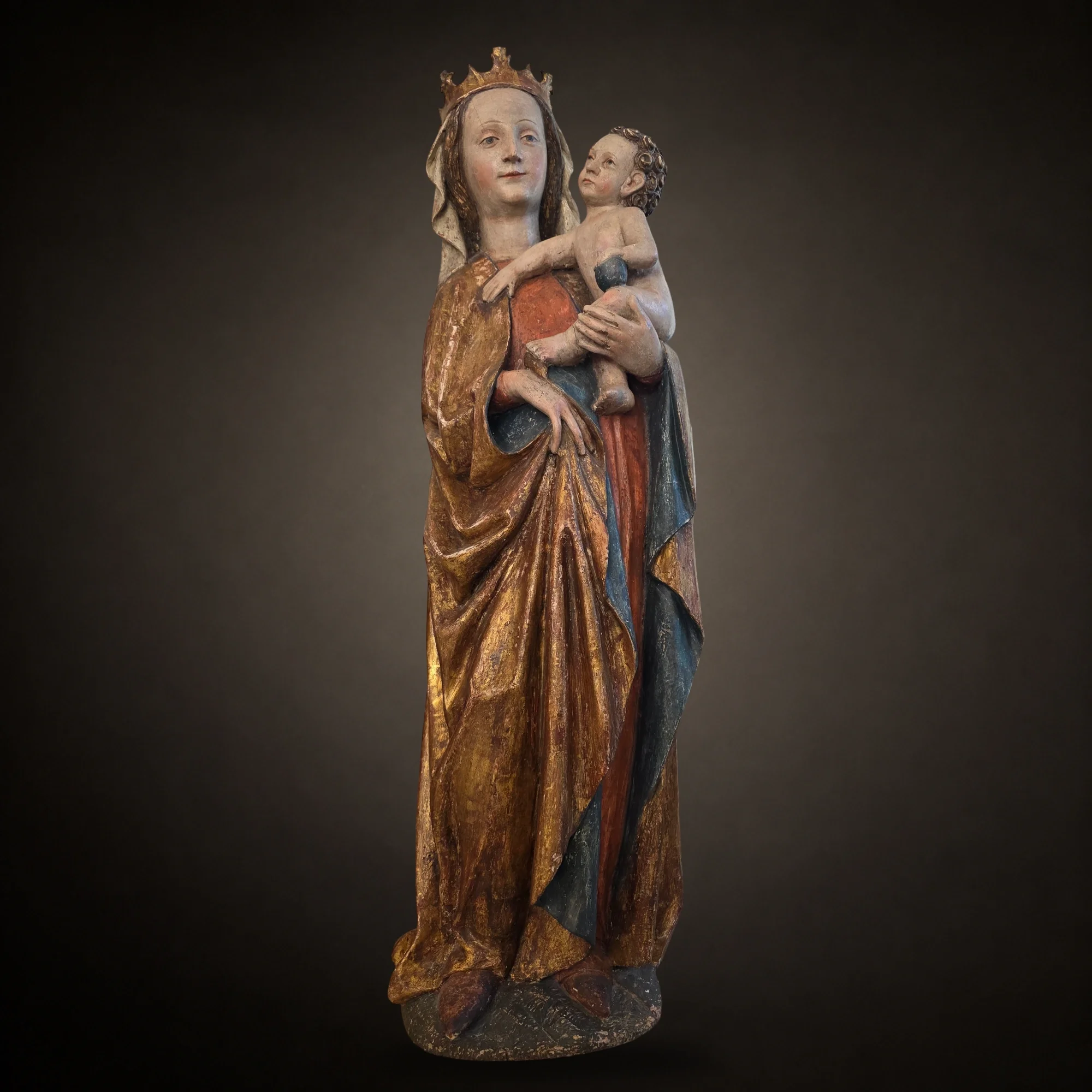
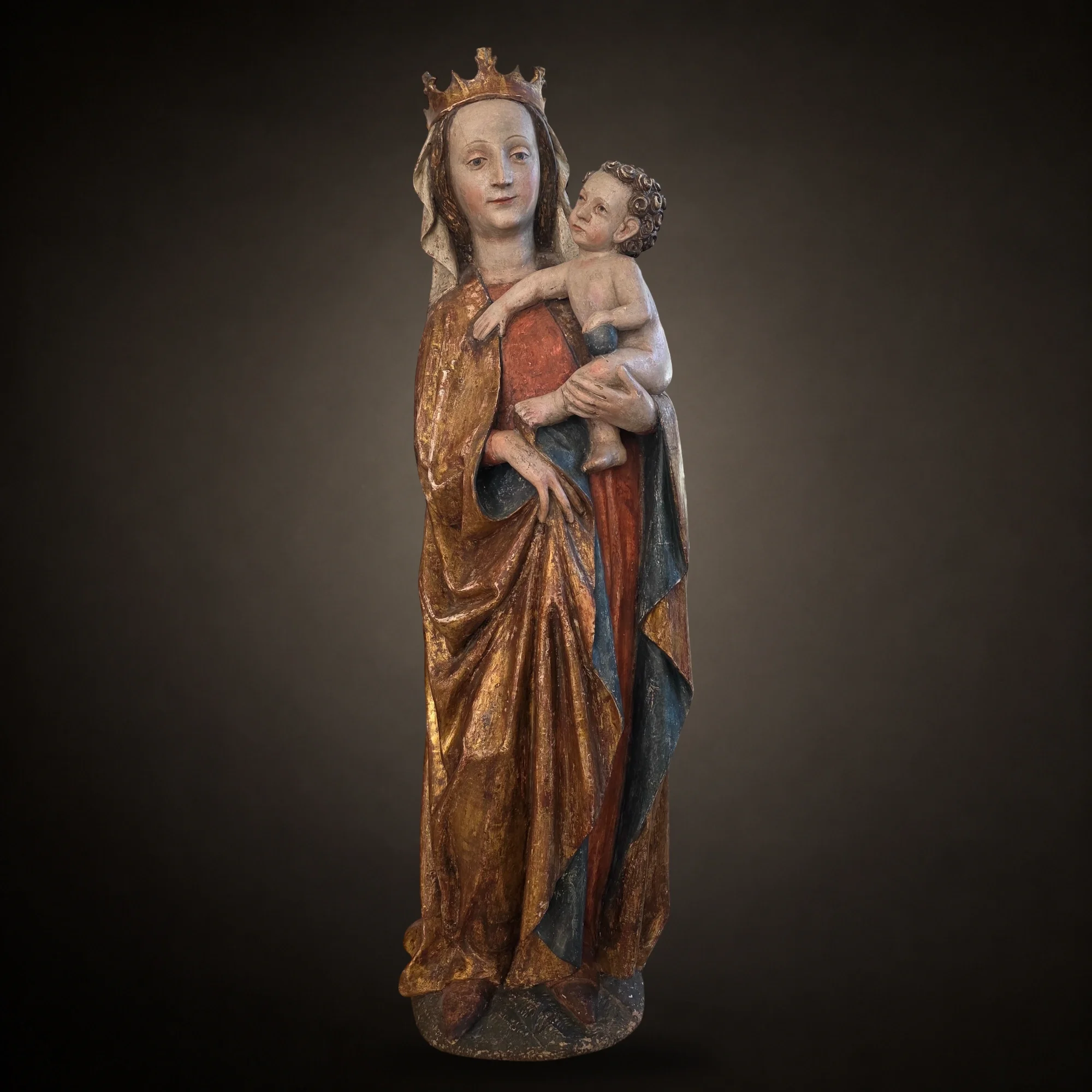
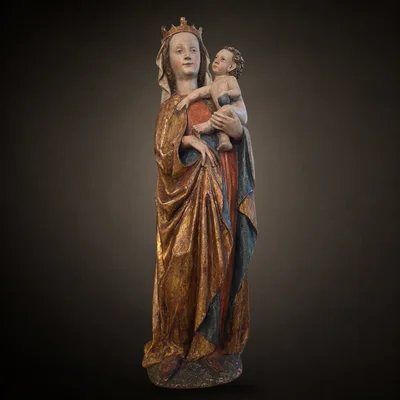
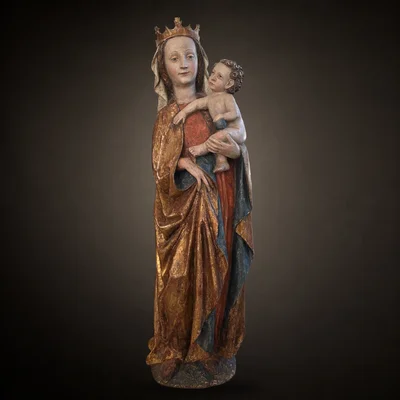
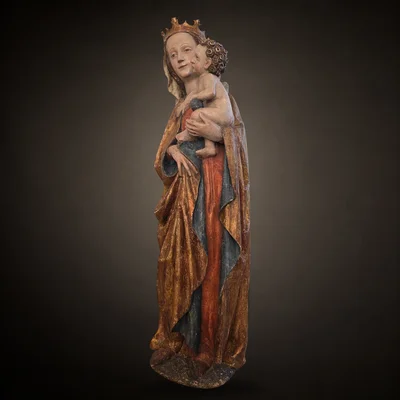
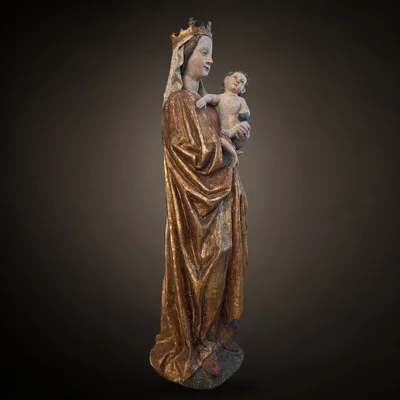
This carved, polychromed and gilded limewood Virgin and Child belongs to the late Gothic sculptural tradition of Southern Germany. Standing 110 cm high, it can be situated in Southern Swabia, within the area of the Westallgäu, Wangen and Lake Constance, and dated to circa 1470–1480. The Virgin is shown standing, holding the Child high on her left arm. The elongated proportions of the figure, the restrained softness of the face, the angular treatment of the mantle and the lively pose of the Child characterize a work still marked by the Soft Style (Weicher Stil), while already reflecting the new sculptural developments of the last quarter of the 15th century. Comparisons with sculptures from Rankweil, Nonnenhorn, Markdorf and Wangen, and above all with the corpus associated with Hans Rueland, allow this Virgin and Child to be placed within the close circle or workshop of the master, probably circa 1470–1480.
The Virgin’s calm and contemplative face is characterized by a high forehead, downcast eyes, a straight nose and a small, clearly defined mouth. Her head is covered by a light veil and surmounted by an open crown, while the polychromy combines a red dress with a gilded mantle lined in blue-green.
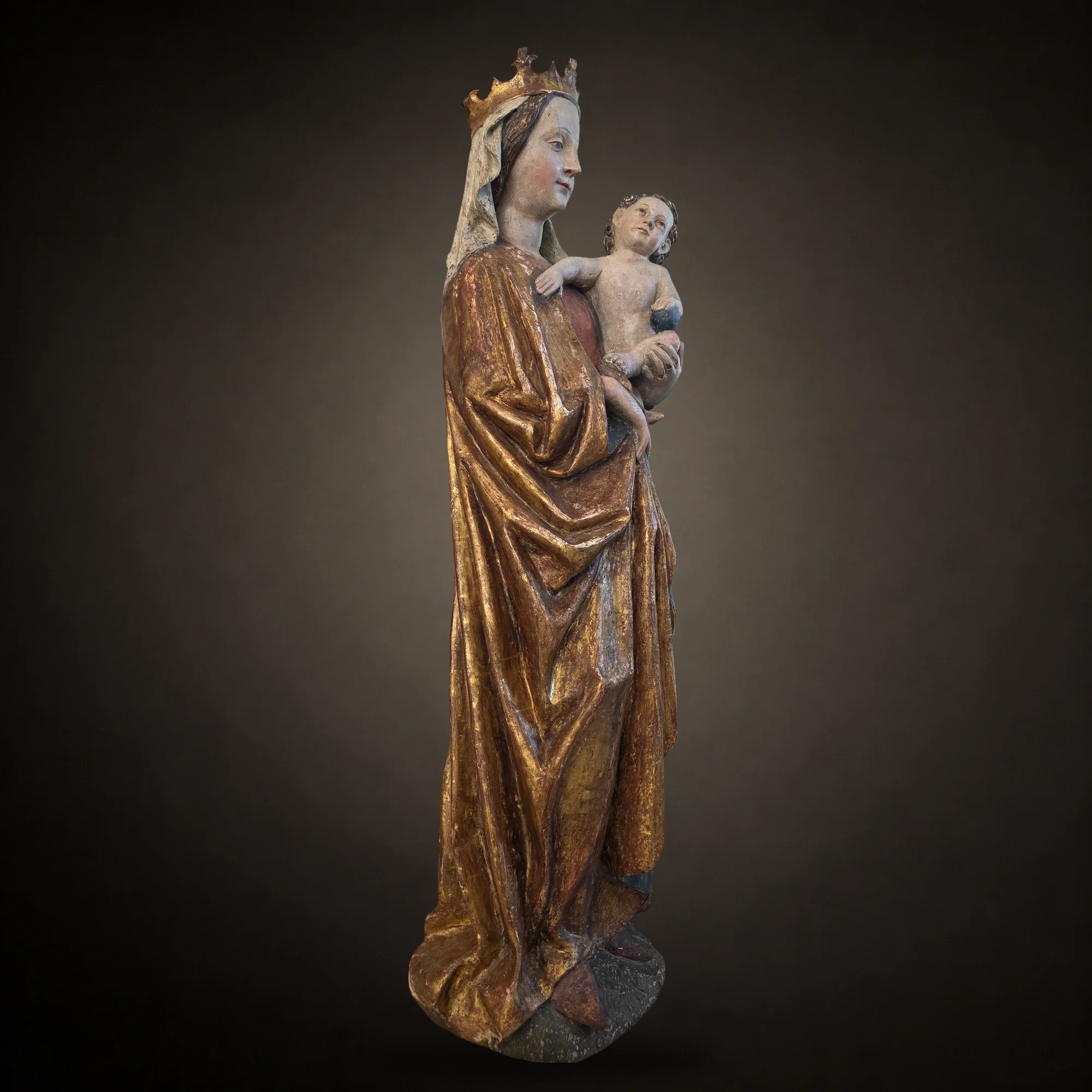
The mantle, drawn broadly across the front of the body, is arranged in deep, broken and angular folds that strongly structure the silhouette. This vocabulary of drapery, together with the facial type and the treatment of the hands, finds close parallels in works associated with Hans Rueland and his circle.
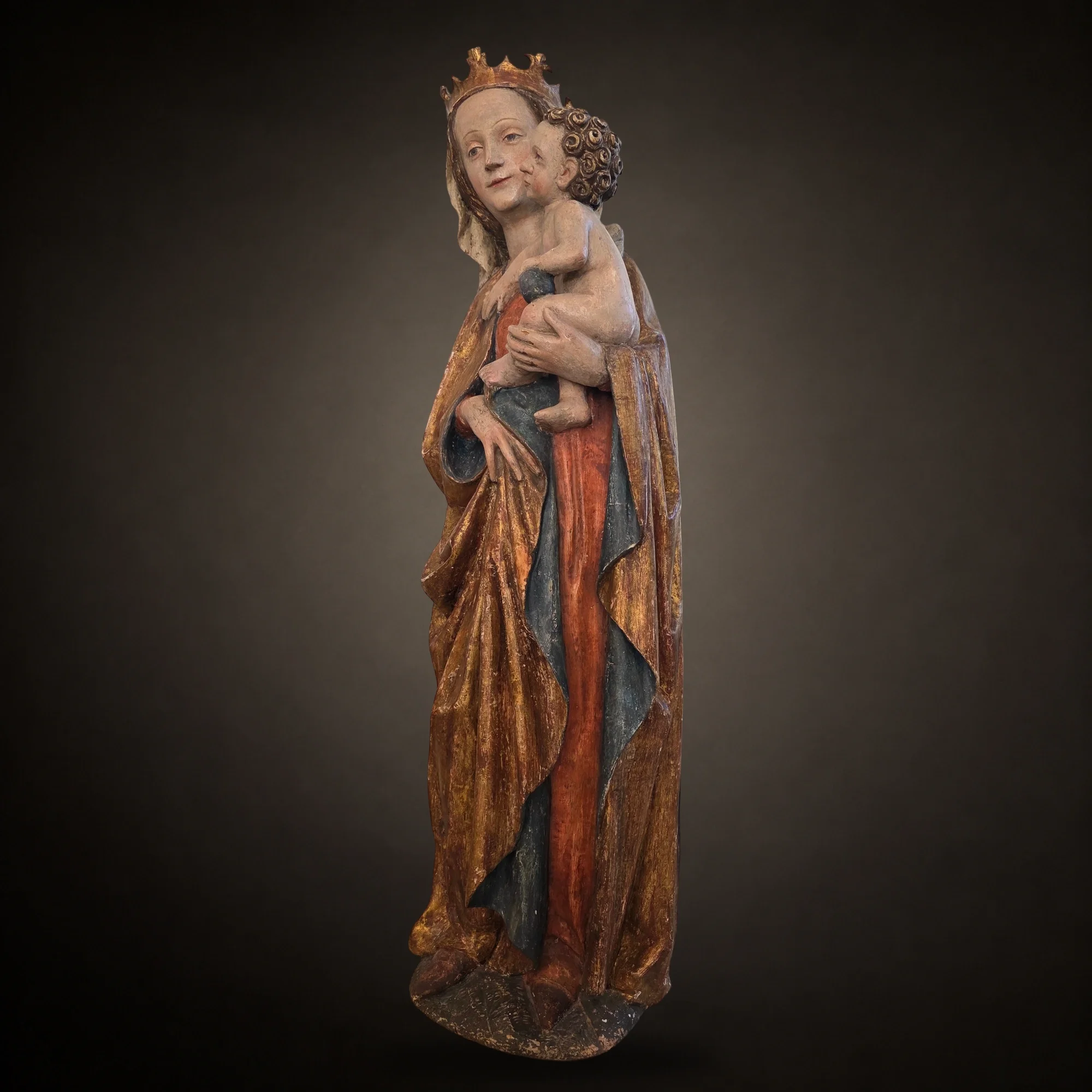
The Child, animated by a transverse movement, has hair arranged in tight spiral curls and crossed legs. He holds a blue orb, while his pose creates a dynamic interplay with the verticality of the Virgin. The recurrence of these characteristics within the corpus supports an attribution to the close circle of Hans Rueland or to his workshop.
Full documentation and study available on request.
Selected bibliography:
· Erkenntnisse über Bildhauer Rueland: weitere Werke des Wangener Meisters der Spätgotik entdeckt, Albert Scheurle, Westallgäuer Heimatblätter, vol. 14, no 14, March-April 1977, pp. 53-54.
· Allgäuer Bildschnitzer der Spätgotik, Albrecht Miller, Kempten im Allgäu, 1969
· Schwäbische Bildschnitzkunst der Sammlung Dursch, Willi Stähle, Rottweil, I: Katalog 14. und 15. Jahrhundert, Veröffentlichungen des Stadtarchivs Rottweil, 1983, pp. 107-118.
· Die mittelalterlichen Skulpturen, vol. II: Stein- und Holzskulpturen 1400–1530. Ulm und südliches Schwaben, Claudia Lichte and Heribert Meurer, Ostfildern, Jan Thorbecke 2007
In-depth study of the artwork
| Subject: | Virgin and Child, circle or workshop of Hans Rueland |
|---|---|
| Material: | carved limewood, hollowed at the back, polychromed and gilded |
| Dimensions: | height 110 cm |
| Origin: | Southern Swabia, Westallgäu – Wangen region – Lake Constance |
| Date: | 1470-1480 |
| Provenance: | former collection from the Wangen region |
| Condition: | areas of the polychromy retouched |
| Reference: | 295 |
Description
Mary is shown standing and crowned, carrying the Christ Child on her left arm. Her slender silhouette retains a solemn frontality, subtly enlivened by a slight contrapposto. The Virgin wears a long red dress covered by a broad gilded mantle, whose blue lining appears within the deep openings created by the drapery. A light veil frames the face and falls over the shoulders beneath an open foliate crown.
The mantle is drawn transversely across the body and held by the Virgin's right hand. This gesture creates a succession of deep folds, at times supple and enveloping, at others broken into sharply defined ridges.
The completely nude Child is seated on Mary's left arm. His crossed legs introduce an oblique movement that contrasts with the Virgin's verticality. His left hand rests on a blue globe, an evocation of his sovereignty over the world, while his right arm extends freely in front of his mother's chest. His face is turned upward, without meeting his mother's gaze. His particularly characteristic hair consists of small, thick, spiral curls arranged regularly around a broad, uncovered forehead.
The relationship between Mother and Child remains restrained. Mary does not look directly at her son: her slightly inclined face remains turned toward the worshipper. The Virgin's peaceful expression is defined by a high forehead, almond-shaped eyes with slightly lowered lids, a long straight nose and a small mouth suggesting a restrained smile. The hands, with long, slender and almost parallel fingers, contribute to the measured elegance of the whole.
The sculpture is deeply hollowed at the back, following a practice characteristic of large limewood altarpiece figures produced in the southern German-speaking regions. The old polychromy and gilding, now worn and locally retouched, still reveal the original chromatic balance between the gold of the mantle, the red of the dress and the blue-green of the lining.
In conception, the work stands at the transition between the final manifestations of the Weicher Stil, perceptible in the softness of the face, the slender silhouette and the enveloping movement of the mantle, and a later sensibility characterized by more sharply broken folds, firmer ridges and a more structured plastic construction. This combination points toward sculpture produced in the Westallgäu and on the northern shores of Lake Constance during the decades 1460-1480.
The Virgin's physiognomy, with its broad forehead, narrow eyes, straight nose and small mouth, finds correspondences in the corpus traditionally assembled around Hans Rueland, also known as the Master of Wangen.
An attribution to the circle or workshop of Hans Rueland, around 1470-1480, therefore constitutes the proposal most consistent with the work's material, morphological and stylistic characteristics.
Geographical and stylistic context
The sculpture belongs to the artistic sphere of Southern Swabia, more specifically to the territory between the Westallgäu, Upper Swabia and the eastern and northern shores of Lake Constance. In the fifteenth century this region did not form a unified political entity. It was divided among Free Imperial Cities, secular lordships, ecclesiastical territories and the possessions of major abbeys. This fragmentation did not prevent the emergence of a shared visual culture.
Wangen occupied a privileged position within this network. Having become a Free Imperial City at the end of the thirteenth century, it lay at the crossroads of routes leading to Ravensburg, Lindau, Leutkirch and Isny. The production and trade of linen, together with the growth of transalpine exchanges, contributed to the prosperity of the city and its hinterland. This economic context supported workshops capable of responding both to urban commissions and to the needs of religious communities established around Lake Constance.
Wangen's artistic activity cannot, however, be understood independently of the major centres of Upper Swabia. By the mid-fifteenth century Ulm had become the principal centre for the renewal of sculpture in the south-western German-speaking world. The works of Hans Multscher and the Ulm workshops established a new conception of the figure, placing greater emphasis on bodily presence, facial characterization and the spatial organisation of drapery. Memmingen was another important centre for the production and export of carved altarpieces. Innovations from these workshops spread toward Ravensburg, the Westallgäu and Lake Constance.
The workshops of the Westallgäu did not simply reproduce the language of Ulm. They offered a more restrained interpretation, characterized by expressive reserve and by the persistence of forms inherited from the Weicher Stil. Figures often retain a slender silhouette and a calm presence. Faces, only slightly individualized, are constructed from regular forms: high forehead, full oval, narrow eyes, straight nose and small mouth. This physiognomic gentleness is gradually combined with firmer modelling of the volumes and a stronger articulation of the garments.
The evolution of the drapery is one of the most significant markers of this transformation. The still supple and enveloping fabrics of the first half of the fifteenth century acquire, from mid-century onward, deeper and more clearly articulated folds. Broad flat surfaces now alternate with projecting ridges, oblique breaks and triangular falls. In the Lake Constance region the folds remain lighter, structuring the drapery without dominating the line of the body.
Marian sculpture produced in this region also preserves certain features of the courtly tradition. The softness of the face and restraint of the expression maintain a devotional distance, while the presence of a nude and mobile Child introduces a more human dimension. The contrast between the stability of the Mother and the animation of the Child becomes one of the essential devices of the composition. This tension between majesty and intimacy distinguishes an important part of Marian statuary from the Westallgäu and Bodensee during the second half of the fifteenth century.
The use of limewood is likewise consistent with the proposed geographical attribution. The sculpture is deeply hollowed at the back, like most large figures intended for altarpieces, in order to reduce stresses within the wood and limit the risk of cracking.
Hans Rueland, also known as Johannes Rueland and traditionally called the Master of Wangen, worked within this environment. According to local tradition he came from the hamlet of Ruhlands near Opfenbach, and he is documented as a woodcarver in Wangen between 1474 and 1487. Art-historical literature has sometimes described him as a pupil of Hans Multscher. In the absence of documentary evidence for a direct apprenticeship, this relationship must be treated with caution; it nevertheless reflects the undeniable presence of Ulm models in the sculptural language associated with Rueland.
The characteristics of the present Virgin and Child are coherent within this regional context. The slenderness of the figure, the restraint of the expression, the lingering softness of the face and the more angular construction of the mantle correspond to the transitional phase between the tradition of the Weicher Stil and fully developed Late Gothic sculpture. Its geographical attribution may therefore be narrowed to the Westallgäu and the eastern basin of Lake Constance.
Comparative corpus and dating
The comparative study must distinguish between documented works by Hans Rueland, sculptures attributed to him by local tradition, and works more broadly assigned to his workshop or circle.
The Gnadenbild at Rankweil provides a first point of comparison. This limewood Virgin and Child, preserved in the Basilica of Our Lady at Rankweil, is generally dated around 1460 and attributed to Hans Rueland. Crowned Mary stands on a crescent moon and carries the nude Child on her left arm. He places his right arm around his mother's neck and holds a gilded walnut in his left hand. Despite the iconographic differences, notably the walnut at Rankweil and the globe in the present sculpture, both groups are based on a common formula: a crowned, frontally presented Virgin carrying on her left side a nude Child whose mobility animates the composition.
The comparison with Rankweil is particularly relevant in the relationship between Mary's stability and the Child's movement. In both works the maternal body remains strongly vertical, while the Child introduces a series of oblique lines through the orientation of the torso and the disposition of the legs. This difference suggests placing the present work after the Gnadenbild.
The early figures in the Chapel of St James at Nonnenhorn provide a second group of comparisons. Saint Catherine and Saint John the Baptist, placed on the left side wall, are regarded in local documentation as youthful works by Hans Rueland and dated around 1460. Their attribution has sometimes been formulated under the conventional name Master of the Imberg Altarpiece, a reminder that the reconstruction of the sculptor's early corpus remains debated. Regardless of this question of nomenclature, the belonging of the present Virgin to this artistic milieu appears well established.
Saint Catherine at Nonnenhorn provides the most significant physiognomic comparison. Her face has a high, smooth forehead, a regular oval slightly narrowing toward the chin, narrow eyes with lowered lids, a long nose and a small mouth whose corners suggest a restrained expression. These features recur in the present Virgin, with the same search for calm. The manner in which the forehead is exposed beneath the crown, the face framed by hair or veil, and the neck slightly elongated further strengthens the comparison.
The Virgin of Mercy at Markdorf provides the principal documented anchor in the 1470s. Formerly the central figure of the altarpiece of the Brotherhood of the Protective Mantle, it was executed by Hans Rueland in 1474. Its different function requires a selective comparison: the broad opening of the mantle and the kneeling faithful belong to a collective composition without equivalent in the present group. The Marian type nevertheless remains very close. The Markdorf Virgin has a long silhouette, a relatively small head, a regular face dominated by a broad forehead, and a distant yet benevolent expression. The position of the hands and the continuity of the long vertical lines contribute, as in the present sculpture, to combining devotional majesty with gentleness.
Markdorf also makes it possible to gauge the development since the early sculptures at Nonnenhorn. The face remains peaceful, but the figure acquires a more assertive structure. The folds are no longer merely supple and enveloping: they define broad surfaces, organize the volume and emphasize the main directions of the composition. The present Virgin displays the same balance. It preserves the softness of the earlier works while showing a more deeply carved mantle and more pronounced breaks. This combination brings it closer to the Markdorf phase than to Rueland's presumed beginnings.
The Madonna attributed to Hans Rueland in the Heimatmuseum at Wangen is another important element of the corpus. Locally it is regarded as a product of the Wangen workshop executed between 1460 and 1480. It likewise shows a crowned Virgin carrying the Child on her left arm. The comparison is therefore geographical, typological and chronological. Surface comparison must nevertheless remain cautious, since the work was stripped and entirely repainted around 1900. Its removable crown also covers a cavity in the head, probably intended for a relic, a feature that illustrates the functional diversity of images produced in the workshop.
Despite these transformations, the Wangen Virgin retains a structure comparable to that of the present sculpture: the same overall verticality, the same asymmetry created by the Child placed on the left side, and the same contrast between Mary's small head and the broad gilded mass of the mantle. The Child is likewise conceived as a relatively autonomous figure rather than as a mere extension of the maternal body. This parallel is especially important because it concerns a work traditionally located within the Wangen workshop itself.
The Virgin and Child in the Church of Our Lady at Eriskirch, originating from a Markdorf confraternity altarpiece and dated 1486, provides a particularly useful comparative terminus. This work has a later structure: the figure is strongly upright, the folds follow more rectilinear lines and the silhouette acquires a more rigorous monumentality. The Child, placed on Mary's right arm, retains a certain mobility, but the whole is more firmly governed by the vertical architecture of the maternal body.
Several details connect the Eriskirch Virgin with the present sculpture: the open crown, high forehead, small mouth, slender hands and the presence of a nude Child with animated legs. The comparison also reveals a chronological difference. At Eriskirch, vertical folds and taut surfaces dominate; transitions are drier and the figure appears more strictly ordered. The mantle of the present Virgin, by contrast, retains softer passages and a broader transverse movement. It therefore seems earlier than the work of 1486, while already anticipating some of its solutions.
The reliefs of the Nativity and the Adoration of the Magi from the Markdorf confraternity altarpiece of 1474, now preserved in the Dominikanermuseum in Rottweil, also illustrate the style developed by Rueland and his workshop during this period. Faces become more individualized, hair and beards are divided into more systematic locks, and the fabrics tend to multiply sharp ridges. The Child in the present group already has strongly individualized curls rolled into regular spirals, while Mary's face and the movement of the mantle remain less emphatic. This coexistence of early and more developed traits probably corresponds to an intermediate phase in the workshop's production.
The present Virgin shares with these later figures a taste for deep folds and clearly drawn ridges. It does not, however, possess their graphic density or rigidity. Her face remains closer to the gentleness of Saint Catherine, while her mantle stands between the breadth of Markdorf and the firmer structuring of Eriskirch. A date around 1490 therefore appears too late. Conversely, the Child's crossed legs, the autonomy of his movement and the already angular construction of the folds make a date confined to around 1460 difficult to sustain.
In terms of chronology, the present sculpture therefore finds its place in the middle of the corpus, between the early and later groups. A date range of 1470-1480 appears the most plausible.
The observed comparisons concern a sufficiently broad range of features to go beyond a merely regional affinity: facial type, proportions of the hands, treatment of the curls, balance between frontality and movement, and alternation of broad planes with angular folds. These features do not allow the personal hand of Hans Rueland to be isolated with certainty. The corpus attributed to the sculptor remains partly constructed through stylistic comparison and probably includes works in which several collaborators participated.
These convergences do not allow Hans Rueland's personal hand to be identified with certainty, but they justify, at the very least, assigning the work to his close circle and make an execution within his workshop a plausible possibility.
Bibliographical references
- • Albert Scheurle, “Erkenntnisse über Bildhauer Rueland: weitere Werke des Wangener Meisters der Spätgotik entdeckt”, Westallgäuer Heimatblätter, vol. 14, no. 14, March-April 1977, pp. 53-54.
- • Albrecht Miller, Allgäuer Bildschnitzer der Spätgotik, Kempten im Allgäu, Verlag für Heimatpflege, 1969.
- • Willi Stähle, Schwäbische Bildschnitzkunst der Sammlung Dursch, Rottweil, I: Katalog 14. und 15. Jahrhundert, Veröffentlichungen des Stadtarchivs Rottweil, 8, Rottweil, Stadtarchiv, 1983, pp. 107-118.
- • Claudia Lichte and Heribert Meurer, Die mittelalterlichen Skulpturen, vol. II: Stein- und Holzskulpturen 1400-1530. Ulm und südliches Schwaben, Ostfildern, Jan Thorbecke Verlag, 2007.
Related works
- • Eriskirch, Church of Our Lady — Hans Rueland, c. 1486.
- • Saint Catherine, Nonnenhorn — attributed to Hans Rueland, c. 1460.
- • Gnadenbild, Rankweil — attributed to Hans Rueland, c. 1460.