
Origin : Saalfeld, Thuringia, Germany.
Medium : Limewood.
Size : Height 75 cm
Period : Circa 1505–1510.
Condition : Woodworm damage, minor overpainting
REF. 281
Saint John - Saalfeld School. Hans Gottwald von Lohr.
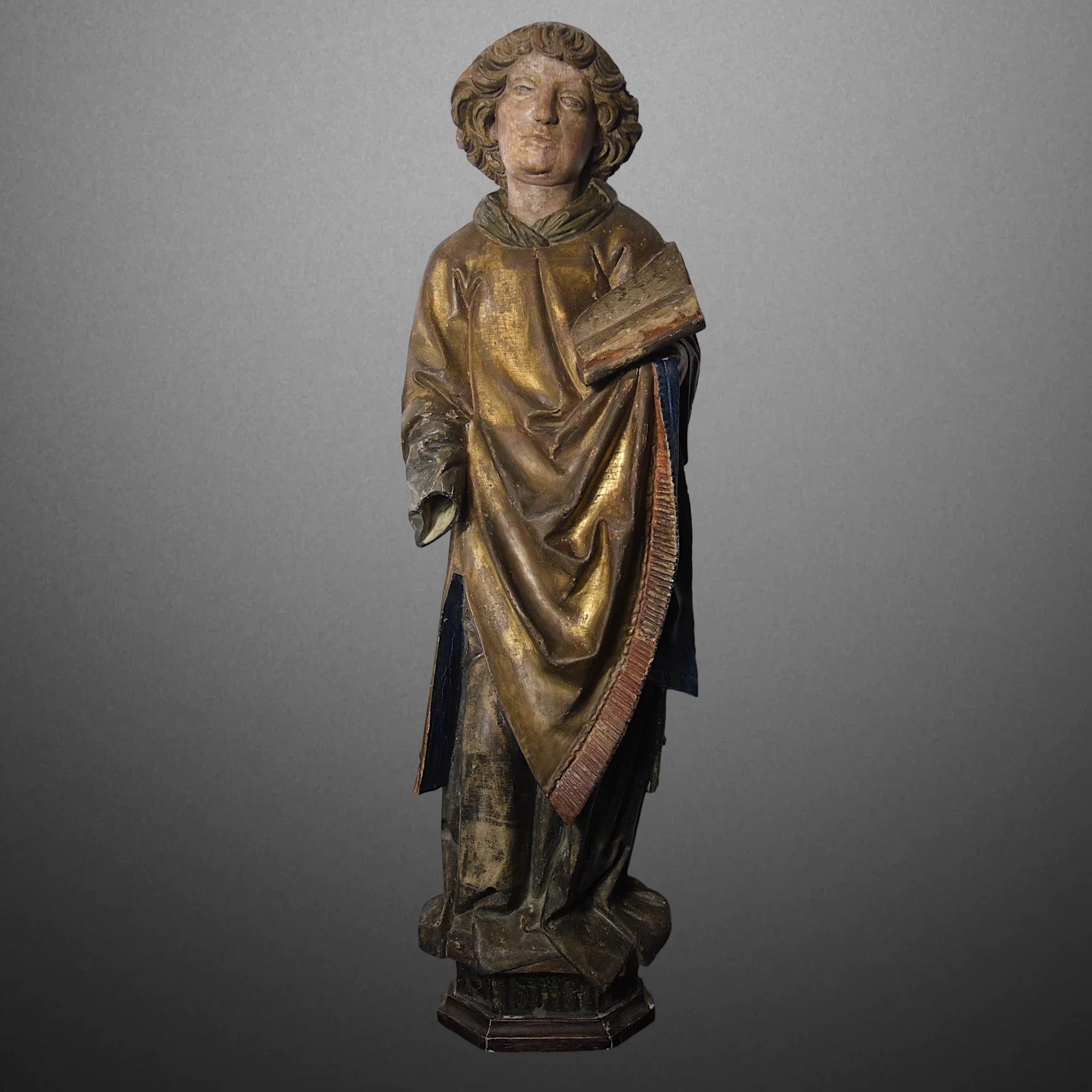
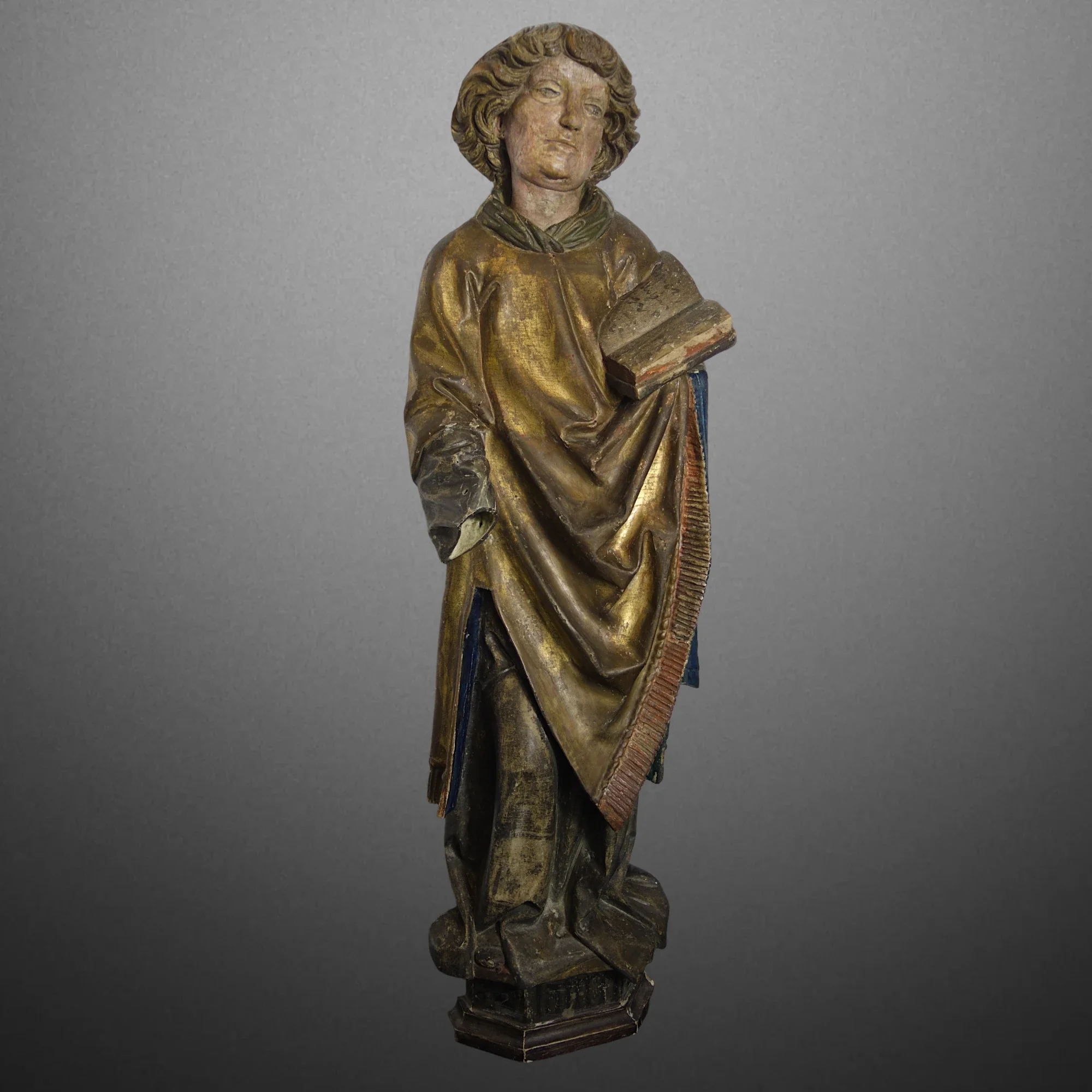
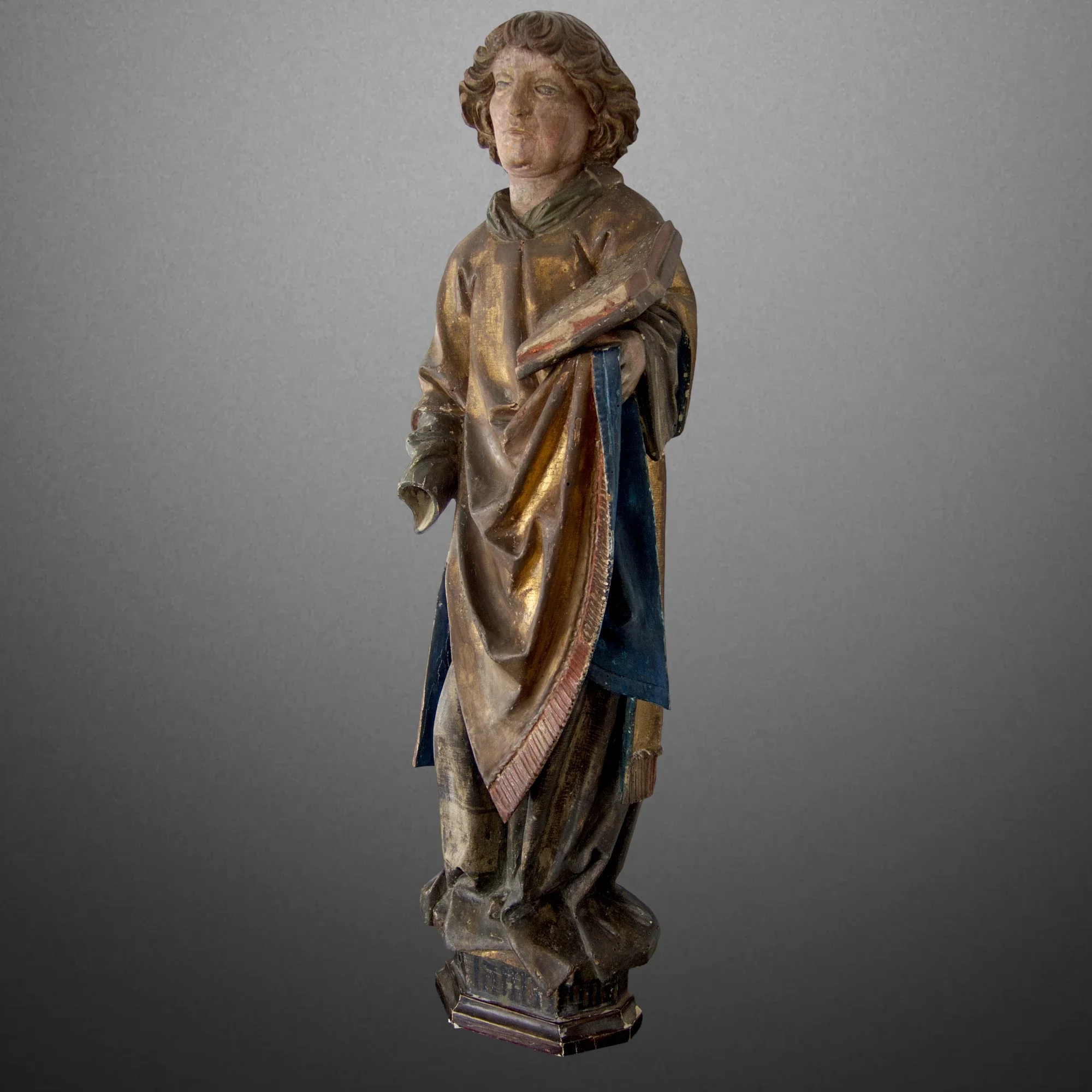
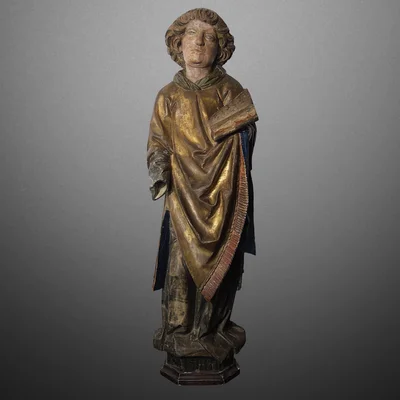
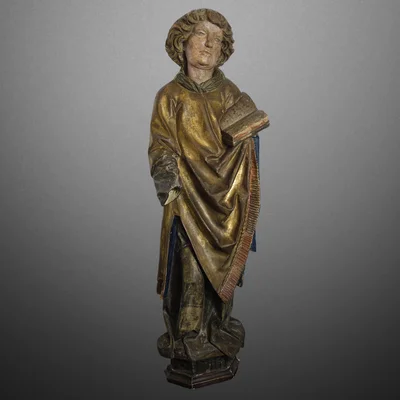
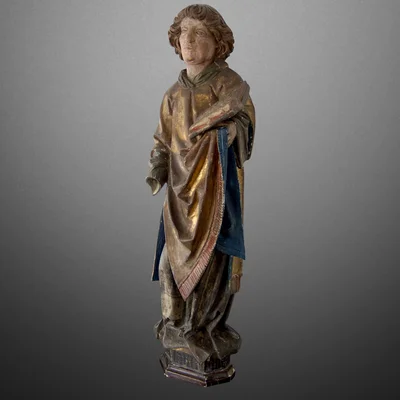
Saint John the Evangelist in polychrome and gilt limewood. The saint is clad in a gilt mantle with blue lining, with broken folds characteristic of late Gothic German sculpture, particularly the workshops of Thuringia and Franconia. The tunic, visible at the rounded neckline and at the bottom of the sculpture, falls in relatively simple vertical, tubular folds, creating a visual supporting column that contrasts with the mantle, treated with great volumetric complexity, typical of the “broken folds” (Knitterfalten) or “angular folds” used in the Saalfeld school. An old collector’s label mentions an attribution to Valentin Lendenstreich, the Master of the Neusitz Altarpiece. The relative stiffness of certain sections, combined with the depth of the carving, suggests more strongly the hand of Hans Gottwald von Lohr and his synthesis between Thuringian fluidity and the structural rigour inherited from the Würzburg school than the style of Valentin Lendenstreich.
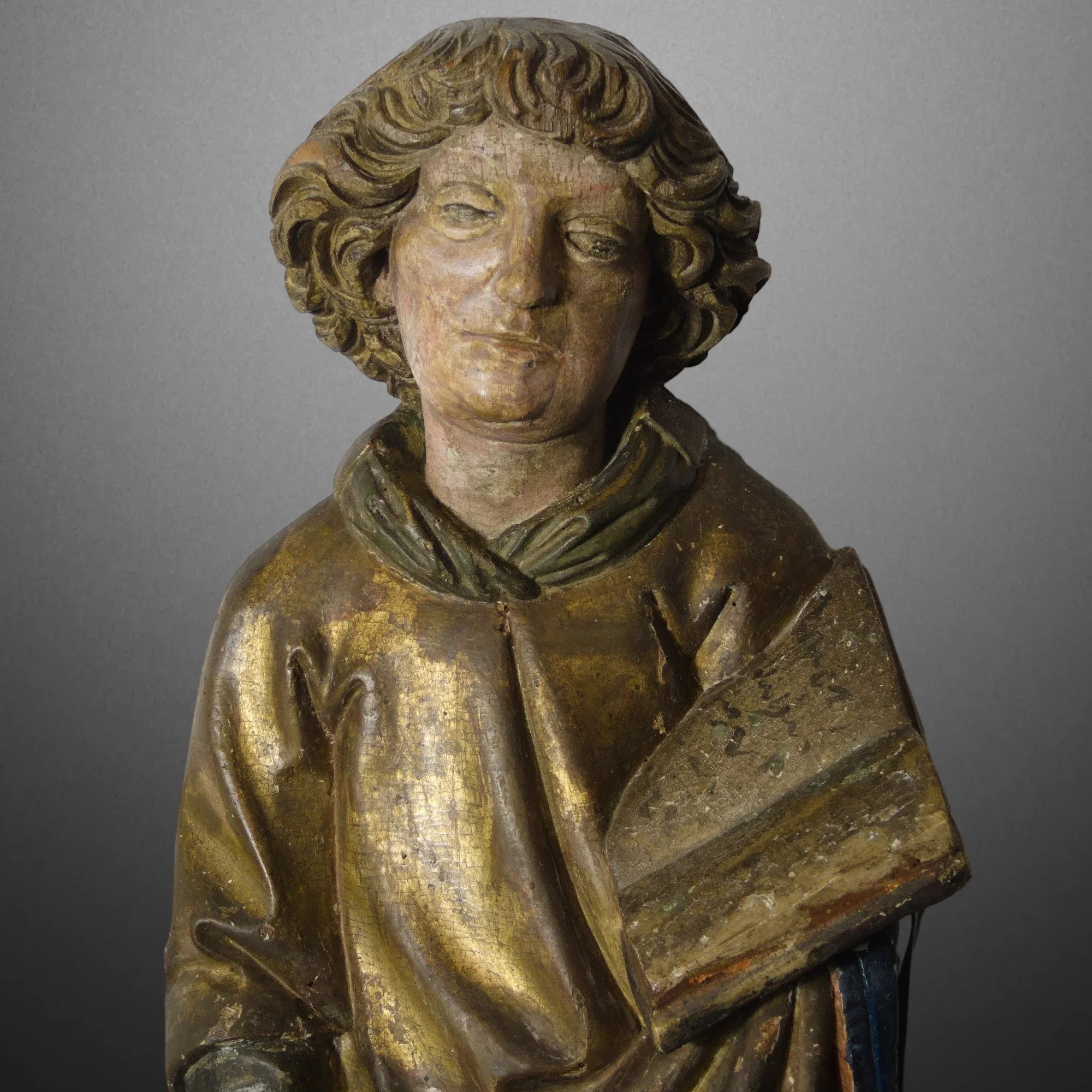
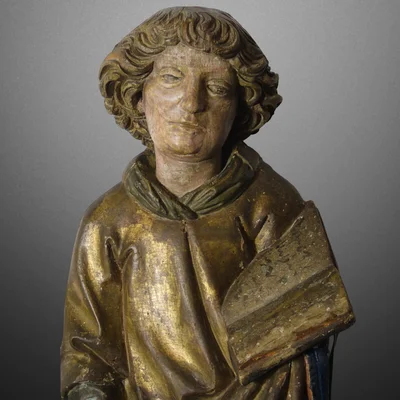
The face presents the characteristic typology of Saint John the Evangelist: a youthful, beardless physiognomy, marked by a sorrowful gravity. The features are strongly defined, in a quest for expressiveness typical of Thuringian sculpture around 1500–1510, with almond-shaped eyes and slightly protruding eyeballs, surmounted by heavy half-closed eyelids.
The hair, treated with great virtuosity, forms a dense sculptural mass framing the face and revealing a high forehead. It unfolds in thick undulating locks falling heavily onto the nape of the neck, worked with chisel and gouge, with deep undercutting to generate intense contrasts of light and shadow.
This sculpture achieves a synthesis between the works of Tilman Riemenschneider and those of Valentin Lendenstreich, supporting the attribution to Hans Gottwald von Lohr, who was Riemenschneider’s pupil before joining the Saalfeld school and taking over its direction on the death of Valentin Lendenstreich.
This sculpture once formed part of a larger ensemble, more specifically an altarpiece with three-quarter-round figures. Such altarpieces are known in Thuringia in the area around Saalfeld, such as the retables of Erfurt or Rudolstadt, both attributed to the hand of Hans Gottwald von Lohr.
References consulted:
· Bau- und Kunstdenkmäler Thüringens: Herzogthum Sachsen-Meiningen: Kreis Saalfeld, Georg Voss & Paul Lehfeldt, Jena, 1892.
· Meisterwerke der Kunst aus Sachsen u. Thüringen, Oskar Doering, Magdeburg, 1905.
In-depth study of the artwork
| Subject: | Saint John the Evangelist |
|---|---|
| Material: | polychromed and gilded limewood |
| Dimensions: | height 75cm |
| Origin: | Saalfeld, Germany |
| Date: | circa 1505-1510 |
| Attribution: | Saalfeld School, attributed to Hans Gottwald von Lohr |
| Former attribution: | Valentin Lendenstreich or the Master of the Neusitz Altarpiece, according to an old collection label |
| Condition: | woodworm damage, minor areas of overpainting |
| Reference: | 281 |
Description
Saint John the Evangelist carved in polychromed and gilded limewood. The saint wears a gilded mantle with a blue lining, arranged in broken folds characteristic of German Late Gothic sculpture and, more particularly, of workshops in Thuringia and Franconia. An old collection label records an attribution to Valentin Lendenstreich or to the Master of the Neusitz Altarpiece.
The tunic, visible at the rounded neckline and at the lower part of the sculpture, falls in relatively simple vertical tubular folds, creating a visual supporting column that contrasts with the agitation of the mantle. The latter is treated with great volumetric complexity, characteristic of the style of “crumpled folds” (Knitterfalten), or angular folds, current in the Saalfeld School.
The arrangement of the garments gives the saint a strong physical presence despite the narrowness of the timber block. The relative rigidity of certain sections, combined with the depth of the carving, evokes the hand of Hans Gottwald von Lohr and his synthesis of Thuringian fluidity with the structural rigour inherited from the Würzburg school more closely than it does the style of Valentin Lendenstreich.
Stylistic analysis and attribution
The face displays the characteristic type of Saint John the Evangelist: a youthful, beardless physiognomy imbued with sorrowful gravity. The features are strongly marked in the expressive manner characteristic of Thuringian sculpture around 1500-1510, with almond-shaped eyes and slightly prominent eyeballs beneath heavy, half-closed lids.
The hair, carved with considerable virtuosity, forms a dense sculptural mass framing the face while leaving a high forehead exposed. Thick, undulating locks fall heavily onto the nape, worked with chisel and gouge and deeply undercut to produce intense contrasts of light and shadow. The curls reveal a deliberately graphic stylisation reminiscent of the engravings of Martin Schongauer, which were often used as models by sculptors of the Saalfeld School and the circle of Hans Gottwald.
This sculpture creates a synthesis between the work of Tilman Riemenschneider and that of Valentin Lendenstreich, reinforcing the attribution to Hans Gottwald von Lohr, who had been a pupil of Riemenschneider before joining the Saalfeld School and taking over its direction after Valentin Lendenstreich’s death.
Identification and original function
The base of the sculpture bears an old, though probably later, inscription reading “Saint Laurentius”. However, the saint’s physiognomy, the book, and above all his garments rule out this identification: Saint Lawrence was a deacon and could not have worn such a mantle; he should have been represented in a dalmatic.
By virtue of its size and form, the sculpture originally belonged to a larger ensemble, more specifically an altarpiece with figures carved nearly in the round. Such altarpieces are known in Thuringia in the area around Saalfeld, notably the Erfurt and Rudolstadt altarpieces, both attributed to the hand of Hans Gottwald von Lohr.
The Saalfeld School and Hans Gottwald von Lohr
The Saalfeld School in Thuringia was a workshop chiefly specialised in the production of altarpieces around 1500. It supplied numerous high-quality wooden sculptures for churches in the Saalfeld and Rudolstadt region. In addition, many scholars identify the Master of the Neusitz Altarpiece with Hans Gottwald.
The most important workshop in Saalfeld, a trading town then attached to the bishopric of Würzburg, was directed by the wood sculptor Valentin Lendenstreich, who died in 1506, and after his death by Hans Gottwald von Lohr, who died in 1542 and subsequently married his widow. Hans Gottwald is recorded as a pupil and assistant of Tilman Riemenschneider in Würzburg, where he worked until 1501, before joining Valentin Lendenstreich in Saalfeld.
Hans Gottwald thus developed a distinctive style influenced by both masters.
Related works
- • Erfurt Altarpiece — Hans Gottwald von Lohr, overall view and details.
- • Saint Boniface, Rudolstadt — attributed to Hans Gottwald von Lohr.
- • Work attributed to Hans Gottwald von Lohr — Hampel auction house, Munich.
- • Marian altarpiece attributed to Valentin Lendenstreich — Museum für Kunst & Gewerbe Hamburg, inv. 1898.265, overall view and details.
Bibliographical references
- • Bau- und Kunstdenkmäler Thüringens : Herzogthum Sachsen-Meiningen: Kreis Saalfeld, Georg Voss & Paul Lehfeldt, Jena, 1892.
- • Meisterwerke der Kunst aus Sachsen u. Thüringen, Oskar Doering, Magdeburg, 1905.