
Origin : Upper Rhine, Basel.
Medium : Limewood carved in the round, polychromed and gilded.
Size : Height 55 cm
Period : circa 1515 to 1520.
Condition : Minor losses and wear to the polychromy and gilding.
Price : on demand
REF. 296
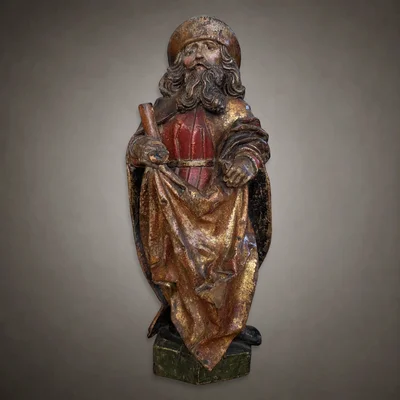
Saint James the Greater, Upper Rhine Workshop of Martin Hoffmann
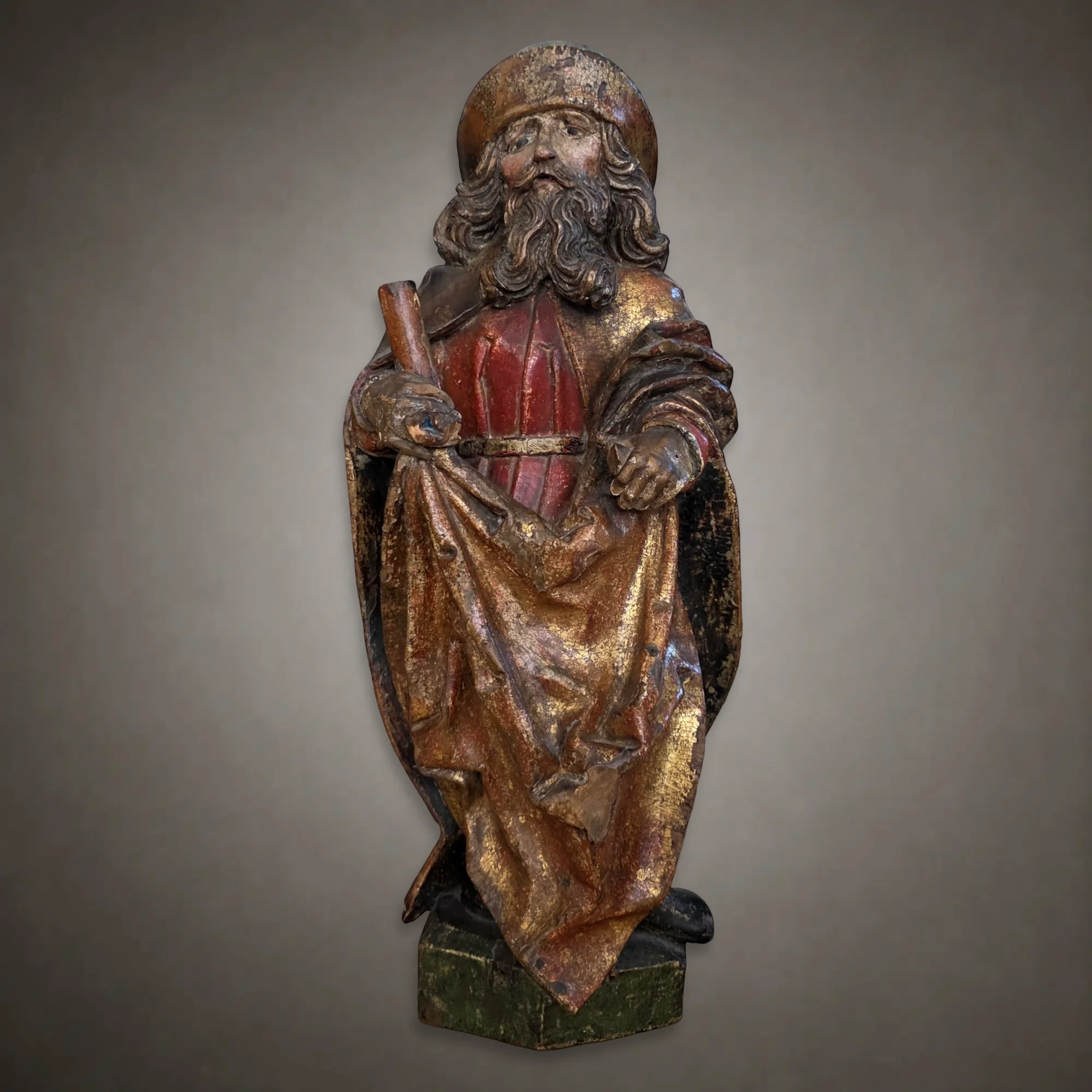
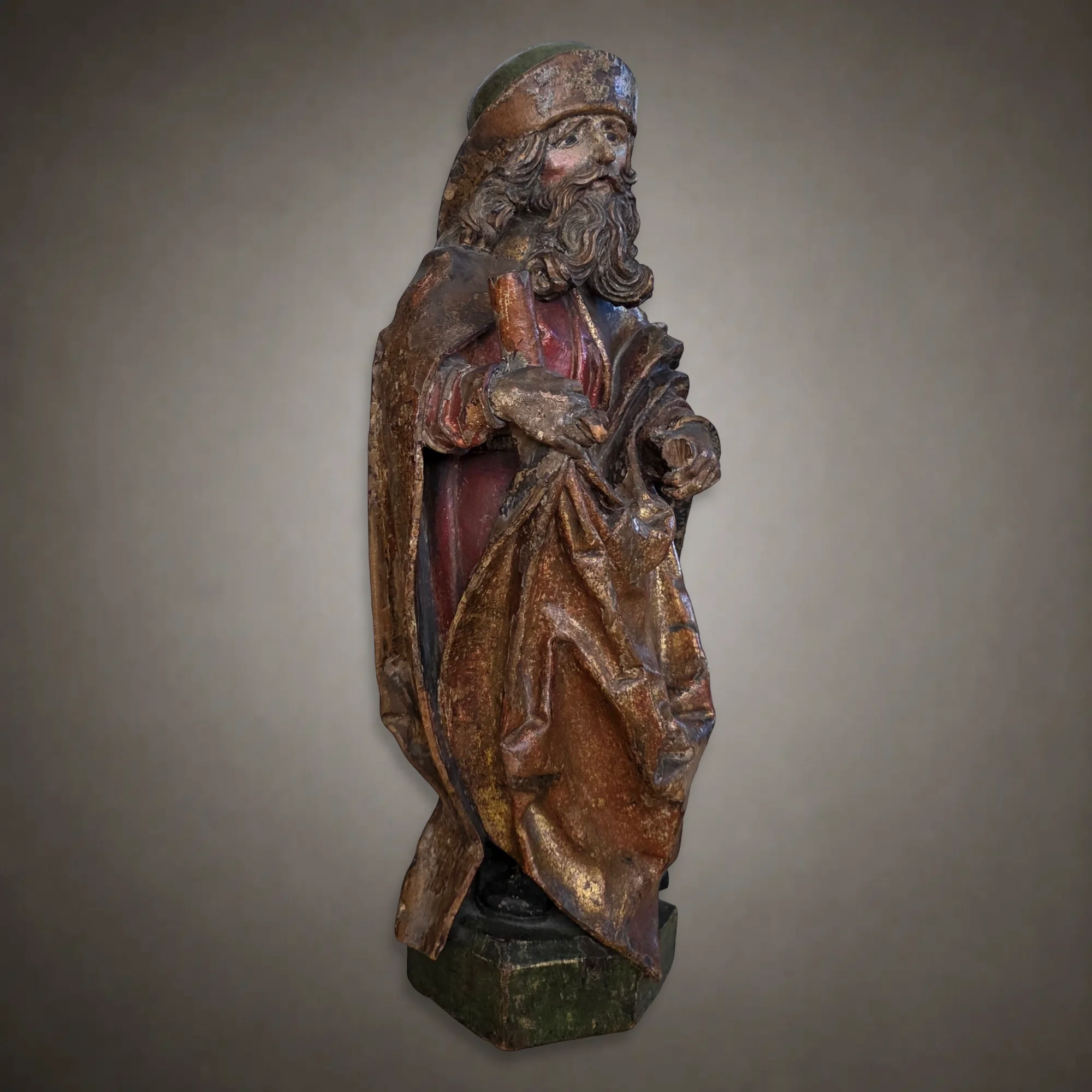
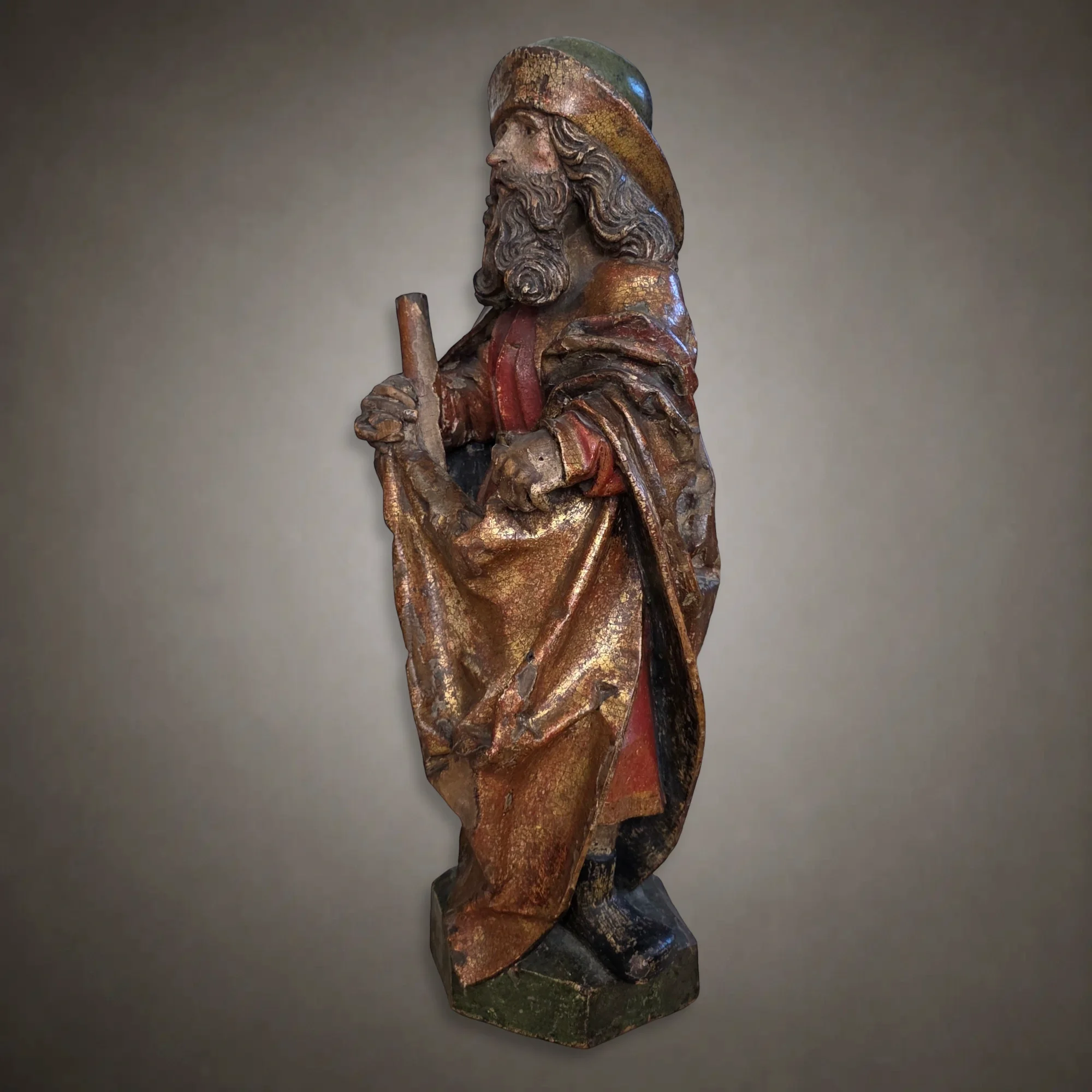
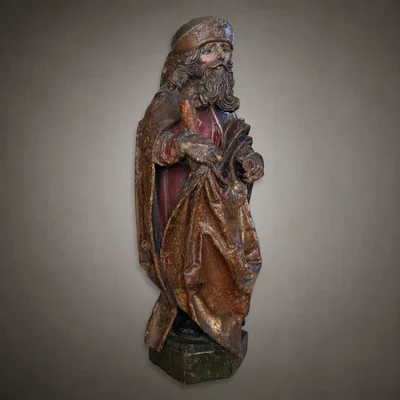
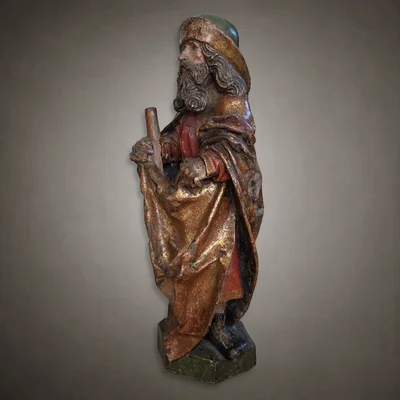
This polychromed and gilt limewood sculpture depicts Saint James the Greater as a mature man, identifiable by his broad pilgrim hat and the fragment of a pilgrim staff preserved in his right hand. Standing 55 cm high, it belongs to the sculptural tradition of the Upper Rhine and can be located more precisely in Basel, circa 1515 to 1520, in the workshop of Martin Hoffmann. The saint is shown standing, enveloped in a broad gilded mantle raised by both hands. His head is thrown back, his gaze directed upwards and his mouth slightly open, giving the figure a powerful expressive intensity. The deeply set eyes, thick eyelids, firmly defined bridge of the nose and beard arranged in vigorously carved locks are the principal physiognomic characteristics of the work. The facial expression, the distinctive shape of the eyes, the compact construction of the hands and the sculptural organisation of the mantle closely relate this sculpture to the Basel corpus associated with Martin Hoffmann. The convergence of these elements supports an attribution to his workshop and a date circa 1515 to 1520.
The closest comparison can be made with the Head of Saint John the Baptist in the Musée de l’Œuvre Notre Dame in Strasbourg, attributed to the workshop of Martin Hoffmann and dated circa 1515. The construction of the anatomical left eye is particularly close: the eyeball turned upwards, a thick and oblique upper eyelid, a more horizontal lower eyelid and a narrow inner corner drawn closely against the root of the nose.
The Man of Sorrows in the Unterlinden Museum provides important correspondences in the technical conception of the sculpture, particularly in the treatment of the reverse, the polychromy and the raised head. The Praying Christ in the Musée de l’Œuvre Notre Dame also provides a particularly relevant parallel for the construction of the gaze and eyelids.
The Saint Martin in the Unterlinden Museum and the Saint Bishop in the Musée d’Art et d’Histoire de Chaumont complete this corpus through their conception of sculpture in the round, their powerfully modelled hands and their draperies structured by deep ridges and abrupt reversals. Taken together, these comparisons place the Saint James at the heart of the Basel group assembled around Martin Hoffmann and support its attribution to the master’s workshop.
Provenance: former collection of Professor Rudolf Schnellbach, director of the Badisches Landesmuseum in Karlsruhe.
Complete documentation and study available on request.
References consulted:
· Hans Rott, Quellen und Forschungen zur südwestdeutschen und schweizerischen Kunstgeschichte im XV. und XVI. Jahrhundert, III, Oberrhein, II, Schweiz, Stuttgart, 1936.
· Annie Kaufmann Hagenbach, Die Basler Plastik des fünfzehnten und frühen sechzehnten Jahrhunderts, Basel, Birkhäuser, 1952.
· Victor Beyer, La Sculpture médiévale du musée de l’Œuvre Notre Dame, Strasbourg, Éditions des Musées de la ville, 1968.
· Monique Fuchs, La Sculpture en Haute Alsace à la fin du Moyen Âge, 1456 à 1521, Strasbourg, Oberlin, 1987.
· Sophie Guillot de Suduiraut, Sculptures allemandes de la fin du Moyen Âge dans les collections publiques françaises, 1400 à 1530, Paris, Réunion des musées nationaux, 1991.
· Sophie Guillot de Suduiraut, Nouvelles attributions au sculpteur Martin Hoffmann et son entourage bâlois, Revue du Louvre et des musées de France, 1998.
In-depth study of the artwork
| Subject: | Saint James the Greater, workshop of Martin Hoffmann |
|---|---|
| Material: | limewood carved in the round, polychromed and gilded |
| Dimensions: | height 55 cm |
| Origin: | Upper Rhine, Basel |
| Date: | 1515 to 1520 |
| Provenance: | former collection of Professor Rudolf Schnellbach, director of the Badisches Landesmuseum in Karlsruhe |
| Condition: | minor losses and wear to the polychromy and gilding |
| Reference: | 296 |
Description
This sculpture represents Saint James the Greater as a mature man with long hair and a full beard. He wears a belted tunic covered by a broad mantle and is distinguished by his wide pilgrim’s hat. The upper part of a pilgrim’s staff survives in his right hand, although it is now truncated. The hat and staff identify the figure as Saint James, even though the scallop shell, his most immediately recognizable attribute, is no longer preserved or may never have been prominently represented.
Associated since the Middle Ages with pilgrimage to his shrine at Compostela, Saint James is generally represented dressed as a traveller. The staff assists him on his journey, while the broad brimmed hat protects the pilgrim from the weather. Here, however, the image does not emphasize the narrative idea of travel: the saint appears motionless and frontal.
His raised gaze and slightly open mouth introduce a visionary dimension. Saint James does not address the viewer directly: his attention seems directed toward an apparition or figure above him. This orientation may indicate that the sculpture belonged to a larger ensemble, perhaps positioned at the summit of an altarpiece. Its conception in the round and the treatment of the reverse also allow for the possibility of an autonomous display in a space where the figure could be viewed from several directions.
The face is the principal expressive focus of the work. The head is thrown back and slightly turned. The forehead remains largely concealed beneath the brim of the hat. The eyes are deeply set in their sockets and directed upward. Thick eyelids surround projecting eyeballs, while the inner corners of the eyes narrow against the root of the nose. The nose has a firm ridge and a fleshy tip. The slightly open mouth, almost absorbed by the moustache, suggests suspended breath or speech.
The hair and beard are organized into thick locks deeply separated by the chisel. The curls unfold in successive waves, sometimes ending in hooks or tightly wound coils.
Beneath the mantle, the saint wears a red tunic gathered at the waist by a gilded belt. The vertical folds of this garment follow the axis of the body. The mantle, by contrast, creates a broader movement, lifted and held by both of the saint’s hands.
The folds are not merely drawn across the surface of the wood: their thick ridges, deep recesses and abrupt reversals organize the space in front of the body. The mantle largely conceals the anatomy, yet suggests its movement and gives the figure its sculptural presence.
The hands are broad and powerfully modelled. The relatively short fingers are separated by clear incisions. The right hand firmly grasps the fragment of the staff while also participating in the lifting of the mantle. Despite its losses, the left hand retains the same compact construction and emphatic articulation of the phalanges. The gesture remains legible and helps connect the two sides of the composition.
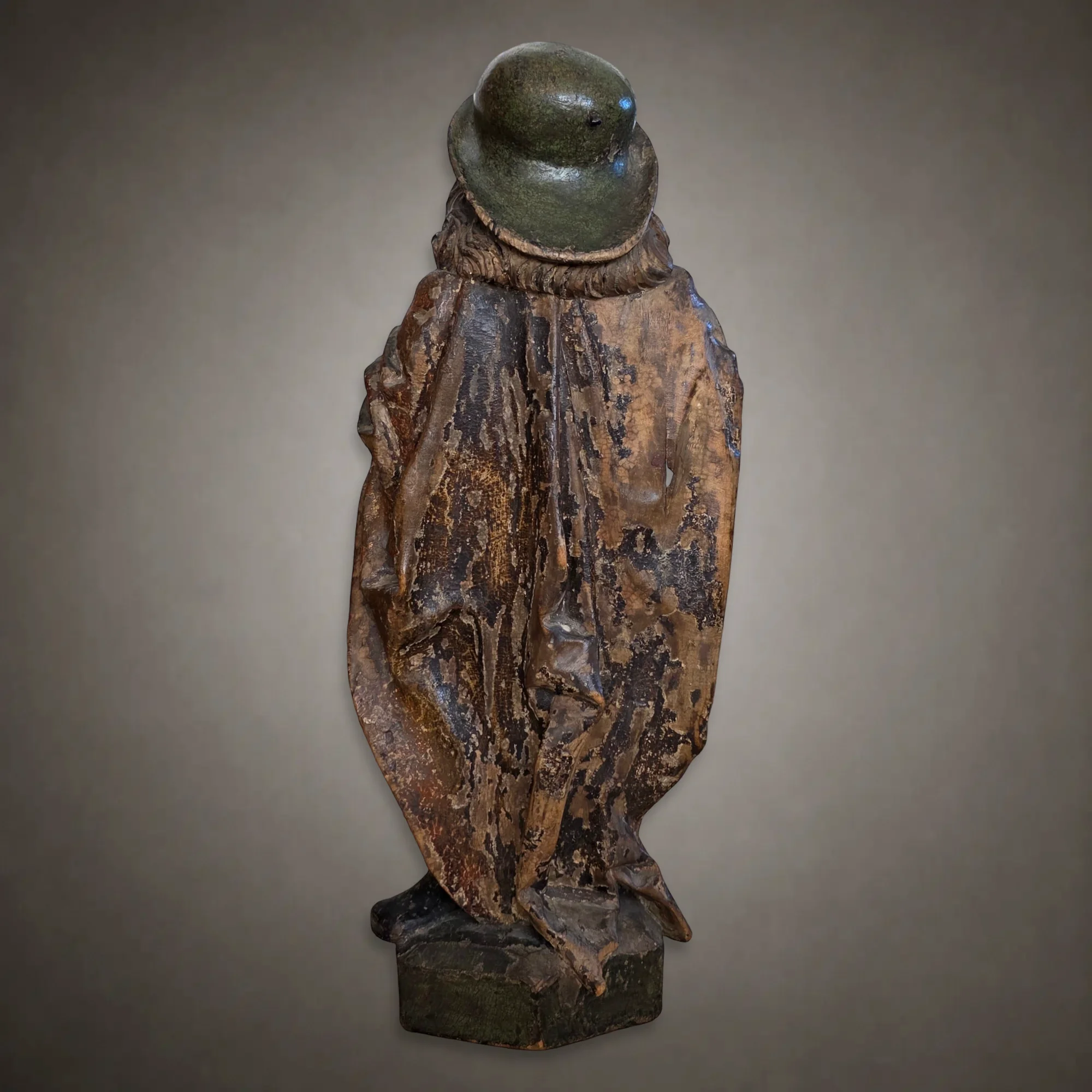
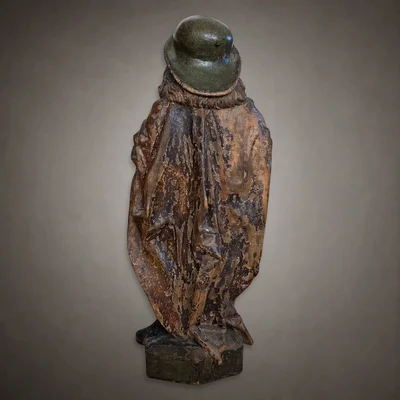
The sculpture is carved from limewood, a species frequently used in Upper Rhine workshops because of its homogeneous structure and its suitability for precise carving. It is conceived fully in the round. The reverse is not flattened: the mantle is carved there in broad planes separated by a central ridge and several vertical grooves. This attention to the back indicates that the work was probably not intended to be enclosed within a narrow niche.
The original polychromy and gilding, still present despite wear, reveal the chromatic organization of the figure. The tunic is red, the belt gilded and the mantle largely covered in gold. Dark tones appear on the reverses and sheltered parts of the garment as well as on the crown of the hat. Pink flesh tones are heightened on the cheeks, while the pupils, eyebrows and contours of the eyelids received darker definition.
In the absence of a stratigraphic study, it is not possible to distinguish with certainty the original layers from possible early retouching, although no visible restorations are apparent.
The sculpture has a drying crack as well as several losses. Only the upper part of the pilgrim’s staff survives. Parts of the left hand and several fragments of the garment are missing. Chips are visible along the borders and most exposed edges of the mantle, especially in its lower section.
The polychromy and gilding show substantial wear, lifting and losses, particularly on the reverse. They nevertheless remain extensive enough to reconstruct the general chromatic scheme of the work: gilded mantle, red tunic, green hat and base, pink flesh tones and a dark tone on the reverse of the garment.
Geographical and stylistic context
The sculpture belongs to the artistic production of the Upper Rhine at the beginning of the sixteenth century and, more specifically, to the Basel milieu of the years 1515 to 1520. Basel was then a particularly active artistic centre at the intersection of Swiss, Alsatian and Swabian territories. Works produced in its workshops circulated widely along the Rhine and as far as religious establishments in Upper Alsace.
Basel sculpture of this period retains certain elements inherited from the Late Gothic, notably a taste for abundant drapery, enveloped silhouettes and rhythms of broken folds. It is nevertheless distinguished by a renewed affirmation of bodily volume and by a more direct search for expression. Faces become strongly individualized, gazes are directed, gestures acquire a psychological function, and garments are no longer reduced to decorative networks: they participate in the three dimensional construction of the figure.
These characteristics are combined in the present Saint James. The composition retains the density and verticality of Late Gothic statuary, yet the raised head, projecting eyeballs, open mouth and hands grasping the mantle introduce a more immediate presence. The breadth of the garment and the depth of its turnbacks likewise reveal a fully plastic conception characteristic of Basel sculpture during the first decades of the sixteenth century.
The polychromy of the reverse and the conception in the round provide another significant indication. Several sculptures associated with the milieu of Martin Hoffmann were designed to be viewed from different angles. They may have been placed at the summits of altarpieces, on open structures, or used as autonomous devotional images.
Comparative corpus and dating
Martin Hoffmann is documented in Basel from 1507 until his death around 1530 or 1531. Basel archival sources record, in 1521, payment for four escutcheons, a fifth panel and two prophets intended for the hall of the Town Hall. These two prophet busts form the documentary starting point around which a group of Basel sculptures sharing common characteristics has gradually been assembled.
The corpus attributed to the master, his workshop and his circle necessarily remains open to revision because of the small number of documented works and the collective organization of workshops. It nevertheless displays remarkable coherence. Sculptures associated with this group are characterized by expressive faces with strongly marked features, powerfully modelled bodies, carefully chosen gestures and animated draperies.
The present Saint James should not be associated with Hoffmann’s workshop on the basis of a single physiognomic detail. The attribution rests on the convergence of several indications: the structure of the gaze, the design of the eyelids, the relationship between nose and mouth, the treatment of the beard, the conception in the round, the attention paid to the reverse, the compact construction of the hands and the plastic organization of the mantle.
The first and morphologically most precise comparison is with the Head of Saint John the Baptist in the Musée de l’Œuvre Notre Dame in Strasbourg, inv. MOND 249, assigned to the workshop of Martin Hoffmann and dated around 1515.
The comparison is particularly convincing in the treatment of the anatomical left eye, on the right for the viewer. In both works, the eyeball appears pushed upward beneath a thick, long and slightly oblique upper eyelid. The lower eyelid, more horizontal, forms a firm border that swells slightly at its centre. The inner corner narrows against the root of the nose, while the outer end tapers abruptly. The pupil is positioned high within the eye opening, giving the gaze its upward direction.
This relationship goes beyond the painted outline of the eyelids and concerns their sculpted construction. The same deliberate asymmetry between the two eyes is also found, reinforcing the orientation of the head. The comparison extends to the shape of the nose, with its clearly defined bridge and fleshy tip, and to the slightly open mouth framed by a moustache whose ends merge into the first locks of the beard. The hair is likewise treated through a comparable system of wavy strands, hollowed at their centres and ending in thick curls.
The Man of Sorrows in the Unterlinden Museum, inv. SB.20, provides correspondences of a different nature. The relationship first concerns technical conception: both works are limewood sculptures with worked and polychromed reverses, conceived to be viewed from several angles. Christ’s head is raised in a comparable attitude, with the gaze directed above the viewer and the mouth slightly open.
In both figures, a broad mantle envelops the shoulders before unfolding across the front. The garment does more than frame the body: it forms an independent plastic mass in front of it, articulated by deep folds and strongly turned edges. The Man of Sorrows also presents this contrast between a relatively compact outer silhouette and an internal animation produced by gaze, gestures and the tensions of the mantle.
The Christ in Prayer in the Musée de l’Œuvre Notre Dame in Strasbourg, inv. MOND 447, provides another essential point of comparison for the construction of the gaze. His raised eyes are not simple almond shapes incised into the surface of the face. They are conceived as volumes set within deep sockets, compressed between a heavy upper eyelid and an almost horizontal lower eyelid. This method creates the same impression of an inward and ascending gaze.
In Saint James as in Christ, the movement of the eyes is reinforced by the inclination of the head and the opening of the mouth. Expression therefore does not result from an isolated distortion of individual features, but from a coordinated construction of the entire face. This coherence is one of the most characteristic signs of the Basel group assembled around Hoffmann.
The Saint Martin in the Unterlinden Museum, inv. 98.9.1, now placed in the circle of Martin Hoffmann and dated around 1520 to 1525, allows comparison of the overall conception in the round, the volumes, polychromy and gestures. Its carved and polychromed reverse shows that it was intended to be seen from all sides, perhaps at the summit of an altarpiece or as an autonomous devotional work. Even more significant is the role assigned to gesture. Saint Martin grasps and extends his mantle in order to divide it; Saint James lifts its folds in front of him. In both cases, the movement of the hands causes the drapery to unfold and determines the entire structure of the composition. The hands are constructed as firm volumes with short, strongly separated fingers. The garment develops in broad expanses interrupted by thick ridges and abrupt breaks.
The Saint Bishop in the Musée d’Art et d’Histoire de Chaumont, inv. 71.474, attributed to Martin Hoffmann and dated around 1520 to 1525, completes this corpus. Comparisons again concern the eyes, in which the thick upper eyelid partially covers the globe, but also the hands and the fold system. The fingers are individualized by clear incisions while remaining united within a compact mass. The draperies alternate continuous ridges, deep grooves and short angular turnbacks.
This manner of opposing large, relatively calm surfaces with zones of more nervous concentration recurs in the mantle of Saint James. The folds converge toward the hands, break close to the gripping points and then broaden as they descend. The Chaumont figure thus confirms the persistence during the 1520s of a vocabulary already visible in Basel works dated around 1515.
Saint James stands chronologically between the Head of Saint John the Baptist, the Man of Sorrows and the Christ in Prayer, dated around 1515, and Saint Martin and the Saint Bishop, generally placed around 1520 to 1525. The proximity of the face to the earliest works in the corpus, combined with a broader and more autonomous conception of the mantle, leads to a proposed date of around 1515 to 1520.
The comparisons assembled here allow the sculpture to be located in the Upper Rhine and, more specifically, in Basel. The morphological relationship with the Head of Saint John the Baptist, particularly evident in the construction of the anatomical left eye, provides the most precise argument. It is reinforced by the shared technical conception with the Man of Sorrows and Saint Martin, by the structure of the gaze observed in the Christ in Prayer, and by the treatment of the hands and draperies of the Saint Bishop in Chaumont.
Differences in format, function and degree of execution between these works preclude seeking a mechanical identity of facture. They instead correspond to the operation of an important workshop in which physiognomic models and technical solutions were shared between the master and his collaborators. Attribution to the workshop of Martin Hoffmann accounts both for the sculpture’s close belonging to the Basel group and for the particular characteristics of its execution.
We therefore propose to recognize this work as a Saint James the Greater carved in Basel around 1515 to 1520 in the workshop of Martin Hoffmann.
Selected bibliography
- • Hans Rott, Quellen und Forschungen zur südwestdeutschen und schweizerischen Kunstgeschichte im XV. und XVI. Jahrhundert, III, Oberrhein, II, Schweiz, Stuttgart, 1936.
- • Annie Kaufmann Hagenbach, Die Basler Plastik des fünfzehnten und frühen sechzehnten Jahrhunderts, Basel, Birkhäuser, 1952.
- • Victor Beyer, La Sculpture médiévale du musée de l’Œuvre Notre Dame, Strasbourg, Éditions des Musées de la ville, 1968.
- • Monique Fuchs, La Sculpture en Haute Alsace à la fin du Moyen Âge, 1456 to 1521, Strasbourg, Oberlin, 1987.
- • Sophie Guillot de Suduiraut, Sculptures allemandes de la fin du Moyen Âge dans les collections publiques françaises, 1400 to 1530, Paris, Réunion des musées nationaux, 1991.
- • Sophie Guillot de Suduiraut, “Nouvelles attributions au sculpteur Martin Hoffmann et son entourage bâlois”, Revue du Louvre et des musées de France, 1998.
- • Sophie Guillot de Suduiraut, “Deux sculptures bâloises attribuées à Martin Hoffmann et à son entourage, acquises par le musée d’Unterlinden de Colmar”, Revue du Louvre et des musées de France, 2001, no. 1, pp. 45 to 50.
Related works
- • Head of Saint John the Baptist, Musée de l’Œuvre Notre Dame, Strasbourg, inv. MOND 249, workshop of Martin Hoffmann, c. 1515.
- • Man of Sorrows, Unterlinden Museum, Colmar, inv. SB.20.
- • Christ in Prayer, Musée de l’Œuvre Notre Dame, Strasbourg, inv. MOND 447.
- • Saint Martin, Unterlinden Museum, Colmar, inv. 98.9.1, circle of Martin Hoffmann, c. 1520 to 1525.
- • Saint Bishop, Musée d’Art et d’Histoire de Chaumont, inv. 71.474, attributed to Martin Hoffmann, c. 1520 to 1525.