
Origin : Florence, Italy.
Medium : Marble.
Size : H. 30,2cm, W. 35cm, D. 6cm
Period : 15th century.
Condition : Minor cracks
Price : 16 000€
REF. 290
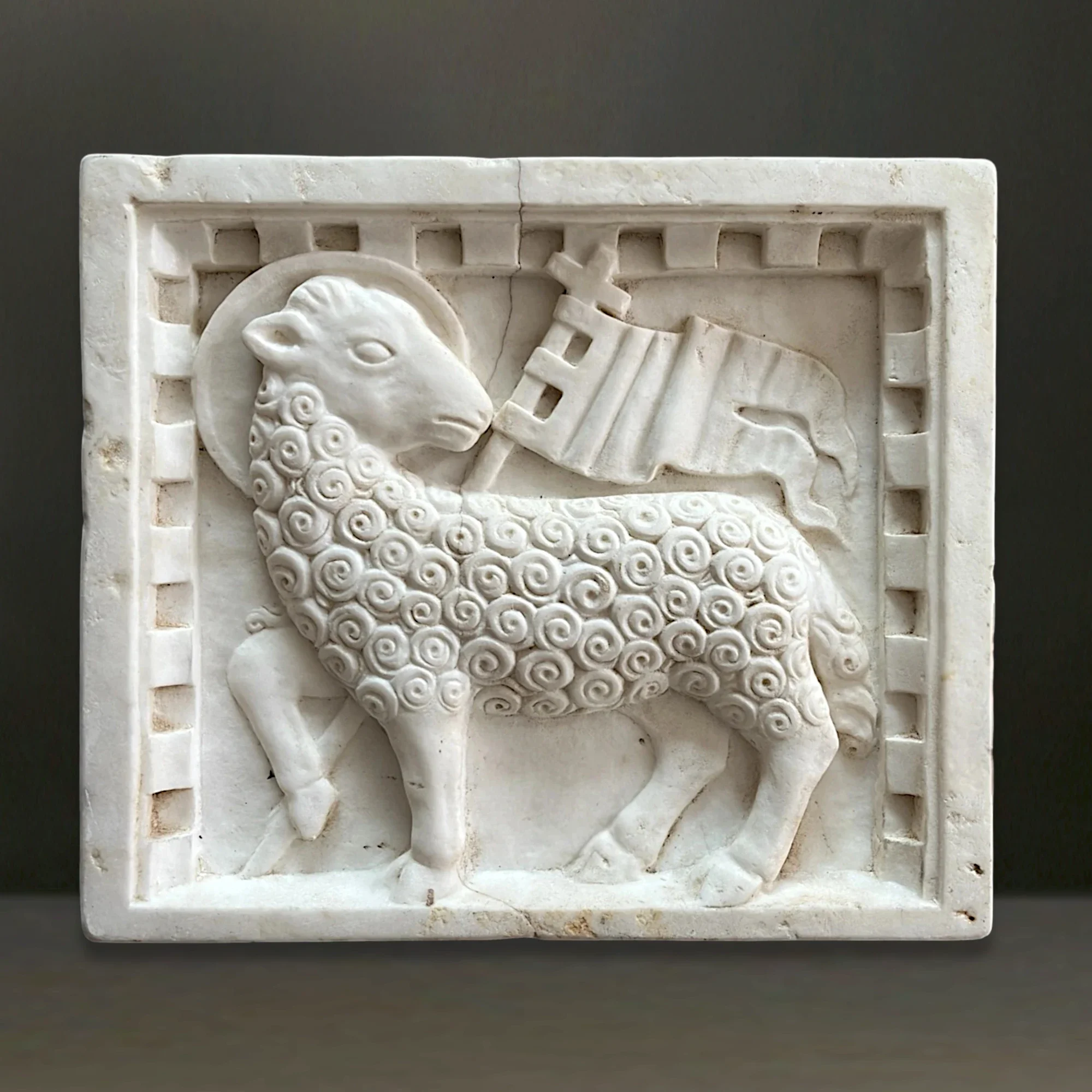
Marble Agnus Dei - Florence - Quattrocento. Coat of arms of the Arte della Lana.
This Florentine marble plaque, carved in bas-relief around 1450, depicts the Lamb of God, emblem of the Arte della Lana, the powerful wool guild of Florence. At once a religious image, a corporate coat of arms and an urban marker, it belonged to the corpus of stone insignia used to signal the presence and properties of this institution within the city, as at the prestigious Palazzo dell’Arte della Lana.
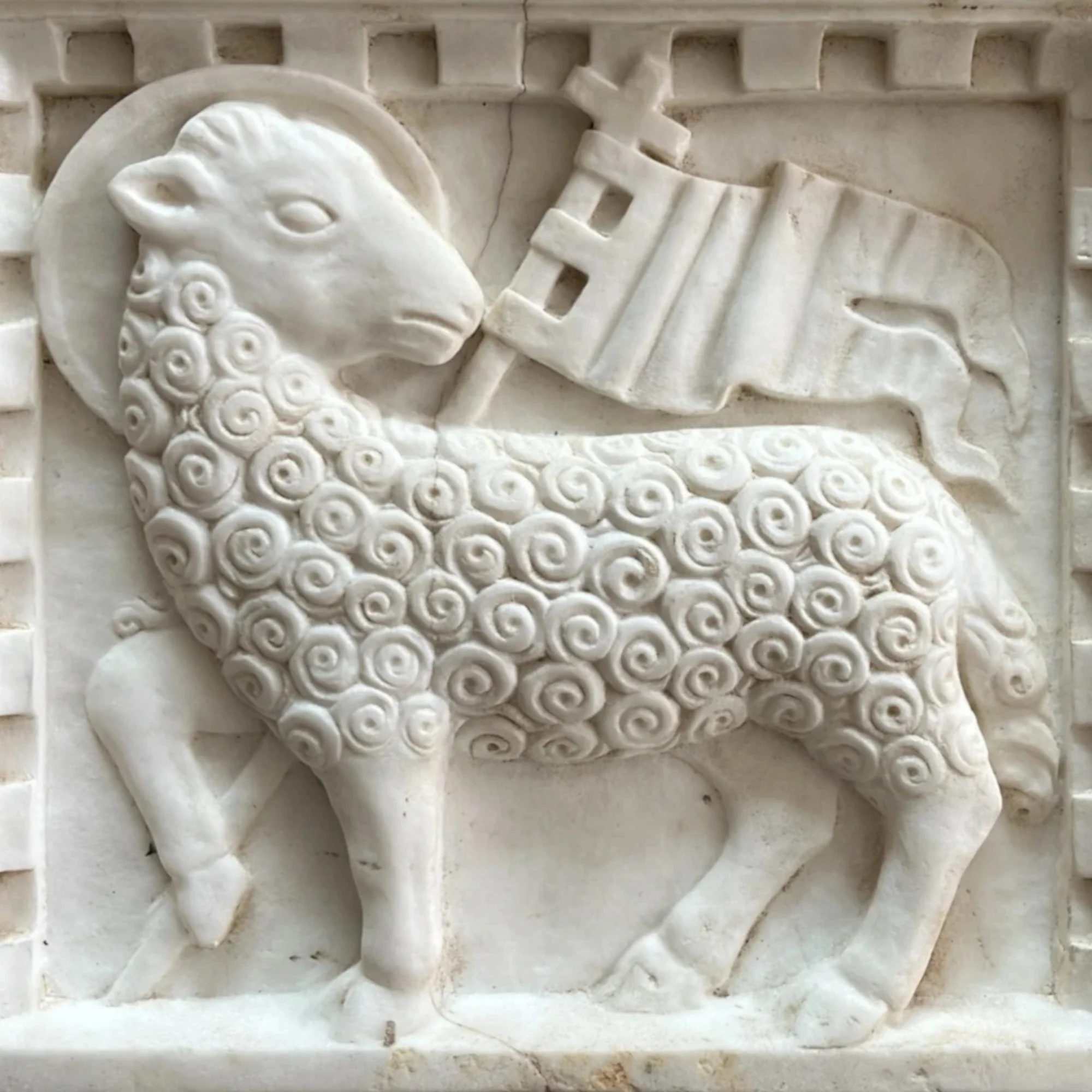
Quadrangular in format, the plaque depicts a haloed Agnus Dei turned to the left, carrying on its back a staff surmounted by a cross, from which a vexillum falls in soft folds. The animal stands on all four legs in a stable and hieratic attitude. The head, with its relatively supple modelling, is characterised by an elongated muzzle, an almond-shaped eye and a clearly defined ear, while the legs and hooves display a firmer and more naturalistic treatment. The fleece, by contrast, is highly stylised, animated by a dense succession of circular and spiral locks covering the neck, flank and hindquarters. The figure stands out against a plain background, within a slightly recessed frame bordered by a crenellated moulding. Through its decorative density, emblematic clarity and noble material, marble, this work relates to the prestigious insignia of the Arte della Lana, while retaining Trecento features that suggest a date around the middle of the 15th century, circa 1430–1450.
Related works: insignia inv. 0900295574, preserved in the Museo di San Marco, and inv. 0900293903 at the Palazzo dell’Arte della Lana.
Full dossier available on request.
References consulted:
· Per filo e per segno. L’Arte della Lana a Firenze nel Cinquecento, Francesco Ammannati, Firenze, 2020
· Il centro di Firenze restituito. Affreschi e frammenti lapidei nel Museo di San Marco, Maria Sframeli dir., Firenze, 1989.
· Patrimonio fragile: pietrini e insegne di proprietà nella città di Firenze, Claudio Paolini, in Tutela & Restauro 2020. Notiziario della Soprintendenza archeologia belle arti e paesaggio per la città metropolitana di Firenze e le province di Pistoia e Prato, Firenze, 2021, p. 353-360.
In-depth study of the artwork
| Subject: | bas-relief, armorial sign of the Arte della Lana |
|---|---|
| Material: | marble |
| Dimensions: | H. 30cm, W. 36cm, D. 6cm |
| Origin: | Florence, Italy |
| Dating: | circa 1450 |
| Provenance: | French private collection |
| Condition: | small cracks |
| Reference: | 290 |
Description
A quadrangular marble slab carved in bas-relief, depicting a nimbate Agnus Dei, facing left and carrying on its back a staff topped with a cross to which a vexillum is attached, falling in supple folds. The animal, treated in profile, rests on its four limbs in a stable and hieratic attitude. The head, relatively softly modeled, is distinguished by an elongated muzzle, an almond-shaped eye, and a clearly delineated ear; the legs and hooves exhibit a firmer and more naturalistic treatment.
The fleece, on the other hand, is rendered in a stylized manner by a tight succession of circular and spiraling locks covering the neck, flank, and hindquarters. The figure stands out against a plain background and is set within a slightly recessed frame, bordered on all four sides by a crenellated molding.
This slab is an armorial sign of the Arte della Lana, the wool guild of Florence.
Geographic and Stylistic Context
In Florence, the Arte della Lana was among the Arti Maggiori, that is, among the wealthiest and most influential guilds in the city. Its power rested not only on the production and trade of woolen cloth, a major sector of the Florentine economy, but also on its institutional weight within the city. The Arte della Lana was thus one of the dominant guilds of Florence, at the heart of Florentine economic and political life at the end of the Middle Ages.
In 1331, the Florentine Republic entrusted the Arte della Lana with exclusive control over the Opera di Santa Maria del Fiore, demonstrating how the guild transcended the mere professional sphere to intervene at the very heart of the city's civic representation.
The coat of arms or sign of the wool guild was the Agnus Dei with a cross-staff and vexillum.
The lapidary signs linked to the guilds must be understood as visible markers of presence, authority, and ownership. Affixed to facades, they did not serve a purely decorative function: they materially signaled a building's belonging to a corporate institution. Italian sources regarding these reliefs explicitly emphasize that in Florence such signs served to attest the Arte della Lana's ownership of the buildings where they were placed; they simultaneously bear witness to the importance of the real estate wealth accumulated by this guild.
The piece must therefore be considered within a specifically Florentine horizon, where the corporate emblem, the religious image, and the urban sign merge into a single form.
Comparison Corpus and Dating
The present slab belongs to the family of lapidary signs of the Arte della Lana preserved in Florence, particularly in the Lapidarium of the Museo di San Marco, on the walls of the Palazzo dell'Arte della Lana, or other Florentine buildings, and listed in the databases of the Catalogo generale dei Beni Culturali. The Museo di San Marco notes that five coats of arms attributable to Arte della Lana properties are preserved in the museum, dating from the 15th century, mostly originating from shops on Via Calimala. This coat of arms thus belongs to a coherent Florentine series, linked to the urban materialization of the guild's possessions.
The earliest examples of this series date back to the Trecento. Record 0900285631 documents an Arte della Lana sign dated circa 1300–1399, preserved at the convent of Santa Maria Novella. This example proves that the heraldry of the Arte della Lana was already fully formulated in the 14th century.
For the early 15th century, record 0900282308 offers a particularly useful anchor point: it is a slab dated 1400–1410, described as a coat of arms adorned with molded frames and dentils. For the mid-Quattrocento, one can cite the slab described in record 0900193978, dated 1400–1449, which retains characteristics inherited from the Trecento, notably in the treatment of the animal's fleece.
The coats of arms can also adopt a more streamlined formulation, as evidenced by slab inv. 0900295574, preserved at the Museo di San Marco and dated to the 15th century.
Finally, one should mention slab inv. 0900293903, embedded in the walls of the Palazzo dell'Arte della Lana and dated to the second half of the 15th century.
Within this corpus, our slab appears to be situated after the forms of the very beginning of the century, but before the more advanced formulations of the later Quattrocento. Its crenellated frame, the decorative density of its surface, the still highly systematic stylization of the fleece, and the emblematic clarity of the silhouette align it more closely with the more archaic states of the series than with the later, more supple, and naturalistic versions. In this sense, the comparison leads to proposing a dating in the second quarter of the 15th century, or more broadly around the mid-15th century, that is, around 1430–1450. This proposition seems the most balanced: it takes into account the medieval antiquity of the type, its Florentine continuity in the 15th century, and the intermediate place occupied by the slab between the forms of the early century and the more evolved variants of the second half of the Quattrocento.
The material used, marble, distinguishes our slab from the majority of the preserved corpus, which is more often executed in stone or pietra serena. This choice of a nobler material suggests that it must have come from a prestigious building or context, perhaps linked to a major institutional commission, similar to slab inv. 0900293902 from the Palazzo dell'Arte della Lana, also carved in marble.
Bibliographical References
- • Per filo e per segno. L'Arte della Lana a Firenze nel Cinquecento, Francesco Ammannati, Florence, 2020.
- • Il centro di Firenze restituito. Affreschi e frammenti lapidei nel Museo di San Marco, Maria Sframeli (ed.), Florence, 1989.
- • Patrimonio fragile: pietrini e insegne di proprietà nella città di Firenze, Claudio Paolini, in Tutela & Restauro 2020. Notiziario della Soprintendenza archeologia belle arti e paesaggio per la città metropolitana di Firenze e le province di Pistoia e Prato, Florence, 2021, pp. 353-360.