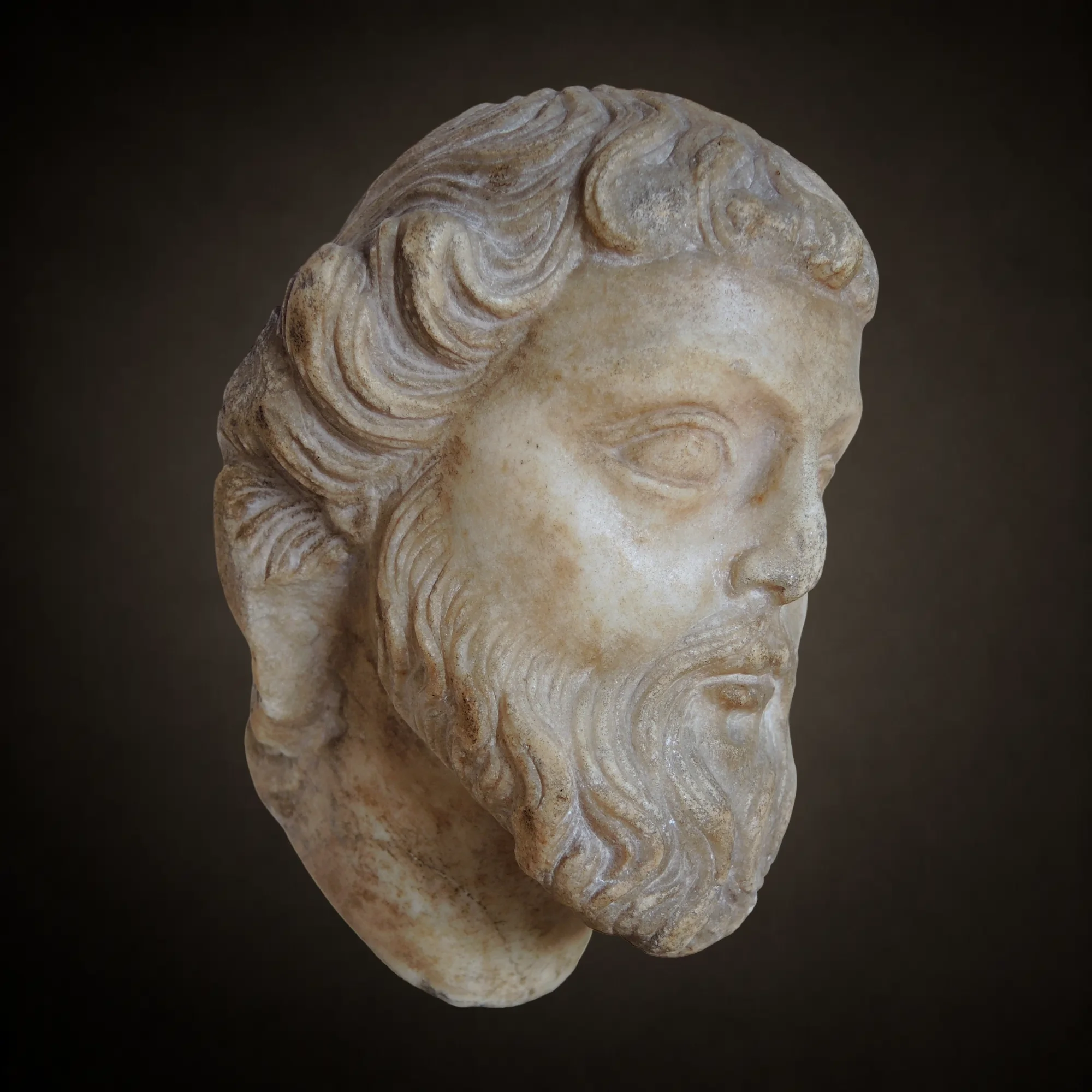

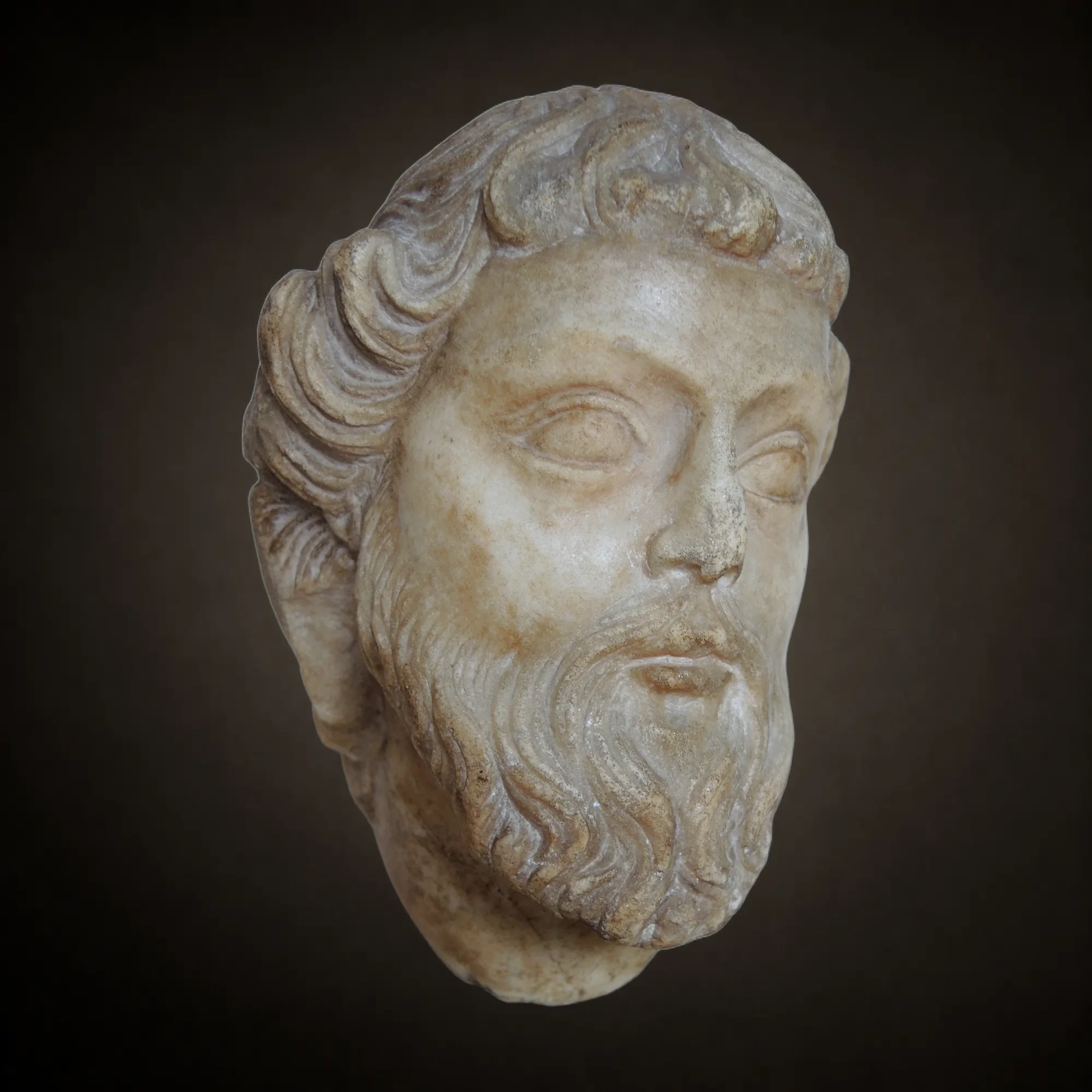
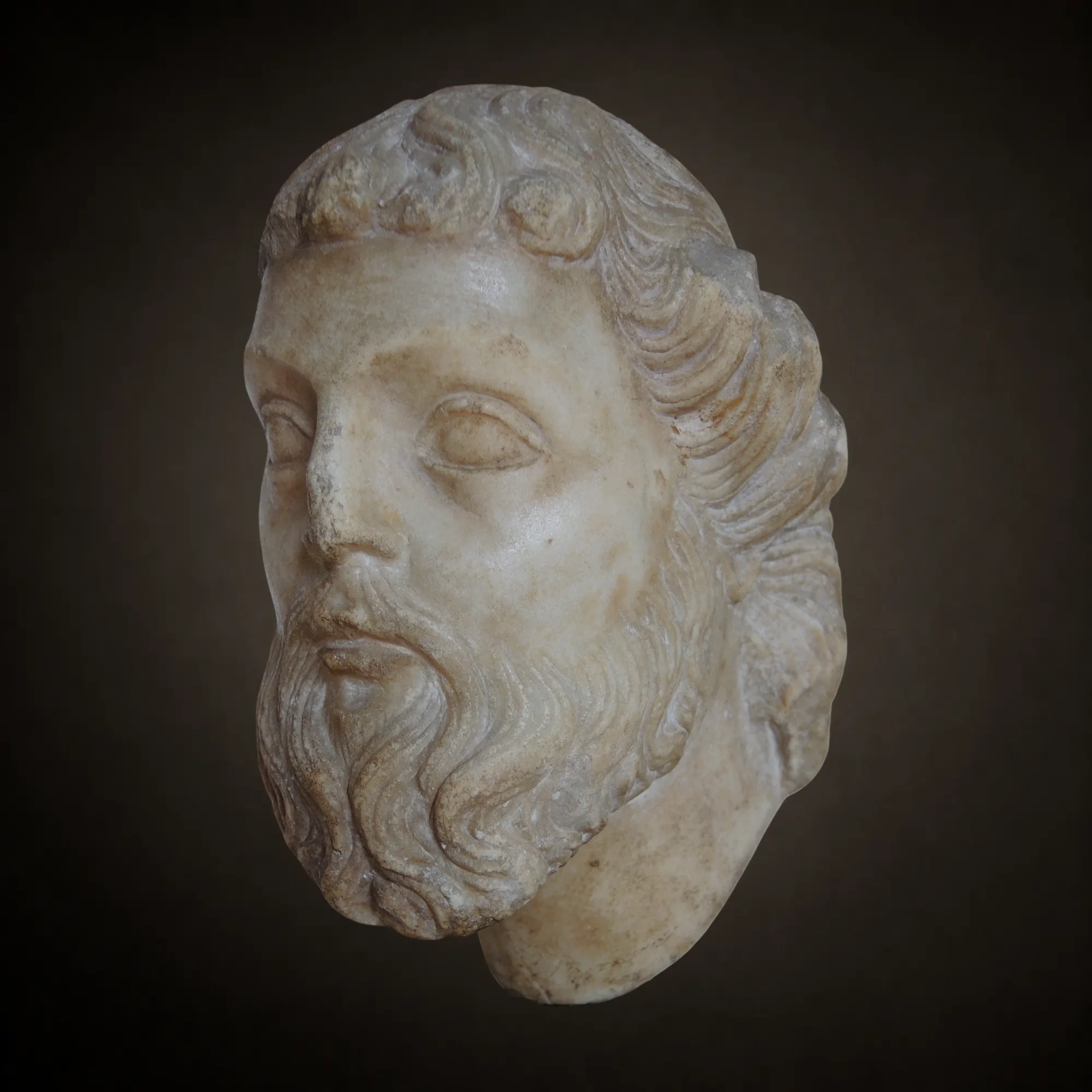
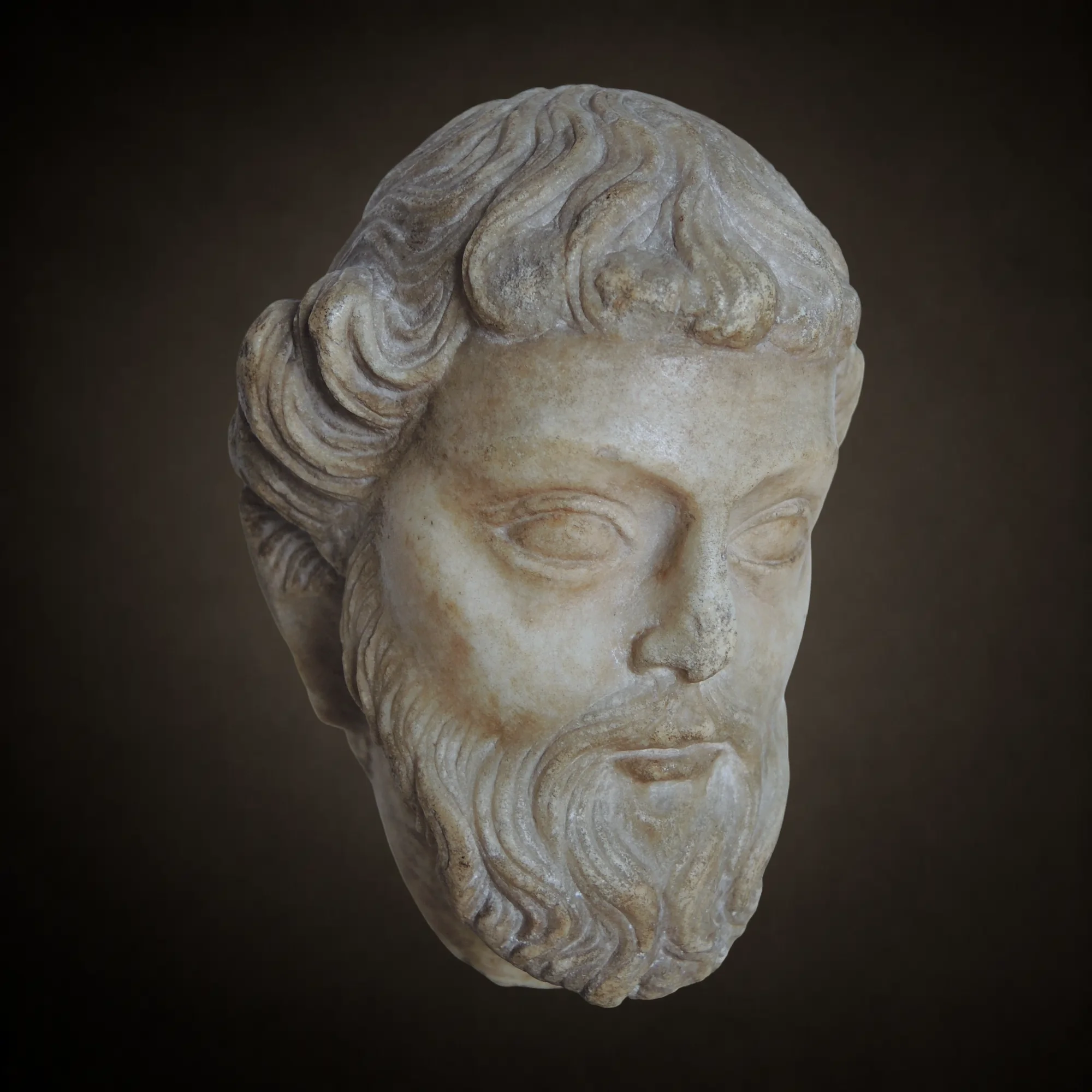
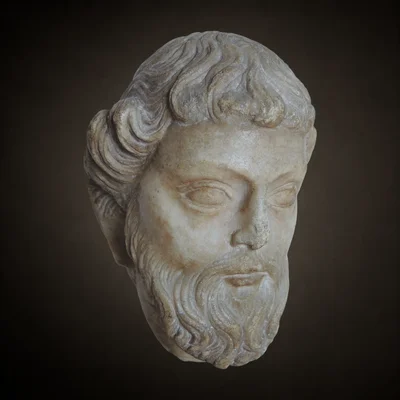
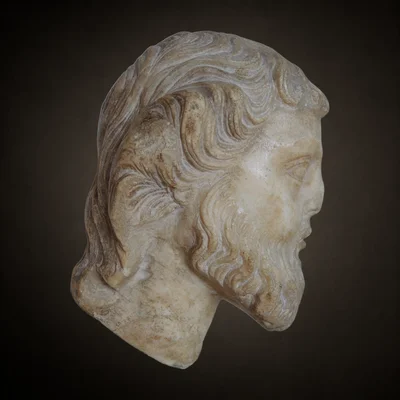
Origin : Siena, Tuscany, Italy.
Medium : Siena marble
Size : Height 16.5 cm; width 12 cm; depth 11.5 cm
Period : Circa 1312 to 1317.
Condition : Surface wear; minor losses to the tip of the nose.
Price : on demand
REF. 262
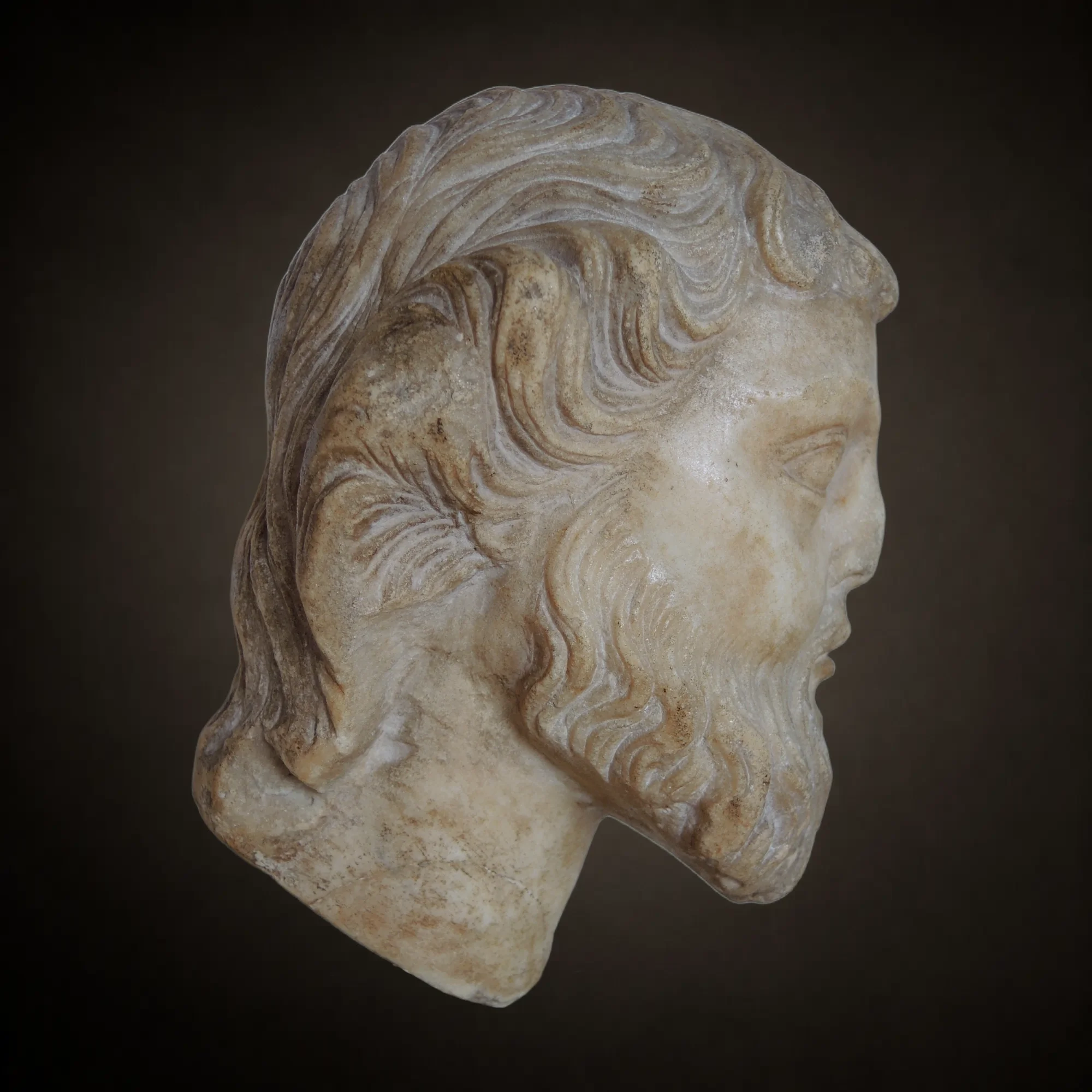
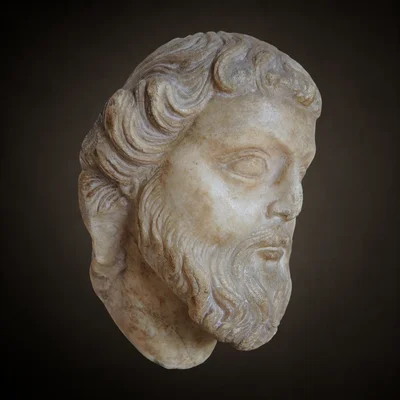
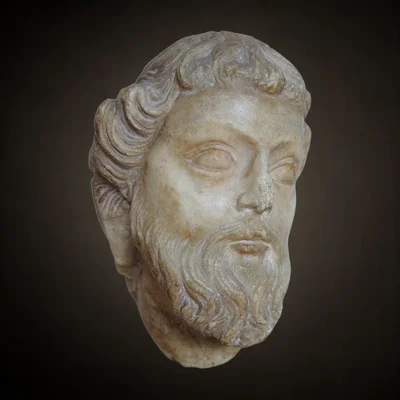
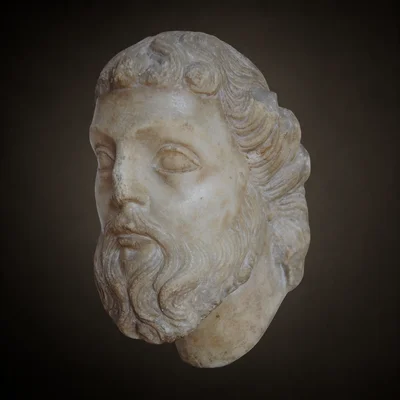
Head of a Prophet, Siena Gano di Fazio, circa 1315
Head of a bearded man carved fully in the round in marble by Gano di Fazio (Siena, documented from 1302 to 1316 or 1317), one of the major figures of Sienese sculpture at the turn of the thirteenth and fourteenth centuries. This previously unpublished work is dated from 1312 to 1317 by Professor Gabriele Fattorini.
The face is distinguished by an elegant Gothic naturalism: the large oval eyes are emphasized by finely delineated eyelids, while the hair and beard are rendered in supple, undulating and deeply incised locks. The volumes of the head, the calligraphic fluidity of the hair and beard and the movement of the locks extending across the sides and back of the head find their closest parallels in the late works of Gano di Fazio.
The most significant comparison is provided by the series of eleven Saints and Prophets from the cathedral of Massa Marittima, now preserved in the Museo d'Arte Sacra.
The affinities are particularly striking with the bearded Prophets and with the young Apostle with a Book: the same construction of the face, the same oval shape of the eyes and, above all, the same naturalistic and rhythmic treatment of the hair and beard. The stylistic evolution towards a freer Gothic manner also relates this head to the sculptures of the monument of Saint Margaret of Cortona and to the Virgin and Child in the Museo Diocesano of Cortona.
The head originally belonged to a statuette carved fully in the round, probably approximately 70 cm high. Its precise iconography cannot be determined with certainty: a prophet or an apostle is the most likely hypothesis, although the possibility of a Blessing Christ is also considered in the study. The quality of the modelling and the maturity of the Gothic language place the work in the final phase of Gano di Fazio's activity, between 1312 and 1317.
This work comes from a German private collection.
A comprehensive study by Gabriele Fattorini, dated Siena, 13 July 2025, recognizes the sculpture as a work by Gano di Fazio and places it within the artist's corpus, notably through comparisons with the funerary monument of Bishop Tommaso d'Andrea at Casole d'Elsa, the funerary monuments of Ranieri degli Ubertini and Gregory X in Arezzo, the tomb of Saint Margaret of Cortona and the Saints and Prophets of Massa Marittima.
Principal references:
· Peleo Bacci, Notizie originali inedite e appunti critici su Gano di Fazio scultore senese, 1944;
· Gianna Bardotti Biasion, « Gano da Siena », Enciclopedia dell'arte medievale, VI, Rome, 1995, pp. 475 to 477;
· Silvia Colucci, « Gano di Fazio e la scultura al passaggio tra Due e Trecento », in Scultura gotica senese, 1260 to 1350, Turin, 2011, pp. 39 to 74;
· Marco Romano e il contesto artistico senese fra la fine del Duecento e gli inizi del Trecento, exhibition catalogue, Casole d'Elsa, 2010.
Full documentation available on request.
In-depth study of the artwork
| Artist: | Gano di Fazio (Siena, documented from 1302 to 1316 or 1317) |
|---|---|
| Subject: | Head of a Prophet |
| Material: | Marble |
| Dimensions: | 16.5 × 12 × 11.5 cm |
| Date: | 1312 to 1317 |
| Study: | Professor Gabriele Fattorini, Siena, 13 July 2025 |
| Reference: | 262 |
Study by Professor Gabriele Fattorini
The following text is based on the study written by Gabriele Fattorini in Siena on 13 July 2025.
The head is distinguished by a graceful Gothic naturalism that relates it to Sienese sculpture of the early fourteenth century and, in particular, as we shall see, to the manner of Gano di Fazio, one of the leading sculptors active in Tuscany at the time, alongside masters of the stature of Nicola and Giovanni Pisano, Arnolfo di Cambio, Marco Romano and Tino di Camaino, in the decades spanning the thirteenth and fourteenth centuries.1
Documentary evidence concerning Gano di Fazio is scarce. Thanks to the research of Peleo Bacci, he is recorded in Siena as a resident of the Vallepiatta district, near the cathedral, between 1302 and 1316, and he must have been born no later than around 1270, since his daughters and heirs are recorded as adults in the « tavola delle possessioni » of 1318.2 Gano thus emerges as the first Sienese sculptor whose artistic personality can be reconstructed, although on the basis of only one securely documented work: the monument to Tommaso d’Andrea, Bishop of Pistoia, still preserved in the Collegiata of Casole d’Elsa (fig. 1). The master proudly left a signature in verse: « Celavit Ganus opus hoc insigne Senesis: / laudibus immensis est sua digna manus », together with an inscription stating that the bishop, a native of Casole, died in 1303 and that his brothers Jacopo and Sozzo commissioned the tomb, suggesting that it was executed in the years immediately following his death, around 1303 to 1305. It is a typical elevated Gothic wall tomb, the earliest surviving example of its kind in which the figure of the deceased is carved fully in the round, with the funerary chest in the lower section and, above it, the recumbent effigy accompanied by five deacons. Two kneel beside him at either end, while the other three support the curtain in the background. Above, the arched field was decorated with a fresco of the Maestà, framed by a pair of lateral columns and a Gothic gable. A frescoed medallion with the Agnus Dei, attributable to the Duccesque Master of Badia a Isola, survives there, while at the summit a trefoil contains a half length relief figure of Christ Blessing.3
The funerary monument facing it, that of the distinguished jurist Bernardino degli Albertini, known as Il Porrina, was also formerly attributed to Gano. The studies of Giovanni Previtali have since recognised it as a work by Marco Romano, an itinerant sculptor who also worked in Cremona, where he created the group of the Virgin and Child with Saints Imerius and Homobonus on the porch of the cathedral façade, and in Venice, where he left the tomb of the eponymous prophet in San Simeone Grande, dated 1318, bearing a signature in verse whose formula is not very different from that on the tomb of Tommaso d’Andrea.4
A profound knowledge of the art of Arnolfo di Cambio undoubtedly lies at the origin of Gano’s artistic language, as scholarship has clearly demonstrated and as can be observed at Casole in the architecture of the tomb, in the motif of the deceased mourned by his attendants and in the solid physical presence of the figures. Yet rather than Arnolfo’s characteristic volumetric synthesis, these figures favour a freer and more naturalistic Gothic style, in which the influence of Nicola and Giovanni Pisano must have played a significant role, although our sculptor consistently avoided the brilliant expressive excesses of the son of the great master « de Apulia », who directed the work on the façade of Siena Cathedral from 1284 to 1297.
A comparable temperament can be recognised in a group of works that, starting from the signed monument, have gradually formed the corpus of Gano di Fazio. In addition to the detached head of Bishop Tommaso d’Andrea in the Museo della Collegiata at Casole d’Elsa, originating from the church of San Tommaso at Querceto and thus confirming the master’s links with the prelate’s family (fig. 2),5 the corpus includes works of considerable importance for Tuscan sculpture around 1300, demonstrating the sculptor’s success beyond the borders of the former Sienese state. The Funerary Monument of Ranieri degli Ubertini, Bishop of Volterra, in San Domenico at Arezzo (fig. 3), may thus be attributed to him. It is another elevated wall tomb, with a fresco of the Virgin and Child above the funerary chest. It should be dated around 1300, by which time the prelate, still alive in 1297, had already died, and is distinguished by a recumbent effigy in high relief placed on the front of the bier and accompanied by two attendants at either end, following models widely used in Florence among the Dominicans and the canons of Santa Reparata.6
Also in Arezzo, the hand of Gano di Fazio can be recognised in the Funerary Monument of Gregory X in the cathedral (fig. 4), datable shortly after 1303, long after the pope’s death in 1277. It consists of a Gothic wall structure dominated by a large gable, with the deceased lying above the funerary chest, which is itself supported by small columns and decorated on the front with an Agnus Dei accompanied by four half length figures of saints.7
Although he is not documented on the cathedral building site, our sculptor must also have worked in his native city, where he received the prestigious commission for the Funerary Monument and Altar of the Blessed Gioacchino Piccolomini in the church of the Servi, the venerated Servite having died in 1305. Here again it must have been a Gothic ensemble, erected after 1310, of which only the front of the funerary chest survives, now in the Pinacoteca Nazionale (figs. 6 and 7). The marble slab is decorated with three reliefs depicting miraculous episodes involving the Blessed, confirming Gano’s tendency towards essential simplification, both in the representation of space and in the narration of events drawn from everyday life: Gioacchino is shown knocking at the door of the convent to be admitted to the order, preventing objects placed on a table from breaking when it overturns during one of his epileptic seizures, and stopping a lit candle from falling during Mass.8
In parallel with the innovations developed in Siena during the second decade of the fourteenth century by Tino di Camaino, and probably by his father Camaino di Crescentino, Gano di Fazio eventually evolved towards a freer Gothic manner, as demonstrated by the Funerary Monument of Saint Margaret of Cortona, preserved in the sanctuary dedicated to her in the Tuscan city (fig. 5). Once again this is an elevated wall tomb, but here characterised by a double gabled architecture beneath which two angels draw aside the curtains of the funerary bed on which the saint lies, formed by a sarcophagus whose front depicts four miraculous episodes. While these scenes retain the restrained sobriety of the Stories of the Blessed Gioacchino Piccolomini, the sculpted figures in the upper section, from the two angels to the Annunciation group placed at the top of the twisted lateral columns, are distinguished by a sinuous Gothic movement constructed through pronounced curves, revealing the change that had taken place in the language of our master. One may wonder whether the stylistically highly consistent Virgin and Child, now in the Museo Diocesano of Cortona (fig. 14), was also connected with the saint’s tomb.9
The Gothic development just described is finally confirmed by the remarkable series of eleven Saints and Prophets from the cathedral of Massa Marittima, now preserved in the Museo d’Arte Sacra, where they may originally have decorated a choir screen. They rank among the absolute masterpieces of Sienese sculpture from the first quarter of the fourteenth century and retain clear traces of polychromy that must once have enhanced their precious character still further (figs. 8 to 10). Four of them were recently presented in the exhibition Siena: The Rise of Painting 1300 to 1350, held in 2024 and 2025 at the Metropolitan Museum in New York (fig. 12) and subsequently at the National Gallery in London. Three of the eleven figures, also distinguished by the greyer tone of their marble, may however not be by Gano, but by the Master of the Malavolti Tomb.10 This artist must have maintained very close relations with Gano, sharing the particular Gothic tendency, distinct from the language of Giovanni Pisano, that characterises the surviving sculptural cycle from the upper façade of Siena Cathedral. It has therefore been proposed that he should be identified with Camaino di Crescentino, father of the more famous Tino, who played an important role on the cathedral building site during these years, while Gano appears in 1311 as a witness to a document in which the same Camaino was appointed representative by a certain Cenne di Corso of Florence to settle a dispute in the territory of Arezzo.11
The Head in the Oeuvre of Gano di Fazio
Having traced the career of Gano di Fazio, we may now return to our head, first noting how frequently comparable detached heads are encountered both on the art market and elsewhere. In Gano’s case, in addition to the already mentioned head of Bishop Tommaso d’Andrea in the museum at Casole, larger than ours but not greatly so since it measures 30 cm in height including the headdress, there is also a badly damaged bishop’s head in the Museo Statale d’Arte Medievale e Moderna in Arezzo (H. 11 cm; fig. 16).12 It should also be recalled that the exhibition at Casole devoted to Marco Romano around fifteen years ago included, among works by Giovanni Pisano, detached heads such as that of Melchizedek from the Fountain of Perugia, now in the Pinacoteca of Volterra (H. 12.5 cm), the head of a putto from the Opera del Duomo in Siena (H. 8.5 cm), and that of a presumed Saint Michael the Archangel formerly in the Carlo De Carlo collection (H. 22 cm). While the head of an Angel in the Museo dell’Opera del Duomo in Siena (H. 30 cm), by an anonymous Sienese sculptor active between the first and second decades of the fourteenth century, and that of a Helmeted Knight in the Museo Statale d’Arte Medievale e Moderna in Arezzo (H. 32 cm), securely placed within the corpus of Agostino di Giovanni, clearly derive from larger figures, the small Head of a Prophet by Marco Romano in the Casole museum (H. 14.5 cm), one of the highlights of that exhibition, offers an excellent comparison both in its dimensions and in its iconographic character. It depicts a bearded figure who nevertheless appears older than ours.13 Its close similarity to the previously mentioned prophet Saint Simeon rightly pointed towards the Venetian activity of this itinerant master, while the conviction that this head came from a statuette carved in the round recalls the two Prophets accompanying Porrina in the Casole tomb. Their dimensions, which are not very different from those of our head, led to the suggestion that the complete figure may have measured approximately 70 cm in height, a scale comparable to that of the two Friars by Goro di Gregorio from the Funerary Monument of Guglielmo da Ciliano, now in the Rectorate of the University of Siena, one in situ and the other in the Salini collection at the Castello di Gallico, or to that of the Saints and Prophets of Massa Marittima mentioned above.14
It is indeed possible to imagine that our head belonged to a figure of a Prophet or a bearded Saint, like those at Massa Marittima, or even, given its appearance, to a Blessing Christ, a subject treated, for example, by Nicola Pisano on the pulpit of Siena Cathedral between 1265 and 1268 (fig. 11). Although no useful or decisive evidence allows the original provenance of the piece to be identified, our head nevertheless displays its closest stylistic connections with several of the statuettes from Massa Marittima. Comparison with the two bearded Prophets, one holding a rolled scroll and the other an unfurled scroll, as well as with the young Apostle with a Book, probably an Evangelist (figs. 18 to 26), reveals decisive affinities in the volume of the head, the large oval shape of the eyes and, above all, in the natural, fluid and calligraphic treatment of the beard and hair. These swell out on either side of the face and undulate with refined Gothic elegance across the top and back of the head, with a precious quality recalling the sublime models of the Crucifixes by Giovanni Pisano and Marco Romano, although in our case the end of the long hair is interrupted by a break (fig. 29).
If the undulation of comparable Gothic linear rhythms was already a hallmark of Gano di Fazio’s works from the tomb of Ranieri degli Ubertini in Arezzo and that of Tommaso d’Andrea in Casole (figs. 15, 17, 27 and 28), the lively naturalism of our head is now fully aligned with the more developed sensibility of the sculptures not only from Massa Marittima but also from Cortona, particularly the Virgin and Child (fig. 14). This points to a date in the years 1312 to 1317, corresponding to the final chapter of our master’s activity. These were the years in which Giovanni Pisano died and when, in the Siena of the Nine, following completion of the Maestà for the cathedral in 1311, Duccio found time to paint a second version of that composition for the cathedral of Massa Marittima, of which a substantial fragment survives, before leaving the scene around 1318 or 1319 and giving way to Simone Martini and the brothers Pietro and Ambrogio Lorenzetti. In parallel, in the field of sculpture, Siena after Gano di Fazio witnessed the emergence of a new and important generation of masters led by Tino di Camaino, Goro di Gregorio and Agostino di Giovanni.
Notes and References
- For two profiles of Gano di Fazio: Gianna Bardotti Biasion, Gano da Siena, in Enciclopedia dell’arte medievale, VI, Rome, 1995, pp. 475 to 477; Silvia Colucci, Gano di Fazio e la scultura al passaggio tra Due e Trecento, in Scultura gotica senese, 1260 to 1350, ed. R. Bartalini, Turin, 2011, pp. 39 to 74, with documentary register and catalogue of works.
- Peleo Bacci, Notizie originali inedite e appunti critici su Gano di Fazio scultore senese (meta XIII sec. 1317), in Idem, Fonti e commenti per la storia dell’arte senese: dipinti e sculture in Siena e nel suo contado e altrove, Siena, 1944, pp. 49 to 109; see also the documentary register in Colucci, Gano di Fazio, cited above, pp. 50 to 51.
- On the tomb of Tommaso d’Andrea: Silvia Colucci, in Marco Romano e il contesto artistico senese fra la fine del Duecento e gli inizi del Trecento, ed. A. Bagnoli, exhibition catalogue, Casole d’Elsa, 2010, Cinisello Balsamo, 2010, pp. 84 to 88; idem, Gano di Fazio, cited above, p. 39, p. 48 notes 1 and 2, pp. 52 to 53, no. 2, with bibliography.
- On the tomb of Messer Porrina and the sculptor Marco Romano, following the fundamental study by Giovanni Previtali, Alcune opere “fuori contesto”: il caso di Marco Romano, in « Bollettino d’Arte », LXVIII, 1983, 22, pp. 43 to 68, see the catalogue of the exhibition held at Casole around fifteen years ago, Marco Romano, cited above, especially pp. 132 to 139, with an essay by Giovanna Valenzano on the Venetian tomb.
- On the head from Querceto: Silvia Colucci, in Marco Romano, cited above, pp. 206 to 209, no. 14; idem, Gano di Fazio, cited above, p. 39, p. 48 note 4, p. 53 no. 3, with bibliography.
- On the Ubertini tomb: Roberto Bartalini, Goro di Gregorio e la tomba del giurista Guglielmo di Ciliano, in « Prospettiva », 41, 1985, pp. 21 to 38, especially p. 35 note 24; Silvia Colucci, Vescovi e santi, papi e condottieri: tipologia dei monumenti funebri aretini, in Arte in terra d’Arezzo. Il Trecento, eds. A. Galli and P. Refice, Florence, 2005, pp. 139 to 160, especially p. 140 and pp. 146 to 151; Frithjof Schwartz, Il bel cimitero. Santa Maria Novella in Florenz 1279 to 1348. Grabmaler, Architektur und Gesellschaft, Berlin Munich, 2009, pp. 239 to 241, 473 to 474 no. K.III,3; Colucci, Gano di Fazio, cited above, pp. 39 to 40, p. 48 notes 8 and 10, p. 53 no. 3, with bibliography.
- On the tomb of Gregory X: Giovanni Freni, The setting of rituals: fourteenth century monuments in Arezzo Duomo, in « Sculpture Journal », IX, 2003, pp. 4 to 18; Guido Tigler, “Quam coluit pacem nobis Gregorius oret”. Considerazioni sul monumento sepolcrale di Gregorio X nel Duomo di Arezzo, in « Arte cristiana », XCI, 2003, pp. 317 to 332 and 399 to 414; Colucci, Gano di Fazio, cited above, p. 40, p. 48 notes 14 to 18, p. 53 no. 4, with bibliography.
- On the Stories of the Blessed Gioacchino Piccolomini: Silvia Colucci, in Duccio. Alle origini della pittura senese, exhibition catalogue, Siena, 2003 and 2004, eds. A. Bagnoli, R. Bartalini, L. Bellosi and M. Laclotte, Cinisello Balsamo, 2003, pp. 488 to 491 no. 85; idem, in Marco Romano, cited above, pp. 210 to 213 no. 15; idem, Gano di Fazio, cited above, pp. 43 to 44, p. 48 note 26, p. 53 no. 4, with bibliography.
- Gianna Bardotti Biasion, Gano di Fazio e la tomba altare di Santa Margherita da Cortona, in « Prospettiva », 37, 1984, pp. 2 to 19, was responsible for restoring the Cortona monument to the corpus of Gano di Fazio; see also Colucci, Gano di Fazio, cited above, pp. 45 to 46, 55 to 56 no. 12, with bibliography, and p. 56 no. 15 for the Virgin and Child.
- On the statuettes from Massa Marittima: Luciano Bellosi, Gano a Massa Marittima, in « Prospettiva », 37, 1984, pp. 19 to 22; Roberto Bartalini, in Duccio, cited above, pp. 492 to 495 nos. 86 to 88; Silvia Colucci, in Marco Romano, cited above, pp. 216 to 219 no. 17; Alessandro Bagnoli, ibid., pp. 226 to 229 no. 20, for the Master of the Malavolti Tomb; Colucci, Gano di Fazio, cited above, pp. 46 to 47, 56 to 57 no. 17, with bibliography.
- Colucci, Gano di Fazio, cited above, p. 50, with bibliography, also recalls that between 18 and 21 June 1304 Gano was entrusted, on behalf of Antonio di Pace, with transferring a plot of land and a vineyard near Siena to Crescentino di Dietisalvi.
- Colucci, Gano di Fazio, cited above, p. 56 no. 16, with bibliography.
- See the corresponding catalogue entries in Marco Romano, cited above, pp. 160 to 167 nos. 3 and 4, pp. 172 to 175 no. 6, pp. 186 to 189 no. 9, pp. 222 to 225 no. 19, pp. 250 to 251 no. 26.
- A. Bagnoli, ibid., pp. 186 to 189 no. 9.