
Origin : Aragon, Spain.
Medium : Polychromed wood.
Size : Height 104 cm
Period : Circa 1300.
Condition : Restorations and losses to the polychromy
Price : on demand
REF. 292
Gothic Virgin in Majesty. Aragon - circa 1300.
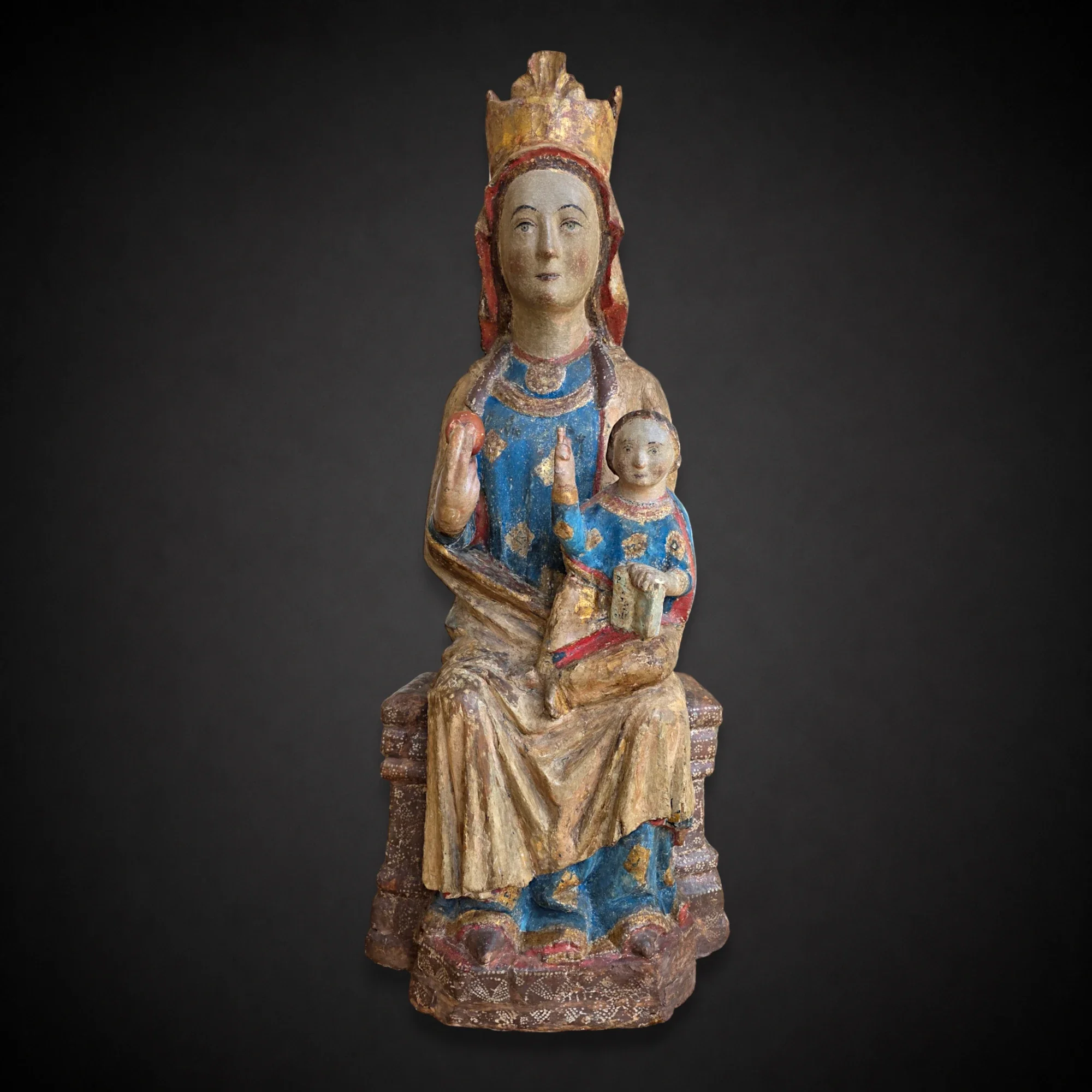
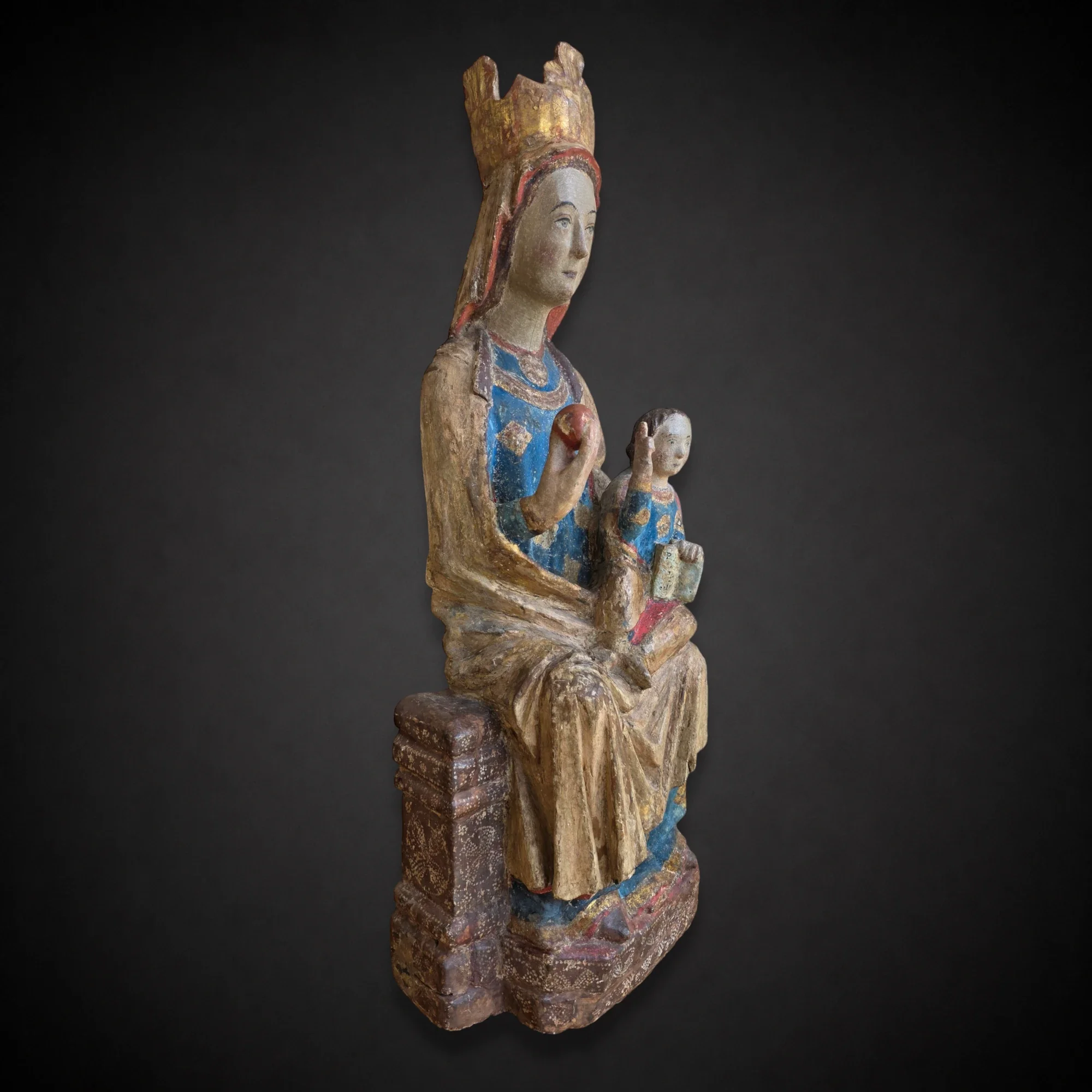
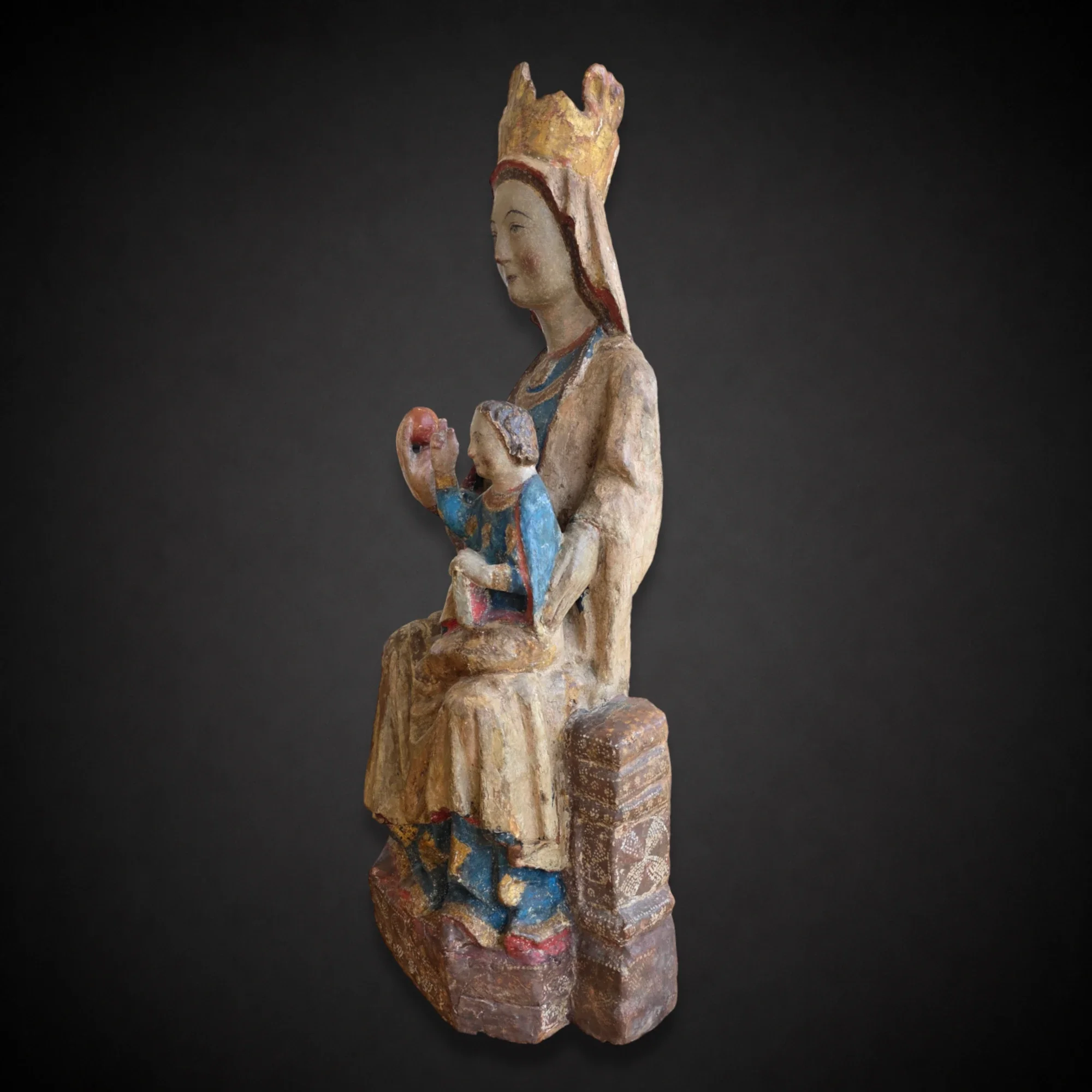
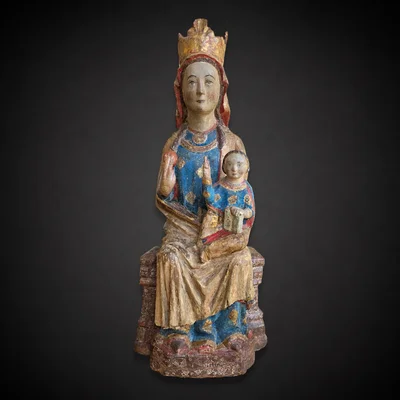
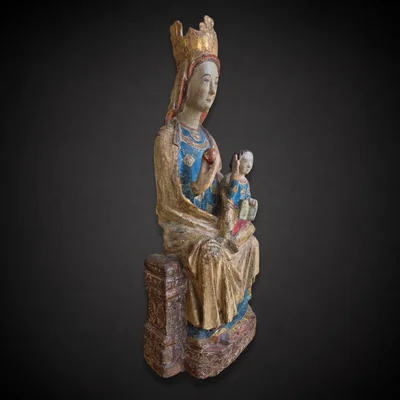
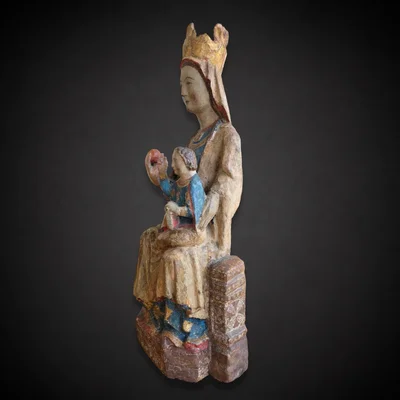
Museum-quality and important Virgin and Child in carved and polychromed wood, preserving significant remains of medieval polychromy. This sculpture belongs to a large family of seated Virgins and Child, known as the “Basque-Navarrese-Riojan” type and disseminated in Aragon around 1300. Mary is represented seated frontally on a richly decorated throne, in a solemn and hieratic attitude. The Virgin wears a tall fleur-de-lis crown, whose silhouette contributes to the monumentality of the figure. A red veil frames her face and falls over her shoulders. The blue tunic, decorated with gilt motifs, appears beneath a broad mantle whose folds fall over the knees. The Child is seated on the Virgin’s left knee, slightly offset from the central axis. He blesses with his right hand and holds a book in the other, probably the Scriptures. This iconographic scheme, widespread among Gothic Virgins of northern Spain, partially breaks with strict Romanesque symmetry.
The most significant parallel is the former Virgin of the Cathedral of Nuestra Señora de la Huerta in Tarazona. This work, studied by Samuel García Lasheras, presents a very close scheme in both composition and polychromy. This comparison allows our sculpture to be placed in western Aragon, probably in the region of Tarazona, a contact zone between Aragon, Navarre and La Rioja, around 1300. Among related works, one may also cite the Virgin and Child preserved in the Metropolitan Museum of Art, New York, inv. 53.67.
Full dossier and study available upon request.
Bibliography consulted:
· La antigua titular de la catedral de Nuestra Señora de La Huerta de Tarazona (Zaragoza) y la difusión de los modelos en la imaginería gótica mariana en Aragón, Samuel García Lasheras in Turiaso, ISSN 0211-7207, No. 24, 2018-2019.
· Medieval Marian Imagery in Navarre, Fernández-Ladreda, Pamplona, 1989.
· Museu Frederic Marès. Catàleg d’escultura i pintura medievals, edited by Francesca Español and Joaquín Yarza Luaces, 1991.
In-depth study of the artwork
| Subject: | Virgin and Child |
|---|---|
| Material: | polychrome wood |
| Dimensions: | Height 104cm. |
| Origin: | Aragon, Spain |
| Dating: | circa 1300 |
| Provenance: | The Bass Museum inv. 63.82, Florida, USA |
| Condition: | losses and overpainting on the polychromy |
| Reference: | 292 |
Description
This important Virgin and Child in carved and polychromed wood belongs to the type of Virgins in Majesty still marked by Romanesque frontality, yet already profoundly renewed by the Gothic sensibility that spread across the north of the Iberian Peninsula at the turn of the 13th and 14th centuries.
Mary is depicted seated facing forward on a massive throne, in a solemn and hieratic attitude. This frontality, inherited from the Romanesque models of the Sedes Sapientiae, endows the image with a strong cultic presence: the Virgin is not only figured as the mother of Christ but as the Seat of Divine Wisdom. However, the softening of the face, the slight smile, the regular oval of the features, and the more supple treatment of the volumes testify to a language that is already Gothic.
The Virgin wears a high fleuron crown, whose silhouette helps monumentalize the figure. A red veil frames the face and descends over the shoulders. The blue tunic, adorned with gilded motifs, appears beneath an ample mantle whose folds fall over the knees. The remains of gilding, combined with the areas of blue, red, and ancient flesh tones, still provide an idea of the work's original visual effect. The preservation of a significant part of the original polychromy is a remarkable element, as sculptures of this group have often been repainted, regilded, or heavily altered over the centuries.
The Child is seated on His Mother's left knee, slightly offset from the central axis. He blesses with His right hand and holds a book, probably the Scriptures, in the other. This iconographic scheme, very widespread in the Gothic Virgins of northern Spain, partially breaks with strict Romanesque symmetry: Christ is no longer simply placed frontally in the center of the maternal lap but shifted laterally, in a livelier and more narrative arrangement.
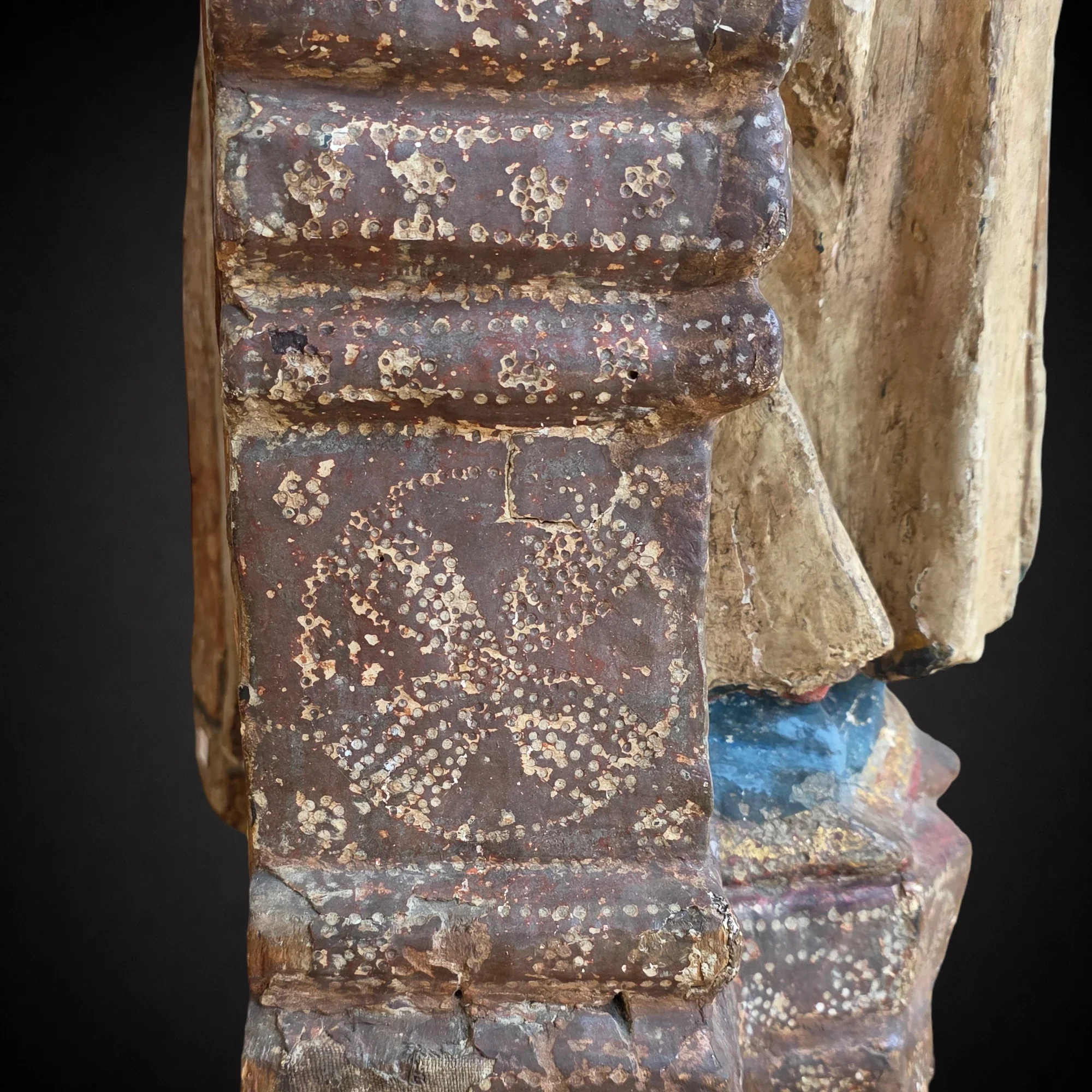
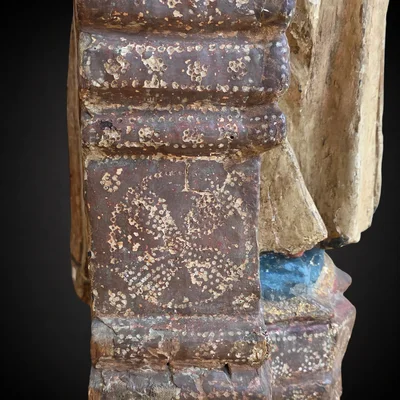
A particularly interesting element lies in the throne, whose side posts feature a painted decoration punctuated with white motifs. This decoration, both geometric and ornamental, reinforces the work's regional anchoring in a northern Iberian, notably Navarro-Aragonese, tradition. The throne is not a mere support here: it participates in the visual construction of the image, framing the sacred figure and underscoring its liturgical function.
The whole is distinguished by its balance between archaism and modernity: the archaism of its frontality, stable composition, and devotional monumentality; and Gothic modernity in the humanization of the faces, the suppleness of the folds, and the quest for a gentler presence. This tension is precisely characteristic of the Virgins produced in the Burgalo-Navarro-Riojan diffusion area and received in Aragon around 1300.
Samuel García Lasheras's study on the former Virgin and Child of the Cathedral of Tarazona recalls that these works often retain the solemnity and frontality of traditional iconography while progressively adopting a more naturalistic treatment of the folds and a Gothic idealization of the features.
Geographic and Stylistic Context
This sculpture is part of a large family of seated Virgins and Child, long designated as the "Basque-Navarro-Riojan" type, but today placed within a broader framework. Recent studies tend to locate the origin of this typology in an area around Burgos, from which it would have spread across a vast zone of the northern Iberian Peninsula: Castile, La Rioja, the Basque Country, Navarre, Aragon, Catalonia, and, more sporadically, other regions.
The general chronology of this type spans from the last third of the 13th century to the middle of the 14th century, with a phase of maximum diffusion between the last decades of the 13th century and the first quarter of the 14th century. This timeframe is particularly fitting for the present sculpture, whose formal characteristics place it around 1290-1310.
The model is defined by several recurrent elements: the Virgin seated frontally on a throne, the Child placed on the left knee, the maintenance of a certain solemnity, the presence of an ample mantle, a necked tunic, a high crown, and, in the most characteristic examples, a system of cords or clasps on the chest. Studies recall that these Virgins are generally seated on a simple throne, often backless, adorned with moldings and sometimes painted decorations; the Child is placed on Mary's left leg, while she places her hand on her Son.
The present sculpture adopts several of these essential traits: Mary's frontality, the Child on the left knee, the blessing, the book, the fleuron crown, the painted throne, the ample mantle, and the lavish polychromy. It thus fully belongs to this tradition, while presenting particularities that invite placing it in a contact zone between Navarre, Rioja, and western Aragon.
García Lasheras's study is particularly important for understanding the spread of this type in Aragon. It emphasizes that the Aragonese images of this group are closely linked to the Navarrese examples: some were likely imported from Navarrese workshops, while others could have been created in Aragon by image-makers from Navarre or trained in that tradition. This observation is essential for our work: rather than choosing too rigidly between "Navarre" and "Aragon," it seems more accurate to speak of a production from the Navarro-Aragonese sphere, probably located in western Aragon or the Tarazona region.
This geographic zone is decisive. The territories of the Cinco Villas and the diocese of Tarazona maintained, during the Middle Ages, constant ties with Navarre due to their border location. García Lasheras highlights these continuous artistic and cultural exchanges between the two spaces. The sculpture studied here should probably be understood within this context: not as an isolated work, but as evidence of a cross-border artistic current, carried by mobile workshops, ecclesiastical commissions, and perhaps forms of aristocratic or royal patronage.
García Lasheras recalls that many of these Virgins were altered or repainted, and that the current polychromy often corresponds to later interventions. In this context, the preservation of a significant part of the polychromy and, above all, the original plastic form constitutes an argument of prime importance for the technical study, aesthetic appreciation, and historical value of the sculpture.
Comparison Corpus and Dating
The most significant parallel is the former titular Virgin of the Cathedral of Nuestra Señora de la Huerta in Tarazona, today known under the invocation of Our Lady of the Rosary. This work, studied by Samuel García Lasheras, presents a very similar scheme: Mary enthroned, the Child seated on the left knee, solemn frontality, crown, polychromy, and a Gothic treatment of forms. It was venerated on the high altar of the cathedral from the early 14th century and can be dated to the first decades of the 14th century.
The proximity to Tarazona is particularly convincing, not only for formal reasons but also geographical ones. Tarazona is located precisely in this contact zone between Aragon, Navarre, and Rioja. The present sculpture shares with that work the same devotional logic: a monumental Virgin, intended for an important sacred space, where traditional frontality is softened by a more human Gothic language.
Other Aragonese Virgins help to better situate the work within the corpus. García Lasheras cites, in particular, the sculptures from Zuera, Tauste, Yéqueda, Ejea de los Caballeros, Uncastillo, Villarroya de la Sierra, Berbegal, Sos del Rey Católico, Trasobares, Mianos, and Borja. These works illustrate the reception of the Burgalese and Navarrese model in Aragon, with varying degrees of fidelity to the initial type and differences indicative of distinct workshops or chronological moments.
The Virgin of Tauste, 110 cm high, offers a particularly interesting parallel in format. Like the present sculpture, it belongs to a category of images with a strong presence, probably linked to important liturgical contexts. The Virgin of Zuera, on the other hand, is associated with the early developments of the type and dated around 1300, due to a still relatively angular but already softened treatment of the drapery. These comparisons confirm that our work is situated at a turning point, between the end of the 13th century and the first decades of the 14th.
The Virgins of Yéqueda, Ejea de los Caballeros, Uncastillo, and Villarroya de la Sierra form another important group. García Lasheras notes that their similarities are such that they could come from the same workshop, perhaps established in Aragonese territory. This hypothesis is valuable for our sculpture, as it shows that western Aragon was not merely a passive reception area for Navarrese or Castilian models, but could also host active workshops capable of locally producing works inspired by those models.
The Virgin of Berbegal, more evolved, belongs to a slightly later phase, situated in the third decade of the 14th century, while the Virgin of Sos del Rey Católico is dated between 1320 and 1340. By comparison, the sculpture studied here seems earlier than these later developments: it retains a more archaic monumentality, a more assertive frontality, and a plastic density that align it closer to works from around 1300.
Finally, the parallels preserved outside Aragon, notably in the Navarro-Riojan area, at the Metropolitan Museum of Art, the MAN, and the Louvre confirm this sculpture's belonging to a widely disseminated but regionally identifiable family. The comparison with Navarrese examples is relevant for the general type, but the parallel with Tarazona seems more effective for specifying its origin: it allows proposing an attribution to western Aragon, within a Navarro-Aragonese sphere, around 1290-1310.
Thus, this Virgin and Child must be understood as an important work of the spread of Marian Gothic art in the northeast of the Iberian Peninsula. Through its monumental format, its typology, the richness of its preserved polychromy, and its proximity to the Virgin of Tarazona, it constitutes a rare testimony to the reception in western Aragon of the great Burgalo-Navarro-Riojan models around 1300.
Bibliographical References
- • La antigua titular de la catedral de Nuestra Señora de La Huerta de Tarazona (Zaragoza) y la difusión de los modelos en la imaginería gótica mariana en Aragón, Samuel García Lasheras in Turiaso, ISSN 0211-7207, no 24, 2018-2019.
- • Fernández-Ladreda, Imagerie médiévale mariale en Navarre, Pamplona, 1989.
- • The Metropolitan Museum of Art. "Additions to the Collections, Eighty-Fourth Annual Report of the Trustees for the Year 1953." The Metropolitan Museum of Art Bulletin 13, no. 1 (Summer 1954). p. 21.
- • Randall Jr., Richard H. "A Spanish Virgin and Child." The Metropolitan Museum of Art Bulletin, n.s., 13, no. 4 (December 1954). pp. 137-43.
- • Museu Frederic Marès. Catàleg d'escultura i pintura medievals, edited by Francesca Español, and Joaquín Yarza Luaces. Fons del Museu Frederic Marès 1. Barcelona: Ajuntament de Barcelona, 1991. p. 239.
- • Fernández-Ladreda Aguadé, Clara. "Algunas reflexiones en torno a las vírgenes del llamado tipo vasco-navarro-riojano." In Congreso internacional "La Catedral de León en la Edad Media": Actas. León: Universidad de León, 2004. p. 628, n. 29.