
Origin : Northern Burgundy and southern Champagne, France.
Medium : Walnut wood, remains of polychromy and gilding.
Size : Height 50 cm
Period : Circa 1260 to 1270.
Condition : Arms and extremities of the legs missing. Surface wear and remains of polychromy and gilding.
Price : on demand
REF. 279
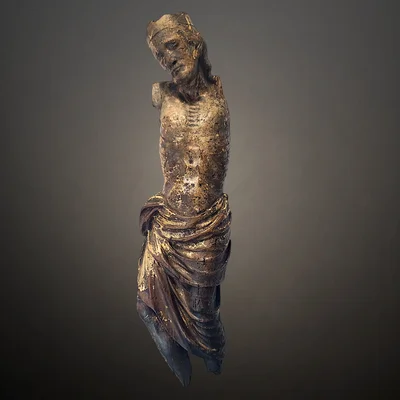
Crowned Christ on the Cross, Burgundy Last third of the 13th century
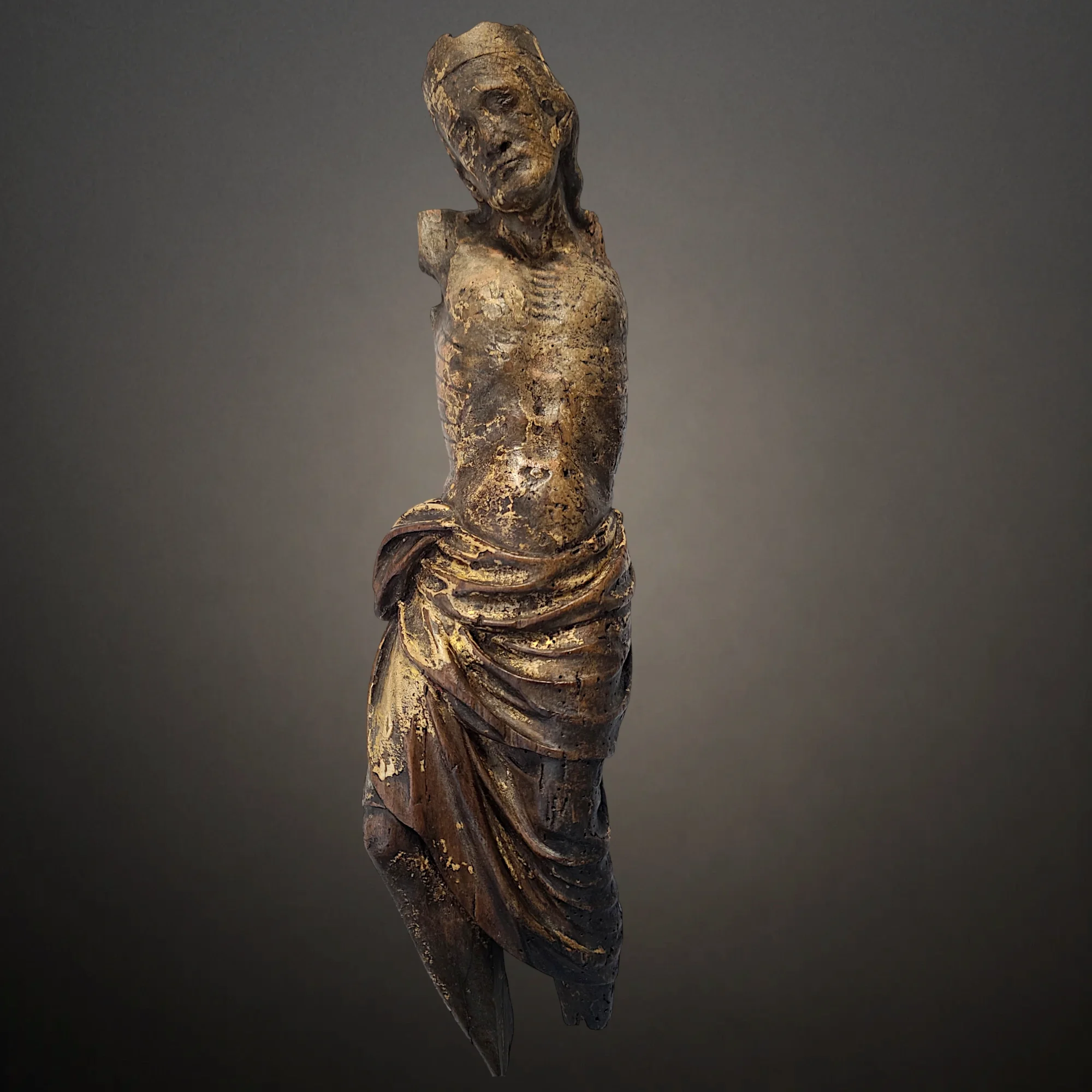
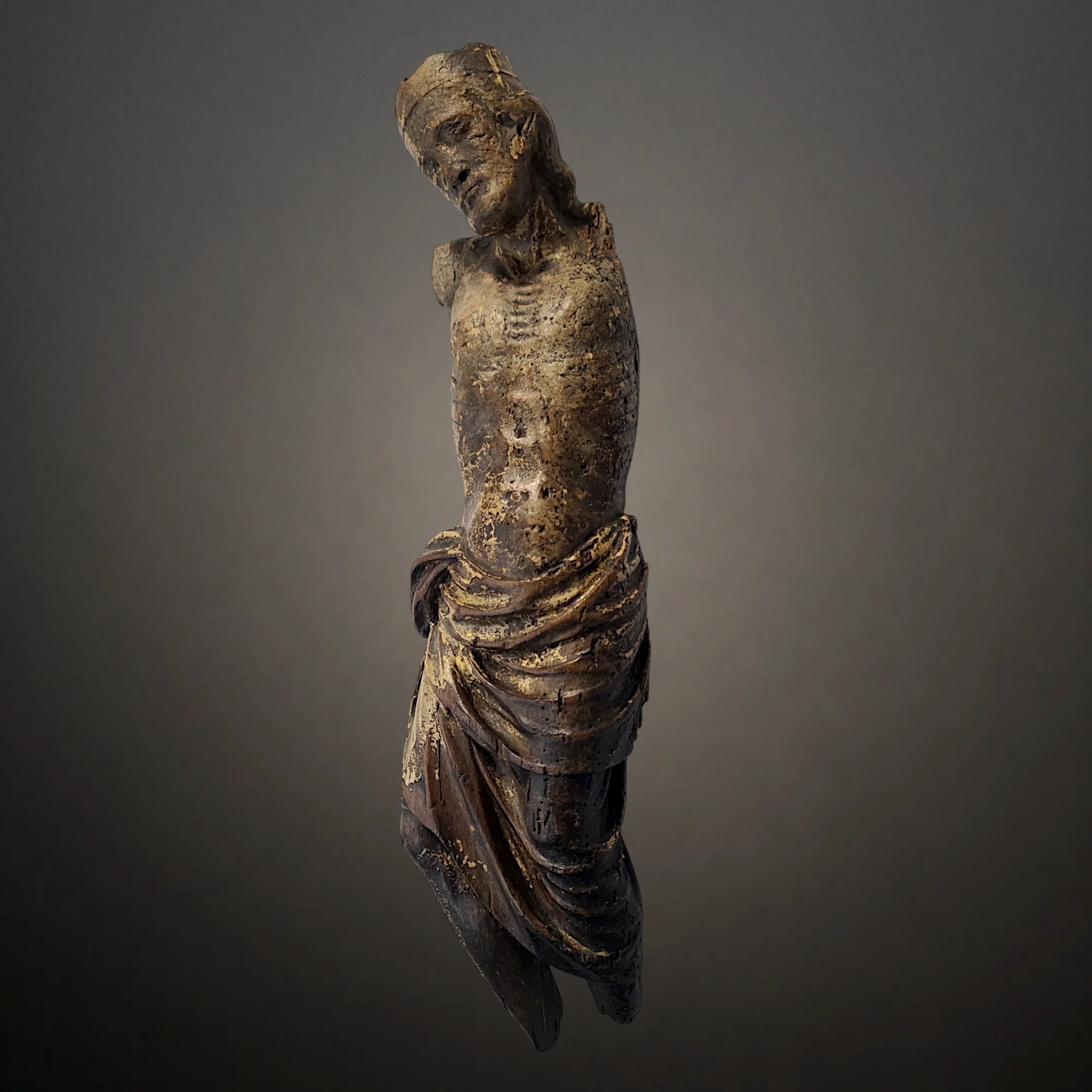
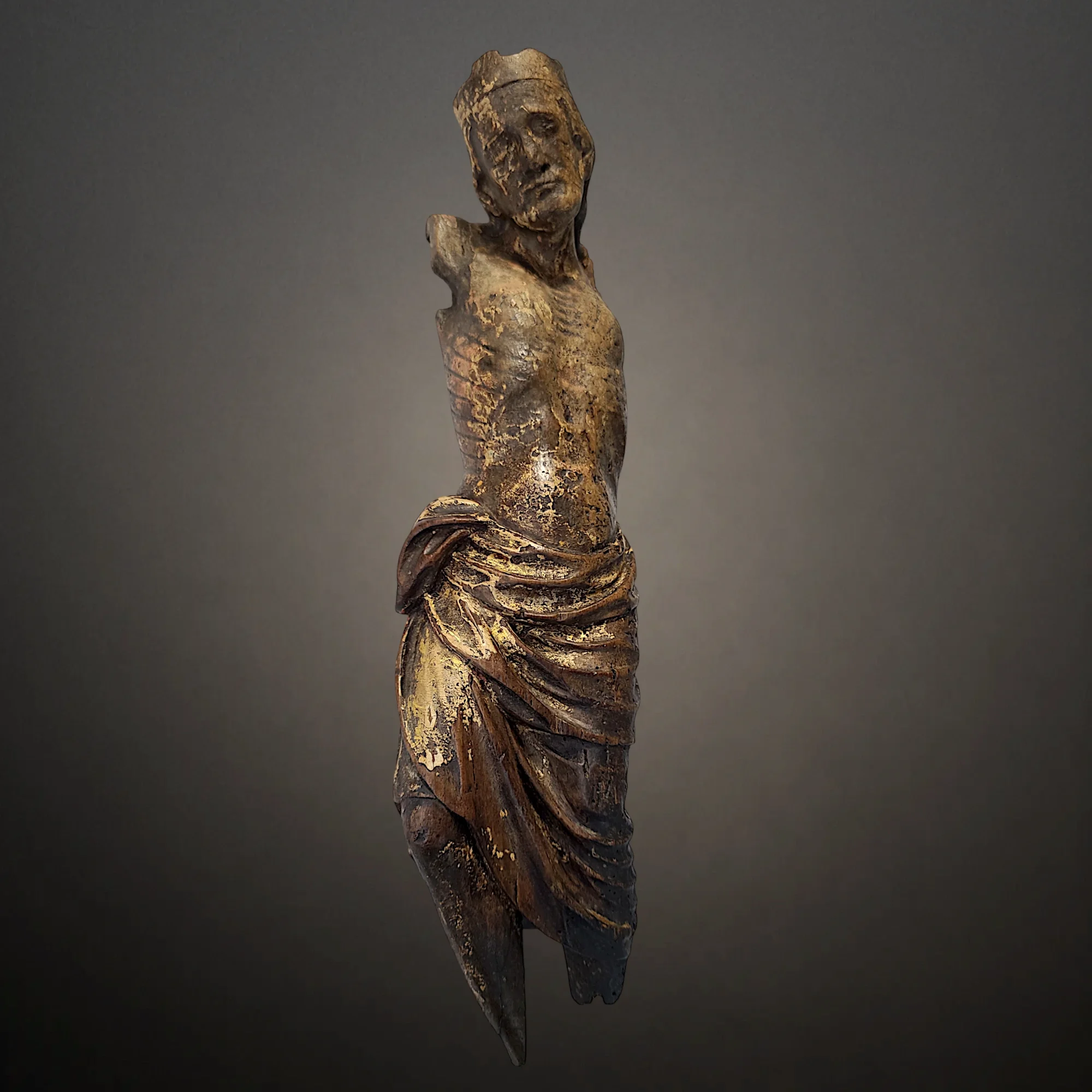
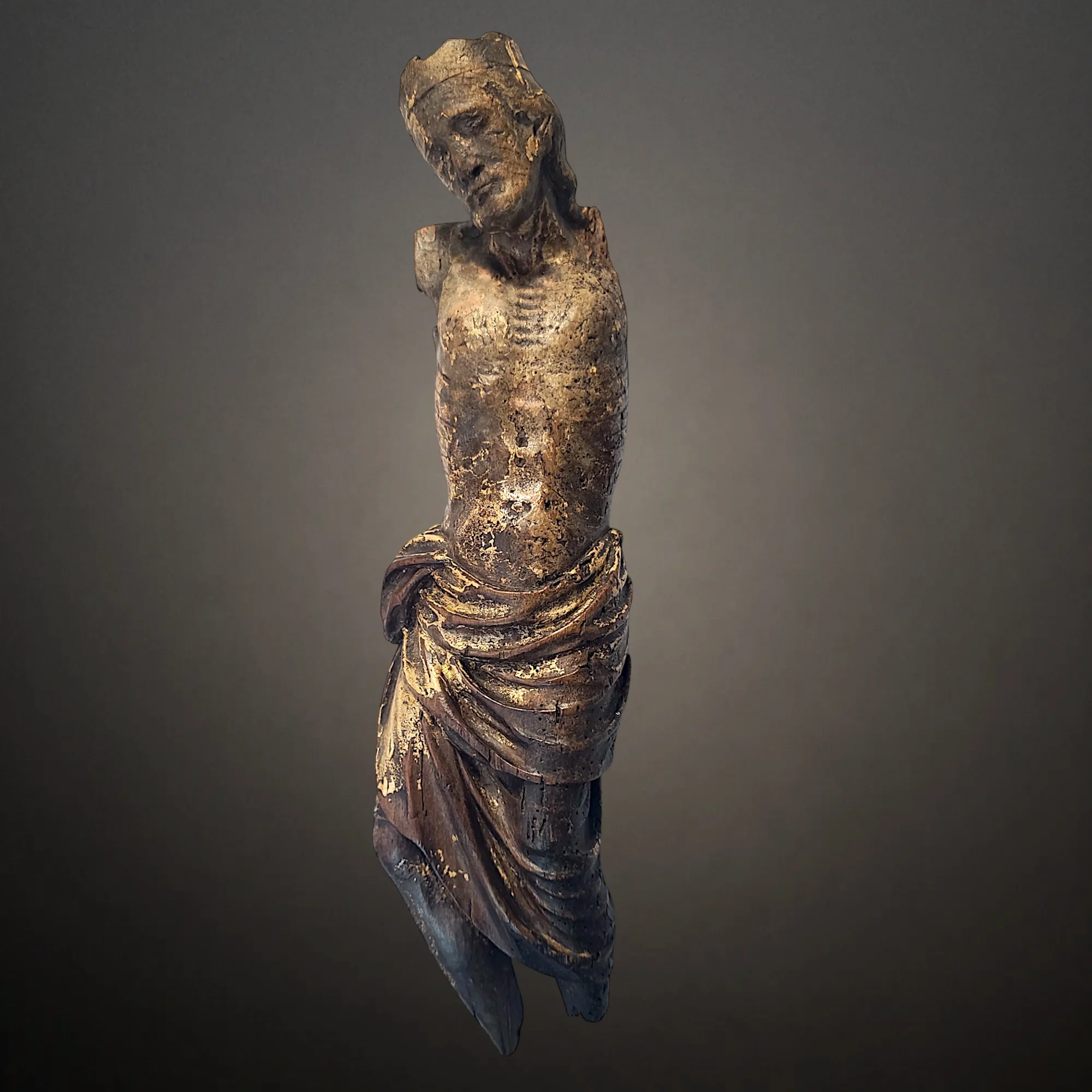
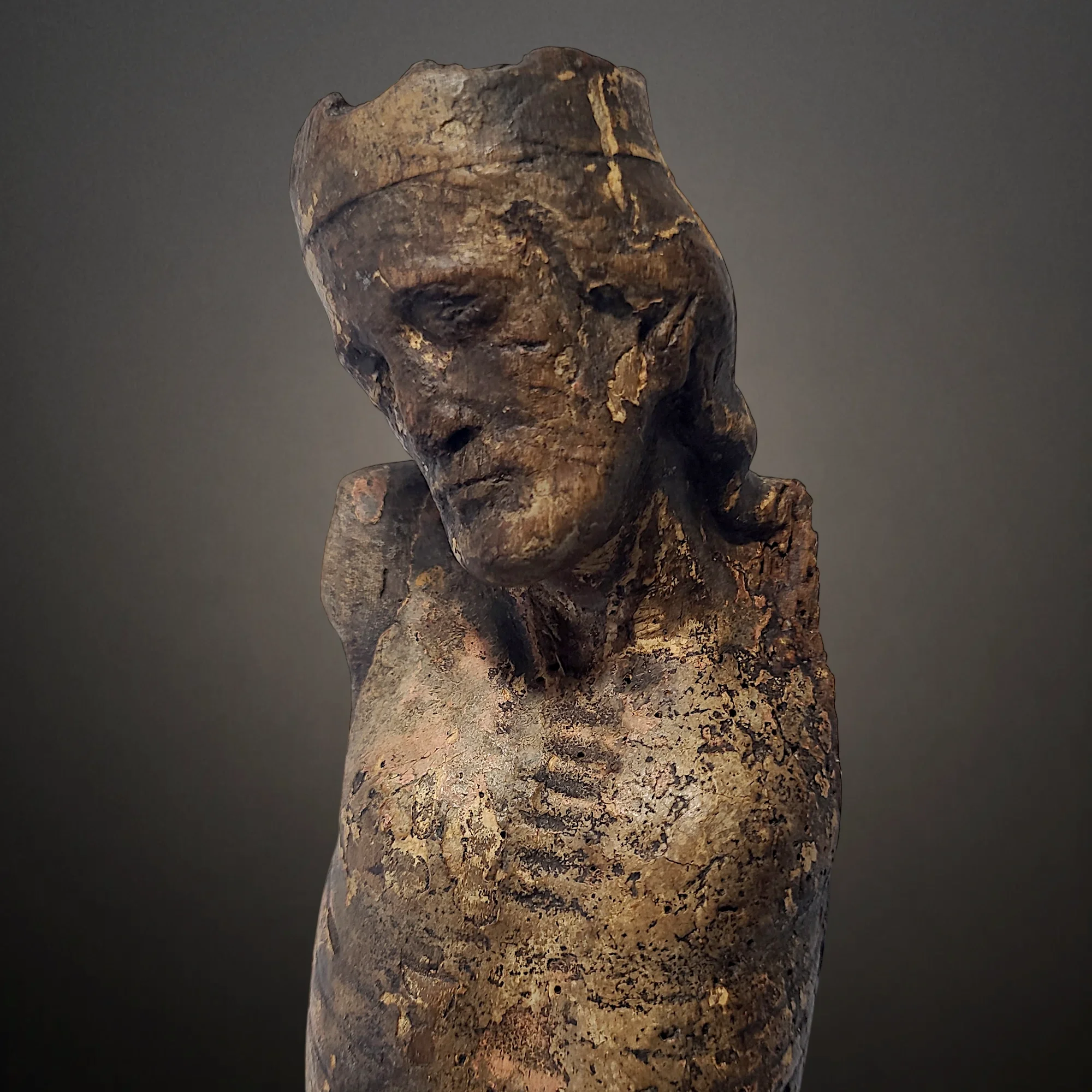
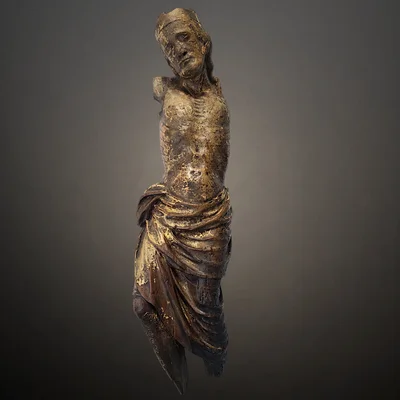
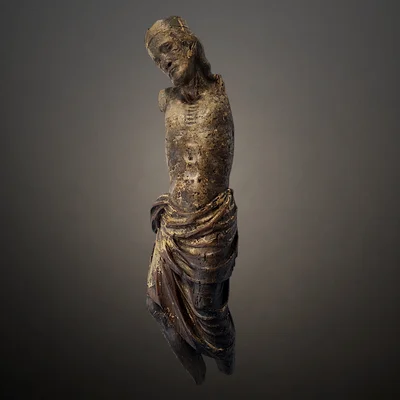
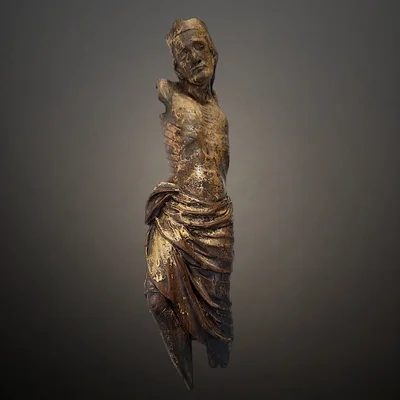
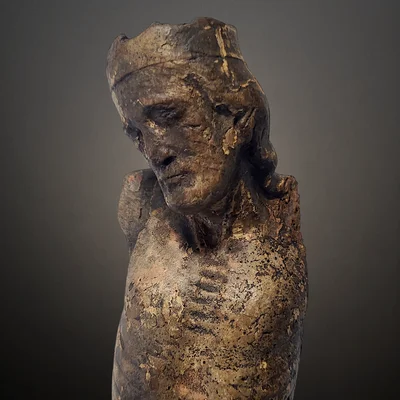
Crowned Crucified Christ carved in polychromed and gilded walnut, sculpted in northeastern France, on the borders of northern Burgundy and southern Champagne, circa 1260 to 1270. This rare French Gothic sculpture represents the dead Christ, his head inclined towards his right shoulder and his body markedly elongated. The royal crown carved from the same block, combined with an already fully Gothic anatomy and a deeply animated perizonium, constitutes one of its most remarkable features. The sculpture retains significant remains of its early polychromy on the body, together with traces of gilding on the crown and perizonium. It bears witness to an essential transitional moment in the evolution of the image of the Crucified Christ during the 13th century, between the tradition of the Christus Rex and the development of the suffering Christ characteristic of the Rayonnant Gothic period.
Christ is represented dead, with a markedly elongated body and his head inclined towards his right shoulder. This disruption of the vertical axis is continued by a subtle shift of the hips and by the asymmetrical movement of the perizonium. The narrow, emaciated face retains a restrained gravity. The lowered eyes and elongated features convey death without any excessive emphasis on pathos. At the same time, the presence of the royal crown, of which the band and the bases of the fleurons survive, preserves the majestic image of the Christus Rex. The ribs are articulated by clearly individualised curved lines, while the abdomen forms a softer and more continuous surface. The slightly projecting belly, narrow waist and elongated torso soften the schematic treatment of the ribcage and firmly place the sculpture within the styles developed around the middle of the 13th century. The perizonium is the most ambitious part of the sculpture. Positioned relatively high on the hips, it broadly wraps around the pelvis before developing into several registers of folds. Broad transverse curves encircle the abdomen and continue into a deep lateral fall. The alternation of projecting ridges and recesses strongly animates the lower part of the figure and responds to the inclination of the head. The overall modelling, elongation of the body and mobility of the drapery demonstrate the assimilation of Rayonnant Gothic, while the graphic treatment of the thorax and the persistence of the royal crown reveal a more conservative character. The most significant comparison is provided by the walnut Crucified Christ preserved in the Rijksmuseum, Amsterdam, inv. BK 1964 8, France, circa 1260. Both sculptures display a comparable contrast between a highly graphic thorax and a softer abdomen, a pronounced elongation of the body and a related organisation of the perizonium around the hips. The Rijksmuseum Christ nevertheless presents a more fluid anatomy and probably originally wore a crown of thorns, whereas the present sculpture exceptionally retains its royal crown. The ivory Christ in the Metropolitan Museum of Art, inv. 1978.521.3, carved in Paris circa 1260 to 1280, provides a second important point of comparison. Despite the differences in material and scale, it shares with the present sculpture the vigorous construction of the body, the emaciated thorax, the supple abdomen and the desire to convey the weight of the body subjected to gravity. These comparisons allow the sculpture to be situated within the third quarter of the 13th century, probably circa 1260 to 1270.
The reverse deeply hollowed with a gouge.
Visible losses to the arms and extremities of the legs. Surface wear, remains of polychromy and gilding. Old traces of woodworm activity on the reverse.
Full documentation available on request.
References consulted:
· THOBY, Paul, Le Crucifix, des origines au Concile de Trente. Étude iconographique, Nantes, Bellanger, 1959 ; supplément, 1963.
· SAUERLÄNDER, Willibald, La Sculpture gothique en France, 1140 à 1270, Paris, Flammarion, 1972.
· WILLIAMSON, Paul, Gothic Sculpture, 1140 to 1300, New Haven, Yale University Press, 1995.
· MÂLE, Émile, L’Art religieux du XIIIe siècle en France, Paris, Armand Colin.
In-depth study of the artwork
| Subject: | Crowned Crucified Christ |
|---|---|
| Origin: | north eastern France, on the borders of northern Burgundy and southern Champagne |
| Date: | circa 1260 to 1270 |
| Material: | walnut, with traces of polychromy and gilding |
| Dimensions: | height 50 cm |
| Condition: | visible losses to the ends of the legs; arms missing; wear and traces of polychromy and gilding |
| Reference: | 279 |
Description
Carved from walnut, this Crucified Christ is preserved without its cross and displays several losses, notably the disappearance of the arms and the lower extremities. The crown, carved from the same block, has lost part of its fleurons. Despite these losses and the wear of the surface, the sculpture remains perfectly legible. Significant traces of polychromy survive on the body, particularly on the thorax, while the crown and perizonium retain traces of gilding. The former flesh tone is also perceptible. Traces of woodworm activity are visible on the reverse.
Christ is represented dead, with a strongly elongated body and the head inclined toward the right shoulder. This break in the vertical axis is one of the essential elements of the composition. It is extended by a subtle shift of the pelvis and by the asymmetrical movement of the garment, so that despite its narrowness the figure cannot be reduced to a rigid frontal construction.
The narrow, emaciated face possesses a restrained gravity. The pronounced inclination of the head, the lowered eyes and the elongated features convey death without seeking excessive pathos. Christ thus retains a majesty that contrasts with the physical weakening expressed by the body. This duality is reinforced by the presence of the royal crown. Its now mutilated fleurons were carried by a regular band that remains clearly visible. The sculpture therefore combines two iconographic conceptions that tend precisely to separate during the 13th century: that of Christ the King, inherited from the Romanesque tradition, and that of the suffering Christ, whose humanity progressively becomes the focus of representation. From the middle of the 13th century onward, texts and images attest to the growing diffusion of the Crown of Thorns, which within a few decades replaced the royal crown on many crucifixes.
The anatomy is treated according to a formula that is both graphic and naturalistic. The ribs are indicated by a succession of clearly legible curved lines, while the lower thorax and abdomen form a much more continuous surface. The slightly projecting belly, narrow waist and elongated torso thus soften the schematic treatment of the rib cage. The body no longer possesses the immobile structure of the great Romanesque Christs, but it has not yet reached the much more accentuated torsions of the Christs of the late 13th century and especially of the following century.
The perizonium is the most ambitious part of the sculpture. Set fairly high on the hips, it broadly envelops the pelvis and develops through several registers of folds. Large transverse curves encircle the abdomen before extending into a deeper lateral fall. The fabric appears successively stretched, turned back and suspended, producing an alternation of projections and recesses that strongly animates the lower part of the figure. The asymmetry of the drapery responds to the inclination of the head and fully participates in the construction of the body.
The reverse is deeply hollowed with a gouge. This hollowing, entirely consistent with the techniques used in medieval wooden sculpture, reduced the mass of the block and limited tensions caused by drying. It also indicates that the sculpture was intended to be fixed to a support. Neither the hollowing nor the dimensions of the work, however, make it possible to identify its original location with certainty. An altar cross, a cross intended for a chapel, or a relatively modest liturgical ensemble therefore remain as plausible as a monumental installation.
Geographical and stylistic context
The sculpture belongs to the profound renewal of the image of the Crucified Christ that accompanied the development of French Gothic art in the 13th century. Between the first decades of the century and the 1270s, the Crucified Christ gradually abandoned the sovereign frontality inherited from Romanesque models. The head lowered, the body lengthened, the ribs became visible, the legs tended to overlap and the organization of the perizonium was freed from symmetry. The image no longer sought only to proclaim Christ's victory over death. It gave increasing presence to his humanity and to the physical reality of the Passion.
The interest of this work lies precisely in the transitional character of its style. The inclination of the head, the emaciation of the thorax and the mobility of the garment belong fully to the Gothic vocabulary of the mid 13th century. The royal crown, by contrast, preserves the memory of the Christus Rex. It should therefore not be interpreted as an awkward archaism, but as the deliberate persistence of an iconography of majesty in an image whose body already adopts the new language of the Passion. This combination is one of the most significant arguments in favour of a date still close to the middle of the century.
The localization between northern Burgundy and southern Champagne should be understood as an artistic area rather than as an attribution to a precisely identified workshop. In the 13th century, the territories between Troyes, Auxerre, Tonnerre and northern Burgundy formed a region particularly receptive to innovations developed on the major building sites of the royal domain and Champagne. The construction of Saint Urbain at Troyes, begun in 1262 and continued during the following decades, represents one of the most radical manifestations of Rayonnant Gothic in this region. The transept of Troyes Cathedral was likewise built around 1260.
This circulation of forms prevents Burgundian sculpture of the 13th century from being defined as a closed entity. Local workshops assimilated developments from Paris, Reims and the great northern centres while frequently retaining a density of material and a graphic emphasis inherited from older traditions. The present Christ appears to belong precisely to this phenomenon of reception. Its overall modelling approaches the most advanced French developments around 1260, but the strongly marked ribs, the relatively compact volume of the perizonium and, above all, the survival of the royal crown give it a more conservative character.
Champagne provides several works of particular value for understanding this milieu. The head of a Prophet from the reverse of the facade of Reims Cathedral, now in the Louvre and dated around 1260, demonstrates the diffusion in the region of a tempered naturalism attentive to physical presence without expressive exaggeration. In another register, a large wooden Virgin or female saint from a Calvary, attributed to Champagne and dated by the Louvre between 1240 and 1300, now deposited at the Musée Saint Remi in Reims, attests to the importance of polychrome wooden sculpture in this region during the second half of the century.
Farther south, Tonnerre provides another particularly significant landmark at the end of the century. The head of a crowned Christ from the hospital of Notre Dame de Fontenilles, a Burgundian work by the Master of Mussy around 1300, shows that the theme of the royal Christ retained real vitality in this region at the turn of the 13th and 14th centuries. It is, however, appreciably later and stylistically more advanced than the present sculpture.
The hypothesis of an origin on the borders of northern Burgundy and southern Champagne is therefore consistent with the composite character of the work: a bodily language directly informed by Rayonnant Gothic, drapery that has become mobile and asymmetrical, but the continued presence of a royal conception of the Crucified Christ. None of these elements alone permits a precise localization. Their combination, however, defines quite accurately a milieu situated on the immediate periphery of the great northern centres, where new formulas were assimilated without immediately eliminating earlier iconographic traditions.
Comparative corpus and dating
The most important comparison is provided by the Crucified Christ in the Rijksmuseum, Amsterdam, inv. BK 1964 8. Carved from walnut, preserving traces of polychromy and gilding and measuring 104 cm in height, it is attributed to France and dated around 1260. Christ inclines his head, has an extremely elongated body, a clearly articulated rib cage and a relatively supple abdomen. His perizonium is tied at the side and develops a succession of oblique folds around the hips. The legs were superimposed and fixed by a single nail.
The photographic comparison is particularly convincing. In both works, the upper body is built on the opposition between a highly graphic thorax and an abdomen treated through continuous surfaces. The same search for elongation, the same progressive narrowing of the waist and, above all, a comparable organization of the perizonium are also found, with several almost horizontal folds encircling the hips before opening into a lateral fall. The Rijksmuseum Christ has a more supple anatomy and a slightly more pronounced overall movement, but the two sculptures unquestionably belong to the same stylistic moment.
One iconographic difference is nevertheless crucial. The Rijksmuseum Christ bears at the temples traces of a device intended for a Crown of Thorns, whereas the present sculpture retains a royal crown carved from the wood. This divergence strengthens rather than weakens the chronological comparison. It places the present Christ in a milieu where the formal transformations of Gothic art were adopted more rapidly than the new iconography of the Passion.
The second major landmark is the small ivory Christ in the Metropolitan Museum of Art, inv. 1978.521.3, carved in Paris around 1260 to 1280. Despite the difference in material and scale, its anatomical conception offers important analogies. The Met specifically emphasizes the vigour of the bodily structure, the closed eyes, the hair falling along the face, the slight twist of the torso and the original arrangement of the crossed legs fixed by a single nail. The comparison concerns above all the relationship between the emaciation of the thorax and the fluidity of the abdomen, as well as the desire to convey the weight of a body now subject to gravity. It shows that the present sculpture participates in developments for which Paris was then one of the principal centres of diffusion.
This comparison with Parisian ivory should nevertheless be used as a comparison of artistic language rather than as an argument for attribution. The rapid development of ivory carving in the capital from the 1260s onward enabled certain formulas, notably the elongation of the body, the displacement of the pelvis and asymmetrical draperies, to circulate widely. The walnut Christ offers a markedly more robust translation of these forms.
The ivory Christ in the Victoria and Albert Museum reproduced in the study, dated around 1320, is much later. It nevertheless remains genuinely relevant to the history of the formula. The body has become more sinuous, the abdomen more supple and the perizonium turns into an almost floating fabric whose ends strongly accentuate the torsion of the figure. Parisian works around 1320 to 1330, such as the ivory Christ OA 10978 in the Louvre, show a comparable development. These works therefore provide a stylistic terminus: they carry much further tendencies that remain restrained in the present Christ. They confirm that a date around 1300 or the beginning of the 14th century would be too late.
At the other end of the chronology, French and Limousin Christs of the early 13th century generally retain a much more stable construction. The bodies remain straight, the garment preserves a more symmetrical organization and royal iconography is frequently associated with an attitude of sovereignty. Limousin crosses of the 13th century still attest to the existence of the crowned Christ, sometimes wearing a long perizonium, but their conception remains fundamentally attached to the tradition of the triumphant Christ. The present sculpture differs through the lowering of the head, the emaciated thorax and the dynamic displacement of the drapery.
The corpus therefore places the work at a very precise moment in the evolution of the image of the Crucified Christ. It is later than the still classical formulas of the first decades of the 13th century, but earlier than the much more tormented and sinuous silhouettes of the late century and the beginning of the 14th century. The Rijksmuseum Christ around 1260 constitutes its closest parallel, while the Parisian ivory in the Metropolitan Museum, around 1260 to 1280, confirms the general chronology. The development of Rayonnant Gothic in Champagne specifically from the 1260s also provides a particularly coherent regional context.
A date in the third quarter of the 13th century, probably around 1260 to 1270, and a localization in north eastern France, on the borders of northern Burgundy and southern Champagne, therefore appear the most coherent. The exceptional persistence of the royal crown, associated with a body already fully Gothic, is the sculpture's most remarkable feature.
Bibliographical references
- • THOBY, Paul, Le Crucifix, des origines au Concile de Trente. Étude iconographique, Nantes, Bellanger, 1959; supplement, 1963.
- • SAUERLÄNDER, Willibald, La Sculpture gothique en France, 1140 à 1270, Paris, Flammarion, 1972.
- • WILLIAMSON, Paul, Gothic Sculpture, 1140 to 1300, New Haven, Yale University Press, 1995.
- • MÂLE, Émile, L'Art religieux du XIIIe siècle en France, Paris, Armand Colin.
- • KOECHLIN, Raymond, Les Ivoires gothiques français, 3 vols., Paris, Auguste Picard, 1924.
- • GABORIT CHOPIN, Danielle, Ivoires médiévaux, Ve au XVe siècle, Paris, Réunion des musées nationaux, 2003.