
Origin : Burgundy, France.
Medium : Walnut wood.
Size : Height 50cm
Period : 13th century.
Condition : Visible losses
Price : on demand
REF. 279
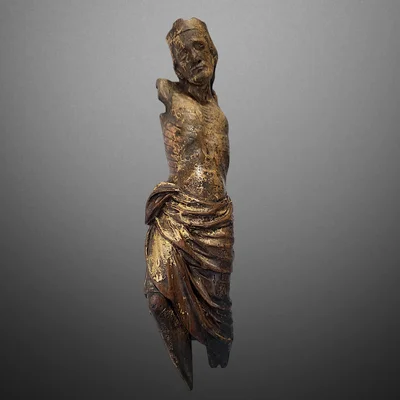
Corpus Christi. Burgundy 13th century.
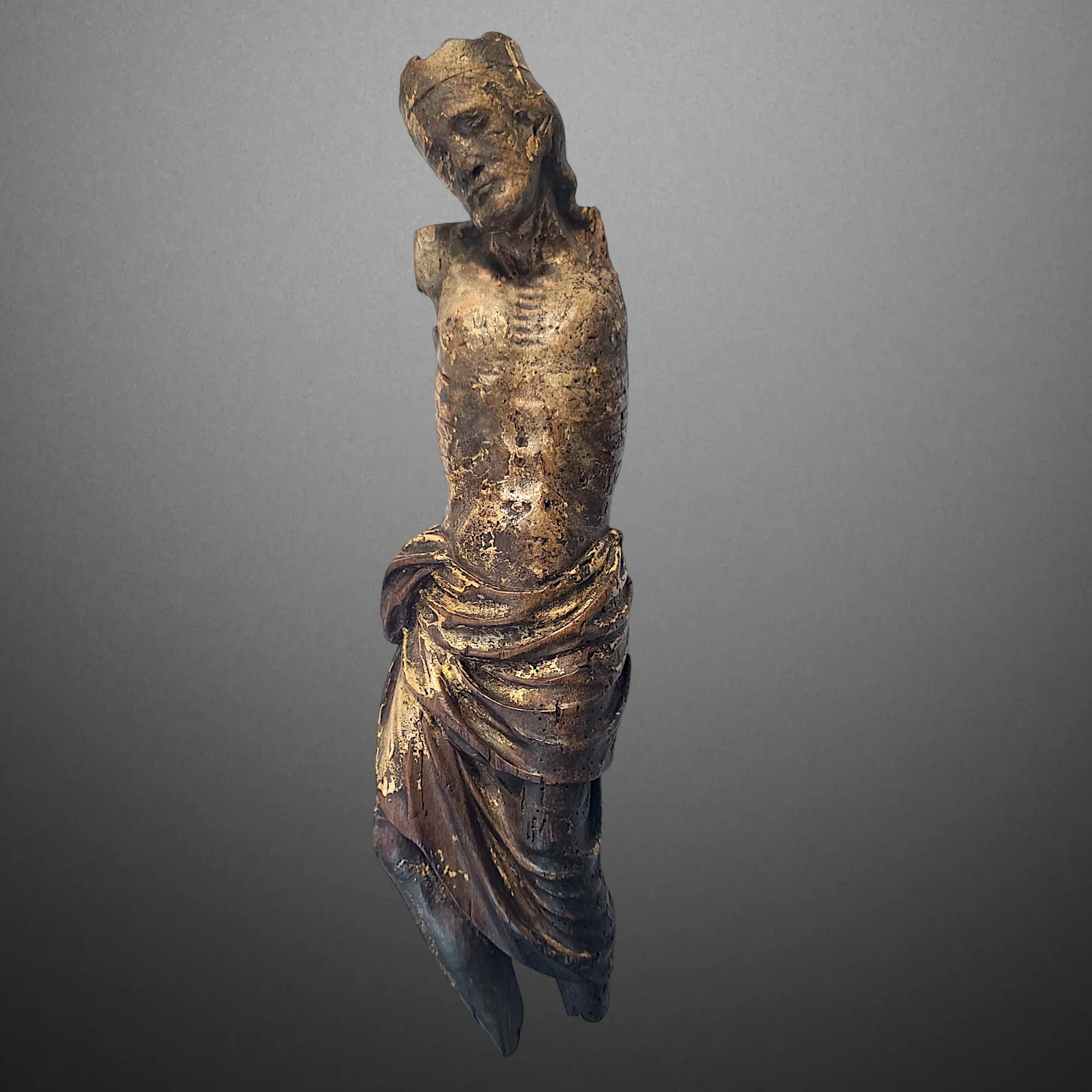
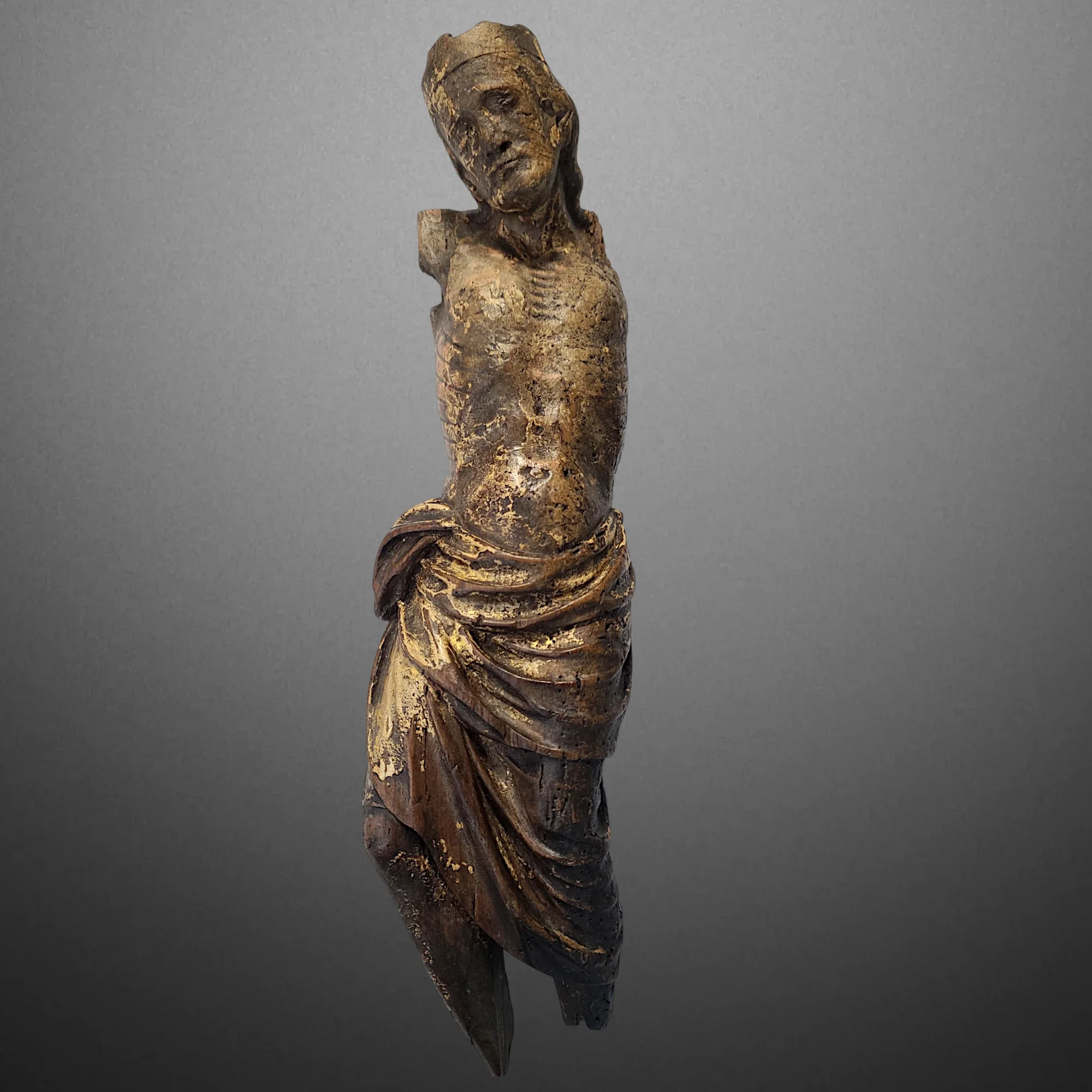
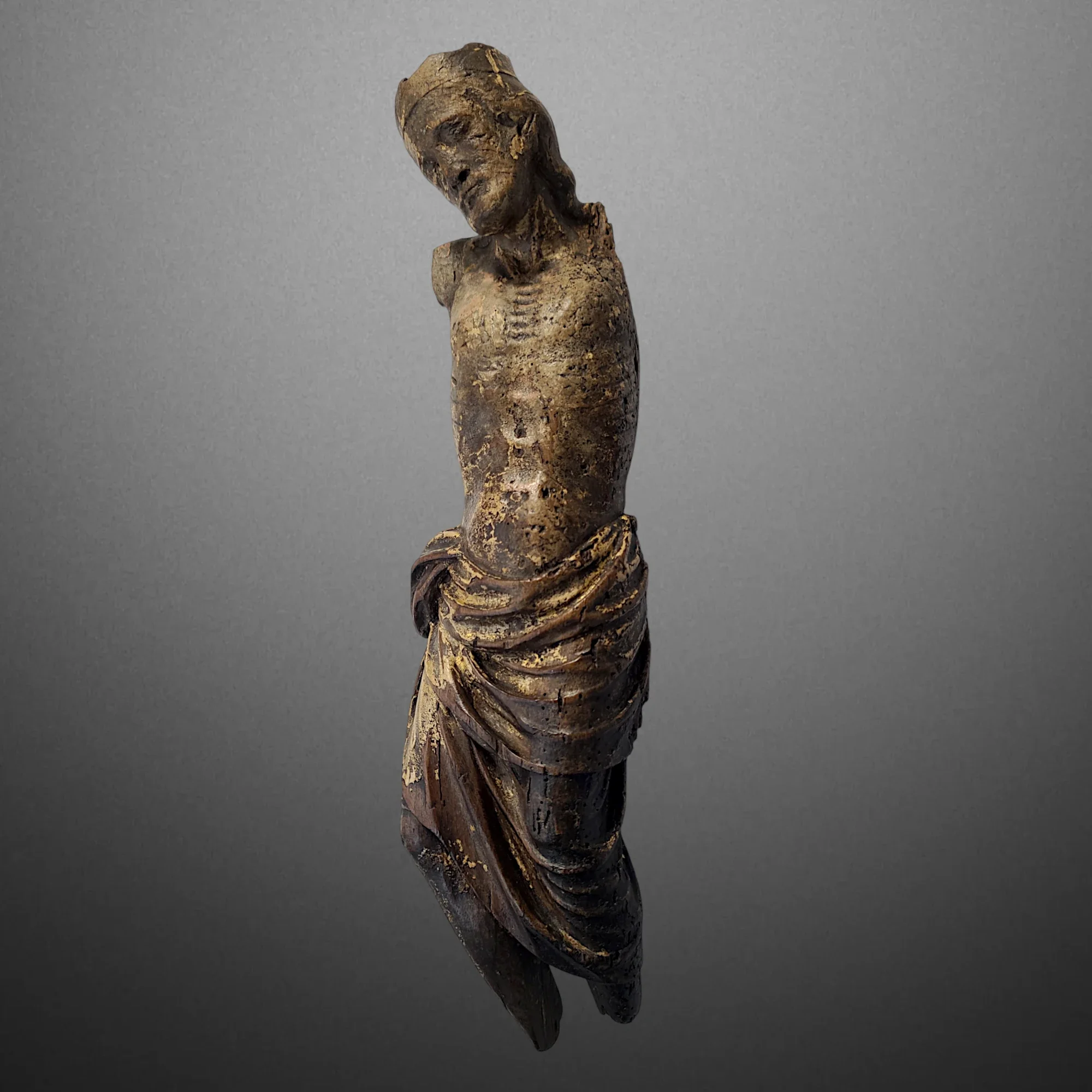
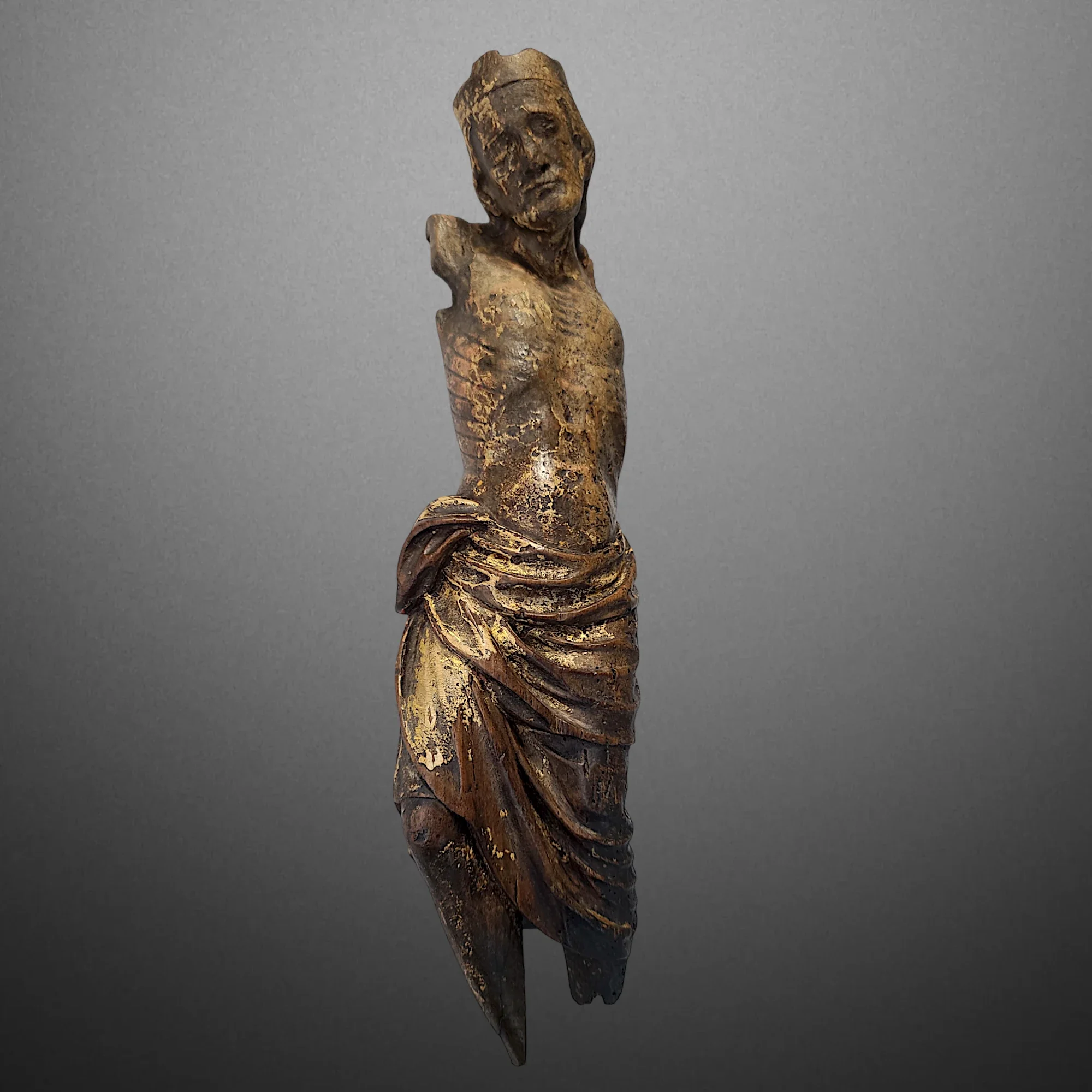
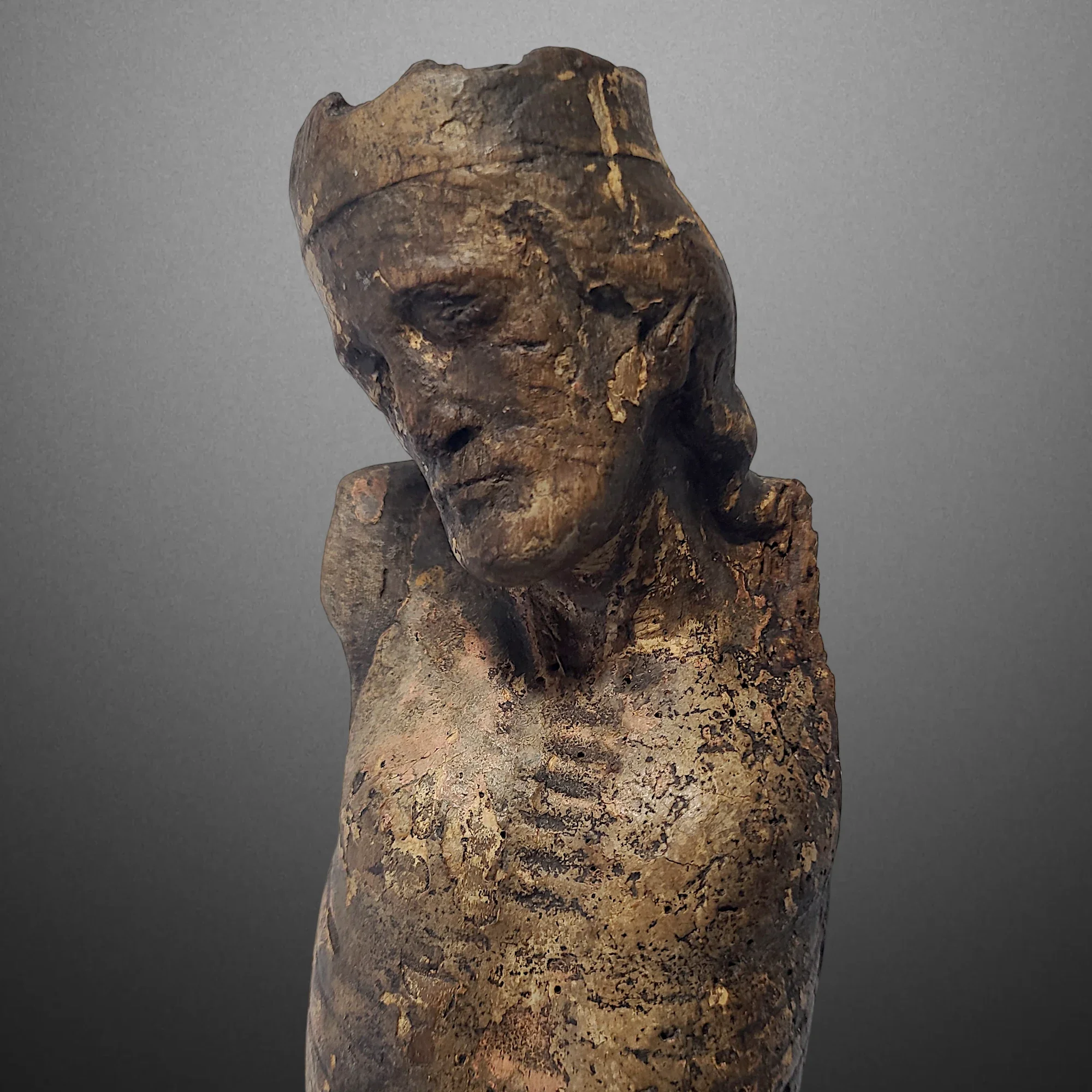
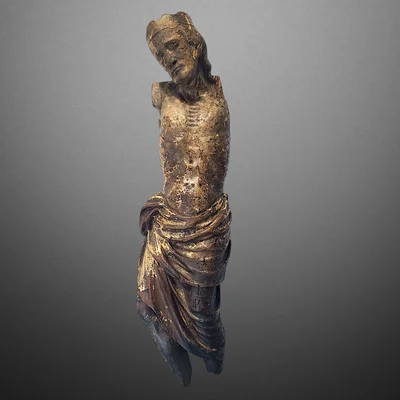
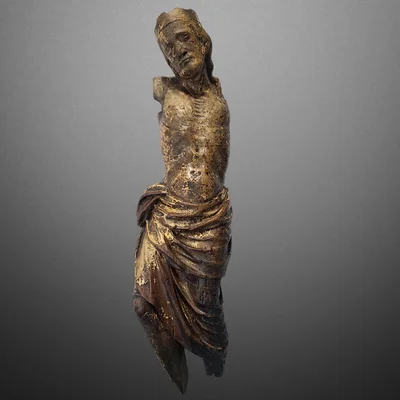
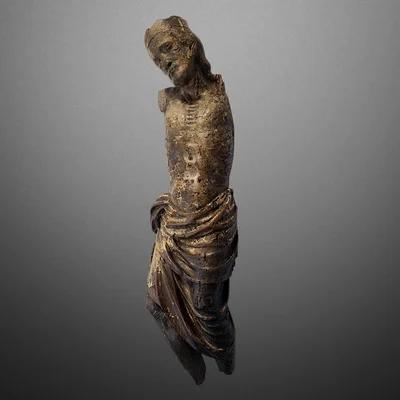
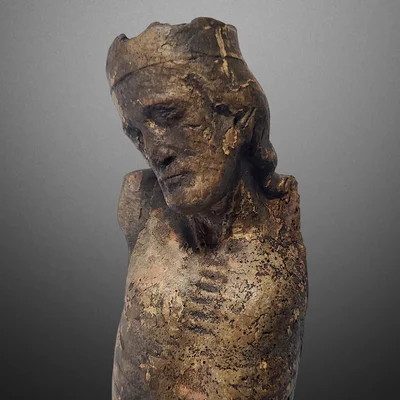
Crowned Christ from the borderlands between northern Burgundy and southern Champagne, dating from the last third of the 13th century. Carved in polychromed and gilded walnut, this Christ preserves significant traces of its original polychromy and gilding. On the torso, particularly on the ribs, the flesh tones are still clearly visible, as are the gilded areas on the perizonium and on the crown. This Corpus Christi, of striking presence, perfectly illustrates the Rayonnant Gothic style with reminiscences of Classic Gothic, notably in its representation of Christ the King.
The anatomy of Christ is characterised by a language that is both graphic and sensitive, typical of workshops working in the orbit of the great northern building sites. The ribcage with its prominent ribs derives from an archaic stylisation intended to underline the emaciation of the crucified body, while the suppleness of the abdomen, slightly distended, bears witness to a new naturalistic observation.
The head, tilted towards the right shoulder, breaks with the axial rigidity of earlier periods. Crowned with a royal crown, of which the bases of the fleurons are still preserved, the face retains an expression of peaceful interiority, far removed from the expressionist renderings that would mark the 14th century.
The long perizonium is tied relatively high on the hips and unfolds in a complex lateral fall over the left hip, creating a dynamic imbalance. The sculptor has carved the material with great virtuosity, organising the drapery into deep undulations and folds that catch the light. This treatment of volume, heir to the early-13th-century Muldenfaltenstil, achieves a synthesis between the elegance of Parisian ivories and the robustness of Burgundian sculpture.
This sculpture may be compared with the Corpus Christi in the Rijksmuseum, dated to around 1260 (see below), and also with the ivory Christ (inv. A.21-1920) in the V&A Museum, particularly for the dynamics of the perizonium. For the modelling of the body one may also cite the ivory Christ in the MET Museum (inv. 1978.521.3), dated to the years 1260–1280.
Hollowed back.
Full dossier available on request.
Bibliography consulted:
·Le Crucifix, des origines au Concile de Trente : étude iconographique, Paul Thoby, 1959.
·L’art religieux du XIIIe siècle en France : étude sur l’iconographie du moyen âge et sur ses sources d’inspiration, Emile Mâle, 1910.
·La Sculpture gothique en France, 1140-1270, Willibald Sauerländer, Paris, 1972.