
Origin : Burgundy, France.
Medium : Limestone.
Size : Height: 90 cm
Period : 15th century.
Condition : Losses to the left hand.
Price : on demand
REF. 280
Circle of Antoine Le Moiturier. Burgundian School 15th century.
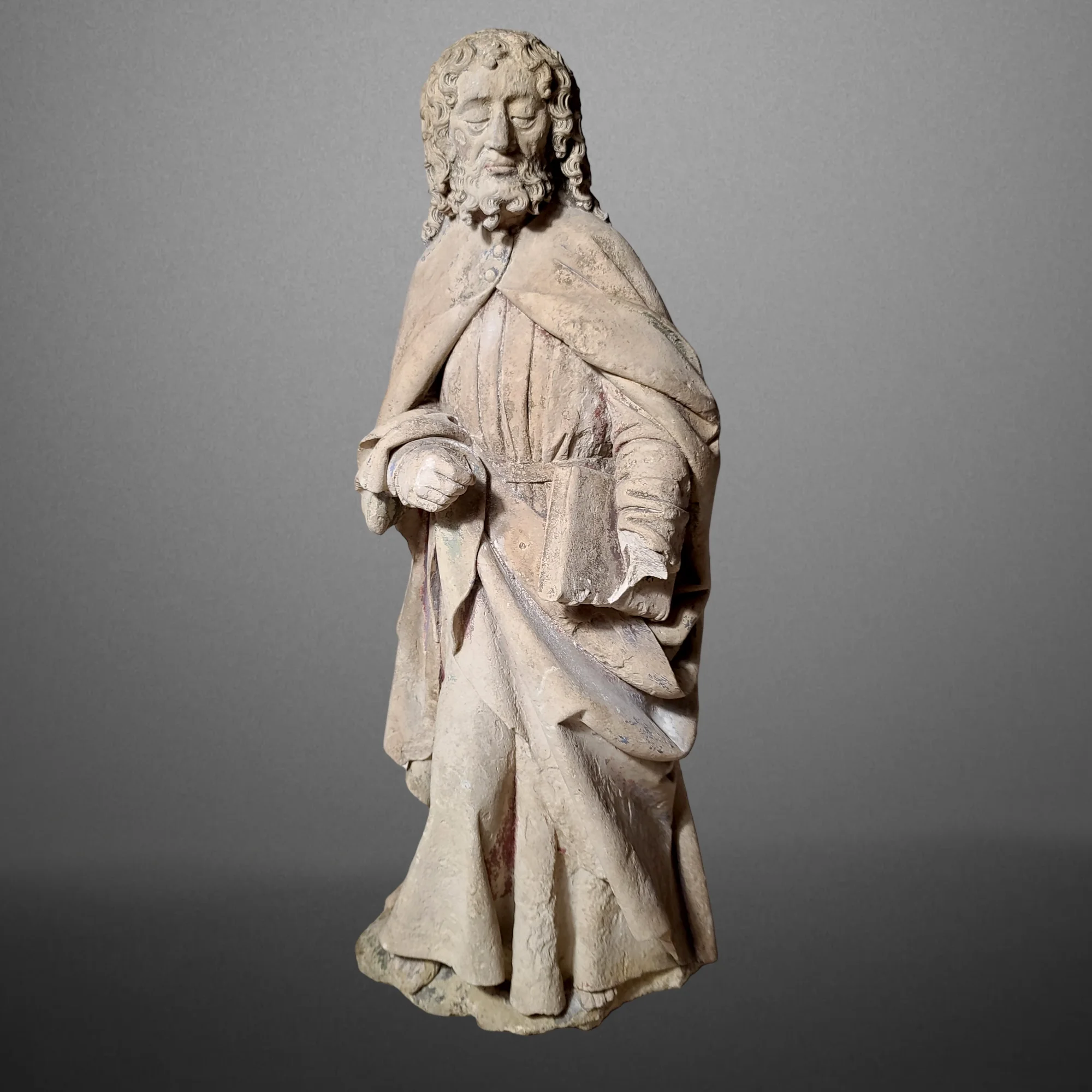
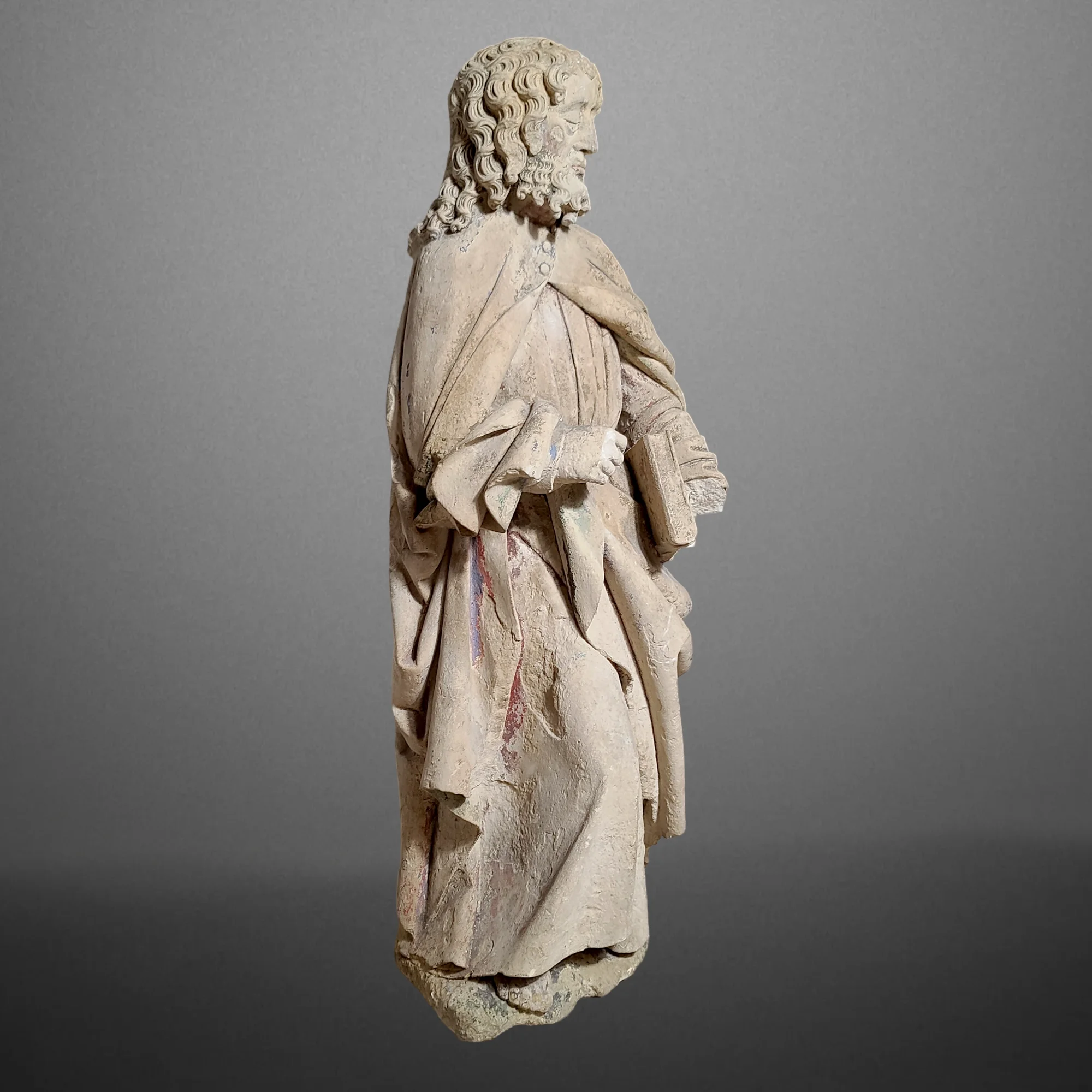
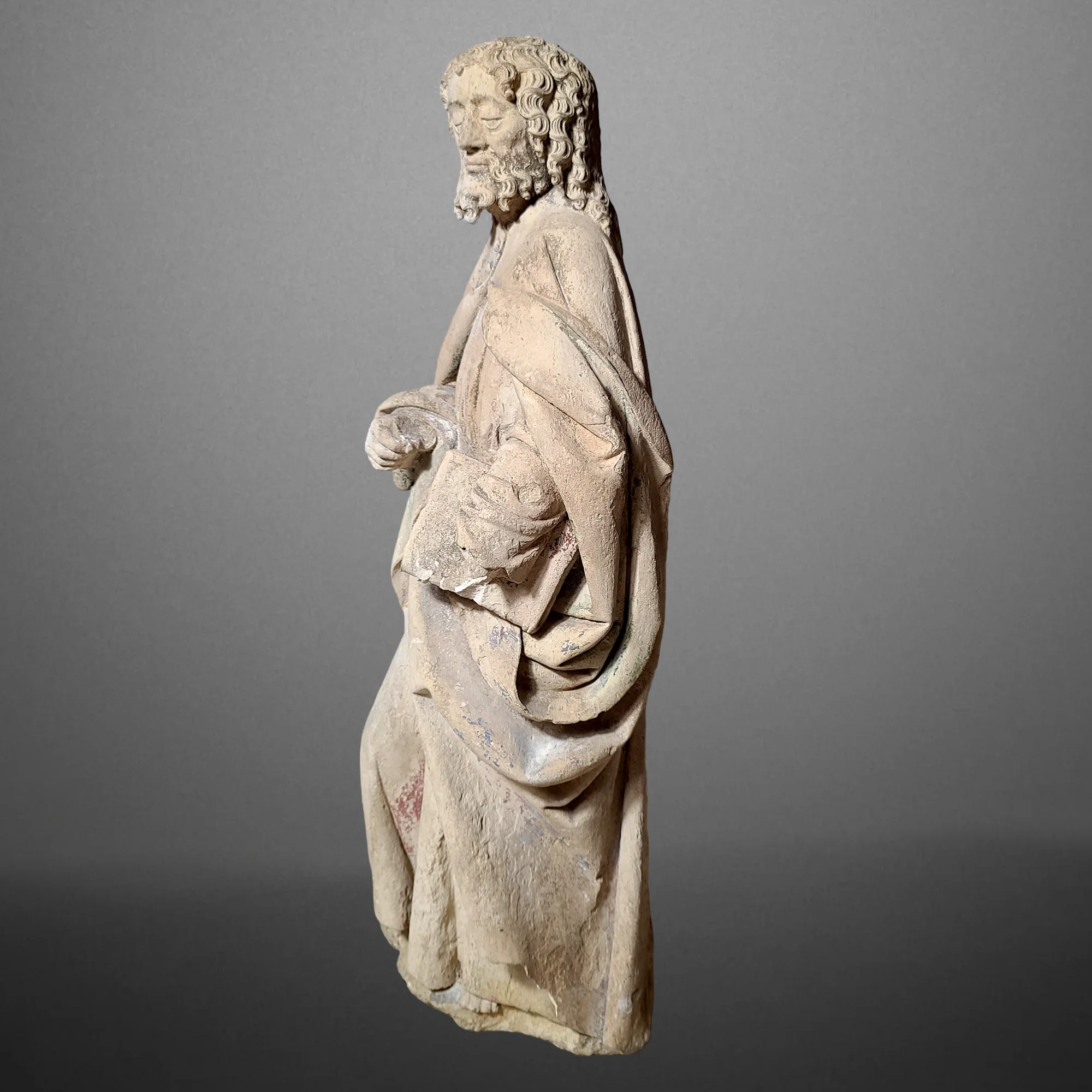
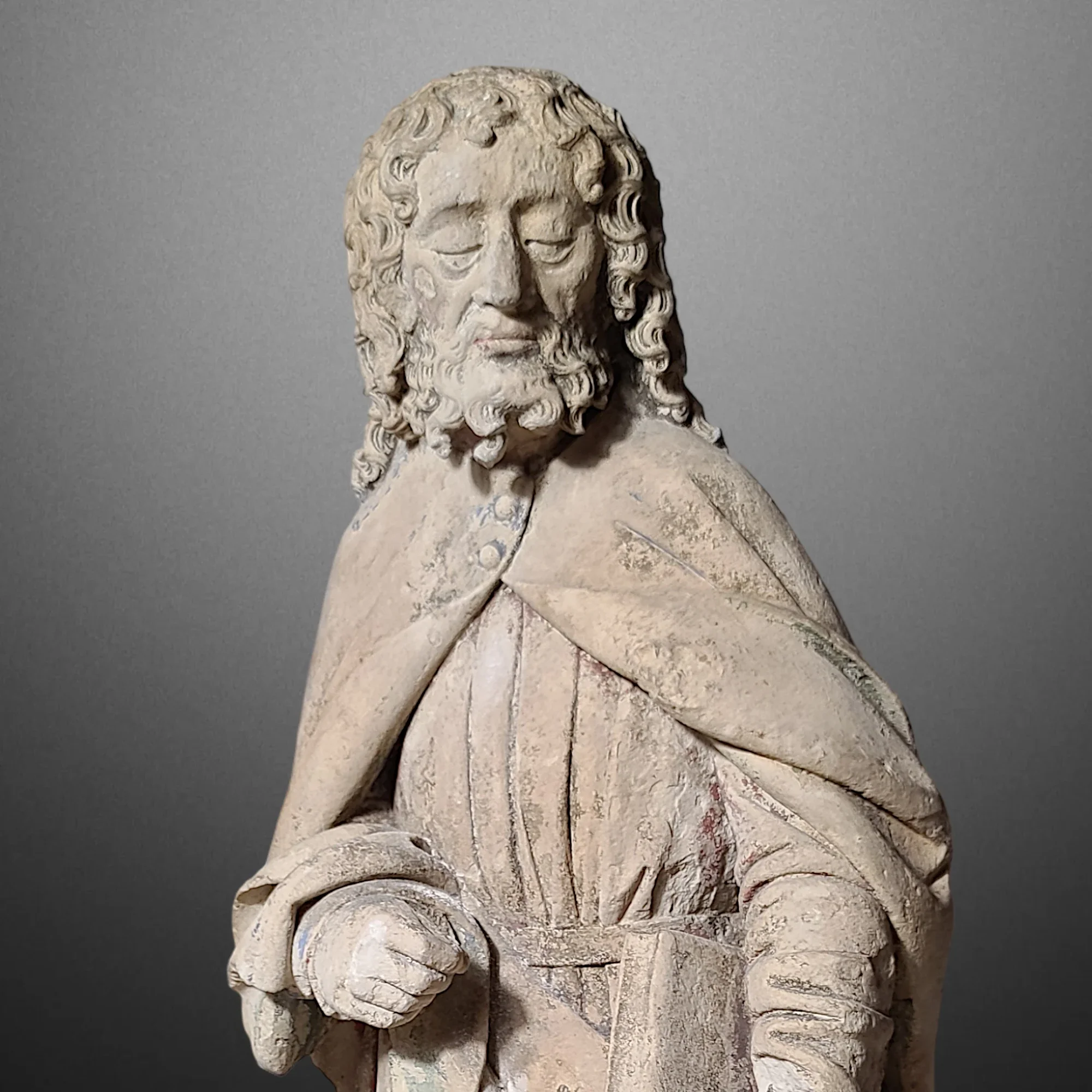
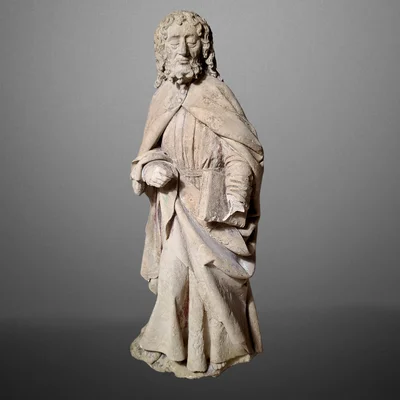
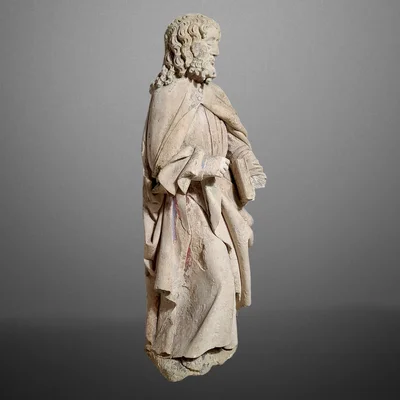
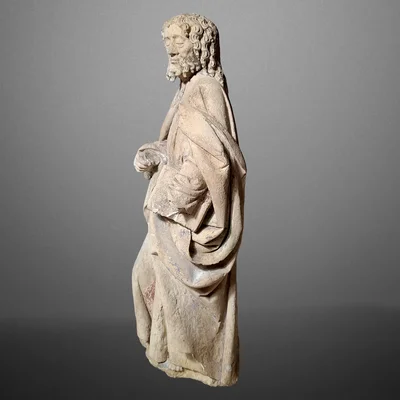
This important Burgundian Gothic sculpture in the round, attributed to the close circle of Antoine Le Moiturier and dated around 1470-1480, represents an apostle, probably Saint Matthew. Carved from pale, fine-grained limestone, the frontal figure is animated by a subtle shift in weight: the left leg supports the body, while the right, slightly advanced, introduces an elegant movement beneath the drapery. The saint wears a long tunic, buttoned at the collar and belted at the waist, beneath a voluminous cloak arranged in broad masses and deep folds. His now incomplete left hand holds a closed book identifying him as an apostle or evangelist. His mature face, framed by a full beard and powerful, deeply hollowed curls, retains a grave expression. Traces of polychromy survive in the garment’s recesses.
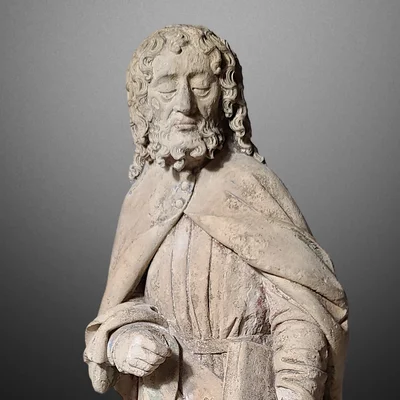
Through its monumental conception, ample drapery and individualized physiognomy, this figure belongs to Burgundian sculpture of the second half of the 15th century. The drapery constructs the volume: deep rounded folds alternate with angular breaks and triangular structures. Hair and beard consist of individualized strands, deeply carved and sometimes hollowed with a drill, forming a crown around the face modelled by light.
Antoine Le Moiturier arrived in Burgundy in the mid-15th century and extended the legacy of Claus Sluter, Claus de Werve and Jean de La Huerta while developing more supple poses, spectacular draperies and more distinctive physiognomies. Although these features do not support a direct attribution to the master, their convergence places the apostle within his close circle, perhaps in the Autun school.
The closest comparisons for the deeply hollowed locks are the Saint John the Baptist at Bussy-la-Pesle, the figure RF 1499 and Flying Angel RF 1625 in the Louvre, the Lectern Angel in the Musée Rolin, and the lion’s mane on the tomb effigies of John the Fearless and Margaret of Bavaria, with its spoon-shaped cavities. The Entombment at Semur-en-Auxois, Saint Stephen RF 1371 and Thomas de Plaine RF 1679 illuminate the organization of the drapery. The combination of monumental silhouette, deep broken folds and individualized physiognomy supports a date around 1470-1480 and an attribution to the circle of Antoine Le Moiturier.
Complete dossier available on request.
References consulted:
· Brigitte Maurice-Chabard, Sophie Jugie and Jacques Paviot (eds.), Miroir du Prince 1425-1510. La commande artistique des hauts fonctionnaires à la cour de Bourgogne, Autun / Ghent, 2021.
· Françoise Baron, Musée du Louvre - Sculpture française - I - Moyen Âge, Paris, 1996.
· Jacques Baudoin, La sculpture flamboyante en Bourgogne et Franche-Comté, Créer, 1996.
In-depth study of the artwork
| Subject: | Figure of an Apostle holding the Book, probably Saint Matthew |
|---|---|
| Material: | carved limestone with traces of polychromy |
| Dimensions: | height 90cm |
| Origin: | France, Burgundy, Autun school |
| Date: | c. 1470-1480 |
| Attribution: | close circle of Antoine Le Moiturier |
| Provenance: | Sotheby’s New York, 22 June 1989, lot 17 |
| Condition: | losses to the left hand |
| Reference: | 280 |
Description
This sculpture in the round, carved from a fine-grained, light-coloured limestone, represents a standing male figure identified by his attributes and costume as an Apostle. The figure is essentially frontal, subtly relieved by a slight sway of the body: the weight rests on the left leg while the free right leg bends slightly forward, creating a discreet sense of movement beneath the heavy fabric. The saint wears a long tunic, buttoned high at the neck and belted at the waist, together with a broad mantle, one end of which is brought across the front of the body like an apron before being held beneath the left arm.
With his left hand, partly veiled by a fold of fabric, he supports a closed book, the Gospel, whose binding is rendered with a concern for realism. The aged physiognomy, bare feet and bifurcated beard suggest Saint Matthew. The right hand does not appear to have held an attribute, or, if it did, it must have been a very slender one — a quill — further supporting the identification as Saint Matthew.
The face, framed by abundant hair falling in tubular locks onto the shoulders and by a bifurcated beard of tight curls, has serene features: almond-shaped eyes with heavy lids, a straight nose and high cheekbones. The work preserves significant evidence of its original polychromy, notably blue pigments in the recesses of the mantle and traces of ochre or red on the tunic.
Stylistic analysis
The monumentality of the figure is created through the treatment of the drapery, which is the principal vehicle of sculptural expression here. The artist favoured heavy fabrics whose material substance is conveyed through deep, ample folds, sometimes breaking into pointed, beak-like forms characteristic of Burgundy at the end of the fifteenth century. Particularly notable are the graphic V-shaped folds across the torso and the vertical, almost architectural fall of the fabric along the saint’s right side.
These heavy fabrics are found in works attributed to Antoine Le Moiturier or to his close circle, such as the Entombment at Semur-en-Auxois, which also offers parallels in the morphology of the faces and the inward quality of the expressions, as well as the Saint Stephen in the Louvre, inv. RF 1371, where the same “turning” dynamic of the drapery can be observed.
The face reveals great refinement of execution. The use of the drill to hollow out the centres of the curls in the beard and hair creates a play of light and shadow that animates the surface of the stone, a technique frequently encountered in high-quality Burgundian workshops. The physiognomy, imbued with benevolent gravity and melancholic inwardness, conveys a humanisation of the sacred. The treatment of the hair recalls the Saint John the Baptist at Bussy-la-Pesle, but even more closely the hair of the Flying Angel in the Louvre and the Angel at the Lectern in the Musée Rolin. The curls and the way they are linked are extremely close.
The connection with the circle of Antoine Le Moiturier becomes particularly compelling when compared with the mane of one of the lions from the tomb effigies of John the Fearless and Margaret of Bavaria: the hollowing and arrangement of the curls in the mane are strikingly similar to those in the hair of our Apostle, including the characteristic spoon-shaped hollowing.
Geographical and chronological attribution
The attribution to the Autun school, or more broadly to Burgundy, is supported by the convergence of material and style. The type of limestone recalls that used in productions from Autun.
The work belongs fully to the aesthetic transition taking place in Burgundian sculpture between the end of the International Gothic style and the emergence of a more measured realism at the beginning of the sixteenth century. Costume details such as the small spherical buttons of the tunic firmly place the representation in the second half of the fifteenth century; a similar garment is seen on the Saint Christopher in the Musée Rolin at Autun (H. 1.20 m, 1470/1480, inv. M. L. 1303). Here, the structure remains powerful, the underlying construction solid, and the drapery retains a Gothic complexity that suggests a comparable date, probably the last quarter of the fifteenth century, circa 1470-1480.
This sculpture may therefore be attributed to the close circle of Antoine Le Moiturier, in Autun, around 1470-1480.
Related works
For the treatment of the drapery:
- • Semur-en-Auxois, Entombment, Antoine Le Moiturier, collegiate church of Notre-Dame, circa 1490.
- • Louvre, Saint Stephen, inv. RF 1371, formerly attributed to Antoine Le Moiturier.
- • Louvre, Thomas de Plaine, inv. RF 1679, formerly attributed to Antoine Le Moiturier, 1470/1480.
For the face and the treatment of the hair:
- • Louvre, attributed to Antoine Le Moiturier, inv. RF 1499, Semur-en-Auxois, circa 1485.
- • Semur-en-Auxois, Entombment, Antoine Le Moiturier, collegiate church of Notre-Dame, circa 1490.
- • Louvre, Flying Angel, inv. RF 1625, Semur-en-Auxois, attributed to Antoine Le Moiturier.
- • Musée Rolin, Angel at the Lectern, ref. POP AP73K001566, Antoine Le Moiturier.
- • Lion from the tomb effigies of John the Fearless and Margaret of Bavaria, ref. POP AP80L050390, Jean de La Huerta or Antoine Le Moiturier.
Bibliographical references
- • Miroir du Prince 1425-1510. La commande artistique des hauts fonctionnaires à la cour de Bourgogne, Maurice-Chabard, Brigitte; Jugie, Sophie; Paviot, Jacques (eds.), exhibition catalogue (Saône-et-Loire, Autun, Musée Rolin, 2021), Autun / Ghent, Musée Rolin / Snoeck, 2021.
- • Miroir du Prince, catalogue sommaire, exhibition catalogue (Saône-et-Loire, Autun, Musée Rolin, 2021), 2021, no. 131.
- • Baron, Françoise, Musée du Louvre - Sculpture française - I - Moyen Age, Paris, 1996, p. 177.
- • Aubert, Marcel; Beaulieu, Michèle, Musée national du Louvre. Description raisonnée des Sculptures du Moyen Âge, de la Renaissance et des Temps modernes, vol. 1, Moyen Âge, Paris, 1950, no. 344.
- • Jacques Baudoin, La sculpture flamboyante en Bourgogne et Franche-Comté, Créer, 1996.
- • Jacqueline Boccador, Statuaire médiévale en France de 1400 à 1530, Zug, Les Clefs du temps, 1974, vol. 1.
- • Sotheby’s New York, Catalogue of European Works of Art, Sale 5881, 22 June 1989.