
Origin : Île-de-France, Parisian milieu.
Medium : Carved white marble with traces of red polychromy.
Size : H. 21.4 cm
Period : Circa 1300.
Condition : Old break at hip level, rejoined. Wear to the face and chips to the wings and base.
Price : on demand
REF. 306
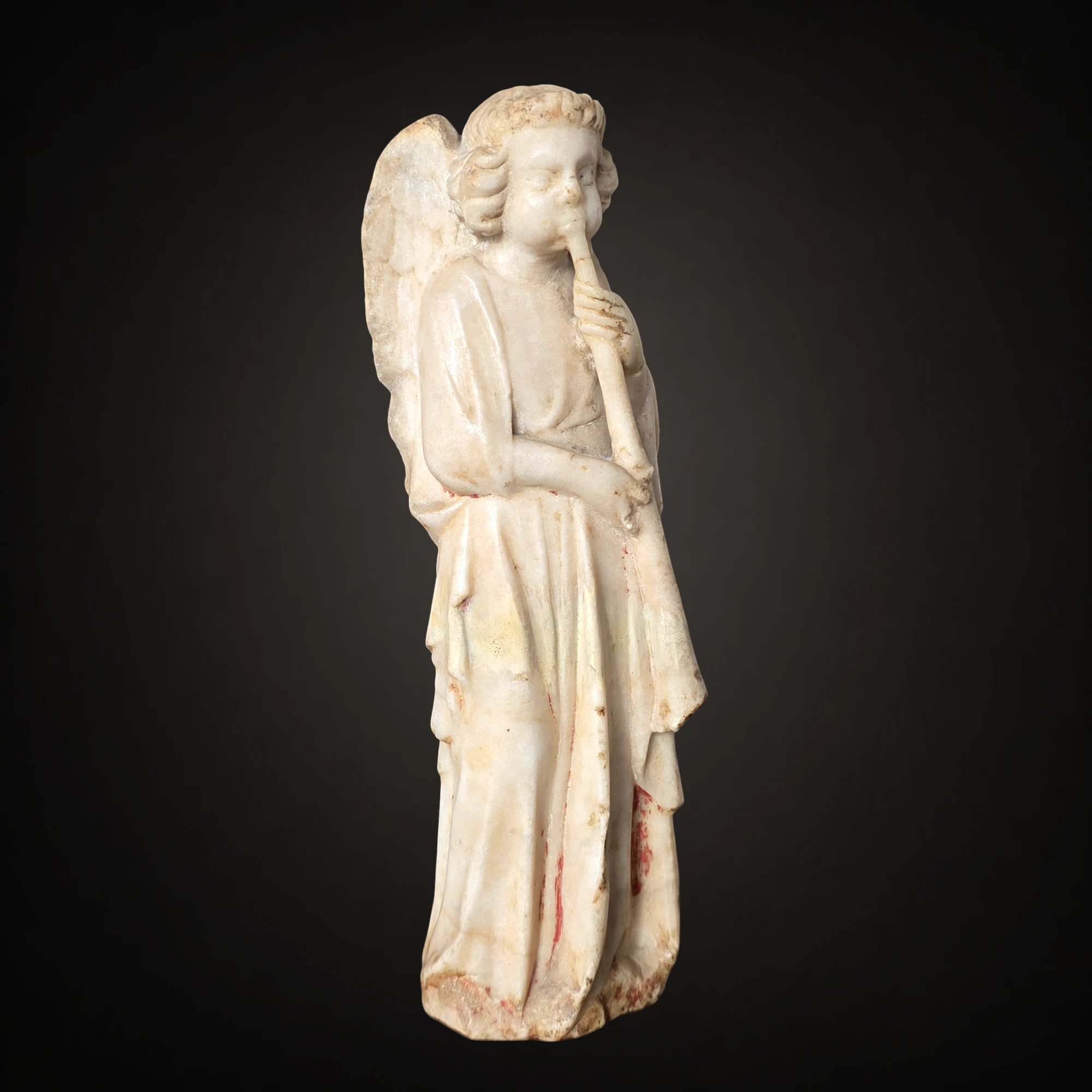
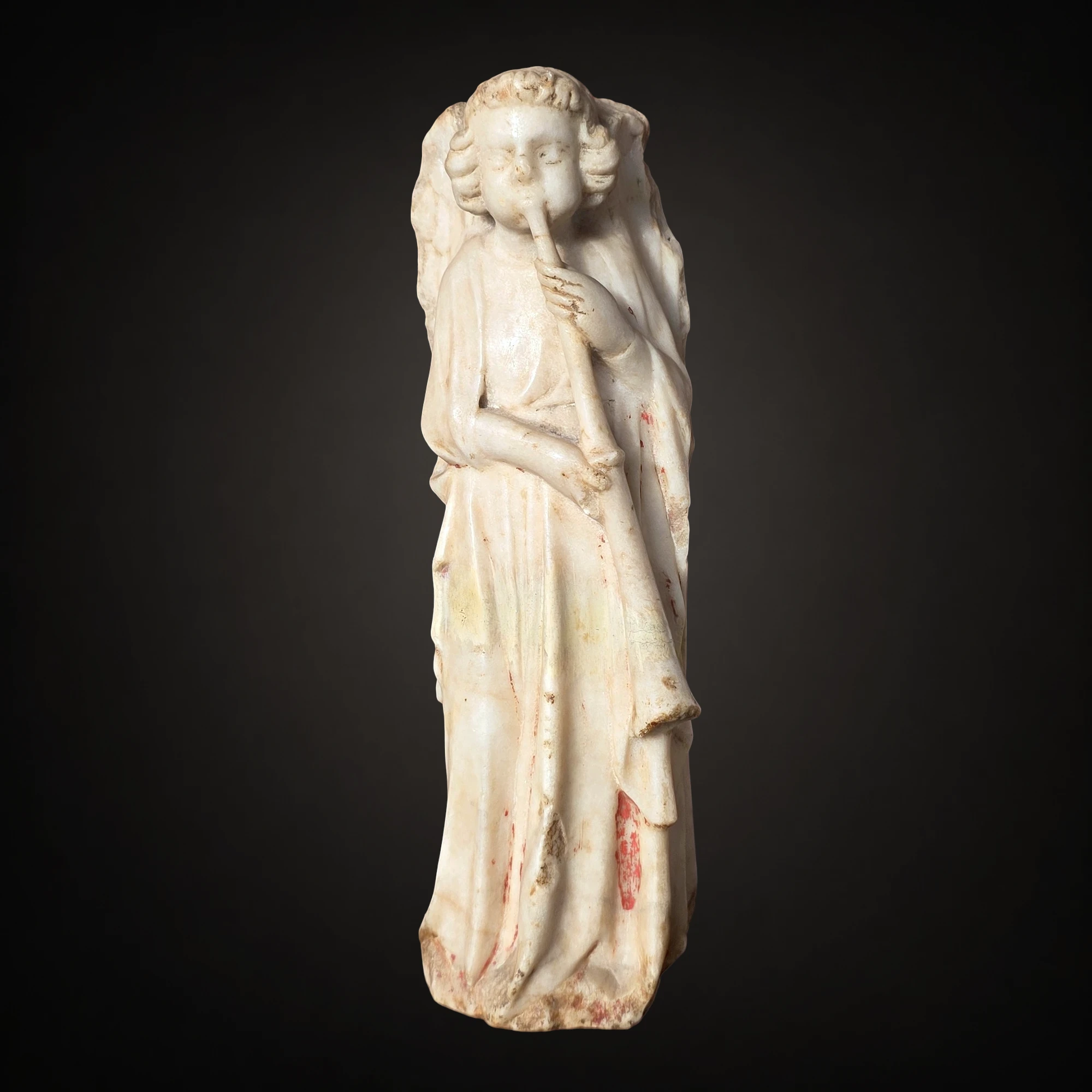
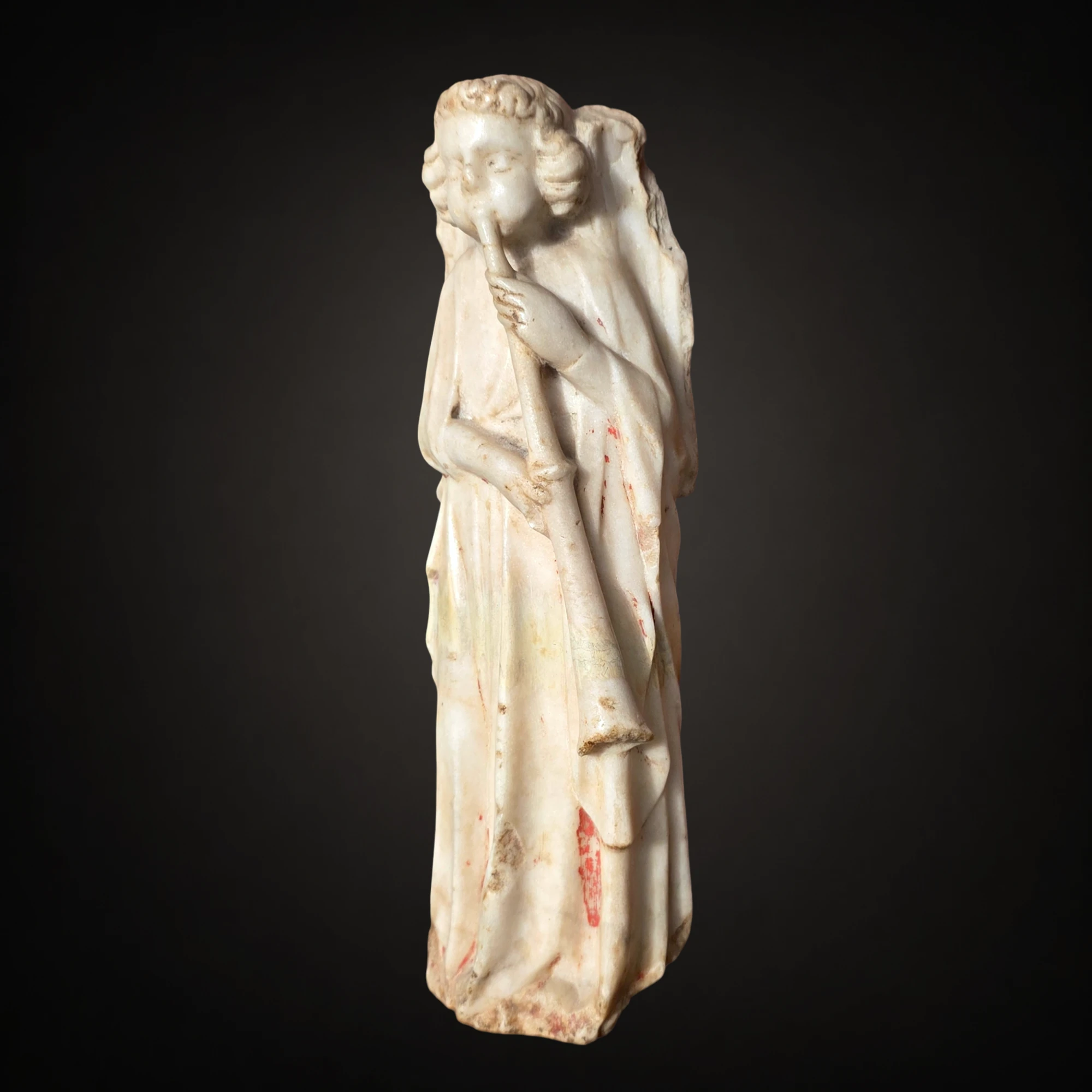
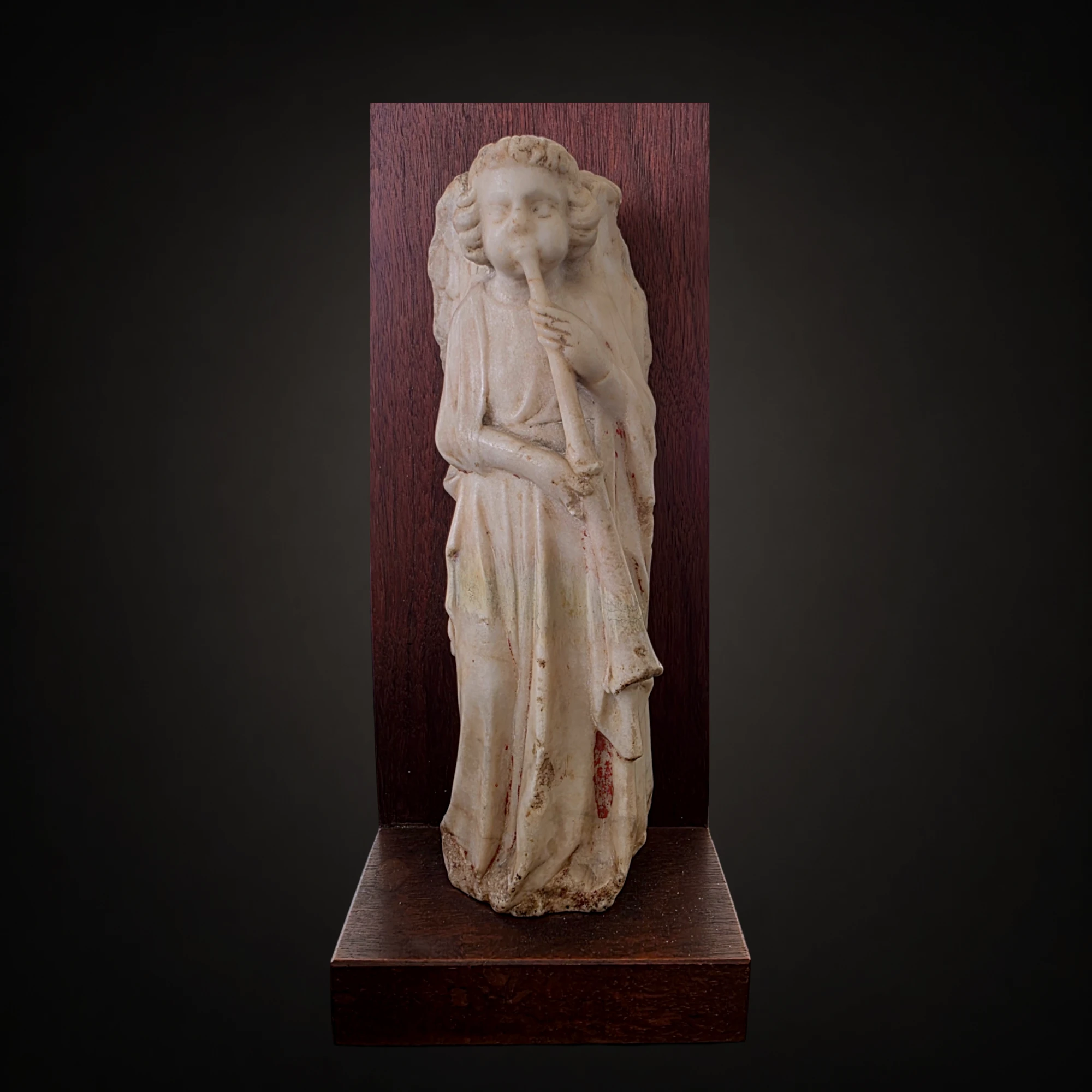
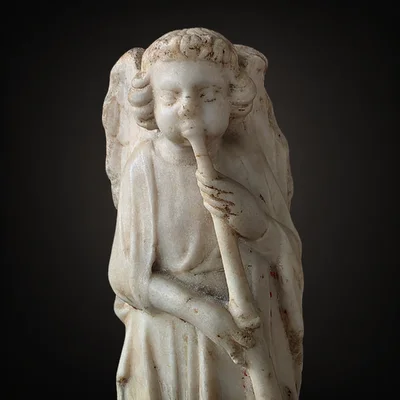
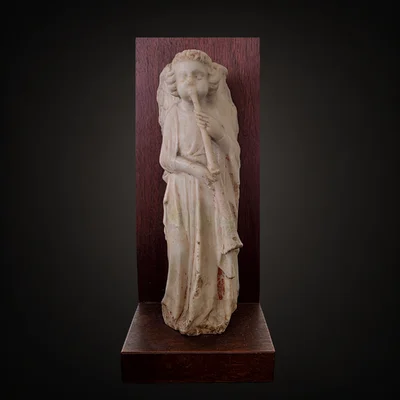
Angel musician, late 13th century. Marble, Paris or Île-de-France
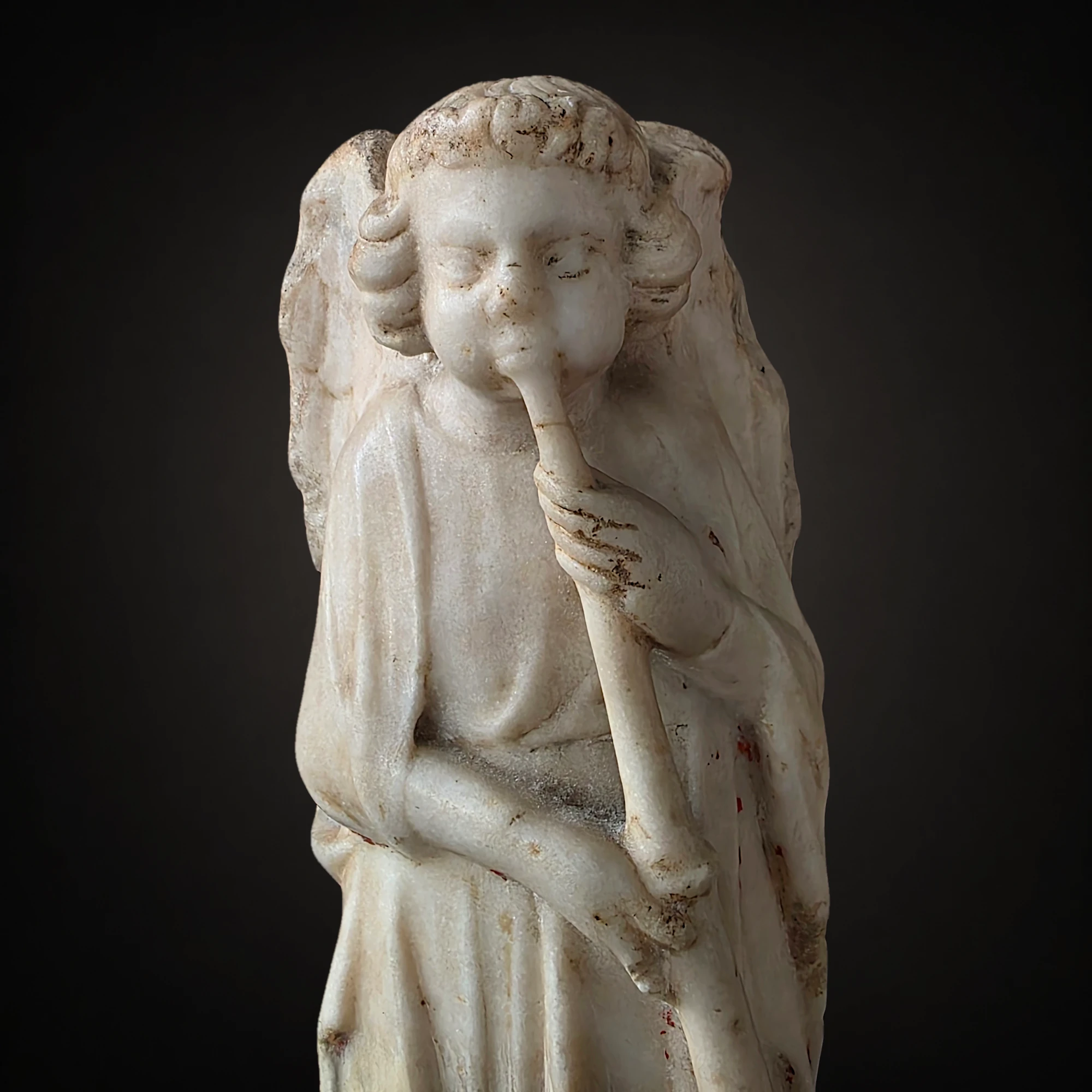
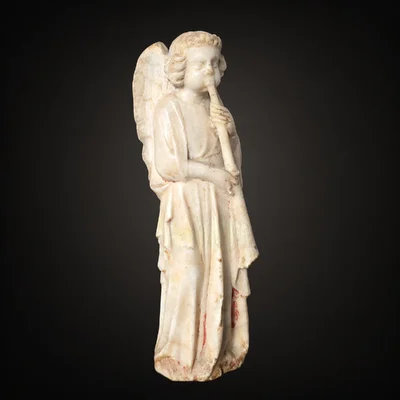
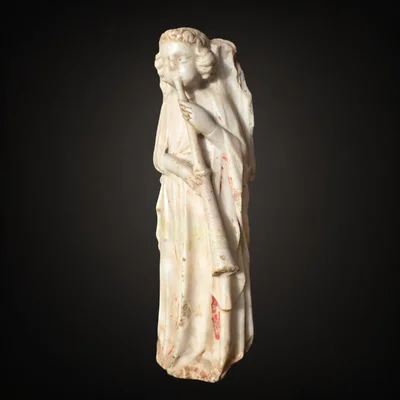
The angel stands with its wings rising behind the shoulders on either side of the head. A long trumpet is held to the lips. It descends diagonally across the body and flares into a bell beside the left leg. A ring encircles the tube midway along its length. The left hand grasps the instrument just below the mouthpiece. The right supports it at hip level, with the forearm drawn across the waist. A short fringe leaves the forehead exposed. On either side of the face, broad, rounded locks are arranged in tiers from the temples to the cheeks. The eyes are narrow and almond-shaped, and the cheeks puff out as the angel blows. The mantle wraps around the shoulders and opens at the front. Below the forearms, the robe falls in long vertical folds that curve towards the base. Traces of red polychromy survive in the folds of the garment. The lightly modelled back suggests that the figure was intended to be seen from the front or in three-quarter view. Comparison with the statues from the priory of Saint-Louis at Poissy places our sculpture in the Parisian milieu around 1300.
Philip the Fair commissioned the construction of the Dominican nunnery of Saint-Louis at Poissy in 1297, the year of the canonisation of his grandfather Louis IX. Seven limestone statues of angels are associated with the sculptural decoration of the church. Two blow trumpets, and the others are associated with the Instruments of the Passion. Together they suggest a Last Judgement cycle, whose original position in the church remains a matter of debate. After the priory church was demolished in the early 19th century, four statues were recorded in the collegiate church of Notre-Dame at Poissy. They entered the Louvre in 1852. The other three figures are held at the Musée de Cluny.
The Louvre’s Angel Blowing a Trumpet (inv. ML 114), dated 1297–1304, offers the closest comparison with our statuette. The exposed forehead beneath a short fringe, the tiered rolls of hair at the sides and the full cheeks give both figures a similar facial type. The mantle opens across the front of the torso, and the long folds of the robe curve towards the base. The trumpeting angel at the Musée de Cluny (inv. Cl. 23292), also from the priory, has a similarly cut mantle and a comparable arrangement of folds, with more pronounced turns at the sides. The comparison therefore rests on features shared by both Poissy figures.
The so-called Altounian angel (Louvre, inv. RFML.SC.2019.31.1), attributed to the French region of Maine and dated to the early 14th century, likewise has a broad forehead, a short fringe and full cheeks. Its curls are carved as more distinct spirals, and its mantle sweeps across the hips in broad, overlapping folds.
The modelling of the face, the tiered locks and the arrangement of the drapery point to an origin for our statuette in the Parisian milieu of the Île-de-France around 1300.
Provenance — Private collection, New York.
Full dossier and detailed study available on request.
Bibliography
· Alain Erlande-Brandenburg, « La priorale Saint-Louis de Poissy », Bulletin monumental, vol. 129, no. 2, 1971, pp. 85–112.
· Alain Erlande-Brandenburg, « Statues d’anges provenant de la priorale Saint-Louis de Poissy », Monuments et mémoires de la Fondation Eugène Piot, vol. 69, 1988, pp. 43–60.
· Jean-René Gaborit, « Les Anges de Poissy », La Revue du Louvre et des musées de France, no. 4, 1998, pp. 29–40.
· Robert Suckale, « Réflexions sur la sculpture parisienne à l’époque de Saint Louis et de Philippe le Bel », Revue de l’Art, no. 128, 2000, pp. 33–48.
· Xavier Dectot, Sculptures des XIe–XIIIe siècles. Collections du musée de Cluny, online catalogue raisonné, « La priorale Saint-Louis de Poissy » and entries for Cl. 23292 and Cl. 18643 a and b.
· Pierre-Yves Le Pogam, « Un ange de la Résurrection », Grande Galerie. Le Journal du Louvre, no. 51, 2020, p. 18.
In-depth study of the artwork
| Subject: | trumpeting angel |
|---|---|
| Material: | carved white marble, with traces of red polychromy |
| Dimensions: | height 21.4 cm |
| Origin: | Île-de-France, Parisian milieu |
| Date: | circa 1300 |
| Provenance: | private collection, New York |
| Condition: | old break and reattachment at hip level; wear to the face and chips to the wings and base |
| Reference: | 306 |
Description
The angel is shown standing, with the wings raised behind the shoulders on either side of the head. He holds to his lips a long trumpet whose tube descends obliquely in front of the body and widens into a bell beside the left leg. A ring encircles the middle of the instrument. The left hand grasps the trumpet beneath the mouthpiece, while the right supports it at hip level, the forearm drawn across the waist.
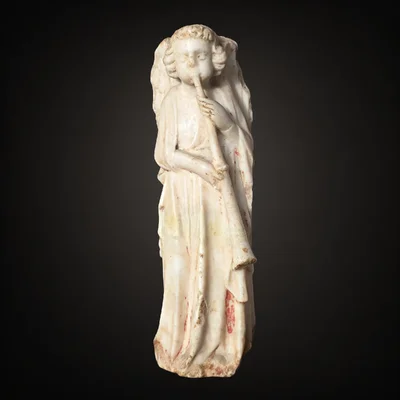
The angel’s forehead is exposed beneath a short fringe. On either side of the face, the hair forms broad rounded locks that overlap from the temples down to the cheeks. The eyes are narrow and almond-shaped, and the cheeks are puffed by the act of blowing. The mantle wraps around the shoulders and opens across the front of the torso. Beneath the forearms, the robe falls in long vertical folds that curve toward the base. The lateral sections form short stepped returns. The reverse is only lightly modelled, with a few barely indicated folds, suggesting that the figure was intended to be viewed mainly from the front or at a three-quarter angle.
The trumpet held to the lips places the figure within the iconography of the Resurrection of the Dead. The First Epistle to the Corinthians associates the sounding of the trumpet with the raising of the dead (1 Cor. 15:52), while the Gospel according to Matthew evokes angels sent with the sound of a trumpet to gather the elect (Matt. 24:31). The statuette probably belonged to an ensemble devoted to the Last Judgement.
Condition
The statuette has an old break at hip level, and the two parts have been reattached. Wear has softened the relief of the eyelids and nose. Chips affect the wings, the right hand and the lower edge of the garment. The trumpet survives from mouthpiece to bell. Traces of polychromy remain on the garment, especially in the recesses and along the folds of the lower section.
The break in the left wing exposes the saccharoidal crystalline grain of the marble.
Geographical and stylistic context
In 1297, the year of the canonization of his grandfather Louis IX, Philip the Fair initiated the construction of the Dominican priory of Saint-Louis at Poissy. The nuns settled there in 1304, when the church and most of its interior decoration were already in place. Seven limestone statues of angels are associated with this project. Most are approximately one metre high and represent standing figures dressed in long robes and mantles. Two angels blow trumpets, while the others are associated with the Instruments of the Passion. The presence of the trumpets led scholars to identify the ensemble as a Last Judgement cycle. Its original location remains debated, notably between the rood screen and a transept portal (Erlande-Brandenburg, 1971 and 1988).
After the Revolutionary sale of the priory and its demolition in the early 19th century, four statues are recorded in the collegiate church of Notre-Dame at Poissy. Sold in 1830 to the architect Auguste Goy, they entered the Louvre in 1852 (ML 112 to ML 115). The other three figures are now in the Musée de Cluny, which acquired its Trumpeting Angel (Cl. 23292) in 1987. The condition of the statues has been interpreted in different ways. Xavier Dectot has notably suggested that the Louvre trumpeting angel may have been extensively recut after the fire of 1695. The Louvre dates it to 1297–1304 (Gaborit, 1998, and Dectot, Musée de Cluny online catalogue).
The Louvre angel ML 114 provides the closest correspondences with the present statuette. The broad exposed forehead beneath a short fringe, the superimposed rolled side locks and the full cheeks form faces of the same type. The mantle follows the line of the shoulders and opens across the front of the torso, while the robe falls in long folds curving toward the base. The Cluny trumpeting angel confirms the relationship in the cut of the mantle and the disposition of the folds. The convergence of these details in the two Poissy statues leads to placing the present sculpture in the Parisian milieu around 1300.
Comparative corpus and dating
1. Angel blowing a trumpet — Priory of Saint-Louis at Poissy, 1297–1304
Paris, Musée du Louvre, inv. ML 114 and N 15004.
Vernon stone. H. 104 × W. 30 × D. 28 cm. From the Priory of Saint-Louis at Poissy, later in the collection of the architect Auguste Goy. Acquired by the Louvre in 1852.
This is the closest parallel for the figure as a whole. The relationship is evident in the narrow opening of the eyes, the relief of the cheeks and, above all, the arrangement of the hair in tightly rolled locks along the temples. In both works, the trumpet runs along the same side of the silhouette, though the hands are differently arranged. The mantle wraps around the shoulders and leaves the fall of the robe clearly visible, its folds curving as they approach the feet. The statuette also displays a similar organization of the fabrics.
2. Trumpeting Angel — Priory of Saint-Louis at Poissy, after 1297
Paris, Musée de Cluny, inv. Cl. 23292.
Vernon chalk with traces of polychromy. H. 100 × W. 26 × D. 26 cm. From the Priory of Saint-Louis at Poissy. Former collection of Victor Geoffroy-Dechaume.
The comparison concerns particularly the construction of the garment. The mantle follows the contour of the arm and opens over the long parallel folds of the robe. The lateral sections, however, form deeper returns than on the present sculpture.
3. Trumpeting Angel, known as the Altounian Angel — Maine, early 14th century
Paris, Musée du Louvre, inv. RFML.SC.2019.31.1.
Limestone. H. 74.5 × W. 20 × D. 21 cm. Former Bernheim-Dauberville collection. The work is documented in the Joseph Altounian collection from 1948 and entered the Louvre by pre-emption in 2019.
The broad forehead, full cheeks and short fringe recall the present statuette. The curls of the Altounian Angel are carved into more individualized spirals, and its mantle crosses the hips in broad superimposed folds. Pierre-Yves Le Pogam emphasized its relationship with the Poissy angels while also noting the particularities of the drapery and contrapposto. The identification of the limestone as coming from Bernay-en-Champagne, in the Sarthe, places the work in the context of Maine and demonstrates the diffusion of these forms beyond the Parisian centre.
4. The Resurrection of the Dead — fragment of the lintel of Notre-Dame de Paris, circa 1230–1240
Paris, Musée de Cluny, inv. Cl. 18643 a and b.
Lutetian limestone with traces of red polychromy. H. 112 × W. 115 cm. From the lower lintel of the central portal of the west façade of Notre-Dame de Paris. Dating according to the Musée de Cluny online catalogue.
The angel holds a long trumpet to his mouth and directs it toward the figures emerging from their tombs. The relief thus clarifies the angel’s role in the Last Judgement scene. The instrument is set at a much more oblique angle, and the drapery is animated by diagonal folds and pointed returns. The fragment attests to the long-standing presence of the theme in Parisian sculpture.
5. Trumpeting Angel — north-eastern France, 14th century
Boston, Museum of Fine Arts, inv. 61.196.
Alabaster with traces of polychromy and gilding. H. 46.4 × W. 17.1 × D. 12.7 cm. Documented in Zurich in 1960; acquired by the museum in 1961.
The Boston angel displays the same arrangement of wings and hands. The left hand grasps the tube near the mouthpiece and the right holds it lower down. The bell opens in front of the robe. The instrument nevertheless remains almost vertical in Boston, while in the present statuette it moves farther away from the axis of the body. The marked collar and more projecting frontal curls also distinguish the Boston figure. The museum dates the work broadly to the 14th century. This later example helps confirm the earlier dating of the present work, which follows conventions of the late 13th and early 14th centuries.
Synthesis of the corpus and proposed dating
The two angels from the Priory of Saint-Louis provide a firm reference point at the turn of the 13th and 14th centuries. The Louvre dates ML 114 to 1297–1304. The present ref. 306 shares most closely with this statue the construction of the face, the stepped arrangement of the hair and the overall organization of the garment. The drapery of the Cluny angel confirms this relationship.
The comparison therefore supports an execution around 1300 in the Île-de-France, within the Parisian milieu.
Bibliographical references
- • Alain Erlande-Brandenburg, “Statues d’anges provenant de la priorale Saint-Louis de Poissy”, Monuments et mémoires de la Fondation Eugène Piot, vol. 69, 1988, pp. 43–60.
- • Jean-René Gaborit, “Les ‘Anges de Poissy’”, La Revue du Louvre et des musées de France, no. 4, 1998, pp. 29–40.
- • Robert Suckale, “Réflexions sur la sculpture parisienne à l’époque de Saint Louis et de Philippe le Bel”, Revue de l’Art, no. 128, 2000, pp. 33–48.
- • Xavier Dectot, Sculptures des XIe–XIIIe siècles. Collections du musée de Cluny, online catalogue raisonné, entries Cl. 23292 and Cl. 18643 a and b.
- • Xavier Dectot, “La sculpture gothique”, Musée de Cluny gallery sheet, sections on the Priory of Saint-Louis at Poissy and the mirror case L’Assemblée.
- • Pierre-Yves Le Pogam, “Un ange de la Résurrection”, Grande Galerie. Le Journal du Louvre, no. 51, 2020, p. 18.